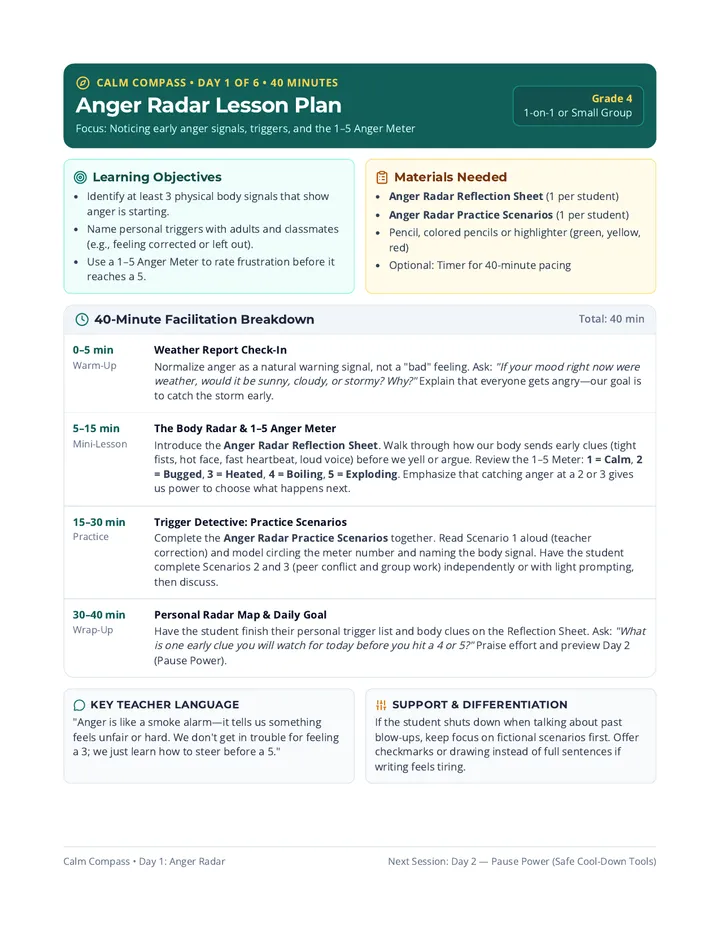
Reaction Detectors Slides
Reaction Detectors
Notice Your Body • Size the Problem • Pick a Calm Tool
💓 Body Clues • 📏 Problem Meter • 🧰 Calm Toolkit
🎬 Watch: Body Clues
Video Spot 1
Video Placeholder: Emotions & Body Signals
Paste your YouTube link here (2–3 min kid-friendly clip on noticing feelings in the body)
👀 Look for: Where do characters feel big feelings?
Your Body Sends Clues!
Before we react, our body gives us signals.
💓
Fast Heart
Thump, thump, thump!
🔥
Hot Face
Warm cheeks or ears
🌀
Tight Tummy
Butterflies or knots
✊
Tight Hands
Clenched or shaky
Body Scan: Check Yourself!
Point to where you feel emotions most.
🧍
Head → Heart → Tummy → Hands
😌
Calm Body
Slow breath, loose shoulders
😬
Wiggly / Alert Body
Fast heart, tight tummy
🌋
Ready-to-Pop Body
Hot face, clenched fists
How Big Is the Problem?
Every problem has a size!
1 • TINY
✏️
Quick Fix
Broken pencil, spilled water, wrong line
2 • MEDIUM
🧩
Needs a Plan
Argument with friend, lost game, hard work
3 • BIG
🚨
Get an Adult
Someone is hurt, unsafe, or emergency
Does My Reaction Match?
Goal: Keep the problem and reaction balanced!
✏️ = 😌
Balanced! ✅
Tiny Problem → Calm Reaction
“Oops, I’ll grab another pencil.”
✏️ ≠ 🤬
Out of Balance! ⚠️
Tiny Problem → Huge Reaction
Yelling or throwing makes the problem bigger!
Practice 1
Show 1, 2, or 3 Fingers!
🥤💧
Your water bottle tips over on your desk.
1. How big is the problem?
2. What is a matching reaction?
1️⃣ Tiny
2️⃣ Medium
3️⃣ Big
Practice 2
Show 1, 2, or 3 Fingers!
🏀😔
Two friends argue over the rules at recess.
1. What body clues might you feel?
2. How big is this problem?
1️⃣ Tiny
2️⃣ Medium
3️⃣ Big
🎬 Watch: Calm Down Tools
Video Spot 2
Video Placeholder: Guided Breathing / Coping
Paste your YouTube link here (2–3 min follow-along breathing or calm-down video)
🌬️ Follow along and notice how your body feels after!
Your Calm-Down Toolkit 🧰
Pick a tool when your body clues get loud!
🎈
Belly Breath
Smell the flower, blow the candle
🖐️
Count to 5
Slowly tap each finger
🧱
Wall Push
Push hands gently for 5 seconds
🙋
Ask for Help
Use calm words with an adult
Let’s Practice: Balloon Breaths! 🎈
Put both hands on your tummy and try 3 rounds together.
👃
1. Breathe In
Count 1 - 2 - 3 - 4
→
⏸️
2. Hold
Count 1 - 2
→
🌬️
3. Blow Out
Count 1 - 2 - 3 - 4 - 5
You Are a Reaction Detector! 🔍
Hold up 1, 2, 3, or 4 fingers for the tool you want to try today:
1️⃣ 🎈
Belly Breath
2️⃣ 🖐️
Count to 5
3️⃣ 🧱
Wall Push
4️⃣ 🙋
Ask for Help
Body Clues and Tools Worksheet
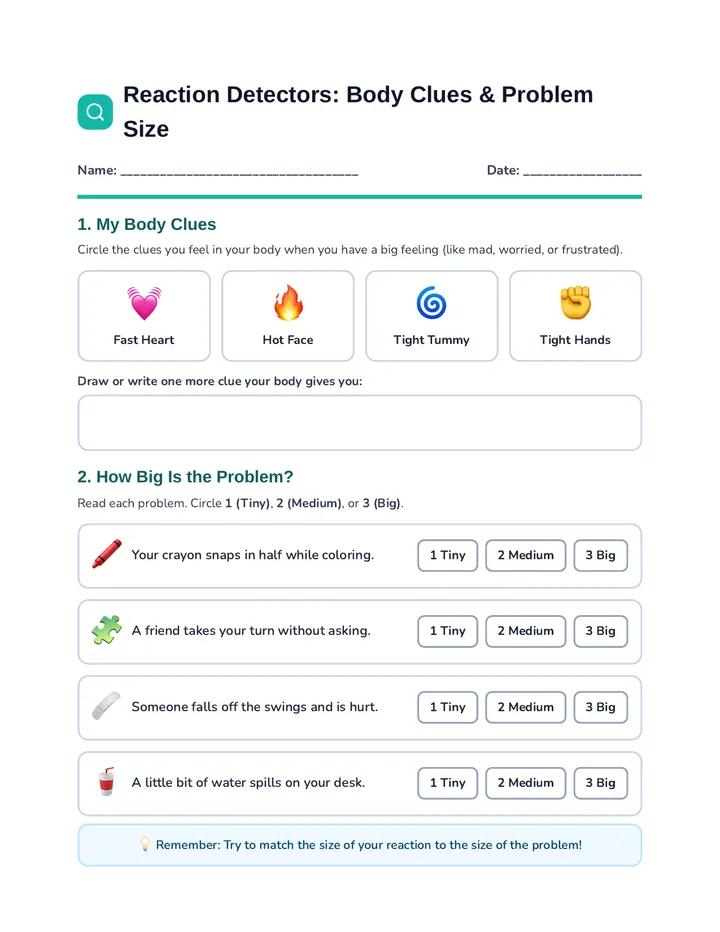
Reaction Detectors: Body Clues & Problem Size
Name: ____________________________________ Date: __________________
1. My Body Clues
Circle the clues you feel in your body when you have a big feeling (like mad, worried, or frustrated).
💓 Fast Heart
🔥 Hot Face
🌀 Tight Tummy
✊ Tight Hands
Draw or write one more clue your body gives you:
2. How Big Is the Problem?
Read each problem. Circle 1 (Tiny), 2 (Medium), or 3 (Big).
🖍️ Your crayon snaps in half while coloring.
1 Tiny 2 Medium 3 Big
🧩 A friend takes your turn without asking.
1 Tiny 2 Medium 3 Big
🩹 Someone falls off the swings and is hurt.
1 Tiny 2 Medium 3 Big
🥤 A little bit of water spills on your desk.
1 Tiny 2 Medium 3 Big
💡 Remember: Try to match the size of your reaction to the size of the problem!
Reaction Detectors: Calm-Down Plan
Page 2
3. Match the Reaction
Imagine your tower of blocks falls down right before you finish. Draw or write a calm, matching reaction you could have:
Write one calm thing you could say:
4. My Calm-Down Toolkit
Circle 2 tools you want to use next time your body clues get loud:
🎈 Belly Breath
🖐️ Count to 5
🧱 Wall Push
🙋 Ask for Help
Draw yourself using your favorite calm-down tool:
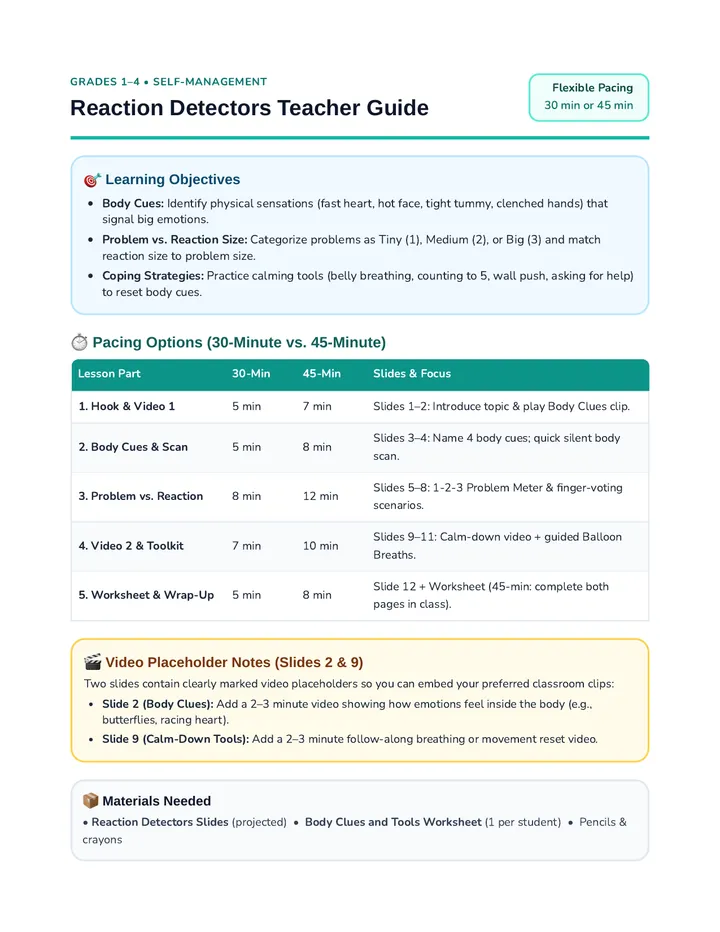
Reaction Detectors Teacher Guide
Grades 1–4 • Self-Management
Reaction Detectors Teacher Guide
Flexible Pacing
30 min or 45 min
🎯 Learning Objectives
- Body Cues: Identify physical sensations (fast heart, hot face, tight tummy, clenched hands) that signal big emotions.
- Problem vs. Reaction Size: Categorize problems as Tiny (1), Medium (2), or Big (3) and match reaction size to problem size.
- Coping Strategies: Practice calming tools (belly breathing, counting to 5, wall push, asking for help) to reset body cues.
⏱️ Pacing Options (30-Minute vs. 45-Minute)
| Lesson Part |
30-Min |
45-Min |
Slides & Focus |
| 1. Hook & Video 1 |
5 min |
7 min |
Slides 1–2: Introduce topic & play Body Clues clip. |
| 2. Body Cues & Scan |
5 min |
8 min |
Slides 3–4: Name 4 body cues; quick silent body scan. |
| 3. Problem vs. Reaction |
8 min |
12 min |
Slides 5–8: 1-2-3 Problem Meter & finger-voting scenarios. |
| 4. Video 2 & Toolkit |
7 min |
10 min |
Slides 9–11: Calm-down video + guided Balloon Breaths. |
| 5. Worksheet & Wrap-Up |
5 min |
8 min |
Slide 12 + Worksheet (45-min: complete both pages in class). |
🎬 Video Placeholder Notes (Slides 2 & 9)
Two slides contain clearly marked video placeholders so you can embed your preferred classroom clips:
- Slide 2 (Body Clues): Add a 2–3 minute video showing how emotions feel inside the body (e.g., butterflies, racing heart).
- Slide 9 (Calm-Down Tools): Add a 2–3 minute follow-along breathing or movement reset video.
📦 Materials Needed
• Reaction Detectors Slides (projected) • Body Clues and Tools Worksheet (1 per student) • Pencils & crayons
Facilitation Prompts & Answer Key
Page 2
🗣️ Key Discussion Prompts
Body Clues (Slides 3–4):
“Before we yell or cry, our body sends us warning lights—like a fast heart or tight tummy. Put your hand on the spot where you usually feel frustration first.”
Problem Size vs. Reaction Size (Slides 5–8):
“A tiny problem needs a tiny fix. If we have a huge reaction to a tiny problem, our reaction actually creates a second, bigger problem! Show 1, 2, or 3 fingers for each scenario.”
Coping Practice (Slides 10–11):
“Let’s practice Balloon Breaths while we are calm so our brain remembers how to use it when our body feels ready to pop. Notice if your shoulders drop on the blow-out.”
🧩 Differentiation (Grades 1–4)
Grades 1–2 Support
- Read worksheet scenarios aloud together.
- Let students draw their reaction in Part 3 instead of writing sentences.
- Act out “Calm Body” vs. “Ready-to-Pop Body” with safe, silent freeze poses.
Grades 3–4 Extension
- Have partners invent a new Medium Problem and role-play a balanced reaction.
- Ask students to write an “I-statement” for the calm speech lines on Page 2.
- Connect body cues to personal triggers during independent work or recess.
✅ Worksheet Answer Key (Part 2: Problem Size)
1. Crayon snaps: 1 Tiny
3. Someone is hurt: 3 Big
2. Friend takes turn: 2 Medium
4. Water spills: 1 Tiny
Note: Parts 1, 3, and 4 are personal reflection/application items—accept any thoughtful, safe response.