Quiet Voices Lesson Plan Quiet Voices, Big Learning
Classroom (Tier 1) Lesson Plan
Time: 30 Minutes
Audience: 5th Grade
Topic: Focused Learning
Why This Lesson Matters
Understanding how disruptive conversations hinder learning empowers students to take ownership of their classroom environment, fostering better focus and academic success for everyone.
Teacher Prep
• Review the Slide Deck to familiarize yourself with the content and talking points.
• Print copies of the Disruption Scenarios Worksheet (one per student or pair).
• Print copies of the Active Listening Checklist (one per student).
Materials Needed
Quiet Voices, Big Learning Slide Deck
Disruption Scenarios Worksheet
Active Listening Checklist
Pencils or pens
Learning Objective
Students will be able to identify how disruptive conversations impact classroom learning and practice strategies for active listening and respectful communication.
Instructional Approach: Interactive discussion, scenario analysis, and role-playing.
Instructional Steps
5m
Warm-Up: Think-Pair-Share
• Display Title Slide. Ask: "Think about a time when you were trying to learn something, but it was hard to focus because of distractions. What was happening?"
• Turn and share (2 min). Call on a few students to share with the whole class. Emphasize that distractions make it hard to learn.
10m
Understanding Disruptions
• Advance to "What's the Buzz?" slide. Lead a discussion on what "disruptive conversations" mean. Ask: "What does it mean when a conversation is disruptive?"
• Show "Domino Effect" slide. Explain how disruptions spread.
• Distribute Disruption Scenarios Worksheet . Read 2-3 scenarios as a class. Discuss impacts and suggest solutions.
10m
Practicing Active Listening
• Transition to "Super Listener Skills!" slide. Distribute Active Listening Checklist .
• Model active listening with a volunteer. Demonstrate eye contact, nodding, and summarizing.
• Paired Practice: Students share a weekend story while partners practice active listening (5 min total).
5m
Wrap-Up: Learning Pledge
• Display "Our Learning Pledge" slide. Ask: "What is one thing you can do to help make our classroom a better place for learning for everyone?"
• Write 2-3 key ideas on the board to form a class "Learning Pledge."
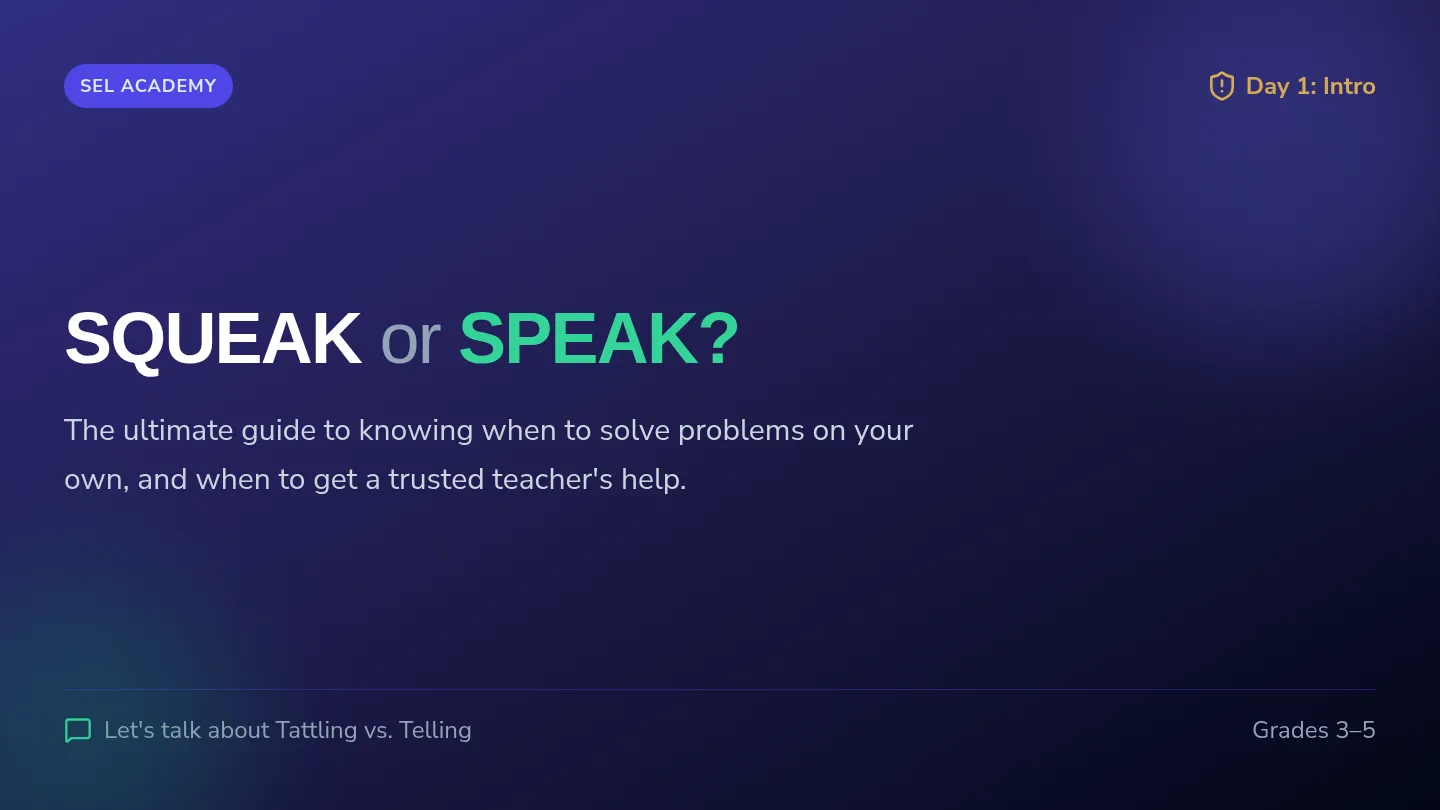
Quiet Voices Slides Quiet Voices,
Big Learning
How Our Conversations Affect Everyone
Teacher Notes
Welcome students and introduce the topic. Ask them to think about a time they found it hard to focus.
What's the Buzz?
Think about a time you wanted to learn, but couldn't focus because of noise or talking.
What happened?
Teacher Notes
Prompt students to share their experiences with distractions. Use this to lead into the idea that distractions make learning difficult.
When is Talking Disruptive?
Not listening to the teacher
Talking during explanations
Distracting others around you
Making it hard for classmates to hear or think
Teacher Notes
Define disruptive conversations. Ask students how these feel and why they are problematic.
The Domino Effect of Noise
One small chat can turn into a big distraction for many!
How does this happen?
Teacher Notes
Explain the 'domino effect' of disruptions – how one small conversation can spread and impact the whole class.
Super Listener Skills!
How can we make sure our classroom is a place where everyone can hear and learn?
Active Listening!
Teacher Notes
Introduce active listening as a solution. Explain that listening isn't just about hearing, but about understanding.
Active Listening Checklist
1
Look at the speaker
2
Nod or use "mm-hmm" to show engagement
3
Don't interrupt
4
Ask clarifying questions
5
Summarize what you heard
Teacher Notes
Review points. Model with a student, then have students practice in pairs.
Our Learning Pledge
What is one thing you will do to help our classroom be a focused place for learning?
Commitment
Respect
Focus
Teacher Notes
Lead students in creating a class pledge or agreement based on today's discussion.
Disruption Scenarios Worksheet Disruption Scenarios
Analyzing how noise impacts our learning community
Name: __________________________ Date: ____________
Directions: Read each scenario below. Think about how the disruptive conversation affects learning for everyone involved. Then, suggest a helpful solution for the students.
1
Mariah and Leo are whispering and giggling about a video game during the teacher's explanation of a new math concept. The teacher pauses, but they don't notice right away. Several students near them are looking over, annoyed.
Impact on Mariah & Leo:
Impact on Classmates:
A Better Choice:
2
During independent reading time, two friends, Chloe and Sam, start talking loudly about their weekend plans. Other students around them are trying to concentrate on their books, but it's hard to ignore Chloe and Sam.
Impact on Chloe & Sam:
Impact on Classmates:
A Better Choice:
3
The teacher is giving important instructions for a group project. Suddenly, Noah leans over to Emily and starts telling her a funny story that happened at lunch, causing Emily to laugh. Both miss part of the instructions.
Impact on Noah & Emily:
Impact on Classmates:
A Better Choice:
4
It's quiet work time, and everyone is focused on their assignments. Suddenly, David starts humming a song and tapping his pencil on his desk, disrupting the peaceful environment for those around him.
Impact on David:
Impact on Classmates:
A Better Choice:
Active Listening Checklist Active Listening Checklist
Use this guide to become a "Super Listener" in our classroom. Practice these skills every time someone is sharing!
Student: __________________________
When Someone Else is Talking
Make Eye Contact
Look at the person who is speaking. It shows you are paying attention without staring.
Show You're Engaged
Nod your head, or make small sounds like 'mm-hmm' to show you're following along.
Don't Interrupt
Wait until the person has finished speaking before you say anything at all.
Ask Clarifying Questions
Ask questions like: "Can you explain what you meant by...?" or "So, if I understand...?"
Summarize What You Heard
Briefly repeat back: "So you're saying...?" or "It sounds like you felt..."
When It's Your Turn to Talk
Speak Clearly: Loud enough for others to hear.
Take Turns: Don't dominate the conversation.
Be Respectful: Share ideas in a kind and thoughtful way.
Class Discussion Guide Impact of Our Voices
Teacher Facilitation & Discussion Guide
1. Introduction: The Power of Words
5 Minutes
Teacher Prompt:
"We all have voices, and our words are powerful. Today, we're going to talk about how our conversations in the classroom can either help or hinder our learning. Who can share a time when a conversation around them made it hard to focus?"
How did that make you feel?
What was the impact on your ability to learn or concentrate?
2. Exploring Disruptive Conversations
10 Minutes
Teacher Prompt:
"What exactly makes a conversation 'disruptive' during learning time? Is it always about being loud, or can other things make a conversation disruptive?"
Can a quiet whisper still be disruptive? How?
Think about the Disruption Scenarios Worksheet . What were some key takeaways?
What do we miss out on when there are too many distractions?
3. Solutions: Becoming Super Listeners
10 Minutes
Teacher Prompt:
"Now that we understand the problem, let's talk about solutions. We discussed active listening. Why is it such a powerful tool in preventing disruptions?"
What does active listening 'look like' and 'sound like'?
How does it help you, the listener, learn better?
What challenges might we face when trying to be active listeners?
4. Our Collective Responsibility
5 Minutes
"Creating a great learning environment isn't just up to one person; it's a team effort. What is one specific thing you can commit to doing today?"
How can we gently remind each other to be mindful?
What benefits do we all gain from focused learning?
Focus Check Exit Ticket Focus Check: Exit Ticket
Quiet Voices, Big Learning
Name: __________________________ Date: ____________
1. What is one way a disruptive conversation can make it harder for you or your classmates to learn?
2. Name one specific "Super Listener Skill" you reviewed today that you can use in class.
3. Why is it important for everyone in the classroom to try and reduce disruptive conversations?
Focus Check: Exit Ticket
Quiet Voices, Big Learning
Name: __________________________ Date: ____________
1. What is one way a disruptive conversation can make it harder for you or your classmates to learn?
2. Name one specific "Super Listener Skill" you reviewed today that you can use in class.
3. Why is it important for everyone in the classroom to try and reduce disruptive conversations?
Focus Detectives Game Focus Detectives
Case File: The Mystery of the Missing Focus
Detective Briefing: Your teacher will describe different classroom scenarios. Listen carefully and be a Focus Detective ! For each case, decide if the students are showing Disruptive Voices or Active Listening .
CASE A: THE GREAT GALAXY DEBATE
Ms. Chen is explaining a new science project about the solar system. Liam and Olivia are leaning in close to each other, whispering about whose turn it is in a video game they played last night. Ms. Chen notices and has to pause her explanation.
Findings:
Disruptive Voices
Active Listening
Why? (Evidence):
CASE B: STORY TIME SUCCESS
Mr. Davis is reading a chapter from a new adventure book to the class. Maya is looking at Mr. Davis, occasionally nodding her head. When he asks a question about the plot, she raises her hand and then summarizes what she heard happening in the story.
Findings:
Disruptive Voices
Active Listening
Why? (Evidence):
CASE C: ART CLASS CHAOS
During art class, the teacher is demonstrating how to mix new colors. Ben and Chloe are talking loudly about what they want for lunch, distracting students sitting near them who are trying to watch the demonstration.
Findings:
Disruptive Voices
Active Listening
Why? (Evidence):
CASE D: GROUP WORK GOODNESS
During small group work, the teacher asks each group to share one idea they came up with. Sarah's group is presenting. David is looking at Sarah and listening. When Sarah finishes, David says, "So, your idea is to build a bridge with toothpicks? That's cool!"
Findings:
Disruptive Voices
Active Listening
Why? (Evidence):
Quiet Voices Answer Key Answer Key & Teacher Reference
Quiet Voices, Big Learning Lesson Materials
Disruption Scenarios Worksheet
Scenario 1 (Mariah & Leo):
Impact on self: Miss key information for the math concept, fall behind on the assignment.Impact on others: Students nearby get distracted/annoyed; teacher has to stop teaching, losing time for everyone.Solution: Save the video game talk for recess; use active listening during the explanation.
Scenario 2 (Chloe & Sam):
Impact on self: Don't get their reading done; miss out on the story/practice.Impact on others: Makes it impossible for nearby students to "get lost" in their books.Solution: Whispering or using a "level 0" voice; write a note to talk later during a break.
Focus Detectives Game
CASE A: THE GREAT GALAXY DEBATE
Finding: Disruptive Voices
Evidence: Whispering during teacher's explanation; caused the teacher to pause.
CASE B: STORY TIME SUCCESS
Finding: Active Listening
Evidence: Eye contact, nodding, summarizing the story when asked.
CASE C: ART CLASS CHAOS
Finding: Disruptive Voices
Evidence: Talking loudly about unrelated topics during a demonstration; distracting others.
CASE D: GROUP WORK GOODNESS
Finding: Active Listening
Evidence: Eye contact while teammate is speaking; clarifying/summarizing teammate's idea.
TEACHER TIP: MONITORING THE PLEDGE
When creating the Learning Pledge , look for commitments that are actionable. Instead of "I will be good," encourage "I will save whispers for independent time" or "I will use eye contact when my partner is talking."