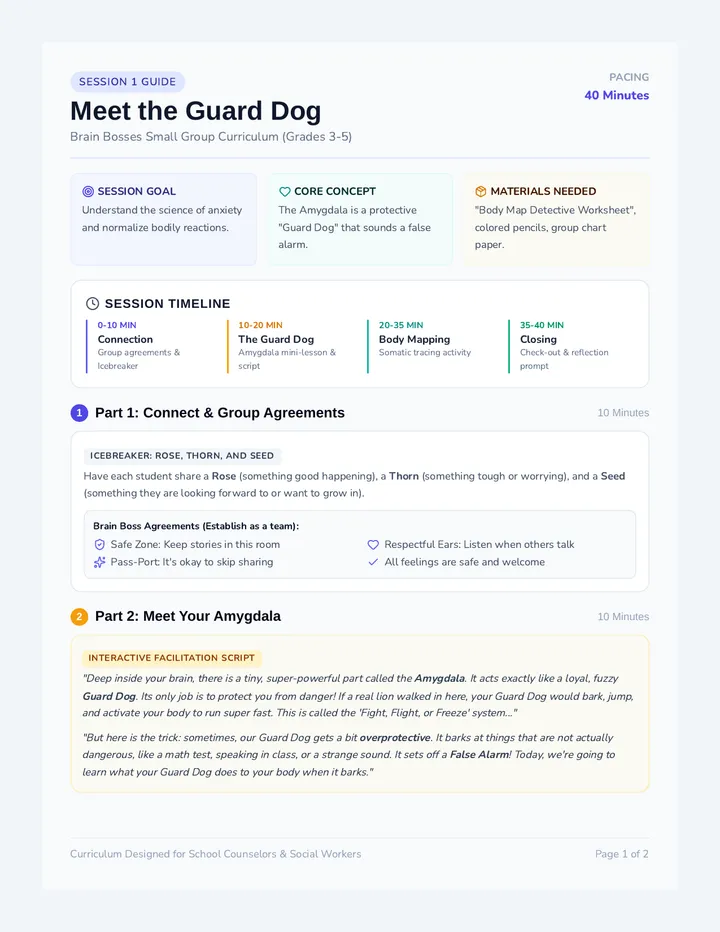
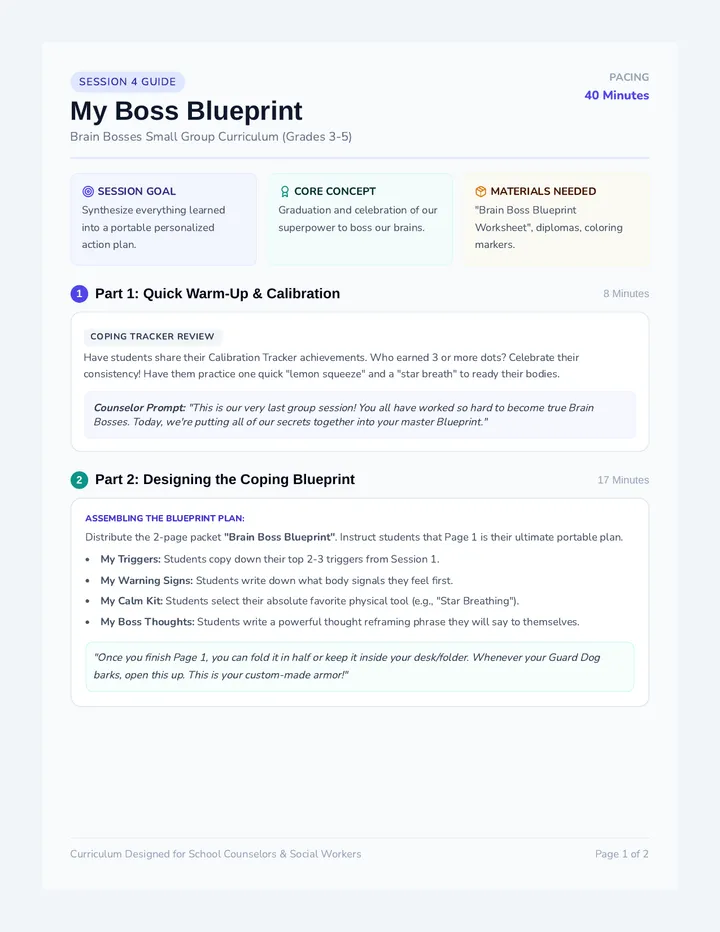
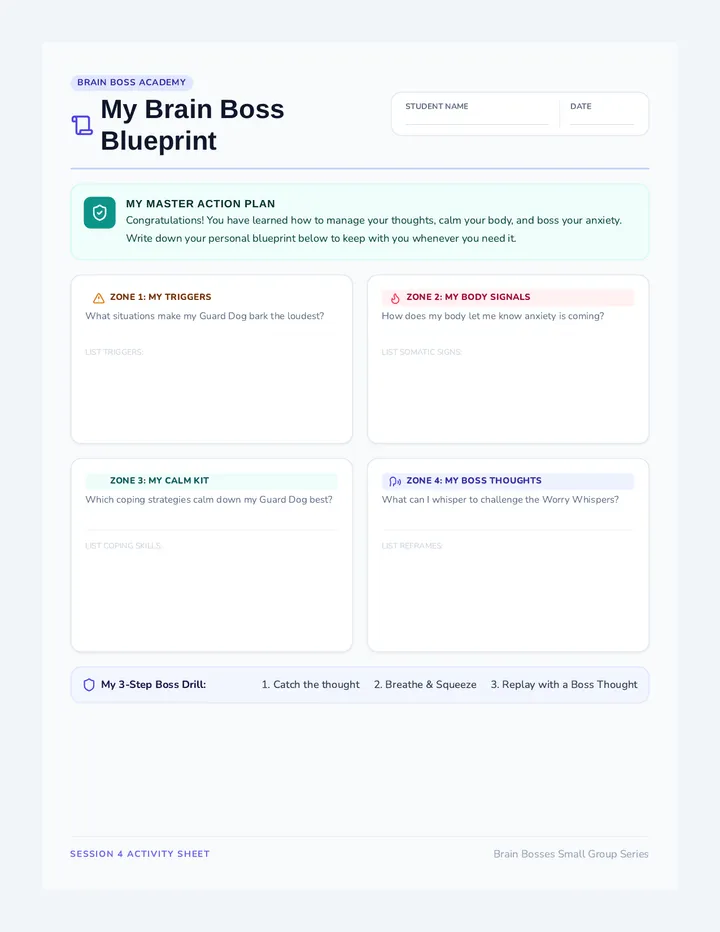
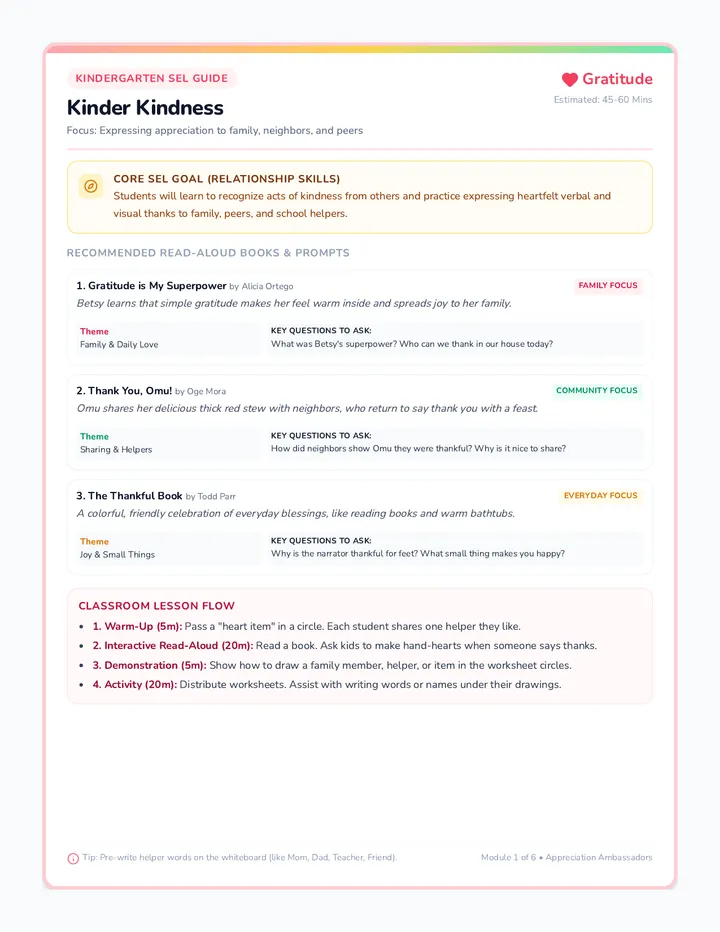
Squeak or Speak Slides
SEL Academy
Day 1: Intro
SQUEAK or SPEAK?
The ultimate guide to knowing when to solve problems on your own, and when to get a trusted teacher's help.
Let's talk about Tattling vs. Telling
Grades 3–5
DAY 1: THE CORE CONCEPTS 1 / 5 Days
Squeaking
Telling on someone just to get them in trouble or to get your own way.
- No one is in danger or hurt.
- The problem is small or simple.
Speaking
Reporting an issue to keep someone safe, healthy, and protected from harm.
- Someone is unsafe or hurt.
- You need help to keep order.
Turn and Talk: Why do people sometimes "squeak" instead of trying to solve the problem first?
DAY 1: PRACTICE 2 / 5 Days
Is it Squeaking or Speaking?
SCENARIO A
"Leo took two cookies from the cafeteria tray during lunch when the sign said only take one."
Answer: Tattling (Squeaking) No danger or harm!
SCENARIO B
"Maya fell off the swings and is sitting on the woodchips crying, holding her arm."
Answer: Telling (Speaking) Safety issue! Help needed!
If someone is hurt, ALWAYS speak up immediately!
DAY 2: PROBLEM SIZES 2 / 5 Days
How Big is the Problem?
We must look at the size of the problem to make the right call.
K
Kid-Sized Problems
These are small, annoying, or minor. Kids have the power to solve them!
Examples: Cutting in line, choosing a game first, sharing a pencil, talking during a work time.
B
Big-Sized Problems
These are dangerous, illegal, or physically harmful. Adults must step in.
Examples: Bullying, physical fights, fire/emergencies, throwing dangerous items, stealing.
Key Rule: Adults solve Big Problems. Kids can try to solve Kid Problems first!
DAY 2: TEST YOUR SKILLS 2 / 5 Days
Is this a Kid-Sized or Big Problem?
1 "Someone keeps whispering during independent silent reading time."
Kid-Sized Problem
2 "You see a student pulling another student's hair on the bus."
Big Problem (Safety!)
3 "A classmate says they don't want to play soccer with you."
Kid-Sized Problem
How could we solve the kid-sized problems without squeaking? We'll find out on Day 3!
DAY 3: STOP & THINK FLOWCHART 3 / 5 Days
The 3-Step Stop & Think Filter
Run any problem through these three filter questions before you go to the teacher.
1
Is it Dangerous?
Is someone about to get hurt, or is property being broken? If YES, go tell.
2
Is it On Purpose?
Did they mean to do it repeatedly to bother people, or was it just an accident?
3
Have I Tri-ed?
Did you try using your words or walking away before asking for teacher backup?
We will use our paper Stop & Think Desk Mats to practice!
DAY 3: CASE STUDY 3 / 5 Days
The Case
"Noah accidentally bumped my desk and my pencil box spilled."
Filter 1
Is it Dangerous?
NO. It's just a spilled pencil box.
Filter 2
Is it On Purpose?
NO. It was an accident.
Filter 3
Have I Tri-ed?
Not yet, but I can pick them up.
Result: Squeak Alert! Going to the teacher would be Squeaking. Just say "That's okay!" and help each other clean up.
Self-regulation means we stop, look at the filters, and choose helpful actions.
DAY 4: KID POWER 4 / 5 Days
4 Powerful Kid-Sized Solutions
If it's a kid-sized problem, you have the superpower to handle it yourself!
1. Ignore It
If someone is making a silly face or noise, ignore them and look away.
2. Move Away
Change spots at the carpet or lunch table to find a quiet space.
3. Talk It Out
Use a friendly, strong voice to tell them what you need them to do.
4. Compromise
Rock-Paper-Scissors or take turns to decide who goes first.
Let's Practice: We will act out these 4 solutions using our scenario cards during morning meeting!
DAY 4: TALK IT OUT 4 / 5 Days
The Bug & Wish Formula
How to tell classmates about a problem in a respectful but strong way.
"It bugs me when..." (Say what is bothering you)
"...and I wish you would..." (Say what they can do to help)
Example: "It bugs me when you look over at my test paper, and I wish you would keep your eyes on your own work."
Example: "It bugs me when you take my green marker, and I wish you would ask me first next time."
This is a superpower! You can solve most kid problems using just these words.
DAY 5: REVIEW GAME SHOW 5 / 5 Days
Ultimate Review Challenge!
Read each scenario. Use hand signals: 🤫 for Squeak, 🗣️ for Speak!
Scenario 1
"Eli is sticking his tongue out at you while you walk to the pencil sharpener."
SQUEAK (🤫 Ignore/Move!)
Scenario 2
"You see someone in the playground corner with a pack of matches trying to light a stick."
SPEAK (🗣️ Fire hazard!)
Scenario 3
"Clara is coloring her binder with her own yellow marker during lesson time."
SQUEAK (🤫 Not your issue!)
You are amazing! You've learned how to filter, act, and speak up for safety.
DAY 5: COMMITTED TEAM 5 / 5 Days
Our Classroom Pledge
"We promise to respect each other's spaces. We promise to try kid-sized solutions first. We promise to SPEAK UP when someone is unsafe, and we promise to keep our classroom positive and cooperative!"
Solve Minor Issues Protect Each Other Keep Classroom Peace
You are official Squeak or Speak Champions! Let's sign our desk flowcharts today.
Squeak or Speak Discussion Cards
SQUEAK OR SPEAK SCENARIO CARDS
Morning Meeting Role-Play & Discussion Activity • Page 1
Grades 3-5
Teacher Tip: Cut along the dotted lines. Have students work in pairs to role-play the scenario, answer the 3-step Filter Checklist, and discuss the questions together.
Scenario 1
The Playground Push
"During recess, Leo wanted to use the swings. Instead of waiting for his turn, he ran up and shoved Maya off the swing. Maya is crying on the ground."
Stop & Think Checklist:
Dangerous?
On Purpose?
Tried Words?
Discussion Questions:
- Is someone unsafe here? Why?
- Should we squeak or speak up?
Scenario 2
The Marker Hog
"In art class, Sam has been using the only gold marker for ten minutes. You want to use it, but Sam says, 'Just wait, I need to color my whole page.'"
Stop & Think Checklist:
Dangerous?
On Purpose?
Tried Words?
Discussion Questions:
- Is Sam putting anyone in danger?
- What kid-sized solution can you use?
Scenario 3
The Desk Bump
"Oliver is carrying a pile of library books. He accidentally bumps into Clara's desk and knocks over her green pencil box. The crayons roll everywhere."
Stop & Think Checklist:
Dangerous?
On Purpose?
Tried Words?
Discussion Questions:
- Was this on purpose?
- If Clara runs to the teacher, is it tattling?
Scenario 4
The Quiet Corner
"In the back hallway, you see two older students playing with a metal lighter they brought to school. They tell you, 'Don't tell anyone or you'll regret it.'"
Stop & Think Checklist:
Dangerous?
On Purpose?
Tried Words?
Discussion Questions:
- Why is this a Big Problem?
- Should we report this? To whom?
Cut along outer borders • Laminate cards for year-long reuse Squeak or Speak Mastery Curriculum
SQUEAK OR SPEAK SCENARIO CARDS
Morning Meeting Role-Play & Discussion Activity • Page 2
Grades 3-5
Teacher Tip: Continue exploring the remaining 4 scenarios. These emphasize verbal boundaries ("Bug and Wish" statements) and identifying true intentional peer harm.
Stop and Think Flowchart Tool
STOP & THINK DESK TOOL
My Personal Self-Regulation & Problem Solving Guide
Self-Regulation Tool Grades 3-5
Name:
Date:
Should I Squeak or Speak? The 3-Step Filter Path
🚨 A Problem Happens!
1
Danger Check
Is someone hurt, in danger, or breaking things?
YES → 🗣️ SPEAK UP!
(Tell a teacher now)
NO → Go to Step 2
2
Purpose Check
Did they do it repeatedly on purpose to bother others?
YES → 🗣️ SPEAK UP!
(Tell a teacher)
NO → Go to Step 3
3
Try-It Check
Have I tried at least 2 Kid-Sized Solutions?
YES → 🗣️ SPEAK UP!
(Get backup help)
NO → 🤫 SQUEAK ALERT!
(Try ignoring/talking)
My Kid-Sized Action Plan
Fill in the blanks to practice your powerful problem-solving words. Keep this plan clean for future reference!
1. If a classmate does something minor that bothers me, I will try to either or before asking a teacher.
2. My personal "Bug & Wish" statement to use with peers:
"It bugs me when you: "
"and I wish you would: "
Classroom Team Pledge
"I pledge to use the Stop & Think filters every day. I will protect my classmates by speaking up for safety, and I will grow my brain by solving minor problems on my own."
Sign:
Witness:
Color check: Green = Proceed safely • Red = Stop and report Squeak or Speak Mastery Curriculum
Squeak or Speak Script Guide
TEACHER SCRIPT & PACING GUIDE
Squeak or Speak 5-Day Curriculum Facilitation Guide
Teacher Tool
Daily Time: 10–15 Minutes (perfect for Morning Meeting or SEL blocks)
Grades 3–5
Day 1: Intro to Squeaking vs. Speaking
Slides 1–3
Teacher Hook: "Class, raise your hand if you’ve ever had someone do something annoying, and you weren't sure if you should tell me or try to fix it yourself. Today we are starting a journey to become expert problem solvers."
Direct Instruction: "Look at Slide 2. We have two choices: Squeaking (Tattling) is telling on someone just to get them in trouble or get your own way. Speaking Up (Telling) is reporting an issue to keep someone safe. The big difference is safety. If no one is hurt or in danger, it's a Squeak!"
Guided Practice: "Look at Slide 3. Let's read Scenario A and B. Tell your partner: Is the Cafeteria Cookie stealer putting anyone's safety in danger? No, that's a squeak. What about Maya falling? Yes, that's a safety issue! We must speak up."
Day 2: Kid-Sized vs. Big Problems
Slides 4–5
Teacher Hook: "Yesterday we learned about squeaking and speaking. Today, we look at the 'Size of the Problem' to decide our next steps. Problems come in two main sizes for kids."
Direct Instruction: "Look at Slide 4. Kid-Sized Problems are small, annoying, or simple. Kids have the power to solve these! Big Problems are dangerous or physically harmful. Adults have to step in. If you bring me a kid-sized problem before trying to solve it, it's squeaking!"
Guided Practice: "Slide 5 has three examples. Let's vote. Whispering during silent reading? Kid-sized. Pulling hair on the bus? That's a Big safety issue! Classmate refusing to play soccer? Kid-sized. You have the power to handle the soccer and reading issues."
Facilitation Notes & Prep
- Day 1 Prep: Make sure students have access to visual slides. Preview the "squeak" sound effect if you like to make it playful.
- Day 2 Prep: Emphasize that kid-sized doesn't mean "unimportant." It means they are smart and strong enough to solve it.
Squeak or Speak Script Guide Page 1 of 2
TEACHER SCRIPT & PACING GUIDE
Squeak or Speak 5-Day Curriculum Facilitation Guide
Teacher Tool
Day 3: The Stop & Think Test
Slides 6–7 / Flowchart Tool