Guard Dog Lesson Plan Session 1 Guide
Meet the Guard Dog
Brain Bosses Small Group Curriculum (Grades 3-5)
PACING 40 Minutes
Session Goal
Understand the science of anxiety and normalize bodily reactions.
Core Concept
The Amygdala is a protective "Guard Dog" that sounds a false alarm.
Materials Needed
"Body Map Detective Worksheet", colored pencils, group chart paper.
Session Timeline
0-10 Min
Connection
Group agreements & Icebreaker
10-20 Min
The Guard Dog
Amygdala mini-lesson & script
20-35 Min
Body Mapping
Somatic tracing activity
35-40 Min
Closing
Check-out & reflection prompt
1 Part 1: Connect & Group Agreements 10 Minutes
Icebreaker: Rose, Thorn, and Seed
Have each student share a Rose (something good happening), a Thorn (something tough or worrying), and a Seed (something they are looking forward to or want to grow in).
Brain Boss Agreements (Establish as a team):
Safe Zone: Keep stories in this room
Respectful Ears: Listen when others talk
Pass-Port: It's okay to skip sharing
All feelings are safe and welcome
2 Part 2: Meet Your Amygdala 10 Minutes
Interactive Facilitation Script
"Deep inside your brain, there is a tiny, super-powerful part called the Amygdala . It acts exactly like a loyal, fuzzy Guard Dog . Its only job is to protect you from danger! If a real lion walked in here, your Guard Dog would bark, jump, and activate your body to run super fast. This is called the 'Fight, Flight, or Freeze' system..."
"But here is the trick: sometimes, our Guard Dog gets a bit overprotective . It barks at things that are not actually dangerous, like a math test, speaking in class, or a strange sound. It sets off a False Alarm ! Today, we're going to learn what your Guard Dog does to your body when it barks."
Curriculum Designed for School Counselors & Social Workers Page 1 of 2
Session 1 Guide
Somatic Mapping & Triggers
Brain Bosses Small Group Curriculum (Grades 3-5)
PACING 40 Minutes
3 Part 3: Somatic Mapping Activity 15 Minutes
Step-by-Step Instructions:
Distribute the "Body Map Detective Worksheet" to each student.
Ask students to think about the last time their Amygdala sounded an alarm (their "worry dog" barked). Where did they feel it first?
Have them color/mark their worksheets using different colors for different physical reactions:
Red/Orange for heat, racing heart, or shaking hands.Blue for butterflies, tummy aches, or feeling frozen/cold.Purple for tight shoulders, headaches, or tears.
Encourage students to share what their specific body signs are. Remind them: "My body reaction might be different than yours, and that is 100% normal!"
Counselor Discussion Prompts:
• "How does knowing your body signs help you *before* the worry gets too big?"
• "Why do you think our bodies get so energized when we feel worried or scared?"
• "If your Guard Dog is just trying to protect you, how can we say 'thank you, but I've got this'?"
4 Part 4: Defining Our Triggers 5 Minutes
Anxiety triggers are the specific "bark prompts" that set off our Guard Dog. Walk students through the Trigger Checklist on the worksheet.
Common School Triggers: Tests, presenting, choosing a seat at lunch, tough math problems, being late.
Common Social/Home Triggers: Making new friends, dark rooms, being away from family, tryouts, loud noises.
5 Part 5: Reflection & Exit Routine 5 Minutes
Exit Prompt (Go-Around)
Have each student complete this sentence out loud before leaving:"My guard dog usually barks when __________ but my body lets me know by __________."
Curriculum Designed for School Counselors & Social Workers Page 2 of 2
Body Map Detective Worksheet Brain Boss Academy
Body Map Detective
Student Name ___________________________
Date ____________
The Guard Dog Report
Anxiety is actually your brain's protective "Guard Dog" (the Amygdala) trying to keep you safe! It releases rapid energy into your body. This makes you feel strong, fast, and warm, but it can also feel uncomfortable if it's a false alarm.
1. Color Your Body Signals
Color the circles on the body to match where you feel anxiety the most!
Mind Races / Headache
Heart Beats Fast
Tummy Butterflies
Shaky / Sweaty Hands
Wobbly / Jiffy Legs
2. Detective Checklist
Check off the body signs you have noticed in yourself:
Tight or heavy chest
Fast breathing / hot face
Dry mouth / difficulty talking
Feeling dizzy or floaty
Crying or feeling teary
Clenched fists / tight muscles
Fun Fact: Did you know that yawning can sometimes be your body trying to get more oxygen to calm your Guard Dog down?
3. My Guard Dog's Triggers
Check the boxes of things that make your Guard Dog start barking!
Taking a big test
Speaking in front of class
Making a mistake
Trying something new
Loud environments
Going to bed / dark
Being late for school
Meeting new friends
Other Trigger: __________________
Session 1 Activity Sheet Brain Bosses Small Group Series
Thought Detective Guide Session 2 Guide
Thought Detective
Brain Bosses Small Group Curriculum (Grades 3-5)
PACING 40 Minutes
Session Goal
Understand that thoughts directly drive how our bodies feel and how we act.
Core Concept
Our brain plays 'Worry Whispers'. We can challenge them with evidence.
Materials Needed
"Thought Detective Worksheet", pencils, whiteboard or markers.
1 Part 1: Check-In & Guard Dog Review 8 Minutes
Checking in on the Guard Dog
Have students quickly show on their fingers (1-5) how active their "Guard Dog" has been this past week. Have 1-2 students share a moment where their Guard Dog "barked" and what body signals they noticed.
Counselor Connection: "Last week, we mapped our body alarms. But what starts the barking in the first place? Often, it starts with a tiny, quiet whisper in our minds..."
2 Part 2: The CBT Triangle Mini-Lesson 12 Minutes
Draw a simple triangle on the board with the words THOUGHTS (top), FEELINGS (right), and ACTIONS (left). Explain how they are all best friends that whisper to each other:
1. The Thought
"I'm going to fail this spelling test."
2. The Feeling
Tummy butterflies, panic, Guard Dog barks!
3. The Action
Closing the folder, putting head down, giving up.
"What if we changed the thought at the very top? If we think, 'I practiced this and I'll do my best,' does our Guard Dog still bark as loudly? Let's find out how to catch those thoughts!"
Curriculum Designed for School Counselors & Social Workers Page 1 of 2
Session 2 Guide
Fact Trial Facilitation
Brain Bosses Small Group Curriculum (Grades 3-5)
PACING 40 Minutes
3 Part 3: The Fact Trial Activity 15 Minutes
How to Teach the "Fact Trial" Method:
Explain that Worry Whispers are like rumors. A good detective doesn't believe a rumor without checking the facts first! Teach them to ask three questions:
Q1: Fact Check
"What is the actual proof that this bad thing will happen?"
Q2: History Check
"Did this happen last time? What usually happens?"
Q3: Power Check
"If the worst did happen, can I handle it? Who can help?"
Worksheet Facilitation Steps:
Give each student the "Thought Detective Worksheet" .
Thought Detective Worksheet Brain Boss Academy
Thought Detective
Student Name ___________________________
Date ____________
The Detective Mission
Your brain sends you "Worry Whispers" (anxious thoughts) that aren't always true. A good Thought Detective doesn't just believe them—we put them on a Fact Trial to see if they have real proof!
1 Catch the Worry Whisper
What is a worry thought that often whispers in your brain and makes your Guard Dog bark? Write it below:
Catch Box
2 The Fact Trial (Inspect Your Thought)
Put your thought on trial by answering these detective inspection questions:
Inspection Point A
What is the actual PROOF that this worry will happen?
Are there facts, or is it just a feeling?
WRITE PROOF HERE:
Inspection Point B
What happened in the past? Did it turn out okay?
Think about other times you had this worry.
WRITE HISTORY HERE:
Detective Verdict Scale
How much real proof does this worry actually have?
No Proof at All A Tiny Bit Lots of Proof
3 Write a Balanced Boss Thought!
Reframe your worry into a strong, realistic thought. (Example: "This test is tough, but I studied and will try my best.")
Boss Box
Session 2 Activity Sheet Brain Bosses Small Group Series
Calm Kit Guide Session 3 Guide
The Calm Kit
Brain Bosses Small Group Curriculum (Grades 3-5)
PACING 40 Minutes
Session Goal
Practice physical strategies to manually lower the body's overactive alarm system.
Core Concept
We can use breathing and grounding to tell the Guard Dog we are safe.
Materials Needed
"Grounding Compass Board", pencils, coloring markers/crayons.
1 Part 1: Check-In & Thought Swap Review 8 Minutes
CBT Review Circle
Have students share if they "caught" a Worry Whisper this week. Did they use their Fact Trial to build a Boss Thought? Celebrate any attempt, emphasizing that reframing takes practice!
Counselor Connection: "Sometimes our Worry Whispers are so loud that our Guard Dog gets fully activated before we can even think. When that happens, we need to soothe our body first. Today we build our Calm Kit!"
2 Part 2: Deep Breathing & Muscle Relaxation 12 Minutes
Tool 1: Star Breathing (Deep Diaphragmatic)
Show students how to trace a star shape (available on their worksheet). Breathe in as you trace up a point, hold at the tip, and breathe out as you slide down. Script: "Breathing deeply sends a message directly to your brain saying: 'Hey Guard Dog, there's no lion here! You can relax.'"
Tool 2: Progressive Muscle Relaxation (PMR)
Teach "Squeeze & Release". Have students clench their fists, shoulders, and faces as tight as a lemon for 5 seconds, then completely let go like a wet noodle. Script: "Worry makes our muscles tight without us noticing. Squeezing and letting go teaches our muscles how to turn off the tension."
Curriculum Designed for School Counselors & Social Workers Page 1 of 2
Session 3 Guide
Grounding & Compass Practice
Brain Bosses Small Group Curriculum (Grades 3-5)
PACING 40 Minutes
3 Part 3: The 5-4-3-2-1 Grounding Compass 15 Minutes
Why Grounding Works:
Explain that when we worry, our minds travel to the future (what-ifs). Grounding brings our minds back to the present (right here, right now) using our five senses.
Sensory Navigation:
5 Things You Can SEE: Look around the room (e.g., clock, table, shoe).4 Things You Can TOUCH: Feel the physical textures (e.g., chair fabric, denim jeans).3 Things You Can HEAR: Listen for quiet sounds (e.g., air conditioner, bird, breathing).2 Things You Can SMELL: Notice smells (e.g., pencil eraser, lotion, school air).
Grounding Compass Board Brain Boss Academy
Grounding Compass Board
Student Name ___________________________
Date ____________
Present Moment Grounding
Anxiety can make our thoughts run ahead into the future. Grounding pulls your mind right back into the safe and calm present moment using your physical senses.
Tool 1: Star Breathing
Start at the "START" dot. Trace up a line while taking a slow deep breath in. Pause at the peak. Trace down while slowly breathing out!
HOLD
BREATHE OUT
BREATHE IN
● START HERE
"Trace the star 3 times to tell your Guard Dog that you are completely safe."
Tool 2: Grounding Compass
Look closely around the room right now and record your findings:
5
Things I SEE around me:
___________________________________________________
4
Things I can TOUCH (how do they feel?):
___________________________________________________
3
Things I HEAR (near or far):
___________________________________________________
2
Things I can SMELL:
___________________________________________________
1
Thing I can TASTE or how my mouth feels:
___________________________________________________
3. My Daily Calibration Practice Tracker
Color in a gear bubble each time you practice Star Breathing or Grounding this week!
Monday □ Done
Tuesday □ Done
Wednesday □ Done
Thursday □ Done
Friday □ Done
Session 3 Activity Sheet Brain Bosses Small Group Series
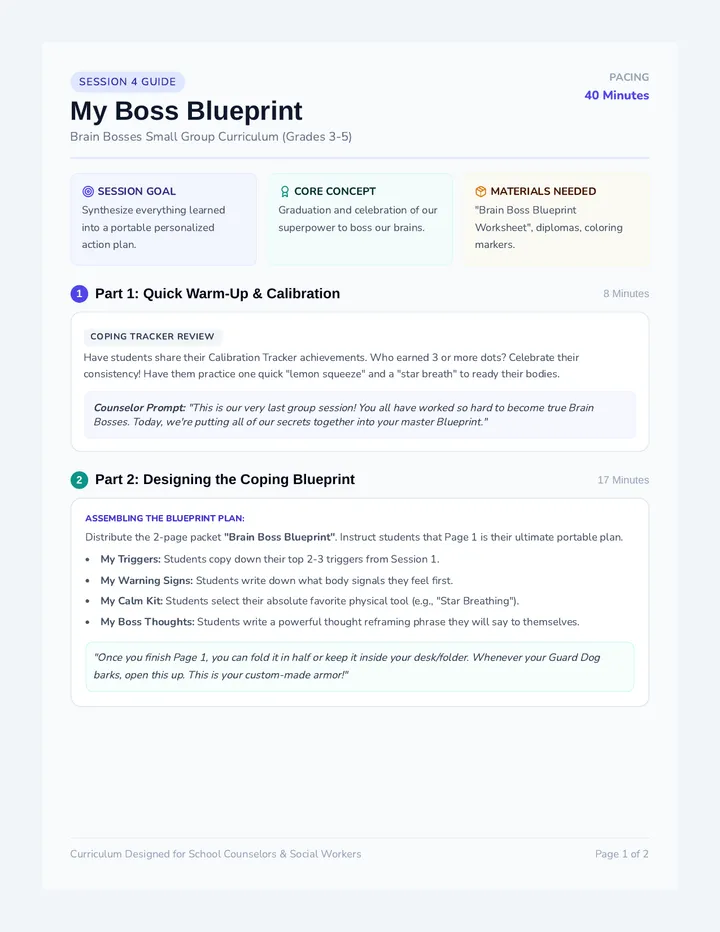
Boss Blueprint Guide Session 4 Guide
My Boss Blueprint
Brain Bosses Small Group Curriculum (Grades 3-5)
PACING 40 Minutes
Session Goal
Synthesize everything learned into a portable personalized action plan.
Core Concept
Graduation and celebration of our superpower to boss our brains.
Materials Needed
"Brain Boss Blueprint Worksheet", diplomas, coloring markers.
1 Part 1: Quick Warm-Up & Calibration 8 Minutes
Coping Tracker Review
Have students share their Calibration Tracker achievements. Who earned 3 or more dots? Celebrate their consistency! Have them practice one quick "lemon squeeze" and a "star breath" to ready their bodies.
Counselor Prompt: "This is our very last group session! You all have worked so hard to become true Brain Bosses. Today, we're putting all of our secrets together into your master Blueprint."
2 Part 2: Designing the Coping Blueprint 17 Minutes
Assembling the Blueprint Plan:
Distribute the 2-page packet "Brain Boss Blueprint" . Instruct students that Page 1 is their ultimate portable plan.
My Triggers: Students copy down their top 2-3 triggers from Session 1.My Warning Signs: Students write down what body signals they feel first.My Calm Kit: Students select their absolute favorite physical tool (e.g., "Star Breathing").My Boss Thoughts: Students write a powerful thought reframing phrase they will say to themselves.
"Once you finish Page 1, you can fold it in half or keep it inside your desk/folder. Whenever your Guard Dog barks, open this up. This is your custom-made armor!"
Curriculum Designed for School Counselors & Social Workers Page 1 of 2
Session 4 Guide
Graduation & Termination
Brain Bosses Small Group Curriculum (Grades 3-5)
PACING 40 Minutes
3 Part 3: The Strength Web Game 10 Minutes
Activity Instructions:
If time/materials allow, use a ball of yarn to create a "Strength Web". Toss the yarn to a student while holding onto the end. Share one thing you have appreciated about their participation or a strength you noticed in them.
That student then holds a piece of the string and tosses the ball to another peer, sharing an encouragement or a strength of that peer. Continue until a full web is formed.
"Look at this web. We are all connected, and we have all helped each other learn to boss our brains this past month! You are never alone in handling worry thoughts."
Brain Boss Blueprint Worksheet Brain Boss Academy
My Brain Boss Blueprint
Student Name ___________________________
Date ____________
My Master Action Plan
Congratulations! You have learned how to manage your thoughts, calm your body, and boss your anxiety. Write down your personal blueprint below to keep with you whenever you need it.
Zone 1: My Triggers
What situations make my Guard Dog bark the loudest?
LIST TRIGGERS:
Zone 2: My Body Signals
How does my body let me know anxiety is coming?
LIST SOMATIC SIGNS:
Zone 3: My Calm Kit
Which coping strategies calm down my Guard Dog best?
LIST COPING SKILLS:
Zone 4: My Boss Thoughts
What can I whisper to challenge the Worry Whispers?
LIST REFRAMES:
My 3-Step Boss Drill:
1. Catch the thought 2. Breathe & Squeeze 3. Replay with a Boss Thought
Session 4 Activity Sheet Brain Bosses Small Group Series
Brain Boss Academy
Official Certificate of Achievement
BRAIN BOSS
This award is proudly presented to a student who has successfully conquered their anxiety, mastered somatic calming skills, challenged worry whispers, and obtained complete authority over their own thoughts.
Graduating Scholar:
Has demonstrated full understanding of the Amygdala Alarm System , practiced5-4-3-2-1 Grounding , and deployed Boss Thoughts in times of worry.
Academy Counselor
APPROVED
Date Certified
Master of Mindset Series