Routine Facilitator Guide Clinical Facilitator Guide
Our Predictable Group Routine
Session 1: Baseline Assessment & Routine Establishment
Provider: Ms. Hartman, LCSW
Duration: 20 Minutes
Setting: Counseling Office
Target Group
NAW, MK, NK
Clinical Focus
Baseline SEL Probes
Core Strategy
Ready-Calm-Connected
IEP Goals & Session Objective
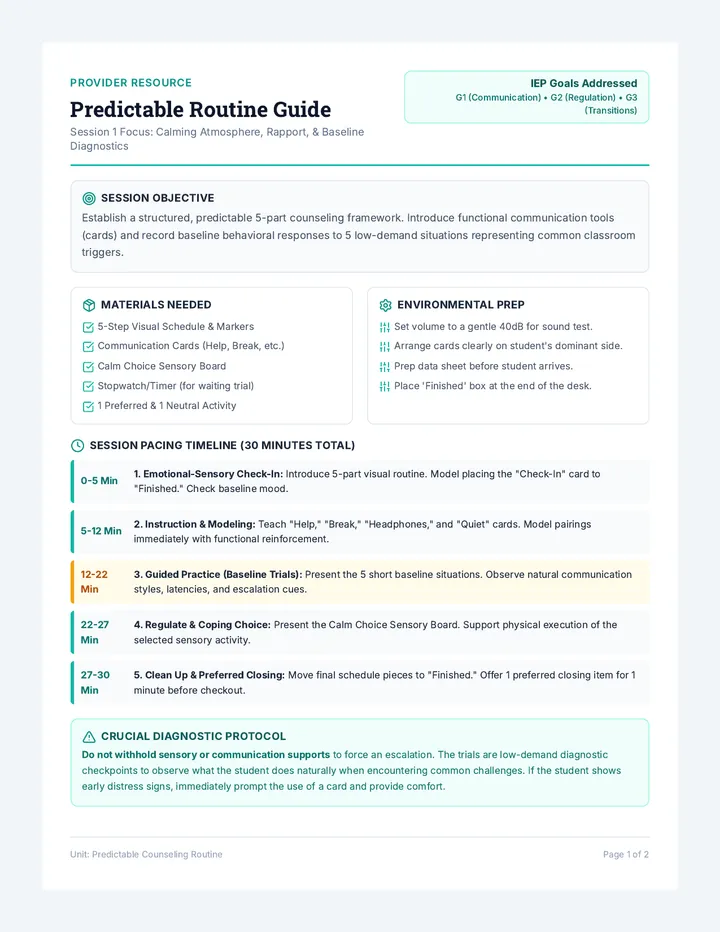
Session Objective: Complete baseline assessment probes of emotional communication, coping choice, ready behavior, direction-following, and cooperative peer interaction during a structured, predictable 20-minute group routine.
Targeted Student Goals:
NAW: Express current emotional state, choose an appropriate coping strategy, and engage in cooperative peer interaction.MK: Communicate personal needs, wants, and feelings using simple language and appropriate social words.NK: Identify a safe physical coping strategy and participate in positive peer-to-peer communication.
The "Ready-Calm-Connected" Sequence
1
READY
Check in, sit in personal space, receive visual schedule.
2
CALM
Identify feeling zone, select and practice coping strategy.
3
CONNECTED
Engage in cooperative task, share social greetings.
Pacing & Baseline Assessment Protocol
Time Routine Segment Baseline Probe Mechanics (No Prompting Initially) 0-4 Min Warm-Up / Ready Deliver visual schedules. Observe student ability to enter, transition, and sit independently. Record baseline ready behavior. Allow sensory tool choice. 4-9 Min Instruction / Calm Introduce the 3-step routine. Run "Feeling Match" probe: display 4 emotion cards and record if student matches, labels, or uses sentence starters naturally. 9-16 Min Practice / Connect Run cooperative token-placing task. Run turn-exchange baseline. Record direction following (2-step instructions) and unsolicited positive comments. 16-20 Min Closing / Finish Students use visual choice boards to state a learned skill. Record target behavior and duration. Review carryover homework cards.
Predictable Group Routine • Facilitator Guide Page 1 of 2
Clinical Facilitator Script
Explicit clinical prompts, cueing hierarchies, and diagnostic script rules
Ms. Hartman's Guide
MANDATORY BASELINE PROBE RULES (No Pre-Coaching)
To gather accurate raw data, always offer an Independent Opportunity first. Allow up to 5 seconds of wait time before applying any prompt level. If a student errors or does not respond, step down the hierarchy and record the final successful prompt level (I = Independent, V = Visual, G = Gestural, VP = Verbal Prompt, PP = Physical Prompt).
Segment 1: Warm-Up & Ready Check (0-4 Min)
Action: Give student a desktop visual schedule and 3 token pieces.
Segment 2: Feeling & Coping Probes (4-9 Min)
Action: Lay the 4 Emotion Cards (Happy/Green, Sad/Blue, Nervous/Yellow, Frustrated/Red) on the table.
Segment 3: Cooperative Task & Peer Interaction (9-16 Min)
Action: Place the cooperative board on the table. Hand student tokens.
NAW: Assess baseline peer interaction. Does NAW pass the token and look at peer without prompting?MK: Assess communication of wants/needs. Does MK say "Your turn" or request a token using descriptive words?NK: Assess safety & body control. Does NK maintain physical boundaries and communicate nicely?
Segment 4: Closing & Home Transition (16-20 Min)
Action: Distribute the Home Guides and Miniature Classroom Visual Strips.
Proactive Co-Regulation & Troubleshooting Guide
If student refuses check-in: Use visual redirection. Point silently to their personalized schedule strip. Avoid verbal negotiations. Keep tone warm and low.
If physical safety boundary is crossed: Instantly cue: "We are safe." Hand over a soft squishy or putty to anchor hand movements.
Predictable Group Routine • Facilitator Guide Page 2 of 2
Group Session Data Record Specialist Clinical Form
Group Session Data Record
Clinical baseline assessments & IEP progress tracking matrices
FORM ID: RCC-B1
Date
Friday, August 28, 2026
Provider Name
Ms. Hartman, LCSW
Session Setting
e.g., Counseling Room
Session Duration
e.g., 20 Minutes
Attendance Baseline Check: NAW (Present) MK (Present) NK (Present)
Baseline Quantitative Progress Matrix
Student Weekly Baseline Target Goal Opps Met Prompt Level Objective Behavior Sample NAW Emotion labels & coping choice + physical peer sharing during connection tasks. ____ ____ [ ] I (Ind) [ ] V (Vis) [ ] G (Gest) [ ] VP (Verb)
| Record physical/verbal social exchanges... |
| MK | Wants, needs, feelings identification + using social greeting phrases. | ____ | ____ |
[ ] I (Ind) [ ] V (Vis) [ ] G (Gest) [ ] VP (Verb)
| Record descriptive words used... |
| NK | Physical self-regulation choices + respectful/safe peer communication. | ____ | ____ |
[ ] I (Ind) [ ] V (Vis) [ ] G (Gest) [ ] VP (Verb)
| Record safe physical actions... |
Narrative Descriptive Logs
1. Actual Verbal Message / Specific Coping Strategy Used / Peer Task Behavior
Write student quotes, exact coping tools selected, and cooperative task dynamic here...
2. Emotional Context / Duration of Focus / Return-to-Task / Carryover Potential
Note triggers, total baseline engagement time in minutes, ability to re-engage, etc...
3. Next-Session Target Focus & Custom Adjustments
Identify prompt adjustments, sensory alterations, or behavioral supports for next session...
PROMPT HIERARCHY REFERENCE KEY
I (Independent): Natural initiation with no visual or physical cues.
V (Visual): Student responds to schedule strips or visual cues.
G (Gestural): Counselor points or gestures to target object.
VP (Verbal): Direct/indirect vocal prompt given by facilitator.
PP (Physical): Light hand-over-hand physical guide (last resort).
Ms. Hartman's Clinical Baseline Matrix Confidential Student Data • August 2026
Student Carryover Toolkit Printable Classroom Aids
My Desk Schedule Strip
Cut along the dotted lines. Tape to student desks for school-wide routine carryover.
Cut & Laminate
STUDENT: NAW • Routine Desktop Visual
Step 1 WARM-UP Check-In
Step 2 READY Sit Safe
Step 3 CALM Take Breath
Step 4 CONNECTED Share Task
STUDENT: MK • Routine Desktop Visual
Step 1 GREET Say Hello
Step 2 READY Feet Still
Step 3 MY FEELING Use Words
Step 4 PARTICIPATE Nice Voice
STUDENT: NK • Routine Desktop Visual
Step 1 TRANSITION Walk Calm
Step 2 SAFE BODY Safe Hands
Step 3 COPING KEY Squeeze Tool
Step 4 COOPERATE Nice Hands
Classroom Carryover Toolkit • Desk Schedules Page 1 of 2
Visual Communication Tokens
Feelings & Coping Visual Cards
Boardmaker-style high-contrast visual cues representing specific baseline feelings and regulatory choices.
Visual Communication
PART A: The Four Emotion Check-In Zones
Green Zone
HAPPY
Safe, calm, ready
Blue Zone
SAD
Tired, slow, down
Yellow Zone
NERVOUS
Wiggly, fast, anxious
Red Zone
ANGRY
Mad, unsafe, stop
PART B: Sensory & Safe Coping Strategy Cards
Sensory
Deep Breath
3 slow breaths
Physical
Squeeze Ball
Use safe hands
Focus
Hand Press
Press palms flat
Spatial
Safe Break
Sit in safe spot
Classroom Carryover Toolkit • Feelings & Coping Symbols Page 2 of 2
Student Routine Workbook My Name
Today's Date
My Group Routine Book
Activity 1: Ready-Calm-Connected
1. Tracing My Three Group Steps
1
Step 1: I am
READY
2
Step 2: I feel
CALM
3
Step 3: I am
CONNECTED
2. My Feeling Check-In
Which face shows how your heart and body feel right now? Color one face.
Happy
Sad
Nervous
Angry
Fill in the missing words for your feeling:
I feel today.
Student Routine Workbook • Section A Page 1 of 2
My Coping & My Connection
Activity 2: Finding Calm & Working Together
3. Finding My Calming Tool
Draw a line from the feeling zone on the left to the safe coping tool on the right.
Red Zone (Angry)
Yellow Zone (Anxious)
Blue Zone (Sad/Tired)
Deep Breathing
Squeeze Squeezy Tool
Quiet Safe Break
What do you need when you are in a yellow or red zone?
I need
What is your goal for today?
I am ready to
4. Connected with My Friends
Draw or write about one nice thing you did or said during our group puzzle task today!
Student Routine Workbook • Section B Page 2 of 2
Counseling Home Guide Counseling Connection
Ready, Calm, & Connected at Home
Supporting your child's emotional regulation and peer relationship goals
Weekly Home Connection Week 1: Establishing Routines
A Note from Ms. Hartman, School Social Worker
Hello! This week, our social work group launched our core group routine: "Ready-Calm-Connected." We are using this predictable structure to help students check in on their feelings, choose healthy self-regulation tools, and work cooperatively with peers. Connecting our school routine to your home is the best way to help your child master these important social-emotional skills. Thank you for your partnership!
Our Three Group Steps
1 READY
Preparing our minds and bodies. Having structured, predictable expectations like keeping safe hands and sitting in a personal space.
2 CALM
Identifying our current emotional zone (Green, Blue, Yellow, or Red) and selecting a safe calming/focusing tool to reset.
3 CONNECTED
Engaging in reciprocal communication, sharing resources, and using kind words to solve collaborative tasks with others.
Understanding the Four Emotional Zones
Green Zone HAPPY & CALM Ready to learn & talk
Blue Zone SAD & TIRED Moving slowly, down
Yellow Zone NERVOUS / SILLY Loss of control, wiggly
Red Zone ANGRY / MAD Stop, unsafe, explosive
Simple Home Puzzles & Carryover Practice
Daily Feeling Check-In: Ask your child: "Which zone is your brain in right now?" Encourage them to use the sentence starter: "I feel ______ because ______."
Practice Coping Tools Together: When your child is calm, model deep breathing. Say: "Let's practice our slow breathing together so we are ready when we feel angry or nervous."
Practice Sharing Turns: Play a low-stakes card game, puzzle, or stacking block activity. Have your child physically hand you a piece and practice saying: "Your turn" or "Here is the block."
Questions or observations? Reach out anytime! Email: mhartman@school.edu • Tel: (555) 019-2831
Partnering For Student Success