Routine Facilitation Guide Provider Resource
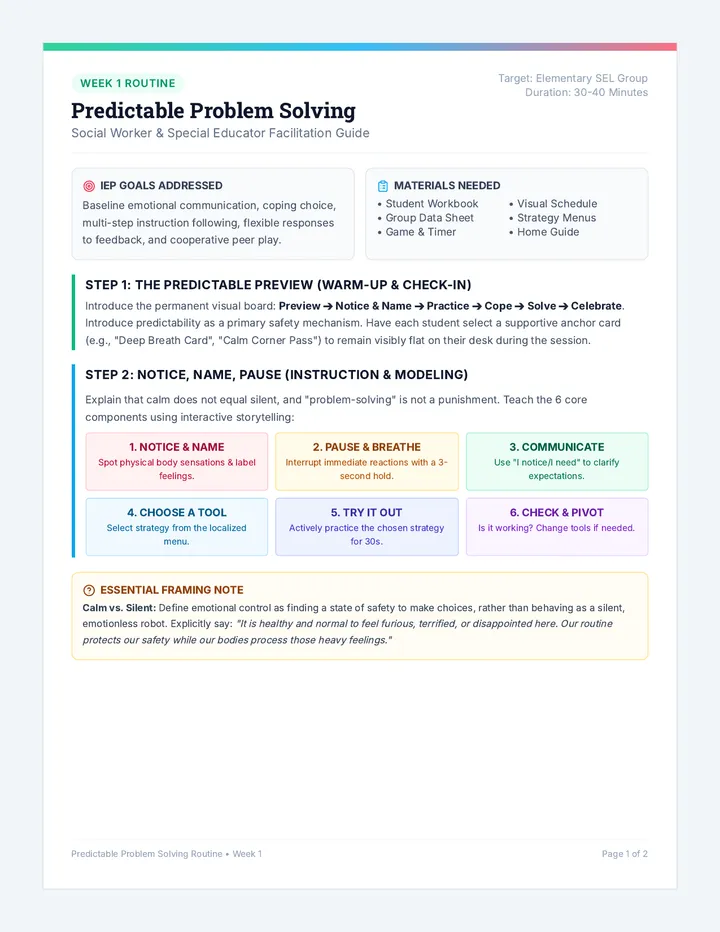
Predictable Routine Guide
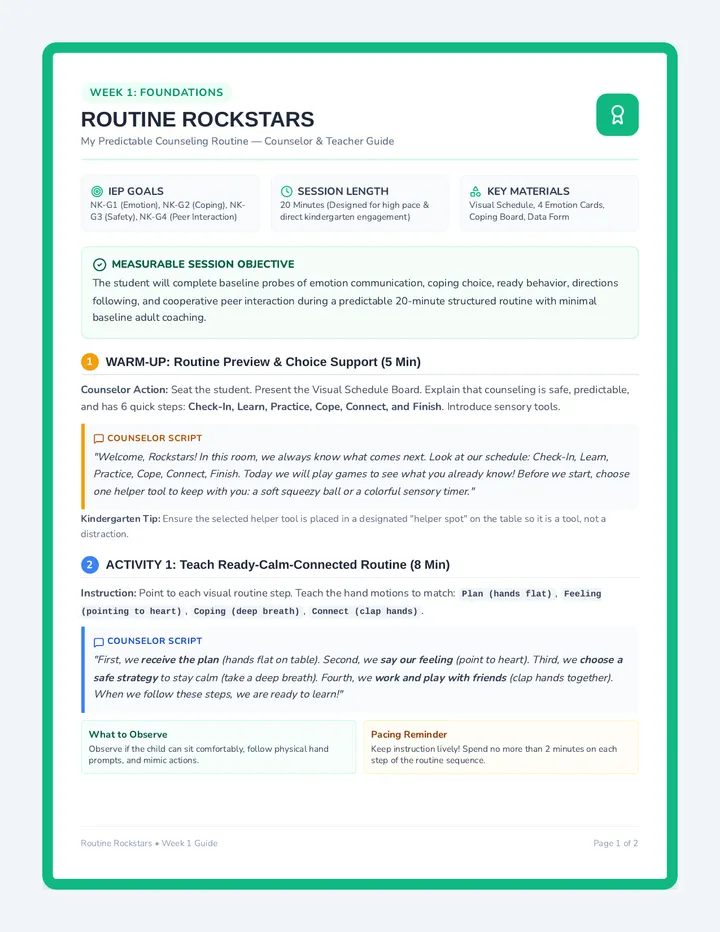
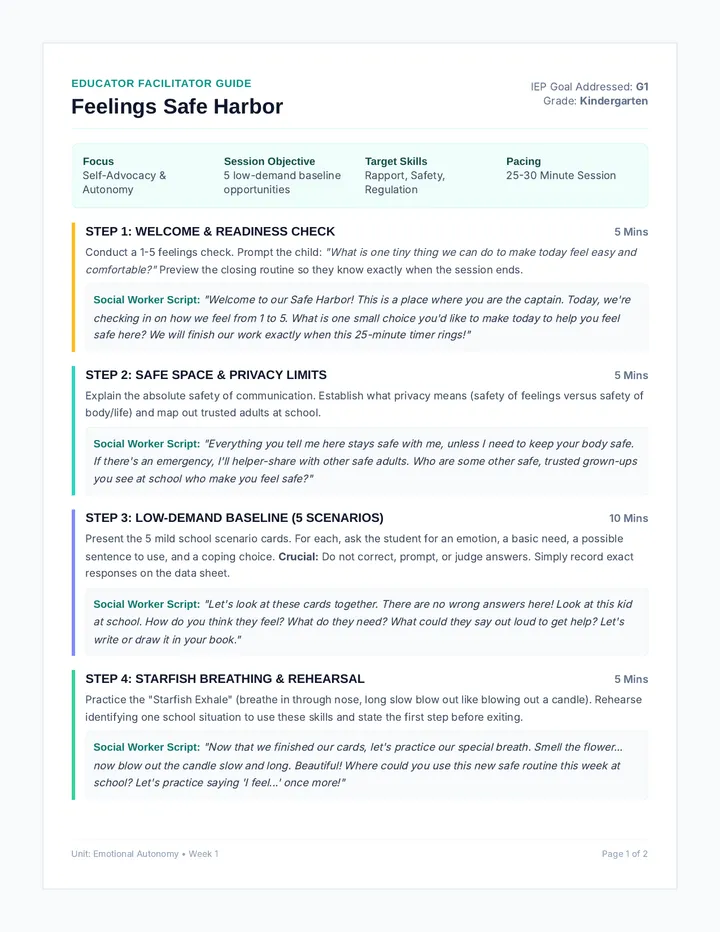
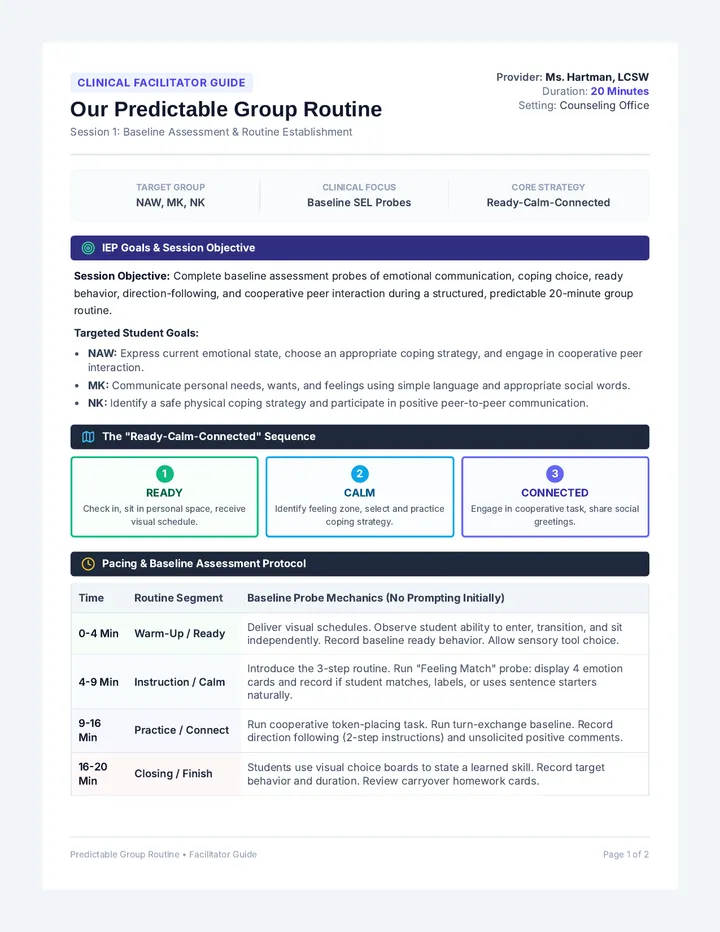
Session 1 Focus: Calming Atmosphere, Rapport, & Baseline Diagnostics
IEP Goals Addressed
G1 (Communication) • G2 (Regulation) • G3 (Transitions)
Session Objective
Establish a structured, predictable 5-part counseling framework. Introduce functional communication tools (cards) and record baseline behavioral responses to 5 low-demand situations representing common classroom triggers.
Materials Needed
5-Step Visual Schedule & Markers
Communication Cards (Help, Break, etc.)
Calm Choice Sensory Board
Stopwatch/Timer (for waiting trial)
1 Preferred & 1 Neutral Activity
Environmental Prep
Set volume to a gentle 40dB for sound test.
Arrange cards clearly on student's dominant side.
Prep data sheet before student arrives.
Place 'Finished' box at the end of the desk.
Session Pacing Timeline (30 Minutes Total)
0-5 Min
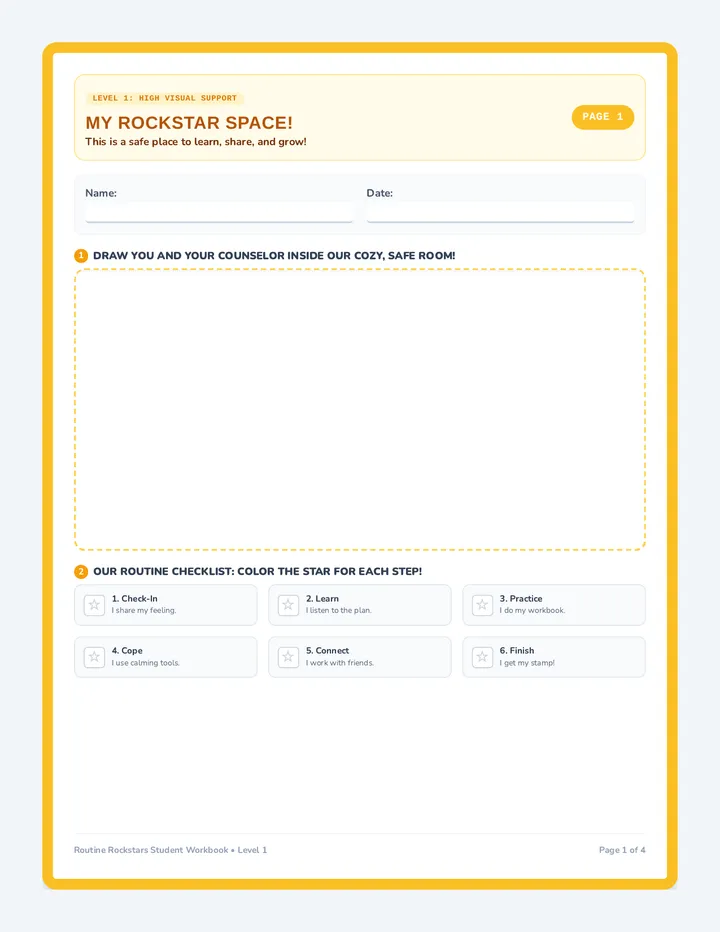
1. Emotional-Sensory Check-In: Introduce 5-part visual routine. Model placing the "Check-In" card to "Finished." Check baseline mood.
5-12 Min
2. Instruction & Modeling: Teach "Help," "Break," "Headphones," and "Quiet" cards. Model pairings immediately with functional reinforcement.
12-22 Min
3. Guided Practice (Baseline Trials): Present the 5 short baseline situations. Observe natural communication styles, latencies, and escalation cues.
22-27 Min
4. Regulate & Coping Choice: Present the Calm Choice Sensory Board. Support physical execution of the selected sensory activity.
27-30 Min
5. Clean Up & Preferred Closing: Move final schedule pieces to "Finished." Offer 1 preferred closing item for 1 minute before checkout.
Crucial Diagnostic Protocol
Do not withhold sensory or communication supports to force an escalation. The trials are low-demand diagnostic checkpoints to observe what the student does naturally when encountering common challenges. If the student shows early distress signs, immediately prompt the use of a card and provide comfort.
Unit: Predictable Counseling Routine Page 1 of 2
Provider Resource
Verbatim Session Scripts
Direct instruction wording and facilitation checklists for each routine component
Provider Role
Social Worker / Counselor
PHASE 1: Check-In Schedule Script Est. Time: 5 Min
"Welcome! This is our counseling space. We will do the same five steps every week so you always know what is next. Let's look: First, Check-In (point). Second, Learn. Third, Practice. Fourth, Regulate. Fifth, Finish. Let's check in now by drawing how we feel."
Checklist: Confirm the student touches or interacts with the schedule. Accept any form of agreement (pointing, nod, vocal).
PHASE 2: Card Instruction & Modeling Est. Time: 7 Min
"Today we are learning tools to talk without needing to speak. Look at this card. It says 'HELP' (show card). If something is hard, touch this card. Let's practice. Touch 'HELP.' Good! Here is your help. Let's try 'BREAK'..."
Checklist: Provide the direct sensory experience immediately. E.g., when they model "Headphones," let them wear headphones for 10 seconds.
PHASE 3: Guided Practice (The 5 Baselines) Est. Time: 10 Min
Introduce the workbook trials sequentially. Follow these exact baseline scripts:
1. Unclear Task:
"Open your workbook and do this page." (Page is intentionally blank with no clear instruction).
2. Sensory Sound:
"Let's play a game while we listen to this sound." (Play moderate noise tape or static).
3. Ten-Second Wait:
"Hold on, I need to write a note. Please wait here." (Turn timer on for exactly 10 seconds).
4. Change Material:
"We need to stop this activity now. Let's put it away." (Gently request closing preferred item).
PHASE 4 & 5: Regulate & Wrap-Up Script Est. Time: 8 Min
"You worked so hard. Let's choose a sensory break now. Look at your board: Breaths, Wall Pushes, Headphones, or Quiet Space. Point to one... Awesome, let's do it together. (After break) Now, let's move 'Finish' to the box. You earned a minute of your choice!"
Unit: Predictable Counseling Routine Page 2 of 2
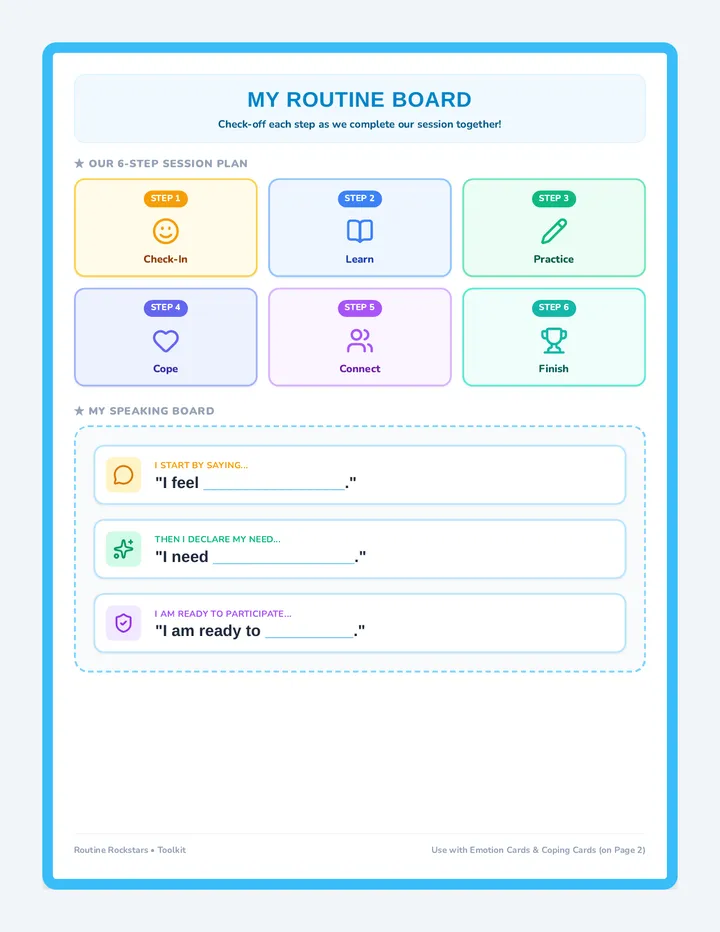
Routine Visual Toolkit Printable Student Resource
Predictable Schedule & Cards
Laminate and cut these visual aids to establish consistent weekly routines
Interactive Tool
My 5-Step Session Schedule
1. Check In Draw & Share
2. Learn Explore Cards
3. Practice Try 5 Situations
4. Regulate Sensory Choice
5. Finish Clean Up & Choice
Printable Communication Cards (Cut Along Dashed Lines)
Lamination recommended
I Need
Help
I Need
A Break
I Need
Headphones
I Need
Quiet Space
Unit: Predictable Counseling Routine Page 1 of 2
Printable Student Resource
Calm Choice Sensory Board
Use this board during Phase 4 of the counseling routine to select regulation strategies
My Calm Toolkit
Choose A Strategy to Reset Your Mind and Body
Breathing
Two Slow Breaths
Breathe in like smelling a flower, out like blowing bubbles
Physical Reset
Five Wall Pushes
Push hands flat on the wall for 5 deep counts
Sensory Cover
Wear Headphones
Blocks out background noises to give your ears a rest
Decompress
Quiet Space
Sit in a soft quiet area for a few moments of peace
How to Use:
If things feel overwhelming, tap or point to any icon on this board. The adult will help you set up that calm strategy immediately. There are no right or wrong choices!
Unit: Predictable Counseling Routine Page 2 of 2
Routine Student Workbook My Counseling Workbook
Week 1: Establishing My Predictable Routine
Name
Date
1 How Do I Feel Right Now? (Circle One Face)
Great
Tired
Worried
Mad
I feel ___________ because:
2 Match the Tools (Draw a Line)
My Cards
"Help" Card
"Break" Card
"Headphones" Card
What it Means
To block out loud sound
When a task is confusing
To pause and catch my breath
Unit: Predictable Counseling Routine Page 1 of 2
Practice & Checkpoints
Complete each small practice task with your counselor
Phase 3
Challenge 1: Drawing Time Ask for HELP if confused
Draw your favorite animal inside this box...
Challenge 2: Audio Check Ask for HEADPHONES if noisy
How does the room sound right now? Circle your answer:
🤫 Shhh... Quiet
🙂 Okay / Normal
🔊 Too Loud!
Challenge 3: Wait Time Star Tracker Ask for A BREAK if needed
Color in one star for every second we wait. Let's count together to 10!
Challenge 4: Switching Activities
Are you ready to stop this game and put it away?
👍 Yes, I can do it!
Challenge 5: Simple One-Step
Color this circle with your favorite crayon!
Unit: Predictable Counseling Routine Page 2 of 2
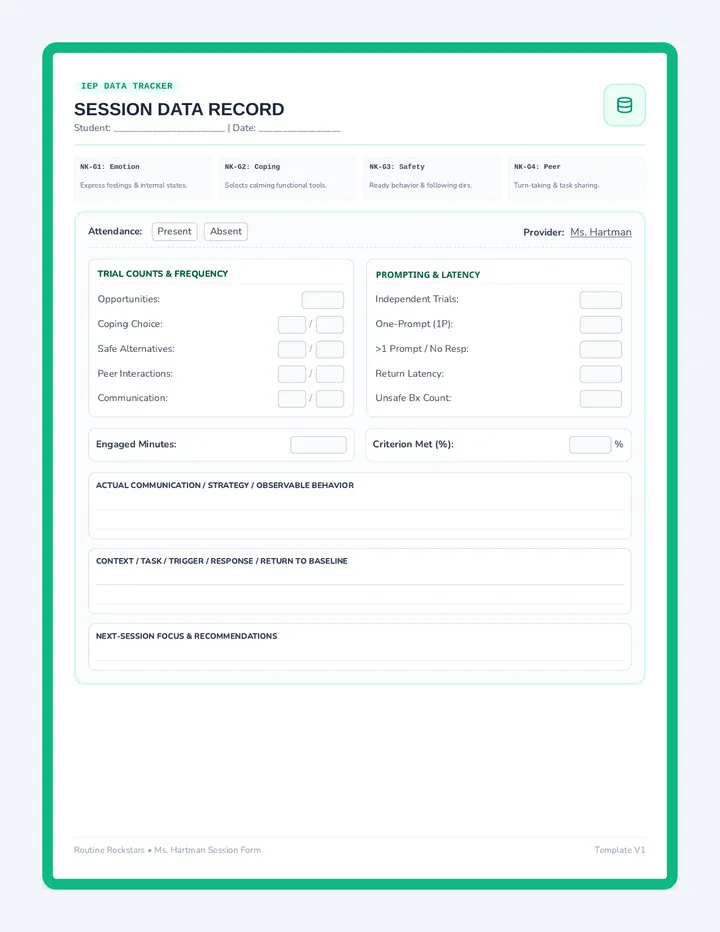
Routine Data Sheet Clinical Data Record
Individual Trial Logging
Session 1 Baseline: Direct observation of student responses under five structured challenges
Session Metadata
Goal Tracking: G1, G2, G3
Date
Attendance Present / Absent
Provider Ms. Hartman
Opportunities
Independent Requests
Prompted (G-V / VP)
Coping (M / AS / ND)
Success %
Individual Trial Log
Situation / Challenge Request Mode Safe Engage Escalation Support Return Lat. 1. Unclear Task No instruction page Ind / Prompt / None Yes / No / Partial Yes / No Dur: ___ Help / Break / None ___ sec 2. Mild Audio Noise Static tape play Ind / Prompt / None Yes / No / Partial Yes / No Dur: ___ Headphones / Quiet ___ sec 3. 10-Second Wait Counselor writes note Ind / Prompt / None Yes / No / Partial Yes / No Dur: ___ Timer / Break / None ___ sec 4. Material Switch Preferred to neutral Ind / Prompt / None Yes / No / Partial Yes / No Dur: ___ Finished box / Choice ___ sec 5. 1-Step Task Simple non-preferred Ind / Prompt / None Yes / No / Partial Yes / No Dur: ___ Help / Break / None ___ sec
Routine Home Guide Home Connection Partner
Counseling Home Guide
Establishing consistent visual predictability and coping strategies between home and school
Family Care Pack
Why Predictability Matters
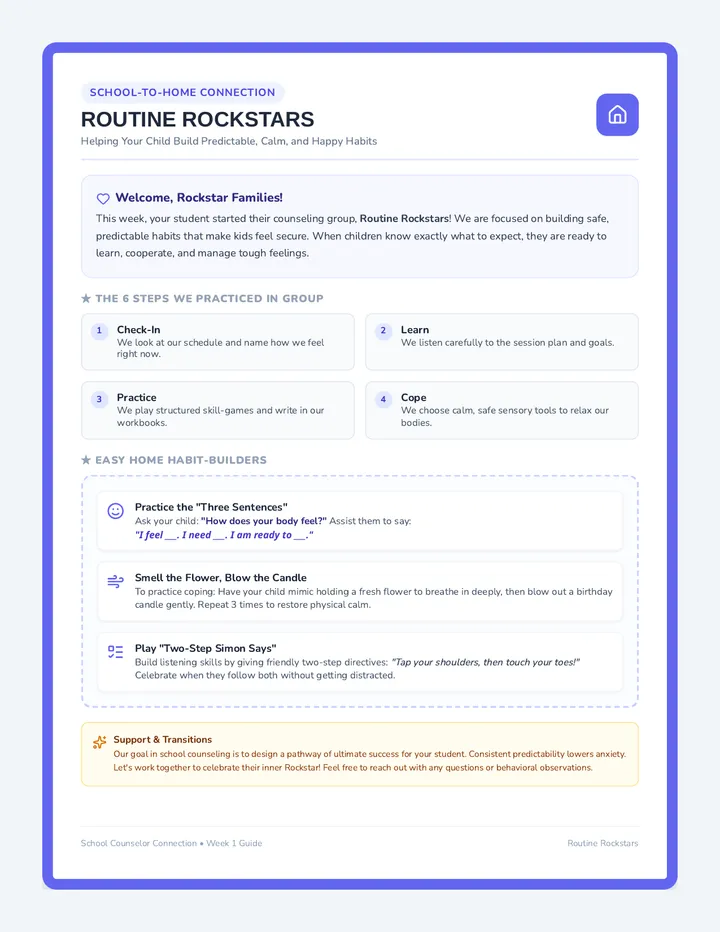
Welcome to our counseling home connection! This week, we established a 5-step visual routine that we will use every single week. When routines are predictable, children feel safe, anxiety decreases, and they are far more prepared to learn and communicate.
Supporting Communication
At school, your child is learning to use four primary Communication Cards to express their needs without needing verbal speech when overwhelmed:
Help: Requested during hard tasks.Break: Used to take a structured pause.Headphones: Blocks loud noises.Quiet: Safe, silent decompress area.
Calm Choice strategies
We are practicing concrete, proactive sensory coping options. You can easily support these identical strategies in your living room:
Two Breaths
Slow nasal inhales
Wall Pushes
Deep muscle pressure
Headphones
Noise containment
Quiet Corner
Low visual input
Family Action Checklist
To reinforce this counseling work, try picking just one or two actions from this checklist this week:
Establish a Visual Checklist: Map out the morning routine (e.g., brush teeth, dress, shoes, backpack) so it looks like a clear, predictable list.
Validate Communication: If your child is struggling to find words, say: "Show me what you need, you can point or use a hand motion."
Designate a "Quiet Corner": Create a tiny dedicated cozy space with pillows or low lighting that serves exclusively for self-regulation.
"Working as a team, we can build a world where transitions are simple, communication is accessible, and regulation is a shared achievement." — Ms. Hartman, Provider
Unit: Predictable Counseling Routine Page 1 of 1