Gratitude Power Slides
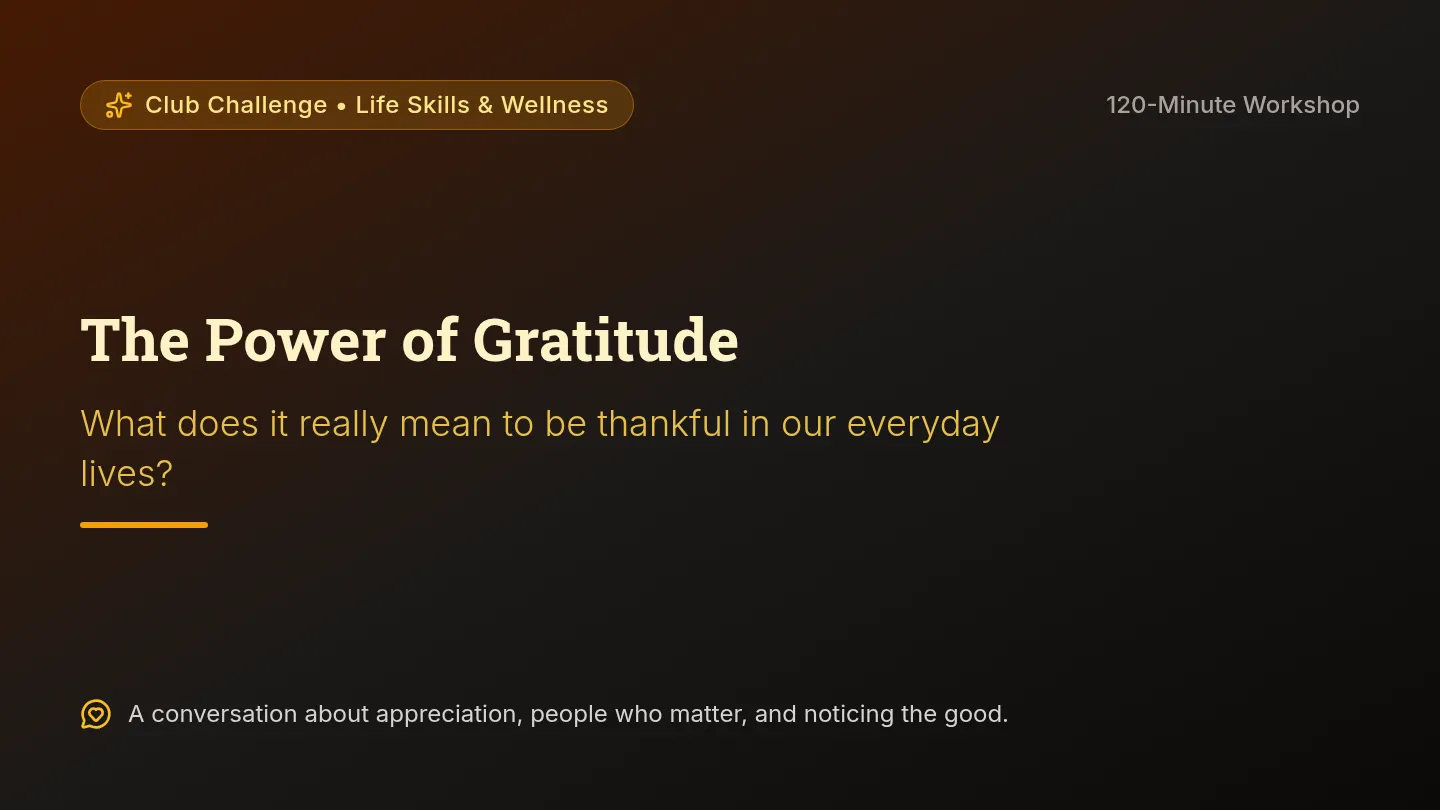
Club Challenge • Life Skills & Wellness
120-Minute Workshop
The Power of Gratitude
What does it really mean to be thankful in our everyday lives?
A conversation about appreciation, people who matter, and noticing the good.
Our Workshop Space
How We Share Today
Every Feeling Counts
There are no wrong answers. Your honesty and personal experience are what matter most.
Listen with Respect
We give each person time to speak without rushing or interrupting them.
Take Your Time
It is completely okay to pause, think, or pass if you need a moment.
Support One Another
We celebrate each other's thoughts and cheer for every person in our room.
We are here to learn from each other's stories.
Warm-Up Question
What is one thing that put a smile on your face this week?
It can be something big, like a fun outing, or something small, like a favorite snack, a funny joke, or a good song.
Why did that moment make you feel good? Take a turn sharing with the group.
The Big Idea
What Does "Gratitude" Mean?
Noticing
Slowing down and seeing something good in your day that you might usually overlook.
Feeling
Allowing your heart and mind to feel thankful for what is present in your life.
Appreciating
Recognizing that someone or something made your day a little brighter or easier.
In your own words: How would you explain what it feels like to be thankful?
Body & Mind
How Does Gratitude Feel Inside?
When you feel genuinely thankful, what happens in your body and mind?
A warm or relaxed feeling in your chest
Your shoulders drop and you breathe easier
A sense of calm, peace, or energy
"When I remember something good, my worries get a little lighter."
Does gratitude make you feel calm, energized, or connected to others?
Take a breath: Notice how you feel right in this moment.
Perspective
Big Celebrations vs. Everyday Moments
Big Moments
- Birthdays and holiday parties
- Going on a special vacation
- Receiving a major award or gift
These happen only once in a while.
Everyday Moments
- A warm cup of coffee or tea
- A friend who waves and says hello
- Sleeping in clean, cozy sheets
These are waiting for us every single day!
Group Question: Why are the small, quiet moments just as important as big celebrations?
Noticing What Is Around Us
Things We Take for Granted
Comfortable Shoes
Keeping our feet dry and warm all day.
A Great Song
Hearing music that changes our mood instantly.
Being Connected
Calling or messaging someone we care about.
A Favorite Meal
Enjoying food that tastes comforting and good.
What is one ordinary object or comfort you are glad you have today?
Real Life Discussion
"Imagine your power went out at home for a whole weekend—no lights, no TV, no microwave, no charging your phone."
When the electricity finally turns back on, how would you feel?
Why does losing something for a little while make us appreciate it so much more?
Share your thoughts: What would you miss the most? Part 1 Reflection
Our Circle
Who Are the People in Our Lives?
Close Friends
People who laugh with us, listen when we are stressed, and share our interests.
Family & Caregivers
People who have known us through changes and check on us when we need support.
Staff, Coaches & Peers
People at programs, jobs, and clubs who help us build skills and reach goals.
Think of one person who was kind to you recently. What did they do?
Community Helpers
People Who Help Quietly Every Day
Bus & Transit Drivers
Getting us to work, club meetings, and doctor visits safely in all kinds of weather.
Grocery & Store Clerks
Stocking shelves, ringing up our groceries, and answering questions with patience.
Maintenance & Janitors
Keeping our buildings clean, fixing broken doors, and keeping us safe.
Cafeteria & Kitchen Teams
Cooking meals, setting up tables, and washing dishes so we can eat comfortably.
How can a simple "Thank you" or smile brighten a worker's long shift?
Real Life Situation
Scenario
You had a frustrating morning. When you arrived at your program, a friend looked at you, noticed your expression, and said:
"Hey, you seem a bit quiet today. Do you want to talk about it or just sit together?"
Question 1
How would it feel to know someone noticed your mood without judging you?
Question 2
Why is being a good listener one of the greatest gifts we can give someone?
Who is someone in your life who really listens to you when you speak?
Action Steps
How Do You Show Someone You Appreciate Them?
Using Your Words
Saying: "I really appreciate how you helped me with that today."
A Note or Text
Sending a simple text, a drawing, or a card that says "Thinking of you!"
A Kind Gesture
Holding a door, saving them a seat, offering a fist bump, or helping carry something.
Which of these ways feels easiest or most natural for you to do?
Group Spotlight
"Who is one person you are grateful for today, and what is one reason why?"
It could be someone in this room, someone at home, a favorite staff member, or a friend from your community.
Take your time. Let's hear from anyone who wants to share.
Remember: Listening to your friend's answer is a way to show them respect!
Holiday Connection
What Comes to Mind When You Hear "Thanksgiving"?
Special Meals
Turkey, stuffing, pies, favorite dishes, or traditions.
Gatherings
Seeing friends, family, roommates, or watching parades.
Rest & Quiet
Taking a day off, relaxing, watching movies, resting.
What is your favorite part of Thanksgiving—or a holiday tradition you enjoy?
All Year Long
Thanksgiving Is 1 Day. Gratitude Is 365 Days.
The Holiday Trap
Sometimes people only talk about thankfulness in November around dinner tables, and then forget about it once the holidays pass.
The Daily Practice
Gratitude gives us strength in January, in April, in August, and on random Tuesday afternoons when we need a lift!
How does practicing thankfulness all year long change how we treat each other?
Honest Conversations
What About When Life Feels Really Hard?
Gratitude is NOT pretending everything is perfect.
It is 100% normal to feel sad, angry, lonely, or tired. You never have to fake a smile or pretend hard things aren't happening.
Gratitude is holding onto one small light.
Even on a rainy, frustrating day, can you still find one thing that feels safe, comforting, or kind?
Let's discuss: What is something you do to comfort yourself when you have had a tough day?
Group Practice
"Even on my hardest day, I am still glad I have..."
My Own Bed
A safe place to rest and recharge tonight.
Someone to Call
A friend or helper who will pick up the phone.
A Comfort Show
A favorite movie or hobby that makes us laugh.
How would you finish that sentence for yourself today?
Social Skills in Action
Giving a Genuine Compliment
Outside Compliments
"I like your shoes!" or "Nice haircut!"
These are friendly and nice to hear, but they are about things on the outside.
Heart Compliments
"You are really patient when we play games," or "You always make me laugh when I feel nervous."
These notice who the person is on the inside!
Which kind of compliment sticks with you longer? Why?
Self-Appreciation
Being Thankful for YOU
Your Efforts
Being proud that you showed up, tried something new, or kept going when it was hard.
Your Kindness
Appreciating how you treat other people, animals, and your friends with care.
Your Talents
Celebrating your unique sense of humor, your art, your memory, or your smile.
What is one quality you like about yourself?
Everyday Habits
Simple Ways to Practice Each Day
Morning
One Good Thought
Before getting out of bed, think of one thing you are looking forward to today.
Afternoon
Say It Out Loud
Tell someone: "Thank you for helping me" or "I like spending time with you."
Bedtime
Three Good Things
Count three small things that went well today, no matter how tiny they were.
Which of these three habits sounds like something you might like to try?
Our Closing Circle
One Final Word of Thanks
Let's go around our group:
What is one thing you appreciated about our conversation or our group today?
You can share a sentence, a single word, or simply say "Thank you for having me."
Club Challenge
Thank You For Sharing Your Voice
"Gratitude is not just something we say. It is how we choose to see our world."
Carry your gratitude with you today, tomorrow, and throughout the coming year.
Have a wonderful, thankful week! You are appreciated.
Gratitude Facilitator Guide
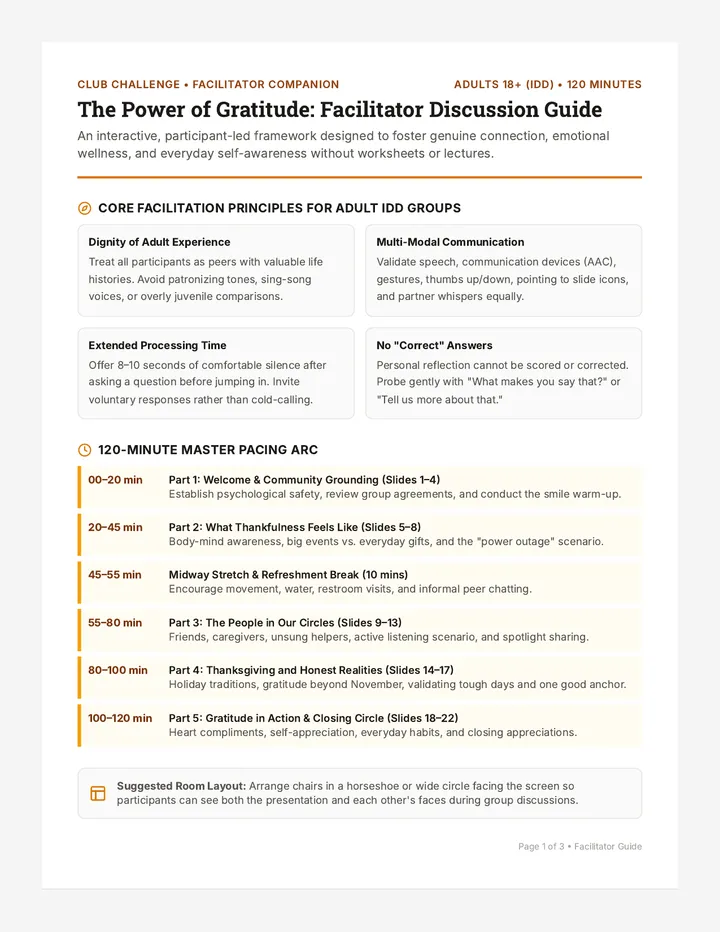
Club Challenge • Facilitator Companion Adults 18+ (IDD) • 120 Minutes
The Power of Gratitude: Facilitator Discussion Guide
An interactive, participant-led framework designed to foster genuine connection, emotional wellness, and everyday self-awareness without worksheets or lectures.
Core Facilitation Principles for Adult IDD Groups
Dignity of Adult Experience
Treat all participants as peers with valuable life histories. Avoid patronizing tones, sing-song voices, or overly juvenile comparisons.
Multi-Modal Communication
Validate speech, communication devices (AAC), gestures, thumbs up/down, pointing to slide icons, and partner whispers equally.
Extended Processing Time
Offer 8–10 seconds of comfortable silence after asking a question before jumping in. Invite voluntary responses rather than cold-calling.
No "Correct" Answers
Personal reflection cannot be scored or corrected. Probe gently with "What makes you say that?" or "Tell us more about that."
120-Minute Master Pacing Arc
00–20 min
Part 1: Welcome & Community Grounding (Slides 1–4)
Establish psychological safety, review group agreements, and conduct the smile warm-up.
20–45 min
Part 2: What Thankfulness Feels Like (Slides 5–8)
Body-mind awareness, big events vs. everyday gifts, and the "power outage" scenario.
45–55 min
Midway Stretch & Refreshment Break (10 mins)
Encourage movement, water, restroom visits, and informal peer chatting.
55–80 min
Part 3: The People in Our Circles (Slides 9–13)
Friends, caregivers, unsung helpers, active listening scenario, and spotlight sharing.
80–100 min
Part 4: Thanksgiving and Honest Realities (Slides 14–17)
Holiday traditions, gratitude beyond November, validating tough days and one good anchor.
100–120 min
Part 5: Gratitude in Action & Closing Circle (Slides 18–22)
Heart compliments, self-appreciation, everyday habits, and closing appreciations.
Suggested Room Layout: Arrange chairs in a horseshoe or wide circle facing the screen so participants can see both the presentation and each other's faces during group discussions.
Page 1 of 3 • Facilitator Guide
Facilitation Playbook: Parts 1 to 3 (Slides 1–13)
First Half (Minutes 00–80)
1 Part 1: Grounding & Warm-Up (Slides 1–4)
Approx. 20 min
Slide 2 (Agreements): Read points aloud and invite participants to nod or raise a hand in agreement. Remind the group: "It is always fine to pass. You never have to share private details."
Slide 3 (Smile Icebreaker): Model first! Share a genuine, simple example (e.g., "A colleague made fresh coffee this morning"). Prompting questions:
- "Was it something you tasted, heard, or did with a friend?"
- "Why did that memory stick with you?"
Slide 4 (Gratitude): Distinguish between saying 'thank you' out of habit vs. feeling thankfulness in your heart.
2 Part 2: What Thankfulness Feels Like (Slides 5–8)
Approx. 25 min
Slide 5 (Somatic Check): Invite participants to place a hand on their chest or take one slow, deep breath. Ask: "Do you feel your shoulders drop when you feel safe and thankful?"
Slide 6 & 7 (Everyday Objects): Contrast holiday gifts with things like warm water, soft socks, or a favorite chair. Probing prompt:
- "What is an object in your bedroom or kitchen you use every day without thinking about it?"
Slide 8 (Power Outage Scenario): Give participants 15 seconds to visualize a dark home. Ask: "What is the very first appliance or light you would turn on when power comes back?" Highlight how absence creates awareness.
3 Part 3: The People in Our Circles (Slides 9–13)
Approx. 25 min
Slide 10 (Unsung Community Helpers): Ask if anyone takes public transit, shops at a local market, or knows building staff. Discuss how community helpers often work without hearing appreciation.
Slide 11 (Listening Scenario): Highlight the feeling of being heard. Ask: "Have you ever had someone look at their phone while you were talking? How did that feel compared to someone making eye contact and listening?"
Slide 13 (Spotlight Sharing): Go around the room gently. Offer response stems for those who want structure:
"I appreciate [Name] because they [action or quality]."
Adaptation Strategy for Low-Verbal Participants
If a participant prefers not to speak or uses limited words, invite them to point to an icon on Slide 7 or Slide 9, or hold up fingers (1, 2, or 3) to choose which helper or moment resonates most. Affirm their selection enthusiastically.
Page 2 of 3 • Facilitator Guide
Facilitation Playbook: Parts 4 & 5, Difficult Emotions & Wrap-Up
Second Half (Minutes 80–120)
4 Part 4: Thanksgiving and Difficult Days (Slides 14–17)
Approx. 20 min
Slide 14 & 15 (Thanksgiving & Year-Round): Celebrate diverse traditions (some love cooking, some like watching parades, some prefer quiet time alone). Clarify that gratitude is a year-round tool, not just a November holiday requirement.
Slide 16 (Tough Days & Toxic Positivity Check): Emphasize this critical distinction:
Facilitator Note: Never tell participants "It could be worse" or "Just be grateful." Acknowledge grief, loneliness, and frustration first: "It is okay to feel sad. Gratitude isn't about ignoring pain; it's about holding onto one small comfort while you heal."
Slide 17 (The One Good Thing): Discuss anchors (a cozy blanket, a warm shower, a pet, a trusted staff member). Ask participants to share their go-to comfort.
5 Part 5: Action, Self-Gratitude & Closing Circle (Slides 18–22)
Approx. 20 min
Slide 18 (Heart Compliments): Contrast external compliments (clothes/hair) with character compliments (kindness, patience, humor). Practice turning an outside compliment into a heart compliment.
Slide 19 (Being Thankful for Yourself): Many adults with IDD receive guidance from others but rarely receive opportunities to celebrate their own resilience. Give time for each person to name one strength.
Slide 21 & 22 (Closing Circle): Conclude with a pass-around appreciation. Thank every participant specifically for their presence, honesty, and listening.
Handling Grief, Loss, or Emotional Disclosures
Holidays frequently bring up missing loved ones who have passed away or family members who are distant. If a participant becomes tearful:
- Pause the group pace: Validate their feeling warmly: "Thank you for sharing something so close to your heart with us."
- Normalize grief: "Feeling sad when we remember someone we loved shows how much they mattered to us."
- Do not force a positive spin: Allow the emotion to breathe. Offer tissues or a glass of water, and ask if they would like to keep listening or take a brief break with a staff member.
Club Challenge Adult Education Series • Self-Awareness & Emotional Wellness Page 3 of 3 • Facilitator Guide