PFL Final Review Packet PFL Final Review Packet
Name: Period:
Directions: Review each Quick Refresher and Worked Example , then answer the Your Turn questions using only the information provided.
Topic 1: Money Basics & Budgeting
Quick Refresher
Needs are essentials for survival (food, shelter, basic utilities). Wants are non-essential extras (streaming services, dining out). A budget prioritizes paying essential needs first. When income exceeds expenses, you have a surplus ; when expenses exceed income, you have a deficit . Net Worth = Total Assets (what you own of value) − Total Liabilities (debts you owe).
Worked Examples
Surplus: Income $1,350 − Expenses $1,100 = $250 surplus .
Net Worth: Cash savings $800 + Car $3,200 = Assets $4,000. Credit debt $1,000 = Liability $1,000. Net Worth = $4,000 − $1,000 = $3,000 .
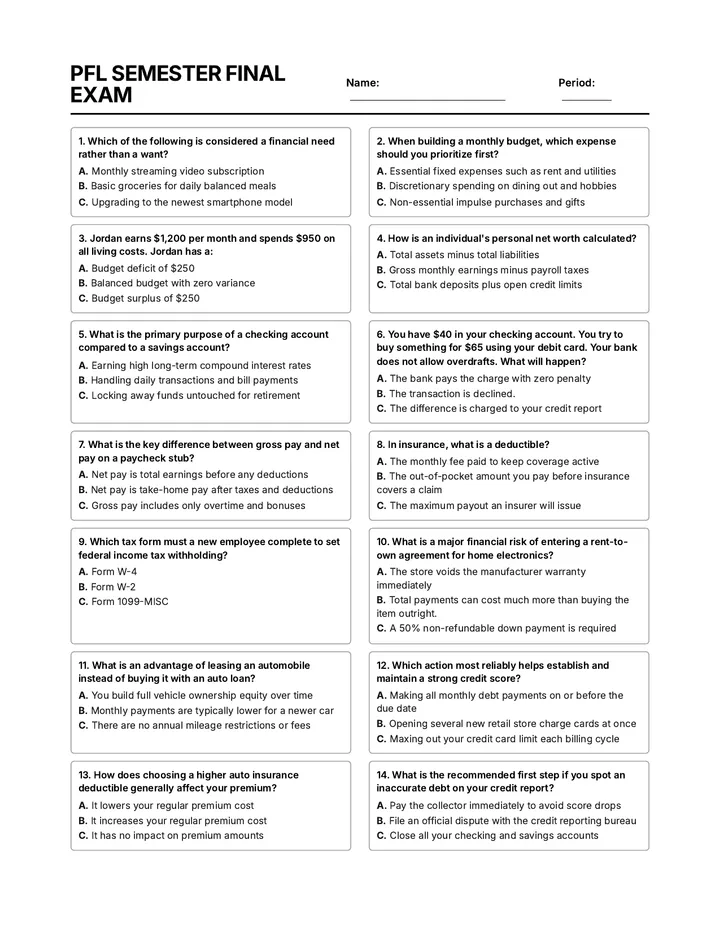
1. Needs vs. Wants: Mark each item as a Need (N) or Want (W) :
____ Monthly electricity bill ____ Upgraded flagship smartphone
2. Budget Priorities: Marcus gets paid on Friday. Which expense must he fund first?
A. Concert tickets before they sell out B. Essential apartment rent and utilities
3. Surplus & Deficit: Sofia's monthly income is $1,400. Her total living costs are $1,550.
Net Balance: $________ Result: [ ] Surplus [ ] Deficit
4. Net Worth: Jamir owns a $4,500 motorcycle and has $1,500 in savings. He owes $2,000 on a personal loan.
Total Assets: $________ Total Liabilities: $________ Net Worth: $________
Topic 2: Banking, Saving & Insurance (Part 1: Bank Accounts)
Quick Refresher
Checking accounts handle day-to-day transactions, bill pay, and debit card purchases. Savings accounts store funds for future goals and emergencies, usually earning interest. A debit card deducts funds directly from checking. If your account balance is insufficient and overdraft protection is disabled, the bank declines the transaction.
Worked Example
Priya has $35 in her checking account and swipes her debit card for a $50 purchase. Because debit cards spend money directly from checking and she lacks overdraft coverage, her transaction is immediately declined .
5. Checking vs. Savings: Match each term with its correct description:
A. Used for everyday spending, debit purchases, and bills.
B. Used to hold savings for future needs and earn interest.
Checking Account:
Savings Account:
6. Debit Cards & Balances:
Tyler has $22 in his checking account. He attempts to swipe his debit card for $40 of gas. His bank does not allow overdrafts. What occurs, and why?
Topic 2: Banking, Saving & Insurance (Part 2: Insurance)
Quick Refresher
An insurance premium is the regular scheduled payment required to maintain coverage. A deductible is the out-of-pocket amount the policyholder pays before insurance begins covering a claim. A higher deductible generally results in a lower premium , with the trade-off of paying more out of pocket if an incident occurs.
Worked Example
David has auto insurance with a $500 deductible. After a $2,400 accident repair, David pays his $500 deductible , and his insurer pays the remaining $1,900 ($2,400 − $500). By choosing a $500 deductible instead of $200, his monthly premium is lower.
7. Insurance Deductible: Elena carries a policy with a $700 deductible. A covered loss totals $2,500.
Elena pays out of pocket: $________ Insurer pays: $________
8. Deductible & Premium Trade-Off: Why would a consumer choose a higher insurance deductible?
A. To reduce the regular monthly premium cost B. To avoid paying out of pocket during an accident claim
Topic 3: Paychecks, Employment & Buying Decisions
Quick Refresher
Gross Pay is total income earned before taxes and withholdings; Net Pay is take-home pay after deductions. New hires complete a W-4 for federal tax withholding; employers provide a W-2 in January showing annual earnings and taxes withheld. Rent-to-own agreements offer small weekly fees but often cost far more than retail cash prices. Leasing a car offers lower monthly payments for a newer vehicle but limits miles and builds zero equity. Building credit requires paying debts on time; maxing cards hurts scores.
Worked Examples
Paycheck: Gross earnings $550 − Deductions $90 = Net pay $460 .
Rent-to-Own: $20/week × 45 weeks = $900 total cost for an item retailing for $550 ($350 extra paid).
Credit: Paying the minimum on time protects your credit score, but carrying high balances harms your credit utilization.
9. Gross Pay & Net Pay: Kayla earns $620 gross wages on her bi-weekly paycheck. Mandatory taxes and deductions equal $115.
Kayla's Net (take-home) Pay: $________
10. W-4 vs. W-2: Complete the sentence by writing W-4 or W-2:
A newly hired worker completes Form ________ to set up income tax withholding, whereas Form ________ arrives after year-end summarizing annual wages earned and total taxes withheld.
11. Rent-to-Own: A laptop retails for $480 cash, or rent-to-own for $16/week for 40 weeks.
Total Rent-to-Own Cost: $________ Extra Cost Paid Above Cash Price: $________
12. Leasing vs. Buying a Car: What is a primary financial disadvantage of leasing a car?
A. Monthly lease payments are always double financing costs B. You do not build ownership equity in the vehicle
13. Building Credit: Which habit most reliably builds and maintains a strong credit score?
A. Making on-time payments on all loan and credit balances B. Maxing out credit card limits and opening multiple cards
Topic 4: Credit, Debt & Consumer Protection
Quick Refresher
Credit reports record borrowing and repayment history. If you identify an unauthorized account or error, report and dispute it directly with the credit bureau. Payday loans are high-cost short-term loans with extremely high fees and annualized interest rates. Phishing scams trick victims via texts or emails into disclosing passwords or PINs; never use unverified links. FDIC insurance protects eligible bank deposits up to $250,000 if an insured bank fails, but does not insure stock market losses.
Worked Examples
Dispute: Nora notices a fraudulent $1,400 credit card account on her report. She files an official dispute with the credit reporting bureau to have it investigated.
Scam Defense: An SMS states: "Debit locked! Click link to enter PIN." Sam ignores the link and calls the verified number on the back of his card.
14. Credit Report Errors: What is the appropriate initial action when discovering an unfamiliar debt on your credit report?
A. File a formal dispute with the credit reporting bureau B. Pay the collection balance to avoid phone calls
15. Payday Loans:
Why do personal finance experts strongly advise borrowers to avoid short-term payday loans?
16. Phishing & Scams: You receive an unexpected text requesting your card PIN to verify your identity. What should you do?
A. Reply to the message with your account credentials B. Do not click; call the verified number printed on your card
17. FDIC Insurance: Circle True (T) or False (F) for each statement:
[ T / F ] FDIC insurance protects checking and savings deposits if an insured bank fails.
[ T / F ] FDIC insurance covers financial losses if stocks drop in value in the stock market.
Topic 5: Investing & Retirement (Part 1: Core Principles)
Quick Refresher
Bank savings are safe, liquid, and ideal for short-term goals, but earn modest returns. Investing in stocks provides higher long-term growth potential to outpace inflation, but carries the risk of losing money. Diversification involves spreading investments across different companies and asset types rather than relying on a single stock, reducing concentration risk.
Worked Example
Mateo invests $1,000. If he buys stock in only one retailer and it declares bankruptcy, he could lose everything. Spreading his money across many companies reduces the risk of depending on just one company's success.
18. Saving vs. Investing: Which financial strategy is best suited for building long-term retirement wealth over 25+ years?
A. Holding cash in a standard bank savings account B. Investing in a diversified portfolio of stock index funds
19. Diversification:
Explain in one sentence how spreading investment capital across different holdings protects an investor:
Topic 5: Investing & Retirement (Part 2: Growth & Employer Match)
Quick Refresher
Simple interest is earned only on the initial principal deposited. Compound interest is earned on both the principal and previously earned interest, accelerating wealth accumulation. A 401(k) employer match occurs when an employer contributes extra funds into your retirement account based on your contributions—providing an immediate return.
Worked Examples
Interest: $1,000 at 5% simple = $50/yr. At 5% compound: Year 1 earns $50 ($1,050 total); Year 2 earns 5% of $1,050 = $52.50 .
401(k) Match: Worker deposits $150. Employer offers 100% match ($150). Total monthly contribution = $300 into retirement.
20. Simple vs. Compound Interest: Which type of interest grows faster over long periods?
Simple Interest Compound Interest
21. 401(k) Employer Match: Lucas earns $2,500/month and contributes $125 to his 401(k). His employer matches 100% up to $125.
Lucas's Contribution: $________ Employer Match: $________ Total Added to 401(k): $________
Topic 6: College & Financial Aid
Quick Refresher
Grants (such as Federal Pell Grants) and scholarships are forms of financial aid that do not have to be repaid. In contrast, student loans (federal or private) are borrowed money that must be repaid with interest over time.
Worked Example
Ava's freshman college tuition is $7,000. She receives a $2,500 Pell Grant, a $1,500 private scholarship, and a $3,000 federal student loan. Only the $3,000 student loan requires repayment after college.
22. Grants, Scholarships & Loans: Classify each funding source as Gift Aid (No Repayment) or Loan (Must Repay):
a. Federal Pell Grant: ________________________________________________
b. Federal Subsidized Student Loan: ___________________________________
Topic 7: Thinking About Your Financial Future
Quick Refresher: Everyday Habits & Savings Vehicles
Sound personal finance habits include tracking cash flow with a budget, paying essential bills first, maintaining emergency savings, and avoiding high-interest debt. For saving: standard savings accounts keep money liquid; a High-Yield Savings Account (HYSA) earns higher interest while staying accessible; a 401(k) enables employer-sponsored retirement investing; and a Roth IRA allows individual retirement investments with potentially tax-free qualified withdrawals.
23. Everyday Money Choices: Identify two actionable habits that prevent personal financial strain:
Habit 1: _________________________________________
Habit 2: _________________________________________
24. Ways to Save & Invest: Match each account with its primary feature:
A. High-interest savings with accessible money.
B. Employer-sponsored retirement account, often with a match.
C. Individual retirement account with tax-free qualified withdrawals.
HYSA:
401(k):
Roth IRA:
25. Personal Financial Reflection (Final Exam Preparation):
Reflecting on your goals after high school, identify one realistic financial habit or account you plan to establish (e.g., maintaining an emergency fund in an HYSA, building credit via on-time payments, or contributing to a retirement account). Explain in 1–2 sentences why this choice will help you:
PFL Final Review Key PFL Final Review Packet — Answer Key
Teacher Reference & Grading Guide • Questions 1–13
25 Total Items • 100% Exam Aligned
Topic 1: Money Basics & Budgeting
1. Needs vs. Wants: Electricity = Need (N) | Flagship Phone = Want (W)
Rationale: Shelter utilities are survival essentials; upgrading an existing working device is non-essential.
2. Budget Priorities: Correct: B (Apartment rent and utilities)
Rationale: A budget prioritizes paying essential needs first before allocating discretionary funds to entertainment.
3. Surplus & Deficit: Balance: −$150 | Result: Deficit
Calculation: Income ($1,400) − Expenses ($1,550) = −$150. Spending exceeds income, creating a budget deficit.
4. Net Worth: Assets: $6,000 | Liabilities: $2,000 | Net Worth: $4,000
Calculation: Assets = $4,500 + $1,500 = $6,000. Liabilities = $2,000. Net Worth = $6,000 − $2,000 = $4,000.
Topic 2: Banking, Saving & Insurance
5. Checking vs. Savings: Checking Account: A | Savings Account: B
Reference: Bank checking serves liquid daily cash flow; savings preserves funds for future goals and accrues interest.
6. Debit Cards & Balances: Transaction Declined
Acceptable Answer: The transaction is declined because debit cards immediately withdraw funds from checking, and the account lacks sufficient balance ($22 balance vs. $40 purchase) with no overdraft coverage.
7. Insurance Deductible: Elena Pays: $700 | Insurer Pays: $1,800
Calculation: Elena pays her out-of-pocket deductible of $700. Insurer pays $2,500 − $700 = $1,800.
8. Deductible & Premium Trade-Off: Correct: A (To reduce regular monthly premium)
Key Principle: Higher deductibles lower the regular premium cost; the consumer accepts higher out-of-pocket risk if a claim is filed.
Topic 3: Paychecks, Employment & Buying Decisions
9. Gross Pay & Net Pay: Kayla's Net Pay = $505
Calculation: Gross Pay ($620) − Deductions ($115) = Net Take-Home Pay ($505).
10. W-4 vs. W-2: First Blank: W-4 | Second Blank: W-2
Concept: Form W-4 sets withholding upon hire; Form W-2 reports annual earnings and total taxes withheld by January 31.
11. Rent-to-Own: Total Cost: $640 | Extra Cost Paid: $160
Calculation: $16/week × 40 weeks = $640 total. Extra cost = $640 − $480 cash retail price = $160 premium.
12. Leasing vs. Buying a Car: Correct: B (Do not build ownership equity)
Trade-Off: Leases offer lower payments for newer models with mileage caps, but vehicle ownership remains with the lessor.
13. Building Credit: Correct: A (Making on-time payments)
Credit Factors: Payment history is the largest score component (35%). Maxing out cards increases credit utilization and harms scores.
PFL Final Review Packet — Answer Key
Teacher Reference & Grading Guide • Questions 14–25
Part 2 of 2 • Scoring & Rubrics
Topic 4: Credit, Debt & Consumer Protection
14. Credit Report Errors: Correct: A (File a dispute with bureau)
Consumer Rights: Consumers have the legal right under the FCRA to dispute inaccuracies directly with credit reporting agencies.
15. Payday Loans: Extremely High Interest & Fees
Acceptable Answer: Payday loans feature exorbitant interest rates (annualized 400%+ APR) and fees that trap borrowers in recurring debt cycles.
16. Phishing & Scams: Correct: B (Call verified number on card)
Best Practice: Never click links in unsolicited messages; directly contact financial institutions using the phone number on official cards.
17. FDIC Insurance: Statement 1: True (T) | Statement 2: False (F)
Coverage Rule: FDIC protects deposit accounts up to $250,000 per bank; it strictly does not insure stock or investment losses.
Topic 5: Investing & Retirement
18. Saving vs. Investing: Correct: B (Diversified stock index funds)
Growth Potential: Over 20+ years, equities historically outpace inflation, whereas cash in savings risks purchasing power loss.
19. Diversification: Reduces Concentration Risk
Sample Student Response: Spreading capital across diverse companies and sectors prevents total financial loss if any single company fails.
20. Simple vs. Compound Interest: Correct: Compound Interest
Mechanism: Compound interest accrues earnings on both the initial principal and accumulated interest, generating exponential growth.
21. 401(k) Employer Match: Lucas: $125 | Match: $125 | Total: $250
Calculation: Lucas deposits $125; employer contributes matching $125. Total monthly 401(k) contribution = $250.
Topic 6: College & Financial Aid
22. Grants, Scholarships & Loans: a. Gift Aid (No Repay) | b. Loan (Must Repay)
Rule: Pell Grants and scholarships are gift aid that require no repayment; federal and private student loans must be repaid with interest.
Topic 7: Thinking About Your Financial Future & Scoring Rubric
23. Everyday Money Choices: Any 2 Sound Financial Habits
Acceptable Habits (Any 2): Making and following a budget; paying bills on time; keeping emergency savings; comparing total borrowing costs; avoiding high-interest payday loans.
24. Ways to Save & Invest: HYSA: A | 401(k): B | Roth IRA: C
Definitions: HYSA = high-rate accessible bank savings; 401(k) = employer retirement plan with match; Roth IRA = individual account with tax-free qualified withdrawals.
25. Personal Financial Reflection Scoring Rubric (2 Points Total):
Full Credit (2 pts): Identifies a realistic habit/tool (e.g., HYSA emergency fund, on-time bill payment, or 401k match) and explains why in 1–2 complete sentences.
Partial Credit (1 pt): Identifies a habit or tool, but rationale is vague, incomplete, or lacks a practical connection to stability.
No Credit (0 pts): Off-topic, inaccurate concept, or left blank.
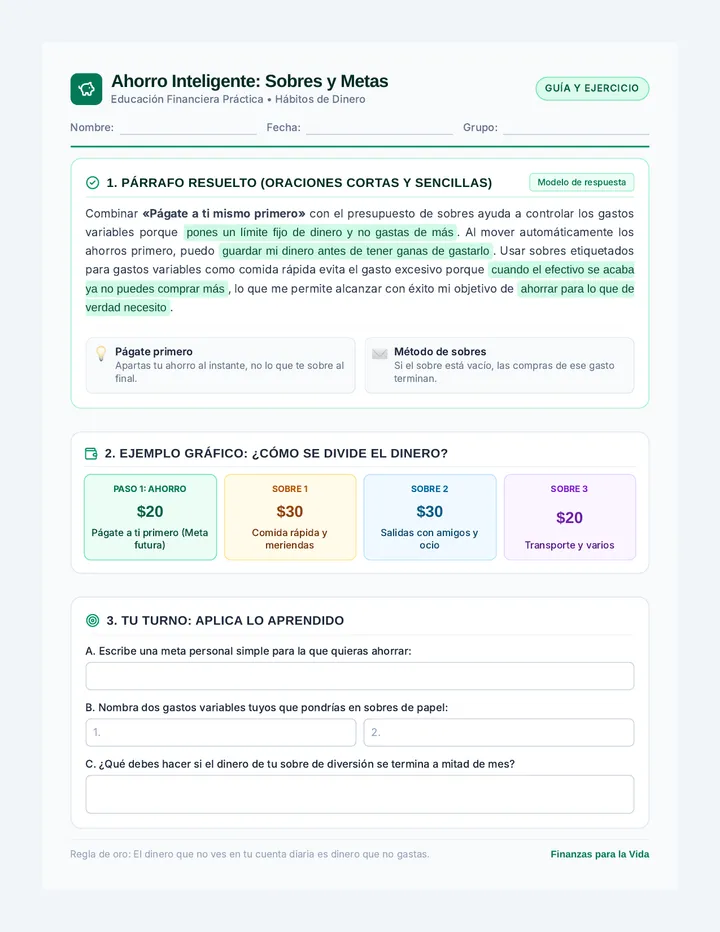
PFL Spanish Review Packet Paquete de Repaso Final de PFL
Nombre: Período:
Instrucciones: Revisa cada Repaso Rápido y Ejemplo Resuelto , luego responde las preguntas de Tu Turno usando únicamente la información proporcionada.
Tema 1: Conceptos Básicos del Dinero y Presupuesto
Repaso Rápido
Las necesidades son esenciales para sobrevivir (comida básica, vivienda, servicios públicos). Los deseos son extras no esenciales (servicios de streaming, salir a cenar). Un presupuesto prioriza pagar primero las necesidades esenciales. Cuando los ingresos superan los gastos, hay un superávit ; cuando los gastos superan los ingresos, hay un déficit . Patrimonio Neto = Activos Totales (lo que posees con valor) − Pasivos Totales (deudas que debes).
Ejemplos Resueltos
Superávit: Ingresos $1,350 − Gastos $1,100 = $250 de superávit .
Patrimonio Neto: Ahorros $800 + Auto $3,200 = Activos $4,000. Deuda de tarjeta $1,000 = Pasivo $1,000. Patrimonio Neto = $4,000 − $1,000 = $3,000 .
1. Necesidades vs. Deseos: Clasifica cada artículo como Necesidad (N) o Deseo (D) :
____ Factura mensual de electricidad ____ Teléfono inteligente de última generación
2. Prioridades del Presupuesto: Marcus recibe su pago el viernes. ¿Qué gasto debe pagar primero?
A. Boletos para un concierto antes de que se agoten B. Alquiler del apartamento y servicios públicos esenciales
3. Superávit y Déficit: El ingreso mensual de Sofia es $1,400. Sus gastos totales son $1,550.
Saldo Neto: $________ Resultado: [ ] Superávit [ ] Déficit
4. Patrimonio Neto: Jamir tiene una motocicleta de $4,500 y $1,500 en ahorros. Debe $2,000 de un préstamo personal.
Activos Totales: $________ Pasivos Totales: $________ Patrimonio Neto: $________
Tema 2: Banca, Ahorro y Seguros (Parte 1: Cuentas Bancarias)
Repaso Rápido
Las cuentas de cheques gestionan transacciones diarias, pago de facturas y compras con tarjeta de débito. Las cuentas de ahorros guardan fondos para metas futuras y emergencias, generalmente ganando intereses. Una tarjeta de débito deduce dinero directamente de cheques. Si tu saldo es insuficiente y no hay sobregiro, el banco rechaza la transacción.
Ejemplo Resuelto
Priya tiene $35 en su cuenta de cheques e intenta pagar $50 con su tarjeta de débito. Como la tarjeta gasta directamente de la cuenta de cheques y no tiene cobertura de sobregiro, su compra es rechazada de inmediato .
5. Cuentas de Cheques vs. Ahorros: Une cada término con su descripción correcta:
A. Usada para gastos cotidianos, compras con débito y pago de facturas.
B. Usada para guardar ahorros para necesidades futuras y ganar intereses.
Cuenta de Cheques:
Cuenta de Ahorros:
6. Tarjetas de Débito y Saldos:
Tyler tiene $22 en su cuenta de cheques. Intenta pagar $40 de gasolina con su tarjeta de débito. Su banco no permite sobregiros. ¿Qué ocurre y por qué?
Tema 2: Banca, Ahorro y Seguros (Parte 2: Seguros)
Repaso Rápido
Una prima de seguro es el pago periódico regular para mantener activa la cobertura. Un deducible es la cantidad que pagas de tu bolsillo antes de que el seguro comience a pagar un reclamo cubierto. Un deducible más alto generalmente resulta en una prima más baja , con la desventaja de pagar más de tu bolsillo si ocurre un siniestro.
Ejemplo Resuelto
David tiene seguro de auto con un deducible de $500. Tras un choque con daños de $2,400, David paga su deducible de $500 y su aseguradora paga los $1,900 restantes ($2,400 − $500). Al elegir un deducible de $500 en lugar de $200, su prima mensual es más baja.
7. Deducible de Seguro: Elena tiene una póliza con deducible de $700. Un siniestro cubierto cuesta $2,500.
Elena paga de su bolsillo: $________ La aseguradora paga: $________
8. Compensación entre Deducible y Prima: ¿Por qué elegiría un consumidor un deducible más alto?
A. Para reducir el costo de la prima mensual regular B. Para evitar pagar de su bolsillo en un reclamo por accidente
Tema 3: Cheques de Pago, Empleo y Decisiones de Compra
Repaso Rápido
El Salario Bruto son los ingresos totales antes de impuestos y deducciones; el Salario Neto es lo que te llevas a casa tras los descuentos. Los nuevos empleados llenan un W-4 para la retención de impuestos; el empleador entrega un W-2 en enero con ingresos anuales e impuestos retenidos. El alquiler con opción a compra ofrece pagos semanales pequeños pero suele costar mucho más que pagar en efectivo. Arrendar un auto (lease) ofrece pagos mensuales menores pero tiene límites de millaje y no genera capital propio. Construir crédito requiere pagar a tiempo; sobregirar tarjetas daña tu puntaje.
Ejemplos Resueltos
Salario: Ingreso bruto $550 − Deducciones $90 = Salario neto $460 .
Alquiler con Compra: $20/sem × 45 sem = Costo total de $900 por un artículo de $550 ($350 pagados de más).
Crédito: Pagar el mínimo a tiempo cuida tu historial, pero tener balances altos perjudica tu uso de crédito.
9. Salario Bruto y Neto: Kayla gana $620 brutos en su cheque quincenal. Los impuestos y deducciones suman $115.
Salario Neto de Kayla (para llevar a casa): $________
10. W-4 vs. W-2: Completa la oración escribiendo W-4 o W-2:
Un empleado recién contratado llena el Formulario ________ para configurar la retención de impuestos, mientras que el Formulario ________ llega al final del año resumiendo los salarios anuales y los impuestos retenidos.
11. Alquiler con Opción a Compra: Una computadora cuesta $480 al contado, o $16 semanales por 40 semanas.
Costo Total en Alquiler con Compra: $________ Costo Adicional Pagado: $________
12. Arrendar vs. Comprar un Auto: ¿Cuál es una desventaja financiera principal de arrendar (lease) un auto?
A. Los pagos mensuales de arrendamiento son siempre el doble de comprar B. No acumulas valor patrimonial (equity) de propiedad en el vehículo
13. Construir Crédito: ¿Qué hábito ayuda más a construir y mantener un puntaje de crédito sólido?
A. Realizar pagos puntuales en todos los préstamos y tarjetas de crédito B. Usar el límite máximo de las tarjetas y abrir varias cuentas a la vez
Tema 4: Crédito, Deuda y Protección al Consumidor
Repaso Rápido
Los informes de crédito registran el historial de préstamos y pagos. Si ves una deuda desconocida o un error, investiga y presenta una disputa ante la agencia de crédito. Los préstamos de día de pago son préstamos a corto plazo con tarifas e intereses altísimos. Las estafas de phishing engañan pidiéndote contraseñas o PINs; no uses enlaces sospechosos. El seguro FDIC protege depósitos elegibles hasta $250,000 si un banco quiebra, pero no cubre caídas en acciones.
Ejemplos Resueltos
Disputa: Nora nota una tarjeta fraudulenta de $1,400 en su informe. Presenta una disputa formal ante la agencia de crédito para que se investigue.
Defensa contra Estafas: Un SMS dice: "¡Tarjeta bloqueada! Ingresa tu PIN aquí." Sam ignora el enlace y llama al número oficial que figura detrás de su tarjeta.
14. Errores en el Informe de Crédito: ¿Qué debes hacer primero al descubrir una deuda desconocida en tu informe?
A. Presentar una disputa formal ante la agencia de informes de crédito B. Pagar la deuda de cobro para evitar que te sigan llamando
15. Préstamos de Día de Pago:
¿Por qué los expertos en finanzas aconsejan evitar los préstamos de día de pago a corto plazo?
16. Phishing y Estafas: Recibes un mensaje de texto inesperado pidiendo el PIN de tu tarjeta. ¿Qué debes hacer?
A. Responder al mensaje enviando los datos de tu cuenta B. No hacer clic; llamar al número verificado impreso en tu tarjeta
17. Seguro FDIC: Marca Verdadero (V) o Falso (F) para cada afirmación:
[ V / F ] El seguro FDIC protege los depósitos de cheques y ahorros si un banco asegurado quiebra.
[ V / F ] El seguro FDIC cubre pérdidas monetarias si las acciones bajan de valor en el mercado bursátil.
Tema 5: Inversiones y Jubilación (Parte 1: Principios Clave)
Repaso Rápido
Los ahorros bancarios son seguros, accesibles e ideales para metas a corto plazo, pero ganan poco rendimiento. Invertir en acciones ofrece mayor crecimiento a largo plazo para superar la inflación, pero conlleva el riesgo de perder dinero. La diversificación consiste en distribuir inversiones en varias empresas y tipos de activos en lugar de depender de una sola acción, reduciendo el riesgo.
Ejemplo Resuelto
Mateo invierte $1,000. Si compra acciones de una sola tienda y esta quiebra, podría perder todo. Distribuir su dinero entre muchas empresas reduce el riesgo de depender del éxito de una sola compañía.
18. Ahorrar vs. Invertir: ¿Qué estrategia es más adecuada para acumular riqueza de jubilación durante más de 25 años?
A. Mantener efectivo en una cuenta de ahorros bancaria tradicional B. Invertir en una cartera diversificada de fondos indexados de acciones
19. Diversificación:
Explica en una oración cómo distribuir el capital de inversión entre varias empresas protege a un inversionista:
Tema 5: Inversiones y Jubilación (Parte 2: Crecimiento y Aporte del Empleador)
Repaso Rápido
El interés simple se gana solo sobre el capital inicial depositado. El interés compuesto se gana sobre el capital inicial y los intereses acumulados previamente, acelerando el crecimiento. La contribución compartida al 401(k) ocurre cuando un empleador añade dinero extra a tu cuenta de retiro según tus aportes.
Ejemplos Resueltos
Interés: $1,000 al 5% simple = $50/año. Al 5% compuesto: Año 1 gana $50 ($1,050 total); Año 2 gana 5% de $1,050 = $52.50 .
Aporte 401(k): Empleado aporta $150. Empleador aporta 100% ($150). Total mensual = $300 para el retiro.
20. Interés Simple vs. Compuesto: ¿Qué tipo de interés genera un crecimiento más rápido con el paso del tiempo?
Interés Simple Interés Compuesto
21. Aporte del Empleador al 401(k): Lucas gana $2,500/mes y aporta $125 a su 401(k). Su empleador iguala el 100% hasta $125.
Aporte de Lucas: $________ Aporte Empleador: $________ Total Agregado al 401(k): $________
Tema 6: Universidad y Ayuda Financiera
Repaso Rápido
Las subvenciones (grants) (como la Beca Pell Federal) y las becas (scholarships) son ayuda financiera que generalmente no se tiene que devolver. En cambio, los préstamos estudiantiles son dinero prestado que se debe devolver con intereses.
Ejemplo Resuelto
La matrícula de Ava es $7,000. Recibe una Beca Pell de $2,500, una beca privada de $1,500 y un préstamo federal de $3,000. Únicamente el préstamo de $3,000 debe ser pagado tras graduarse.
22. Subvenciones, Becas y Préstamos: Clasifica cada fuente como Ayuda de Regalo (No se devuelve) o Préstamo (Se devuelve):
a. Beca Pell Federal: ________________________________________________
b. Préstamo Estudiantil Federal Subsidiado: __________________________
Tema 7: Pensando en tu Futuro Financiero
Repaso Rápido: Hábitos Diarios y Cuentas de Ahorro
Los buenos hábitos financieros incluyen controlar el flujo de dinero con un presupuesto, pagar primero las cuentas esenciales, tener un fondo de emergencia y evitar deudas de alto interés. Para ahorrar: una cuenta de ahorros regular mantiene el dinero disponible; una Cuenta de Ahorros de Alto Rendimiento (HYSA) gana más interés; un 401(k) permite invertir para el retiro con el empleador; y una Roth IRA permite inversiones con retiros calificados libres de impuestos.
23. Decisiones Financieras Cotidianas: Identifica dos hábitos prácticos que evitan el estrés financiero personal:
Hábito 1: _________________________________________
Hábito 2: _________________________________________
24. Formas de Ahorrar e Invertir: Une cada cuenta con su característica principal:
A. Ahorros bancarios con alto interés y dinero accesible para emergencias.
B. Cuenta de jubilación patrocinada por el empleador, a menudo con aporte compartido.
C. Cuenta de jubilación individual con retiros calificados libres de impuestos.
HYSA:
401(k):
Roth IRA:
25. Reflexión Financiera Personal (Preparación para el Examen Final):
Pensando en tus metas después de la preparatoria (high school), identifica un hábito o cuenta financiera realista que planeas establecer (p. ej., fondo de emergencia en HYSA, historial con pagos puntuales o aporte a cuenta de retiro). Explica en 1–2 oraciones por qué te ayudará:
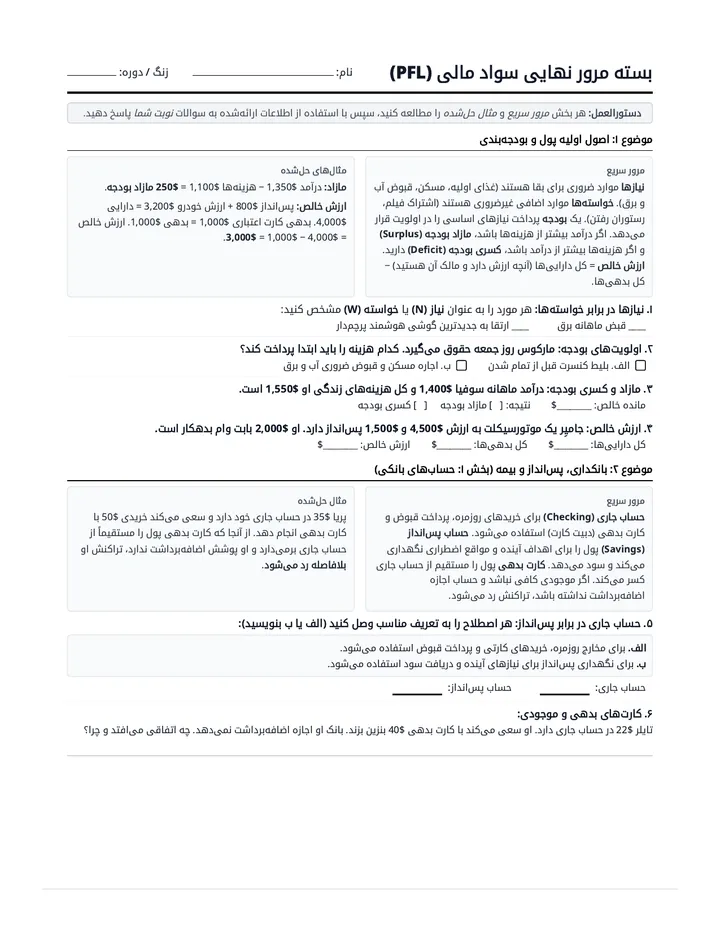
PFL Farsi Review Packet بسته مرور نهایی سواد مالی (PFL)
نام: زنگ / دوره:
دستورالعمل: هر بخش مرور سریع و مثال حلشده را مطالعه کنید، سپس با استفاده از اطلاعات ارائهشده به سوالات نوبت شما پاسخ دهید.
موضوع ۱: اصول اولیه پول و بودجهبندی
مرور سریع
نیازها موارد ضروری برای بقا هستند (غذای اولیه، مسکن، قبوض آب و برق). خواستهها موارد اضافی غیرضروری هستند (اشتراک فیلم، رستوران رفتن). یک بودجه پرداخت نیازهای اساسی را در اولویت قرار میدهد. اگر درآمد بیشتر از هزینهها باشد، مازاد بودجه (Surplus) و اگر هزینهها بیشتر از درآمد باشد، کسری بودجه (Deficit) دارید. ارزش خالص = کل داراییها (آنچه ارزش دارد و مالک آن هستید) − کل بدهیها.
مثالهای حلشده
مازاد: درآمد $1,350 − هزینهها $1,100 = $250 مازاد بودجه .
ارزش خالص: پسانداز $800 + ارزش خودرو $3,200 = دارایی $4,000. بدهی کارت اعتباری $1,000 = بدهی $1,000. ارزش خالص = $4,000 − $1,000 = $3,000 .
۱. نیازها در برابر خواستهها: هر مورد را به عنوان نیاز (N) یا خواسته (W) مشخص کنید:
____ قبض ماهانه برق ____ ارتقا به جدیدترین گوشی هوشمند پرچمدار
۲. اولویتهای بودجه: مارکوس روز جمعه حقوق میگیرد. کدام هزینه را باید ابتدا پرداخت کند؟
الف. بلیط کنسرت قبل از تمام شدن ب. اجاره مسکن و قبوض ضروری آب و برق
۳. مازاد و کسری بودجه: درآمد ماهانه سوفیا $1,400 و کل هزینههای زندگی او $1,550 است.
مانده خالص: ________$ نتیجه: [ ] مازاد بودجه [ ] کسری بودجه
۴. ارزش خالص: جامیِر یک موتورسیکلت به ارزش $4,500 و $1,500 پسانداز دارد. او $2,000 بابت وام بدهکار است.
کل داراییها: ________$ کل بدهیها: ________$ ارزش خالص: ________$
موضوع ۲: بانکداری، پسانداز و بیمه (بخش ۱: حسابهای بانکی)
مرور سریع
حساب جاری (Checking) برای خریدهای روزمره، پرداخت قبوض و کارت بدهی (دبیت کارت) استفاده میشود. حساب پسانداز (Savings) پول را برای اهداف آینده و مواقع اضطراری نگهداری میکند و سود میدهد. کارت بدهی پول را مستقیم از حساب جاری کسر میکند. اگر موجودی کافی نباشد و حساب اجازه اضافهبرداشت نداشته باشد، تراکنش رد میشود.
مثال حلشده
پریا $35 در حساب جاری خود دارد و سعی میکند خریدی $50 با کارت بدهی انجام دهد. از آنجا که کارت بدهی پول را مستقیماً از حساب جاری برمیدارد و او پوشش اضافهبرداشت ندارد، تراکنش او بلافاصله رد میشود .
۵. حساب جاری در برابر پسانداز: هر اصطلاح را به تعریف مناسب وصل کنید (الف یا ب بنویسید):
الف. برای مخارج روزمره، خریدهای کارتی و پرداخت قبوض استفاده میشود.
ب. برای نگهداری پسانداز برای نیازهای آینده و دریافت سود استفاده میشود.
حساب جاری:
حساب پسانداز:
۶. کارتهای بدهی و موجودی:
تایلر $22 در حساب جاری دارد. او سعی میکند با کارت بدهی $40 بنزین بزند. بانک او اجازه اضافهبرداشت نمیدهد. چه اتفاقی میافتد و چرا؟
موضوع ۲: بانکداری، پسانداز و بیمه (بخش ۲: بیمه)
مرور سریع
حق بیمه (Premium) مبلغ منظمی است که برای حفظ پوشش بیمه پرداخت میکنید. فرانشیز (Deductible) مبلغی است که قبل از اینکه بیمه خسارت را بپردازد، شما باید از جیب خود پرداخت کنید. فرانشیز بالاتر به طور کلی به معنی حق بیمه کمتر است، اما در صورت بروز حادثه باید مبلغ بیشتری از جیب بپردازید.
مثال حلشده
دیوید بیمه خودرو با فرانشیز $500 دارد. پس از یک تصادف با خسارت $2,400، دیوید فرانشیز $500 را میپردازد و شرکت بیمه مابقی $1,900 را پرداخت میکند ($2,400 − $500). با انتخاب فرانشیز $500 به جای $200، حق بیمه ماهانه او ارزانتر است.
۷. فرانشیز بیمه: النا بیمهنامهای با فرانشیز $700 دارد. خسارت تحت پوشش $2,500 است.
مبلغ پرداختی النا از جیب: ________$ مبلغ پرداختی شرکت بیمه: ________$
۸. موازنه فرانشیز و حق بیمه: چرا یک خریدار ممکن است فرانشیز بالاتری را انتخاب کند؟
الف. برای کاهش هزینه حق بیمه ماهانه و منظم ب. برای جلوگیری از پرداخت هزینه از جیب در زمان خسارت
موضوع ۳: فیش حقوقی، اشتغال و تصمیمات خرید
مرور سریع
حقوق ناخالص (Gross Pay) کل درآمد قبل از کسر مالیات است؛ حقوق خالص (Net Pay) دریافتی واقعی بعد از کسورات است. کارمندان جدید فرم W-4 را برای تعیین کسورات مالیات پر میکنند؛ کارفرما در ژانویه فرم W-2 را ارسال میکند که کل دستمزد سالانه و مالیات را نشان میدهد. اجاره به شرط تملیک (Rent-to-own) اقساط هفتگی کوچک دارد اما هزینه کل آن بسیار بیشتر از خرید نقدی است. لیزینگ خودرو اقساط ماهانه کمتری دارد اما محدودیت مسافت داشته و مالکیتی ایجاد نمیکند. ساختن اعتبار نیازمند پرداخت سر وقت است.
مثالهای حلشده
حقوق: درآمد ناخالص $550 − کسورات $90 = حقوق خالص $460 .
اجاره به شرط تملیک: $20 در هفته × 45 هفته = مجموع $900 برای کالایی با قیمت نقدی $550 ($350 پرداخت اضافی).
اعتبار: پرداخت به موقع بدهیها نمره اعتبار را بالا نگه میدارد، اما پر کردن سقف کارت به اعتبار آسیب میزند.
۹. حقوق ناخالص و خالص: کایلا در فیش حقوقی دوهفتهای خود $620 درآمد ناخالص دارد. مالیات و کسورات $115 است.
حقوق خالص (دریافتی به خانه) کایلا: ________$
۱۰. فرم W-4 در برابر W-2: جمله را با نوشتن W-4 یا W-2 کامل کنید:
یک کارمند تازهاستخدامشده فرم ________ را برای تعیین کسورات مالیات بر درآمد پر میکند، در حالی که فرم ________ در پایان سال ارسال شده و کل دستمزد سالانه و مالیات کسرشده را نشان میدهد.
۱۱. اجاره به شرط تملیک: یک لپتاپ به صورت نقدی $480 قیمت دارد یا با شرایط $16 در هفته به مدت 40 هفته عرضه میشود.
کل هزینه در حالت اجاره به شرط تملیک: ________$ هزینه اضافی پرداختشده نسبت به قیمت نقد: ________$
۱۲. لیزینگ در برابر خرید خودرو: عیب اصلی مالی لیزینگ (اجاره بلندمدت) خودرو چیست؟
الف. اقساط ماهانه لیزینگ همیشه دو برابر خرید نقدی است ب. شما هیچ سهم مالکیت یا دارایی مالی در خودرو به دست نمیآورید
۱۳. ایجاد اعتبار: کدام عادت به مؤثرترین شکل باعث ایجاد و حفظ یک نمره اعتباری قوی میشود؟
الف. پرداخت سر وقت تمام اقساط وام و صورتحسابهای کارت اعتباری ب. پر کردن کامل سقف کارتهای اعتباری و باز کردن حسابهای زیاد
موضوع ۴: اعتبار، بدهی و حمایت از مصرفکننده
مرور سریع
گزارشهای اعتباری سابقه وامگیری و بازپرداخت شما را نشان میدهند. اگر بدهی ناشناخته یا خطایی دیدید، آن را با آژانس اعتباری پیگیری و اعتراض (Dispute) کنید. وامهای روز پرداخت (Payday loans) وامهای کوتاهمدت با کارمزد و بهره بسیار بالا هستند. کلاهبرداری فیشینگ سعی در سرقت رمزها دارد؛ روی لینکهای ناشناس کلیک نکنید. بیمه FDIC سپردههای بانکی را تا $250,000 بیمه میکند، اما ضرر بازار بورس را پوشش نمیدهد.
مثالهای حلشده
اعتراض: نورا متوجه یک بدهی جعلی $1,400 در گزارش خود میشود. او بلافاصله اعتراض رسمی به آژانس گزارش اعتبار ثبت میکند.
دفاع در برابر کلاهبرداری: پیامی میگوید: "کارت شما قفل شد! رمز را اینجا وارد کنید." سم لینک را باز نکرده و به شماره رسمی پشت کارت زنگ میزند.
۱۴. خطاهای گزارش اعتبار: در صورت مشاهده یک بدهی ناآشنا در گزارش اعتباری خود، اولین اقدام درست چیست؟
الف. ثبت اعتراض رسمی (Dispute) در آژانس گزارش اعتبار ب. پرداخت بدهی برای جلوگیری از تماسهای شرکت وصول بدهی
۱۵. وامهای روز پرداخت (Payday Loans):
چرا کارشناسان امور مالی توصیه میکنند از وامهای کوتاهمدت روز پرداخت اجتناب کنید؟
۱۶. فیشینگ و کلاهبرداری: پیامک غیرمنتظرهای دریافت میکنید که رمز کارت شما را میخواهد. چه باید کرد؟
الف. پاسخ به پیامک و ارسال اطلاعات حساب بانکی ب. کلیک نکردن روی لینک و تماس با شماره تأییدشده پشت کارت
۱۷. بیمه FDIC: برای هر عبارت درست (T) یا نادرست (F) را علامت بزنید:
[ T / F ] بیمه FDIC در صورت ورشکستگی بانک، از سپردههای جاری و پسانداز محافظت میکند.
[ T / F ] بیمه FDIC خسارتهای مالی ناشی از افت قیمت سهام در بازار بورس را پوشش میدهد.
موضوع ۵: سرمایهگذاری و بازنشستگی (بخش ۱: اصول کلیدی)
مرور سریع
پسانداز بانکی امن و در دسترس است و برای اهداف کوتاهمدت مناسب است، اما بازدهی کمی دارد. سرمایهگذاری در بورس پتانسیل رشد بالاتری برای غلبه بر تورم دارد اما با خطر از دست رفتن پول همراه است. تنوعبخشی (Diversification) یعنی پخش کردن سرمایه در شرکتها و داراییهای گوناگون تا ریسک وابستگی به یک شرکت کم شود.
مثال حلشده
متئو $1,000 سرمایهگذاری میکند. اگر او سهام تنها یک فروشگاه را بخرد و آن ورشکست شود، ممکن است همهچیز را از دست بدهد. پخش کردن پول بین چندین شرکت، خطر وابستگی به موفقیت تنها یک شرکت را کاهش میدهد.
۱۸. پسانداز در برابر سرمایهگذاری: کدام استراتژی برای ایجاد ثروت بازنشستگی در طول بیش از ۲۵ سال مناسبتر است؟
الف. نگهداری پول نقد در حساب پسانداز معمولی بانکی ب. سرمایهگذاری در سبد متنوعی از صندوقهای شاخص سهام
۱۹. تنوعبخشی (Diversification):
در یک جمله توضیح دهید چگونه پخش کردن سرمایه بین شرکتهای مختلف از سرمایهگذار محافظت میکند:
موضوع ۵: سرمایهگذاری و بازنشستگی (بخش ۲: رشد و سهم تطبیقی کارفرما)
مرور سریع
سود ساده فقط به اصل پول سپرده تعلق میگیرد. سود مرکب هم به اصل پول و هم به سودهای قبلی انباشته تعلق میگیرد و رشد پول را شتاب میدهد. سهم تطبیقی کارفرما در 401(k) زمانی است که کارفرما متناسب با واریزی شما، پول اضافی به حساب بازنشستگی شما واریز میکند.
مثالهای حلشده
سود: $1,000 با سود ساده ۵٪ = $50 در سال. با سود مرکب ۵٪: سال اول $50 ($1,050 مجموع)؛ سال دوم ۵٪ از $1,050 = $52.50 .
سهم کارفرما: کارمند $150 میگذارد. کارفرما ۱۰۰٪ تطبیق میدهد ($150). مجموع ماهانه = $300 در بازنشستگی.
۲۰. سود ساده در برابر سود مرکب: کدام نوع سود با گذشت زمان سریعتر رشد میکند؟
سود ساده سود مرکب
۲۱. سهم تطبیقی کارفرما در 401(k): لوکاس ماهانه $2,500 درآمد دارد و $125 به 401(k) خود واریز میکند. کارفرما ۱۰۰٪ تا سقف $125 را تطبیق میدهد.
سهم واریزی لوکاس: ________$ سهم تطبیقی کارفرما: ________$ کل مبلغ افزوده به 401(k): ________$
موضوع ۶: کالج و کمکهای مالی
مرور سریع
کمکهزینهها (گرنت) مانند گرنت پِل فدرال و بورسیهها (Scholarships) کمکهای بلاعوض هستند که معمولاً نیازی به بازپرداخت ندارند. در مقابل، وامهای دانشجویی پول قرضی هستند که باید همراه با سود برگردانده شوند.
مثال حلشده
شهریه دانشگاه اِیوا $7,000 است. او یک گرنت پِل $2,500، یک بورسیه خصوصی $1,500 و یک وام دانشجویی فدرال $3,000 دریافت میکند. تنها وام $3,000 باید پس از فارغالتحصیلی بازپرداخت شود.
۲۲. گرنتها، بورسیهها و وامها: هر منبع مالی را به عنوان کمک بلاعوض (بدون بازپرداخت) یا وام (نیازمند بازپرداخت) دستهبندی کنید:
الف. گرنت پِل فدرال (Pell Grant): ____________________________________
ب. وام دانشجویی یارانهای فدرال: ___________________________________
موضوع ۷: تفکر درباره آینده مالی شما
مرور سریع: عادتهای روزمره و انواع حسابهای پسانداز
عادتهای مالی مناسب شامل مدیریت جریان پول با بودجه، پرداخت اولویتدار قبوض اساسی، داشتن پسانداز اضطراری و دوری از بدهیهای با بهره سنگین است. برای پسانداز: یک حساب پسانداز معمولی پول را در دسترس نگه میدارد؛ یک حساب پسانداز با سود بالا (HYSA) سود بیشتری میدهد؛ یک 401(k) امکان سرمایهگذاری بازنشستگی از طریق کارفرما را فراهم میکند؛ و یک Roth IRA حساب بازنشستگی با برداشتهای معاف از مالیات است.
۲۳. تصمیمات مالی روزمره: دو عادت عملی را نام ببرید که از فشارهای مالی شخصی جلوگیری میکنند:
عادت ۱: _________________________________________
عادت ۲: _________________________________________
۲۴. روشهای پسانداز و سرمایهگذاری: هر حساب را به ویژگی اصلی آن متصل کنید:
الف. حساب بانکی با سود بالاتر و پول نقد در دسترس برای مواقع اضطراری.
ب. حساب بازنشستگی تحت حمایت کارفرما که اغلب دارای سهم تطبیقی است.
ج. حساب بازنشستگی فردی با امکان برداشتهای معاف از مالیات در دوران بازنشستگی.
HYSA:
401(k):
Roth IRA:
۲۵. تأمل مالی شخصی (آمادگی برای آزمون نهایی):
با فکر کردن به اهداف خود پس از دوران دبیرستان، یک عادت مالی یا حساب کاربردی واقعبینانه را که قصد دارید ایجاد کنید نام ببرید (مانند پسانداز اضطراری در HYSA، خوشحسابی و پرداخت سر وقت اقساط یا واریز به حساب بازنشستگی). در ۱ تا ۲ جمله توضیح دهید چرا این انتخاب به ثبات مالی شما کمک میکند: