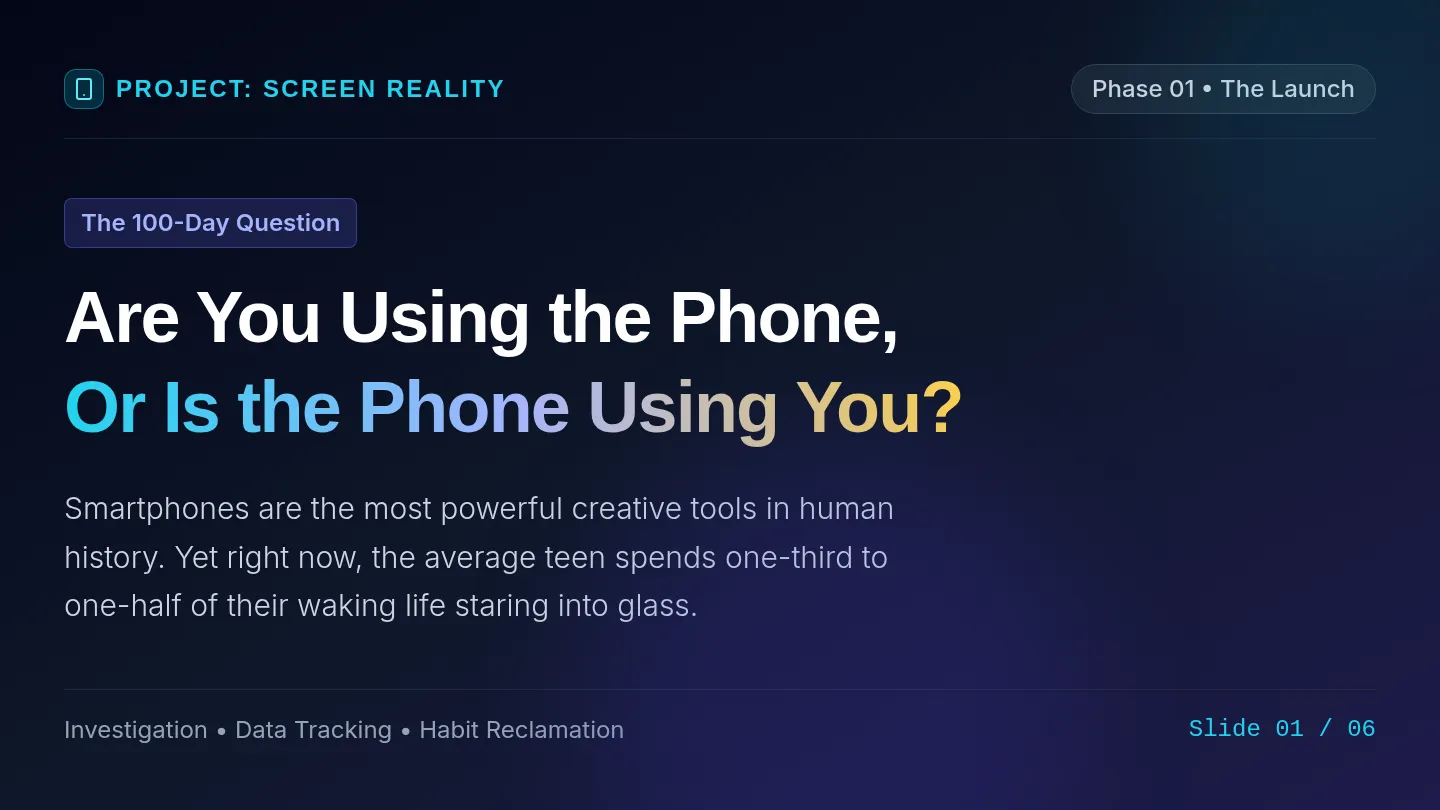
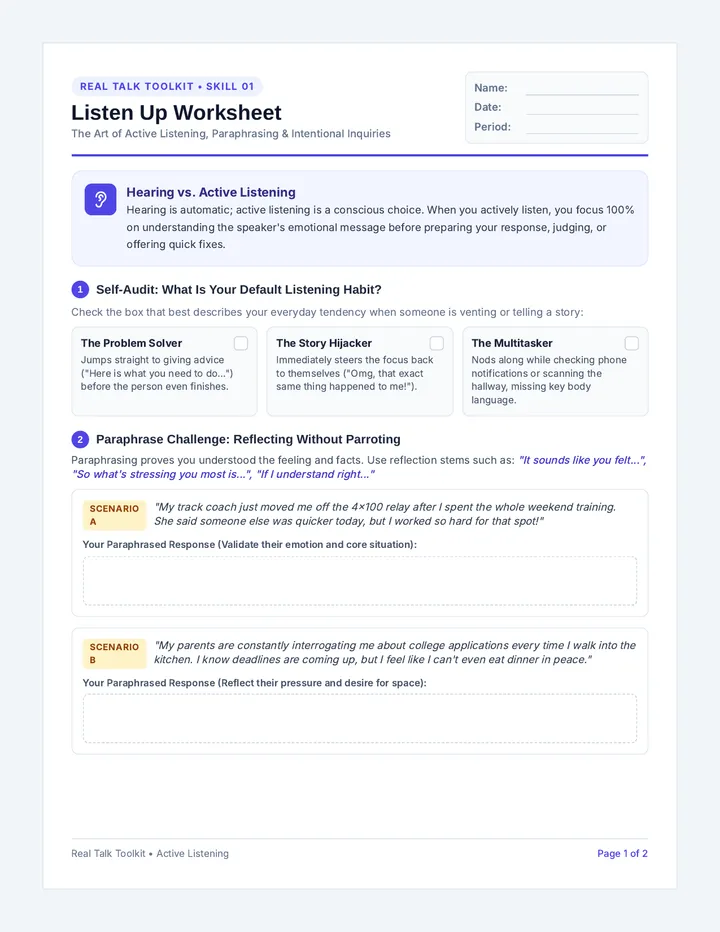
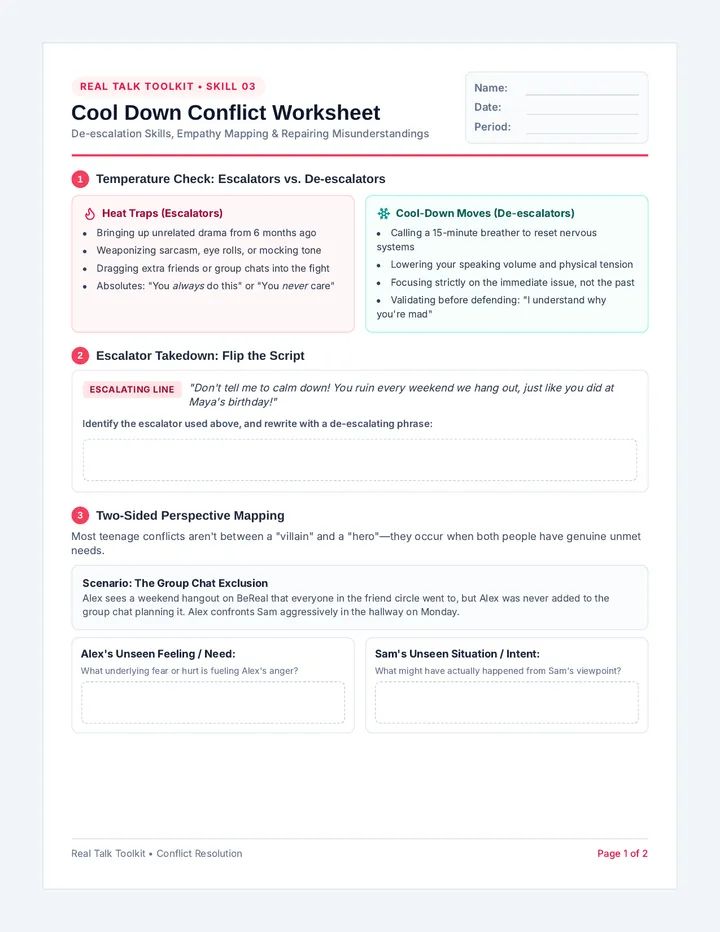
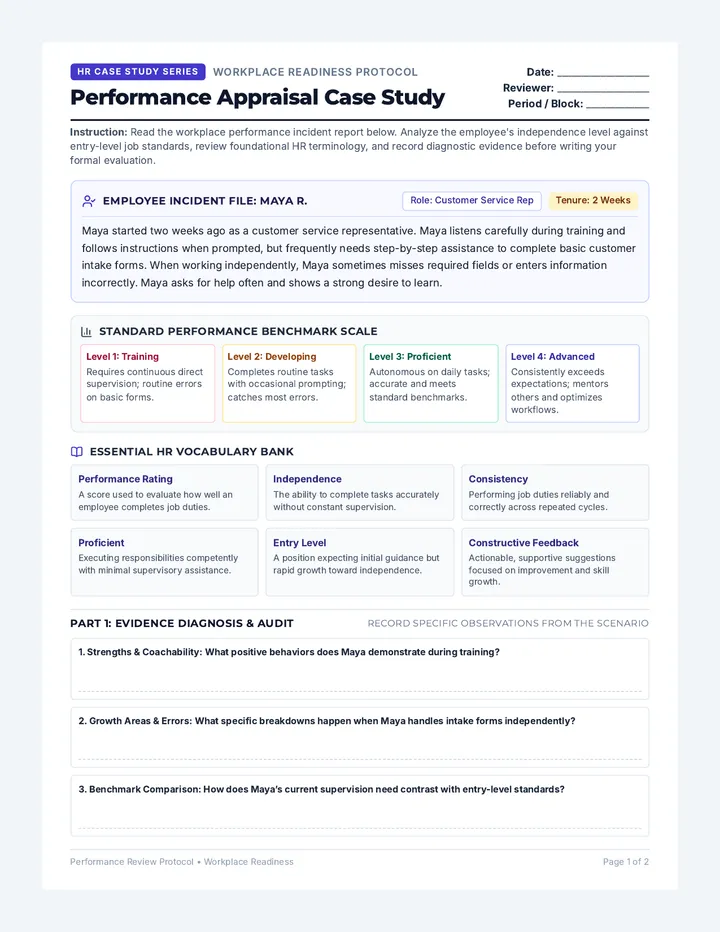
Perspective Shift Slides Perspective Shift
Walking in
Their Shoes
Understanding different viewpoints without losing your own.
What do you see?
Take 10 seconds. Look closely at the image. What is the very first thing that pops out to you?
"We don't see things as they are, we see them as we are."
IMAGE PLACEHOLDER
(Teacher: Show the Duck/Rabbit or Young/Old Woman illusion here)
What is Perspective?
The Lens
The unique way you view a situation based on your experiences.
The Standpoint
Where you are physically and emotionally in a situation.
The Values
The core beliefs that shape how you judge what you see.
Why does it matter?
Better Decisions
You act on the full picture, not just one small corner of it.
Fewer Fights
Understanding "why" someone did something lowers the temperature.
Stronger Vibe
People feel heard, which builds massive respect and trust.
The Big Misconception
Understanding someone else's perspective does not mean you have to agree with them.
Empathy ≠ Agreement
Perspective Power Move
1
STOP
Recognize when you're having an emotional reaction.
2
LOOK
Identify three things that might be influencing their "lens."
3
ASK
Ask a clarifying question instead of making an assumption.
Let's Practice
"Your best friend starts ignoring your texts and posting photos hanging out with someone they know you don't like."
Automatic Reaction
"They're fake and trying to make me mad."
Perspective Shift
What are 2 other possibilities for why this is happening?
Your Turn
Grab your "Viewpoint Vibe Check" sheet. We're going to dive into some real-world situations.
Time to Shift Gears
Viewpoint Vibe Check Worksheet Viewpoint Vibe Check
Perspective-Taking Practice for 9th Grade
Name:
Date:
1
The Anatomy of a Lens
A perspective isn't just "an opinion." It's built from different pieces. Match the term to its meaning below.
A. The Experience
B. The Standpoint
C. The Values
Where you are physically and emotionally in the moment.
Your history, background, and things you've lived through.
Your core beliefs about what is right, wrong, or important.
2
Scenario Practice: The Shift
For each scenario, identify the "Automatic Reaction" (the first, often emotional thought) and then perform a "Perspective Shift" by listing two other possible explanations for what happened.
SCENARIO 1: You see a group of friends laughing and looking at their phones as you walk by. You feel like they're laughing at you.
Automatic Reaction
Perspective Shift (2 Possibilities)
SCENARIO 2: Your teacher gives you a much lower grade on an essay than you expected, with very few comments on why.
Automatic Reaction
Perspective Shift (2 Possibilities)
SCENARIO 3: A parent or guardian snaps at you to "clean up your room" the second you walk through the door after a long day.
Automatic Reaction
Perspective Shift (2 Possibilities)
3
Personal Vibe Check
Think of a small conflict or "weird vibe" you've had recently with someone. Apply the Perspective Power Move below.
The Situation: (Briefly, what happened?)
My "Lens" right then:
How were you feeling? What were you focused on?
Their possible "Lens":
What might have been going on in their day or world?
The "Ask":
Write one clarifying question you could ask this person instead of assuming they were being difficult.
Perspective Shift Facilitation Guide Teacher Resource
Perspective Shift
Facilitation Guide • Grade 9 • 45 Minutes
Theme
The Social Lens
Lesson Objective
Students will define "perspective" through the lens of individual experiences and values, practice the 3-step inquiry strategy to analyze social conflicts, and demonstrate the ability to identify multiple interpretations of a single event.
Materials Needed
Perspective Shift Slide Deck
Viewpoint Vibe Check Worksheet (1 per student)
Optional: Optical illusion images (Duck/Rabbit, etc.)
Key Concepts
Cognitive Flexibility: Switching between different viewpoints.
Cognitive Empathy: Understanding "why" without needing to agree.
Validation: Acknowledging a perspective as real to the person holding it.
Lesson Pacing
0-5 MIN
The Hook: What Do You See?
Display Slide 2. Use an optical illusion to show that two people can look at the exact same data and see different things. Neither is "wrong," but their brain has prioritized different features.
"If we can disagree on a simple picture, imagine how much we can disagree on complex human emotions."
5-15 MIN
Core Concepts: The Lens
Slides 3-5. Break down the components of perspective: Experience, Standpoint, and Values. Crucial Point: Empathy ≠ Agreement. You are training them to be "detectives," not pushovers.
Discussion Prompt:
"Does knowing why someone did something bad make it okay? Why or why not?" (Answer: No, but it makes the problem solvable.)
15-25 MIN
The Strategy & Practice
Slide 6-7. Introduce the STOP-LOOK-ASK strategy. Model the practice scenario on Slide 7. Solicit 3-4 different "possibilities" from the class before revealing any.
Pro-Tip: Push for "charitable" interpretations (giving people the benefit of the doubt).
25-45 MIN
Worksheet & Wrap-up
Students complete the "Viewpoint Vibe Check." Encourage them to work in pairs for Part 2 to brainstorm diverse possibilities. Monitor the room during Part 3 (Personal Vibe Check).
Closing:
Slide 8. Remind them that perspective is a skill, not a personality trait. They have to choose to use it.
Facilitation Mastery
Potential Pitfalls
The "But They're Wrong" Trap
Students may get stuck on the factual "rightness" of a situation. Redirect them to how the other person *feels* and *why* they might feel that way, regardless of the facts.
Viewpoint Vibe Check Answer Key Vibe Check Answer Key
Teacher Reference for "Viewpoint Vibe Check" Worksheet
Key Principle
"Empathy ≠ Agreement"
1
The Anatomy of a Lens
A. The Experience → Your history and background.
B. The Standpoint → Where you are physically/emotionally.
C. The Values → Core beliefs about right and wrong.
2
Scenario Practice: Sample Shifts
*Note: Student answers will vary. The goal is logical, charitable possibilities that don't assume malice.*
SCENARIO 1: Friends laughing at phones as you walk by.
Automatic Reaction
"They're making fun of me."
Perspective Shift Possibilities
They're watching a viral video they just saw.
Someone just told a joke in their group chat.
SCENARIO 2: Teacher gives low grade with few comments.
Automatic Reaction
"The teacher hates me / lazy grading."
Perspective Shift Possibilities
They have 150 papers to grade and ran out of time.
They assume I know the rubric and what I missed.
SCENARIO 3: Parent snaps at you to clean your room.
Automatic Reaction
"They're always on my back for no reason."
Perspective Shift Possibilities
They had a stressful day at work and are overwhelmed.
They're worried about guests coming over later.
3
Grading / Feedback Guidance
Criteria Mastery (Shifted) Developing (Stuck) Diversity Provides two *distinct* possibilities for each scenario. Possibilities are essentially the same or very similar. Logic Possibilities are realistic based on the context. Possibilities are far-fetched or "magical thinking." The "Ask" Clarifying question is non-accusatory (e.g., "Is everything okay?"). Question is passive-aggressive (e.g., "Why are you being like this?").