Peace Pathways Lesson Plan Peace Pathways
Proactive Conflict Resolution
Grade Level
7th Grade
WHY THIS MATTERS
Mastering these skills helps students communicate clearly, build empathy, and foster a positive classroom culture where conflicts become opportunities for growth.
PREPARATION
10 Minutes
Print and cut out Scenario Cards .
Copy Reflection Worksheets (1 per student).
Post chart paper around the room.
Prepare colored markers and a timer.
MATERIALS
Scenario Cards
Reflection Worksheets
Chart Paper & Markers
Classroom Timer
LEARNING OBJECTIVE
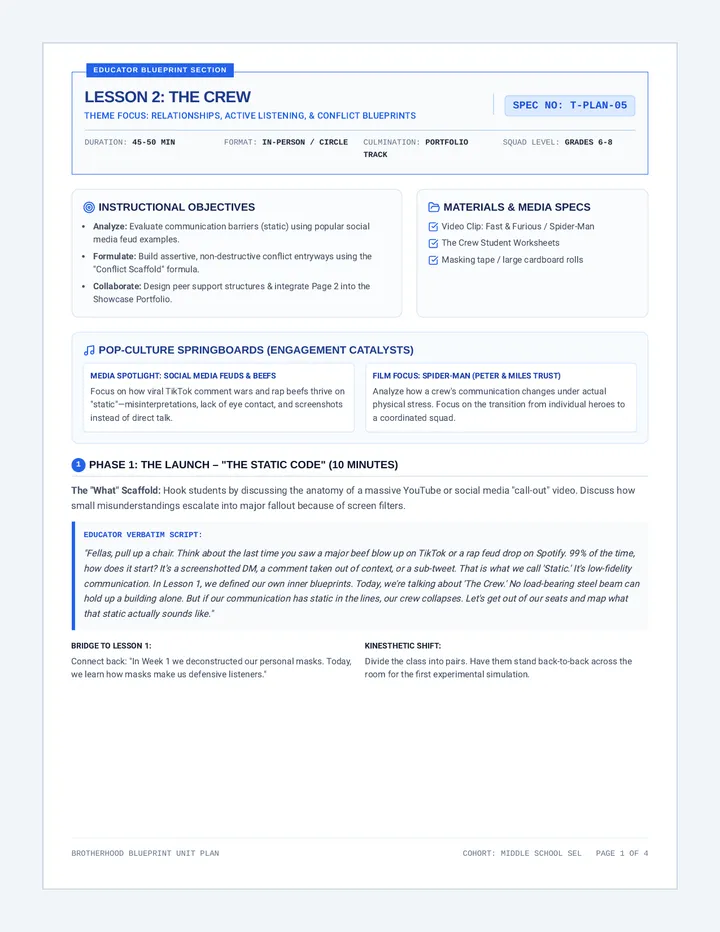
Students will learn and practice three proactive conflict-resolution strategies—Active Listening, “I” Statements, and Compromise—to transform disagreements into collaborative solutions.
LESSON PATHWAY (30 MIN)
1
Introduction to Peace Pathways
5 MIN
Hook: Ask students about a recent disagreement they've had.
Define Conflict Resolution : Solving disagreements peacefully through communication and understanding.
Write key strategies on chart paper: Active Listening, "I" Statements, and Compromise.
2
Small-Group Scenario Exploration
10 MIN
Divide into groups of 3–4; hand out Scenario Cards .
Groups identify the core conflict and choose two strategies to resolve it.
Groups note choices on chart paper and plan a 1–2 minute role-play.
3
Role-Play Demonstrations
8 MIN
Groups present their role-plays (1–2 minutes each).
Class provides feedback: Which strategies were used? How did they show empathy?
Use timer to keep pacing tight.
4
Reflection and Closing
7 MIN
Students complete the Reflection Worksheet individually.
Prompts: Effective strategy, feelings during role-play, real-life application.
Closing: Share 2–3 insights and reinforce key strategies.
Peace Pathways Slides Peace Pathways
Proactive Conflict Resolution
Listen
Speak
Solve
Welcome students and introduce today’s lesson: Peace Pathways. Explain that they will learn proactive conflict-resolution strategies through engaging activities.
Objectives
By the end of this lesson, you will be able to:
Define conflict resolution
Practice three strategies: Active Listening, “I” Statements, and Compromise
Apply strategies to scenarios and reflect on your experience
Read aloud the objectives. Encourage students to think about why these skills are important both in school and daily life.
What is it?
The process of peacefully solving disagreements through communication and understanding.
Respectful Listening
Clear Communication
Mutual Solutions
Ask students to share examples of conflicts they’ve experienced. Present the definition and write key elements on chart paper.
1
Active Listening
Give full attention and eye contact
Use non-verbal cues (nodding)
Reflect back what you heard
Try it:
"I hear you saying that..."
Explain Active Listening. Model with a volunteer: have one student speak and another practice reflecting back the message.
2
"I" Statements
Express feelings without blaming others.
"I feel _____ when _____ because _____."
Focuses on YOUR perspective
Avoids "You always..."
Introduce “I” Statements. Contrast with “You” statements. Invite students to convert a blaming sentence into an “I” statement.
3
Compromise
Finding a middle ground where both parties give and take.
Brainstorm multiple options
Aim for a solution everyone can accept
My Way
Your Way
OUR WAY
Discuss the importance of compromise. Ask students for examples of simple compromises in daily life (e.g., choosing a game to play).
Scenario Challenge
1
Form groups of 3–4
2
Pick a Scenario Card
3
Identify the conflict
4
Choose 2 strategies
Your Goal:
Plan a 1–2 minute Role-Play!
Use the strategies naturally in your performance.
Explain the group activity. Remind students to select two strategies and note them on chart paper before role-playing.
Showtime
Present
Perform your role-play
Listen for class feedback
Reflect
On your worksheet, write about:
What worked best?
How did it feel?
Real-life application
Outline the presentation and reflection steps. Distribute the reflection worksheet and guide students through the prompts.
Peace Pathways Scenario Cards Scenario Challenge Cards
Peace Pathways: Group Activity
CUT ALONG DASHED LINES
1
The Shared Locker
Alex and Taylor share a locker. Alex feels Taylor is too slow; Taylor thinks Alex slams it too loudly. Tension builds every morning.
Core Conflict:
Chosen Strategies:
2
The Project Load
Maya has done most of the research; Jamal has only added a few sentences. Maya feels it's unfair; Jamal is overwhelmed with other work.
Core Conflict:
Chosen Strategies:
3
The Captain's Call
Sam and Priya both want to be gym captain. Sam thinks Priya never passes; Priya thinks Sam hogs the spotlight.
Core Conflict:
Chosen Strategies:
4
The Viral Photo
Jenna posted an embarrassing photo of Carlos without asking. Carlos is upset; Jenna thinks it was just a harmless joke.
Core Conflict:
Chosen Strategies:
5
The Special Markers
Two students need the only set of special markers. Mia has them and is working slowly; Leo needs them quickly to finish.
Core Conflict:
Chosen Strategies:
6
The Spilled Juice
A new student spills juice on Sam's tray. Sam reacts angrily; the new student is embarrassed and wants to apologize.
Core Conflict:
Chosen Strategies:
Peace Pathways Reflection Worksheet Role-Play Reflection
Peace Pathways: Personal Insight Sheet
Reflect & Grow
Explorer Name
Date
Instructions: After your group’s role-play and class feedback, reflect on your experience by answering the questions below. Write your answers in complete sentences.
1 Which conflict-resolution strategy felt most effective during your role-play? Why?
2 How did you feel when using this strategy and participating in the role-play?
3 How can you apply this strategy in a real-life situation (school, home, or friends)? Give a specific example.
4 What is one action you will take next time to improve your conflict-resolution skills? Conflict Snapshot Warmup Conflict Snapshot
Warm-Up Activity • 3 Minutes
Quick Start
Take a moment to reflect on a recent disagreement you experienced (at school, home, or with friends). Answer the questions below in complete sentences.
What happened?
Describe the situation briefly.
How did you feel?
Identify your emotions during the conflict.
How did you respond?
What did you say or do in the moment?
A Different Path?
Which strategy (Listen, "I" Statement, Compromise) might have helped?
"Every conflict is an opportunity to learn a new pathway to peace."
Peace Pathways Exit Ticket Final Destination
Peace Pathways Exit Ticket
Explorer Name
Date
1. Which strategy will you use this week?
2. Where will you apply it? (School, home, etc.)
Confidence Level
How confident are you using these skills?
NOT VERY
1
2
3
4
5
EXTREMELY
Turn conflicts into collaborative solutions.