A 45-minute career exploration module inspired by the fictional tech pioneer Pax Patterson, where students research and map out tech career pathways.
Focuses on rebuilding trust and repairing a reputation after inappropriate behavior has occurred.
Provides alternative social strategies for gaining attention and building connections without using shock-value or inappropriate comments.
Focuses on the unique risks of inappropriate language in digital spaces, including permanent footprints and legal consequences.
Teaches students how to read situational cues and adjust their language 'signal' based on the environment and audience.
An individual social-emotional learning lesson designed for middle school students to understand the social impact of high-risk language and develop a 'social filter' for appropriate communication.
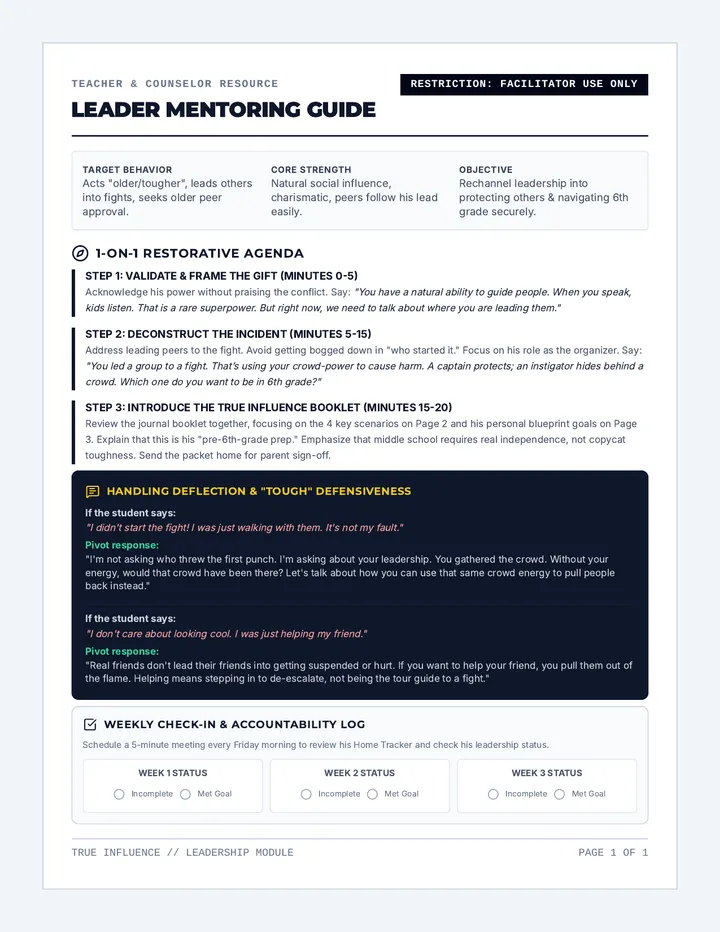
A comprehensive guide for counselors on using narrative approaches to resolve peer conflict through restorative practices, focusing on externalizing problems and identifying values.
In this quick, interactive activity, students explore personal values through a card-sorting exercise to understand how identifying what matters to them builds self-esteem and confidence.
A collection of quick, high-energy session openers designed to build rapport and ease transitions in Tier 3 counseling sessions.
A middle school lesson exploring the emotional and psychological weight of cyberbullying through interactive scenarios and reflective discussion.
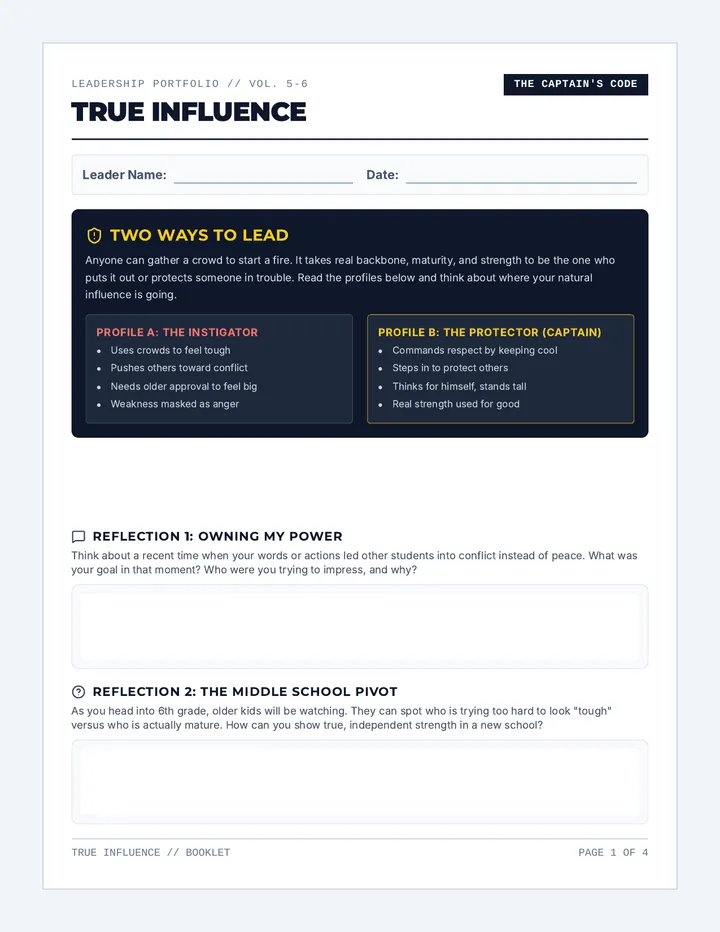
A lesson focused on behavioral regulation and emotional coping for middle school students, using a basketball theme to teach leadership, anger management, and resilience.
A comprehensive guide for school counselors to lead restorative mediations, focusing on narrative techniques to externalize conflict and promote student agency.
A 15-minute targeted lesson for 6th-grade students on navigating peer conflict, regulating emotions during heat-of-the-moment disagreements, and recognizing when a friendship is no longer healthy.
A follow-up lesson for students who need additional support in identifying social cues. This lesson breaks down complex signals into smaller parts and uses high-contrast examples to build accuracy in perspective-taking and consequence prediction.
A lesson designed to help students develop executive functioning skills by breaking a complex research project on school cell phone bans into manageable, planned steps.
This lesson introduces the 'Rock Brain' vs. 'Flexible Brain' concept, providing the student with tools to recognize mental rigidity and practice shifting to adaptable thinking through interactive scenario sorting.
A comprehensive lesson on active listening that teaches students to identify communication barriers and practice empathy through perspective-taking. Students learn to distinguish between the 'signal' (meaning) and 'noise' (distractions) in conversations.
A 30-minute lesson designed for 6th-grade students (ideal for Life Skills or introductory financial literacy) to master the identification and valuation of US coins. Students will explore the 'Money Team' through visual aids, interactive sorting, and matching activities.
A lesson designed to help middle school students develop emotional resilience when facing rumors and gossip through perspective-shifting exercises and practical reframing techniques.
An assessment lesson designed to evaluate students' proficiency in core SEL competencies: self-awareness, self-management, and social awareness through diverse question types.
A fast-paced, high-energy 10-minute exploration of personal identity. Students define identity through seven key lenses and collaborate on a group 'Identity Mosaic' poster to visualize their shared and unique traits.
Students synthesize their learning to set meaningful goals and reflect on their personal growth journey.
Focuses on developing empathy, understanding multiple perspectives, and fostering a deep respect for diversity through cooperative play and scenarios.
A deep dive into managing stress, controlling impulses, and practicing mindfulness to maintain emotional balance in challenging situations.
Students explore their personal values, identify their strengths, and develop a growth mindset to build a strong foundation for self-worth and resilience.
A comprehensive lesson focusing on building inhibition control through 'The Impulse Lab' simulation. Students learn about their 'mental brakes' and practice pausing before acting through a board game and reflection.
A collaborative workshop designed to help community members—students, parents, and leaders—visualize a shared future and identify concrete steps to achieve it through artistic expression and structured dialogue.
A lesson focused on building rapport and reflecting on social, academic, and familial behaviors through structured discussion and personal journaling.
A sophisticated, technical approach to distress tolerance for 2e students, focusing on emotional systems, logical analysis of impulsive vs. regulated behavior, and radical acceptance as a data-driven strategy.
A targeted 30-minute SEL lesson for 7th-grade Tier 2 groups focusing on identifying personal triggers and building a customized self-regulation toolkit. Students will explore body signals and select specific strategies to use when they feel heightened.
Specialized resources for supporting children and adolescents, focusing on age-appropriate explanations and creative memory-keeping.
A practical lesson dedicated to identifying and implementing healthy coping mechanisms to manage the intense emotional waves of loss.
An introductory lesson focused on understanding the landscape of grief and assessing the severity of the client's current experience to guide treatment planning.
This lesson introduces middle school students in therapeutic settings to the concept of working memory using the 'Mental Workbench' analogy. Students will practice auditory and visual-spatial memory tasks and learn strategies to manage 'cognitive overload' in a supportive environment.
A 30-minute mini-lesson for middle schoolers focusing on four key social-emotional challenges: peer conflict, stress management, gossip, and anger control. Students read research-backed strategies and practice through discussion.
A 30-minute Social Emotional Learning lesson designed for middle schoolers to develop strategies for managing defiance, peer conflict, impulsivity, and disengagement. Students explore 'Cool Head' tools to navigate challenging classroom situations effectively.
A comprehensive kit for parents of 6th graders struggling in a specific class, focusing on root-cause investigation, logical consequences, and collaborative problem-solving to improve behavior and academic engagement.
A hands-on STEM and guidance lesson where students use electronic logic gates (AND/OR) to model and solve real-life decision-making scenarios, bridging technical skills with social-emotional reasoning.
A multi-session series designed to address relational aggression by building empathy, identifying harmful social patterns, and empowering students with self-advocacy tools.
A lesson designed for middle school students to master the art of reading verbal and non-verbal social cues, focusing on empathy and effective communication in real-world scenarios.
A 40-minute lesson focused on the 'Pillars of Trust' (Reliability, Honesty, and Care), featuring a collaborative activity and reflection.
Consolidating gains, celebrating growth, and creating a sustainable plan for maintaining the 'preferred future' independently.
Developing a specific 'work win' strategy by focusing on past successes with task completion and academic engagement.
Exploring how positive changes in behavior affect relationships with teachers and peers, reducing arguments through the ripple effect.
Using scaling questions to measure progress in school attendance and anger management while identifying specific steps for improvement.
Identifying 'exceptions'—times when the problem could have happened but didn't—to help the student recognize her own coping skills.
Introduction to SFBT, building rapport, and using the Miracle Question to define the student's preferred future without elopement or anger.
The final day focuses on confidence building, visualization, and finalizing the personal testing blueprint to be opened on test day.
Day 2 shifts the focus from mindset to the mechanics of testing: building academic stamina, managing the 'mid-test slump,' and applying practical problem-solving strategies for difficult questions.
A social-emotional learning lesson for grades 7-8 focused on managing test anxiety, building a growth mindset, and developing practical stress-management strategies for high-stakes testing.
A lesson focusing on navigating three-way friendships, setting healthy boundaries, and resolving common 'three's a crowd' conflicts through effective communication.