Pause Power Slides Self-Regulation Series
PAUSE POWER
Mastering the "Stop-Think-Act" sequence to take control of your actions.
The "Auto-Play" Mode
An impulse is a sudden urge to do or say something without thinking about the outcome.
It happens fast—like a reflex.
It often feels like you aren't in control.
It skips the "Thinking Brain" entirely.
Brain Check
Your brain is built to react fast to save you from danger, but sometimes it reacts fast when it doesn't need to!
THE MENTAL REMOTE
STOP
Freeze! Don't move or speak. Just recognize that an impulse has arrived.
PAUSE
The most powerful button. Use it to check your triggers and consequences.
ACT
Choose the action that helps you reach your goal.
What Pushes Your Buttons?
Triggers are the things that make impulses start.
Social Triggers
• Being teased or left out
• Someone taking your stuff
• Losing a game or competition
Internal Triggers
• Being tired or hungry
• Feeling bored or restless
• Getting frustrated with work
What's one thing that makes you want to react instantly?
Turn & Talk
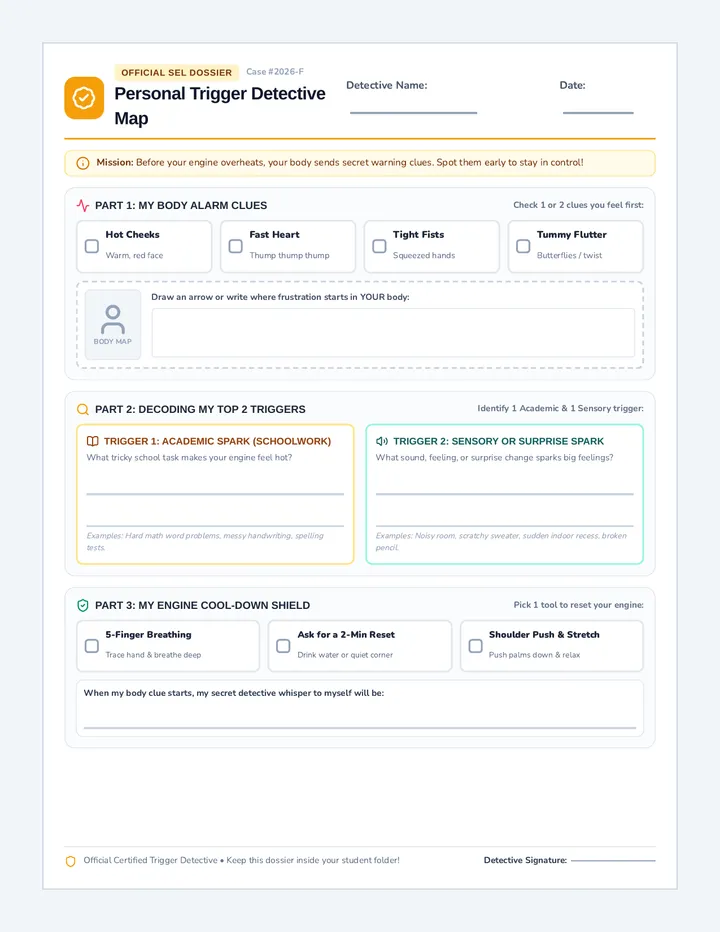
THE PHYSICAL WARNING
👤
Hot Face
Fast Heart
Clenched Fists
Tight Tummy
Your body usually feels the impulse before your brain starts thinking.
Warning Light Activity
When you feel these signals, it means:HIT THE PAUSE BUTTON NOW!
THE 3-STEP SEQUENCE
1
STOP: Name the feeling
"I'm feeling angry" or "I'm feeling excited."
2
THINK: What happens next?
What are my choices? What will the consequences be?
3
ACT: Pick the best choice
Move forward with a plan, not a reflex.
Scenario Practice
What would you do?
"You are standing in line for lunch. Someone accidentally steps on your new sneakers and scuffs them. You feel your face getting hot."
Impulse (Auto-Play)
Shove the person or yell a mean comment back.
Pause Power (Stop-Think-Act)
Take a breath, realize it was an accident, and stay calm.
YOU HAVE THE POWER
The next time you feel a "Physical Warning," remember to reach for your mental remote and hit PAUSE.
Be Kind to Yourself
Train Your Brain
Mental Remote Worksheet My Mental Remote
Impulse Control Training Lab
Agent: ____________________________
Date: ____________________________
Part 1: Identifying Triggers
What "pushes your buttons" and makes you want to react without thinking? Check all that apply.
Social Triggers
Being teased or called a name
Losing a game or competition
Someone touching my stuff
Being left out of a group
Internal Triggers
Feeling tired or sleepy
Feeling hungry or thirsty
Feeling bored with my work
Being asked to do something hard
Part 2: Body Warning Signs
👤
Where do you feel an impulse first? Draw lightning bolts ⚡ or circle the areas on the body map.
Hot Face
Fast Heartbeat
Tight Fists
Butterflies in Tummy
Heavy Breathing
Legs Jiggling
Part 3: Programming My Remote
Pick one trigger from Part 1. Write how you will use your Mental Remote to handle it.
My Selected Trigger
When... ____________________________________________________________________
STOP: What will I say to myself to freeze?
THINK: What are two things that might happen if I react instantly?
ACT: What is a "Power Choice" I can make instead?
I HAVE THE POWER TO PAUSE.
Pause Power Guide Instructional Resource
Pause Power Guide
Facilitator's Manual: Impulse Control & Self-Regulation
Target Duration
45 MIN
Core Objective
Students will identify personal impulse triggers and practice the "Stop-Think-Act" method using the Mental Remote metaphor.
Materials Needed
Slide Deck, Mental Remote Worksheets, Pencils, (Optional) A physical TV remote for demo.
Key Vocabulary
Impulse, Trigger, Consequence, Self-Regulation, Physical Warning.
1
The Hook: "Auto-Play" Mode (Slide 1-2)
"How many of you have ever had a video on YouTube or Netflix 'auto-play' the next episode before you were ready? Our brains have an 'auto-play' mode too—we call it an impulse. It's when we do something before our 'Thinking Brain' even gets a chance to look at it."
Key Points to Cover:
Definition of impulse (reaction vs. action).
Why it's fast (survival brain vs. thinking brain).
Normalize impulses: Everyone has them! The goal is control, not elimination.
2
The Mental Remote (Slide 3)
Introduce the three main buttons. If you have a physical remote, hold it up and mime the buttons.
Stop
Freeze movement and speech. Just acknowledge the feeling exists.
Pause
The "Thinking" space. Weigh choices and consequences.
Act
Proceed with the best choice for the goal.
3
Triggers & Body Signals (Slide 4-5)
This is the "Detective Work" portion of the lesson. Students must learn to catch impulses before they happen.
Discussion Prompt (Triggers)
"Think about the last time you got in trouble for an impulse. What happened right before? Was it a person? A feeling? That's your button!"
Physical Check-In
Guide students to close their eyes and remember a moment of frustration. Ask where they feel it in their body (chest, hands, face).
Worksheet Action
Distribute the **Mental Remote Worksheet**. Students should complete **Part 1 (Triggers)** and **Part 2 (Body Warning Signs)** now.
4
The 3-Step Sequence (Slide 6-7)
Model the "Sneaker Scuff" scenario on Slide 7. Have two volunteers act out the "Auto-Play" version and then the "Pause Power" version.
Worksheet Action: Part 3 (Programming My Remote)
Students pick their most frequent trigger and map out exactly what they will say/think when it happens. Walk around to provide individual feedback.
Pause Power Exit Ticket Pulse Check
Pause Power Exit Ticket
Name
Date
1. What is one physical warning sign your body gives you when you have an impulse?
2. Which button on your "Mental Remote" helps you think about consequences?
Stop
Pause
Act
3. Someone cuts in front of you in the game line. How do you use your "Pause Power"?
Pulse Check
Pause Power Exit Ticket
Name
Date
1. What is one physical warning sign your body gives you when you have an impulse?
2. Which button on your "Mental Remote" helps you think about consequences?
Stop
Pause
Act
3. Someone cuts in front of you in the game line. How do you use your "Pause Power"?