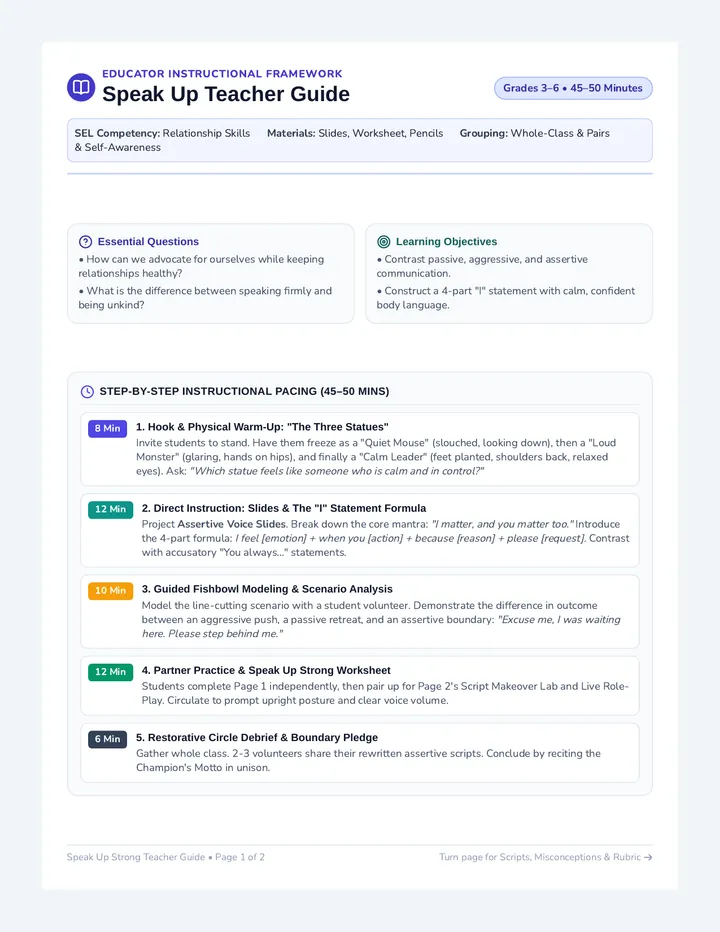
Pause Power Teacher Guide SEL Mini-Lesson Guide • Grade 2
Pause Power: Stop & Think
20–25 Minutes
Impulse Control • Decision Making
Mini-Lesson Objectives
Recognize Physical Clues: Identify body warning signs (racing heart, clutched fists, loud voice) when big feelings surge.Hit the Brain Pause Button: Apply the 3-Step Routine: 1. Stop & Breathe, 2. Think What If, 3. Choose Wise .Weigh Outcomes: Compare immediate reactions vs. thoughtful solutions in peer sharing and turn-taking.
Materials Needed
• Pause Power Slides
• Choice Navigator Sheet
• Pencils & Crayons
• Classroom remote or buzzer (optional hook prop)
Step-by-Step Lesson Pacing
3 MIN
Hook
The Freeze Frame Challenge
Invite students to wiggle, clap, and cheer. Call out "PAUSE BUTTON!" and press an imaginary remote. Everyone freezes in place. Explain: "Your brain has that exact same super-power button inside!"
6 MIN
Teach
Teach the 3-Step Routine (Slides 2–4)
Introduce the anchor steps with full-body gestures:
1. STOP (Hand up + deep belly breath) 2. THINK (Finger to temple: What happens next?) 3. CHOOSE (Thumbs up: Kind & safe move)
7 MIN
Guide
Model with Think-Aloud & Scenario Solving (Slide 5)
Walk through Scenario: Someone accidentally knocks down your block tower at indoor recess. Demonstrate fast reaction (yelling, kicking blocks) vs. hitting Pause Power (breathing, speaking calmly, rebuilding together).
4 MIN
Reflect
Partner Share & Transition to Practice
Partners turn and tell each other their favorite calm-down breath (Bumblebee Breath, Hot Cocoa Breath, or Five-Finger Breath), then transition to the Choice Navigator Worksheet.
Teacher Modeling Script (Verbatim Think-Aloud)
"Uh oh, class! Feel my shoulders right now? They are up to my ears, and my jaw is clenched tight! Somebody just took the red marker I was reaching for. My fast brain wants to snatch it back and yell, ‘Hey, that’s MINE!’ But watch: [Press fingers to chest like a pause button]. BEEP! I hit my pause button. Inhale 1-2-3... exhale 1-2-3. If I snatch it, we get in trouble and lose art time. If I say, ‘Can I use red when you finish that heart?’ we both get to draw. I’m choosing option two!"
Instructional Toolkit
Everyday Situations & Adaptive Supports
Page 2 of 2
4 High-Frequency 2nd Grade Conflict Scenarios
A Line Cutting at Recess
Scenario: You are waiting for the swings and a classmate steps right in front of you.
• Pause Prompt: "I’m frustrated, but pushing causes hurt. I’ll use my calm assertive voice: ‘I was next in line.’"
B Losing a Math Game
Scenario: Your game partner rolls a double six and wins the round. You feel mad and want to knock the dice.
• Pause Prompt: "Pause and take 2 belly breaths. Losing feels bumpy, but saying ‘Good game’ keeps games fun."
C Blurting Out Answers
Scenario: You know the answer to the teacher's riddle and feel super excited to shout it out!
• Pause Prompt: "Excitement is big! Lock the secret in your mouth with an imaginary key and raise a quiet hand."
D Accidental Bumps in Line
Scenario: Walking to lunch, the person behind you accidentally steps on your shoe heel.
• Pause Prompt: "Check intent: Did they do it on purpose or by accident? Check in before getting angry."
Differentiation & Accommodations
For Emerging Readers / ELL
Use traffic-light color cards (Red = Stop, Yellow = Think, Green = Go) and physical gestures. Allow drawing instead of written responses on worksheets.
Sensory / Calming Corner
Provide physical tactile "Pause Buttons" (silicone pop-it poppers or soft felt circles) students can press when feeling overstimulated.
Extension / Fast Finishers
Have students author their own "Pause Power Mini-Comic" illustrating how they saved the day by taking a breath during recess or lunch.
Observable Success Indicators Use during guided practice & unstructured recess
Identifies Big Feeling
Can name emotion (frustrated, angry, overwhelmed, overly excited) and physical body signal.
Pauses Before Reacting
Takes at least 1 breath or uses verbal self-talk ("Hold on, pause") instead of immediate physical reaction.
Selects Peaceful Solution
Chooses an action that keeps people safe and maintains positive classroom community.
Family Connection Note Prompt: Send home a reminder: "Ask your child how they used their brain pause button at school today!"
Pause Power Slides 2nd Grade SEL Superpower
Social Problem-Solving
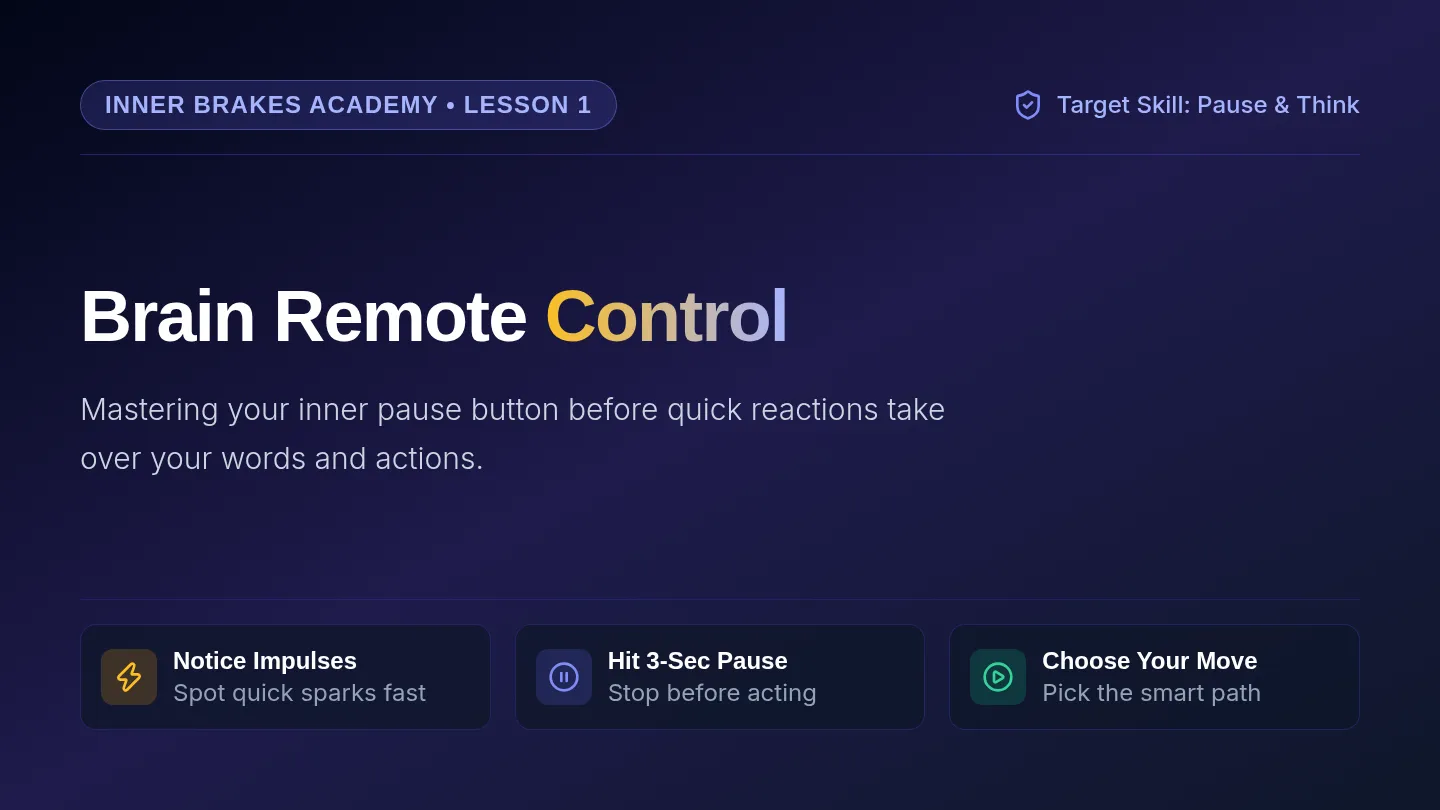
PAUSE POWER!
Stop and Think Before You Act
Hit your brain's internal pause button Lesson 1 • Mini-Lesson
Step 0 • Notice the Signs
Catch Your Big Feelings!
Before you react, your body sends you warning signals:
Hot Cheeks
Your face feels warm or your fists ball up tightly.
Fast Heart
Your heartbeat speeds up like a fluttering drum.
Loud Voice
You feel a sudden urge to shout, push, or run.
When your body rings the alarm, that means: HIT PAUSE!
The Superpower Formula
The 3-Step Pause Routine
1
STOP
Freeze your body right where you are.
Take 1 deep belly breath
2
THINK
Look ahead like a movie in your mind.
Ask: "What happens next?"
3
CHOOSE
Pick the move that keeps everyone safe.
Use calm, kind words
Remember: Stop • Think • Choose gives you total control!
Think Through Choices
What Happens Next?
Scenario: Someone takes your marker
Fast Reaction
Action: Yell loudly and snatch it back!
What happens next?
• The marker breaks or tears paper
• Both friends feel angry and upset
• You lose your art drawing time
Pause & Choose
Action: Breathe, then ask to share!
What happens next?
• Your friend listens and trades colors
• Nobody gets hurt or in trouble
• You feel calm, strong, and proud
Your choice creates what happens next!
Class Challenge
Be a Pause Detective!
Recess Situation:
"You are building a sandbox castle. A classmate runs past and accidentally kicks sand into it. You feel your fists tighten!"
1. STOP
Where do you feel the feeling?
2. THINK
Was it an accident or on purpose?
3. CHOOSE
What is your wisest next step?
Turn and talk with your shoulder partner for 60 seconds! Share your wise move!
Our Classroom Agreement
The Pause Power Pledge
“When big feelings start to rise,”
“I hit pause and use my eyes.”
“I take a breath, I think ahead,”
“And choose kind, safe moves instead!”
Ready to earn your Decision Detective Badge!
Let’s practice on our Choice Navigator →
Choice Navigator Worksheet Name:
Date:
Choice Navigator
Stop, Think, and Choose Your Wise Move!
1. STOP • 2. THINK • 3. CHOOSE
Part 1: My Body Alarm Signals
Color or circle what you feel:
When a big feeling hits you (mad, super excited, or nervous), what happens in your body first?
💓 Fast Heart
✊ Tight Fists
🔥 Hot Face
📢 Loud Voice
Another clue my body gives me:
Part 2: Choice Crossroads • The Water Spill
Scenario 1
The Situation: You worked hard drawing a colorful spaceship. A classmate accidentally knocks their water bottle over, and water spills across your desk onto the paper!
Which choice shows Pause Power? Check your answer:
Choice A: Crumple up the paper, push their desk, and yell, "You ruined my picture!"
Choice B: Take a deep belly breath and say, "Let's grab paper towels fast to dry it off."
Think Ahead: What good thing happens next if you pick Choice B?
Page 1 of 2 • Turn over for your Decision Detective Challenge →
Decision Detective Mission
Put your Pause Power to work!
Page 2 of 2
Part 3: Choice Crossroads • The Playground Ball
Scenario 2
The Situation: You and a classmate both run toward the very last red playground ball. You both put hands on it at the exact same second!
Check the wise move:
Choice A: Yank the ball as hard as you can and run away without sharing.
Choice B: Pause, smile, and say: "Want to play four-square together, or play rock-paper-scissors for who goes first?"
Why does Choice B make recess better for both of you?
Part 4: Draw & Write Your Pause Power
Draw a picture of yourself hitting your pause button and taking a calm breath at school:
When I feel:
I will pause, take a deep breath, and:
Official Decision Detective Badge
I have the power to stop, think, and choose kind actions!
Complete
Choice Navigator Answer Key Teacher Reference • Grade 2 SEL
Choice Navigator Answer Key
Exemplar Guide
Part 1: Body Alarm Signals (Check & Accept)
Any valid self-awareness response accepted
Expected Responses: Students can circle any combination of physical cues (Fast Heart, Tight Fists, Hot Face, Loud Voice).
Sample student responses for additional clue: "Butterflies in my stomach", "Teary eyes", "Tense neck/shoulders", "Wanting to stomping feet", "Clenching my teeth."
Part 2: Choice Crossroads • The Water Spill
Correct Selection: Choice B
"Take a deep belly breath and say, ‘Let's grab paper towels fast to dry it off.’"
What good thing happens next? (Exemplar Criteria):
Look for cause-and-effect reasoning: "The picture dries without tearing," "My classmate helps me clean up," "Nobody gets in trouble with the teacher," or "We stay friends and save the drawing."
Part 3: Choice Crossroads • The Playground Ball
Correct Selection: Choice B
"Pause, smile, and say: ‘Want to play four-square together, or play rock-paper-scissors for who goes first?’"
Why Choice B makes recess better:
Accept answers emphasizing fairness, fun, or safety: "Both people get to play," "Nobody gets hurt or cries," "We don't waste recess arguing," or "Rock-paper-scissors is fair for both of us."
Part 4: Draw & Write Evaluation Rubric
Drawing Component
Depicts student pausing (hands on belly, counting fingers, calm bubble, or asking for help calmly).
Feeling Identification
Completes "When I feel..." with specific emotion word (frustrated, angry, impatient, overwhelmed).
Constructive Action
Names a peaceful solution (count to 5, use words, find a teacher, ask to share, squeeze a stress ball).
Teaching Tip: Celebrate specific self-control moments publicly during daily shout-outs! SEL Growth Mindset