Choice Champions SEL Worksheet 6-Week SEL Capstone Activity
Choice Champions Worksheet
Rules • Self-Care • Safety • Wise Choices
Name:
Date:
Partner:
Quick Check-In: Color or circle your readiness meter today:
🌱 Learning ⚡ Growing 🌟 Champion
1
Pillar 1: Community Rules Protect Us
Individual Reflection
Rules are not just about what we can't do—they keep our classroom safe and fair. Think of one important rule at school or home.
A. Name the rule and explain who it protects:
B. Draw what it looks like when everyone follows it:
Draw your illustration here
2
Pillar 2: Self-Care & Emotional Regulation
Reset Toolkit
When you experience big feelings (frustrated, overwhelmed, or worn out), taking care of your mind and body helps you reset.
4-Count Breaths Inhale peace, exhale tension
Sensory Pause Water break & shoulder roll
Voice the Need Tell a trusted friend or adult
My Personal Reset Plan: What is your favorite strategy when you feel your energy dropping or boiling over?
Partner Turn & Talk: Share your reset strategy with your partner. Listen to theirs and nod when they finish!
Choice Champions SEL Toolkit • Page 1 of 2 Turn page for Real-World Scenarios & Role-Play ➔
Action Scenarios & Role-Play Lab
Practice staying safe and choosing kindness when real-life situations get tricky.
Page 2: Partner & Group
3
Scenario A: Physical & Emotional Safety
Safety & Boundaries
The Dilemma: During outdoor time, a classmate dares you to climb on top of a wobbly, wet storage bin to jump off for a video. They say, "Hurry up! Don't be chicken, everyone is doing it!"
1. Identify the Risk:
2. Words to Set a Safe Boundary:
4
Scenario B: Everyday Dilemma & Empathy
Wise Choices
The Dilemma: You notice a classmate sitting alone at lunch looking tearful and embarrassed because their tray spilled. Your usual friends are calling you to sit at their crowded table with your favorite game.
Quick Choice vs. Wise Choice:
What helpful action could you take?
Partner Role-Play
Pick Scenario A or B with your partner. Act out the safe, respectful response:
• Person 1: Delivers the tricky prompt.
• Person 2: Uses calm voice & clear boundary.
• Both: Switch roles and try again!
Partner Sign-Off:
Whole-Group Circle Prompts
Be ready to share one answer during our class reflection circle:
Q1: Why is following safety rules an act of self-care?
Q2: What makes it hard to say "No" to a friend, and how can we practice courage?
"Champions pause, think, and choose respect!"
Choice Champions SEL Toolkit • Page 2 of 2 Keep this in your SEL binder or portfolio!
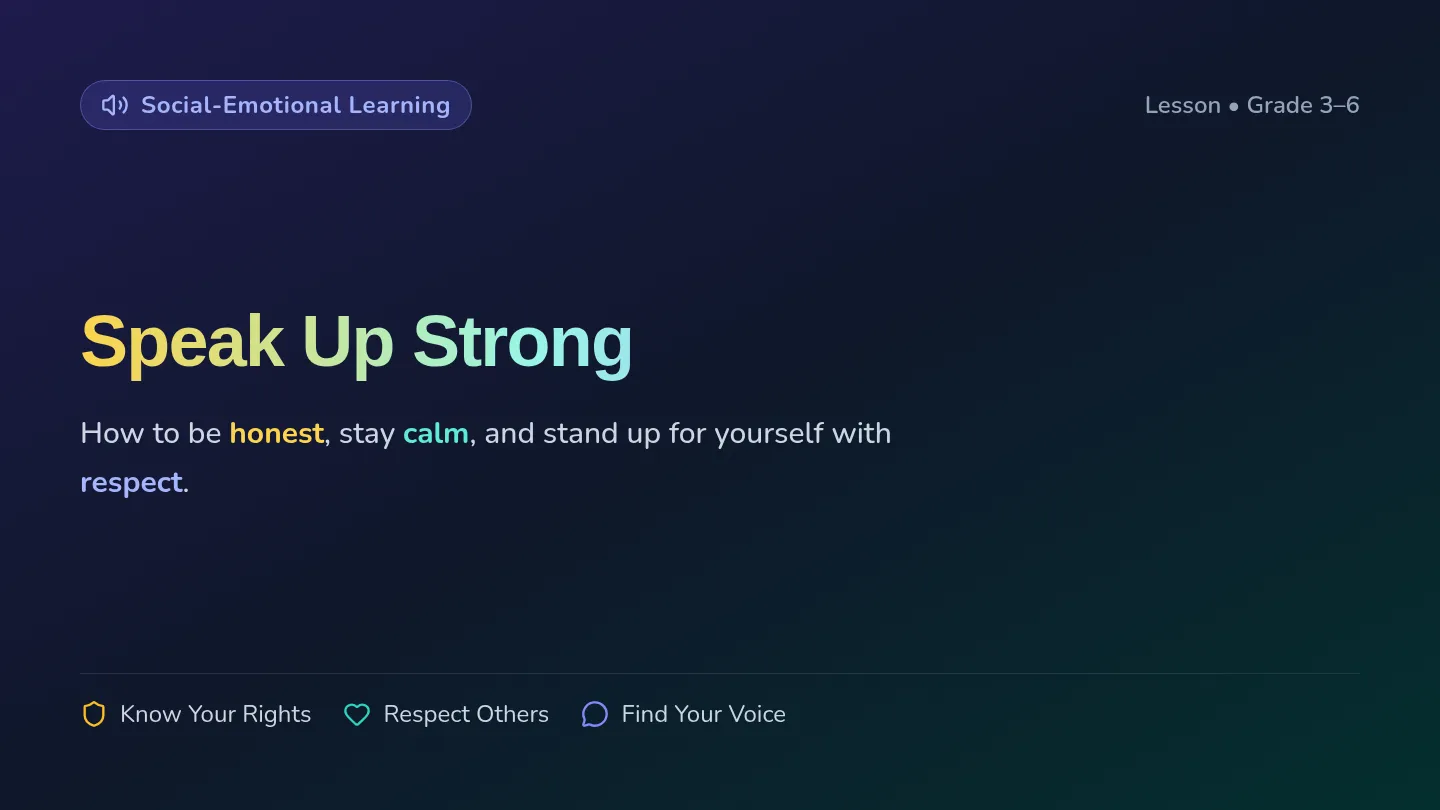
Assertive Voice Slides Social-Emotional Learning Lesson • Grade 3–6
Speak Up Strong
How to be honest, stay calm, and stand up for yourself with respect.
Know Your Rights
Respect Others
Find Your Voice
The Three Communication Voices
Which voice do you hear?
Passive
"The Quiet Mouse"
• Hides true feelings
• Looks at the floor
• Lets others push ahead
• Quiet or whispery voice
"It doesn't matter... whatever you want."
Aggressive
"The Loud Monster"
• Yells or insults
• Points fingers, glares
• Ignores other people
• Demands their way
"Give that to me right now, or else!"
Assertive
"The Calm Leader"
• Speaks clear and firm
• Makes friendly eye contact
• Honest about feelings
• Listens with respect
"I want to take turns. Please wait."
Being assertive means: I matter, and you matter too.
Body Language Checklist
Stand Strong, Stay Calm
Eyes
Direct, friendly eye contact. Not staring angrily, not staring down.
Posture
Shoulders back, feet flat on the floor, head held up with quiet confidence.
Hands
Calm and open at your sides or in front. No clenched fists or pointing fingers.
Voice
Clear, steady, and audible. Never screaming, never muttering under your breath.
💡 Try it now: Sit up tall, take a deep belly breath, and roll your shoulders back!
The Superpower Formula: "I" Statements
Speak Without Blaming
Part 1 "I feel..." (Name the emotion)
Part 2 "when you..." (Describe the action)
Part 3 "because..." (State the reason)
Part 4 "Please..." (Clear request)
Example in Action:
"I feel frustrated when you talk over me because my idea gets lost. Please let me finish my sentence."
Avoid saying: "You always ruin everything!" Use: Clear facts + What you need
Scenario 1: The Line Cutter
Spot the Difference
You have been waiting patiently for the water fountain for 3 minutes. Right as you step up, someone zooms in front of you and takes a sip.
❌ Aggressive
Shoves them aside:"Get out of the way, you jerk!"
❌ Passive
Looks down, stays quiet, walks away thirsty and angry.
✅ Assertive
Calm eye contact:"Excuse me, I was next in line. Please wait your turn behind me."
Notice how the assertive response is calm, direct, and polite —no yelling needed!
Scenario 2: The "Just Kidding" Joke
Setting Healthy Boundaries
A classmate makes fun of your new shoes or haircut in front of the lunch table. Everyone giggles, and the person says, "Relax, it was just a joke!"
How to Use Your Assertive Shield:
1 Hold eye contact: Do not laugh along if it hurt you.
2 State the reality: "It doesn't feel like a joke to me."
3 Make the boundary: "Please stop commenting on my clothes."
4 Walk with pride: If they persist, seek support from an adult.
You never have to pretend something is funny when it disrespects you.
Your Turn: Partner Role-Play
Practice Makes Permanent
Partner Roles:
Partner A: Presents a mild challenge (e.g. asking to copy homework or borrowing a pencil without asking).Partner B: Uses tall posture, calm tone, and an "I" statement to set a boundary.Switch: Take turns so both practice being assertive!
Champion's Motto:
"I speak up for myself with kindness. I stand tall, listen well, and respect everyone's voice—including my own!"
Next step: Complete your Speak Up Strong Worksheet!
Speak Up Strong SEL Program Remember: Practice with courage every day!
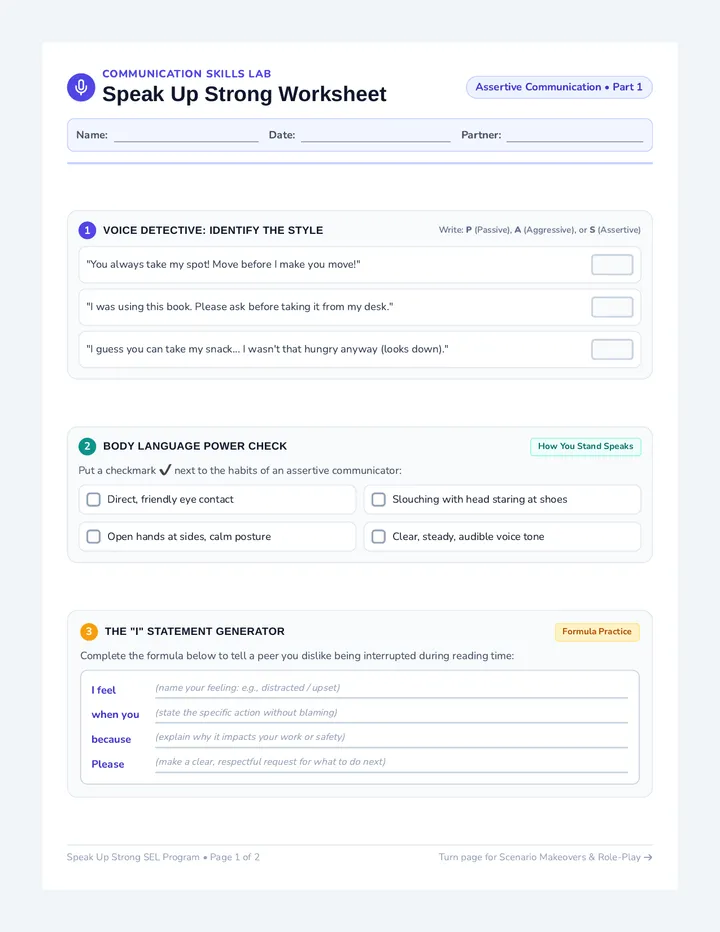
Speak Up Strong Worksheet Communication Skills Lab
Speak Up Strong Worksheet
Assertive Communication • Part 1
Name:
Date:
Partner:
1
Voice Detective: Identify the Style
Write: P (Passive), A (Aggressive), or S (Assertive)
"You always take my spot! Move before I make you move!"
"I was using this book. Please ask before taking it from my desk."
"I guess you can take my snack... I wasn't that hungry anyway (looks down)."
2
Body Language Power Check
How You Stand Speaks
Put a checkmark ✔ next to the habits of an assertive communicator:
Direct, friendly eye contact
Slouching with head staring at shoes
Open hands at sides, calm posture
Clear, steady, audible voice tone
3
The "I" Statement Generator
Formula Practice
Complete the formula below to tell a peer you dislike being interrupted during reading time:
I feel
(name your feeling: e.g., distracted / upset)
when you
(state the specific action without blaming)
because
(explain why it impacts your work or safety)
Please
(make a clear, respectful request for what to do next)
Speak Up Strong SEL Program • Page 1 of 2 Turn page for Scenario Makeovers & Role-Play ➔
Script Makeover Lab & Boundary Shield
Transform unhelpful reactions into calm, powerful assertive statements.
Page 2: Action & Application
Makeover 1: Change Aggressive to Assertive Tone Reset
The Aggressive Reaction: "You always ruin our game! Stop playing right now or I'm never talking to you again!"
Write an Assertive Makeover (firm, calm, states the rule or need):
Makeover 2: Change Passive to Assertive Finding Courage
The Passive Reaction: A classmate pushes in front of you at the recess equipment bin. You sigh, look at your shoes, and say nothing while feeling hurt inside.
Write what you can say and do to assert your fair turn:
Partner Live Script
Write out your 2-line practice script with your partner:
Person A (sets boundary):
Person B (respectful acknowledgment):
We practiced aloud:
Yes!
My Assertiveness Pledge
Draw your symbol of strength or write your personal boundary rule:
Draw your personal shield or write your brave statement here
"I have the right to speak up with kindness!"
Speak Up Strong SEL Program • Page 2 of 2 Keep this in your SEL binder or portfolio!
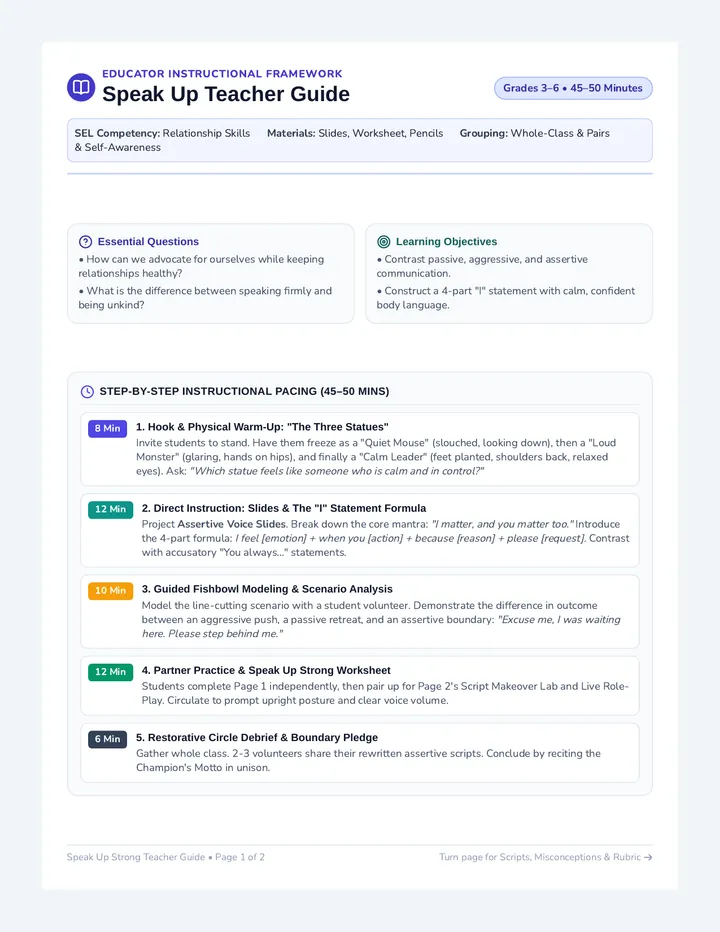
Speak Up Teacher Guide Educator Instructional Framework
Speak Up Teacher Guide
Grades 3–6 • 45–50 Minutes
SEL Competency: Relationship Skills & Self-Awareness
Materials: Slides, Worksheet, Pencils
Grouping: Whole-Class & Pairs
Essential Questions
• How can we advocate for ourselves while keeping relationships healthy?
• What is the difference between speaking firmly and being unkind?
Learning Objectives
• Contrast passive, aggressive, and assertive communication.
• Construct a 4-part "I" statement with calm, confident body language.
Step-by-Step Instructional Pacing (45–50 Mins)
8 Min
1. Hook & Physical Warm-Up: "The Three Statues"
Invite students to stand. Have them freeze as a "Quiet Mouse" (slouched, looking down), then a "Loud Monster" (glaring, hands on hips), and finally a "Calm Leader" (feet planted, shoulders back, relaxed eyes). Ask: "Which statue feels like someone who is calm and in control?"
12 Min
2. Direct Instruction: Slides & The "I" Statement Formula
Project Assertive Voice Slides . Break down the core mantra: "I matter, and you matter too." Introduce the 4-part formula: I feel [emotion] + when you [action] + because [reason] + please [request]. Contrast with accusatory "You always..." statements.
10 Min
3. Guided Fishbowl Modeling & Scenario Analysis
Model the line-cutting scenario with a student volunteer. Demonstrate the difference in outcome between an aggressive push, a passive retreat, and an assertive boundary: "Excuse me, I was waiting here. Please step behind me."
12 Min
4. Partner Practice & Speak Up Strong Worksheet
Students complete Page 1 independently, then pair up for Page 2's Script Makeover Lab and Live Role-Play. Circulate to prompt upright posture and clear voice volume.
6 Min
5. Restorative Circle Debrief & Boundary Pledge
Gather whole class. 2-3 volunteers share their rewritten assertive scripts. Conclude by reciting the Champion's Motto in unison.
Speak Up Strong Teacher Guide • Page 1 of 2 Turn page for Scripts, Misconceptions & Rubric ➔
Facilitation Scripts & Differentiation
Teacher talk moves, responsive scaffolding, and assessment tools.
Page 2: Implementation Tools
Teacher Demonstration Scripts (Say This Aloud)
When defining Assertiveness: "Being assertive is not being bossy or rude. It is simply telling the truth about what you need while still treating the other person with dignity."
When coaching reluctant speakers: "Your voice has value. If looking right in their eyes feels scary right now, look at the bridge of their nose or their forehead—it looks just as strong!"
Common Student Misconceptions & Coaching Responses
Misconception 1: "If I speak up, people won't like me."
Correction: True friends respect clear boundaries. When we keep quiet, resentment builds up. Speaking clearly actually prevents bigger fights later.
Misconception 2: "What if I speak assertively and they laugh or ignore me?"
Correction: Repeat the boundary once with the 'Broken Record' technique: "I heard you, and I still need you to stop." If they continue, it becomes an adult safety matter.
For Anxious / Shy Students:
• Allow students to whisper their line to a trusted buddy before standing up.
• Provide pre-printed sentence frame cards to hold as confidence anchors.
For High-Energy / Impulsive Students:
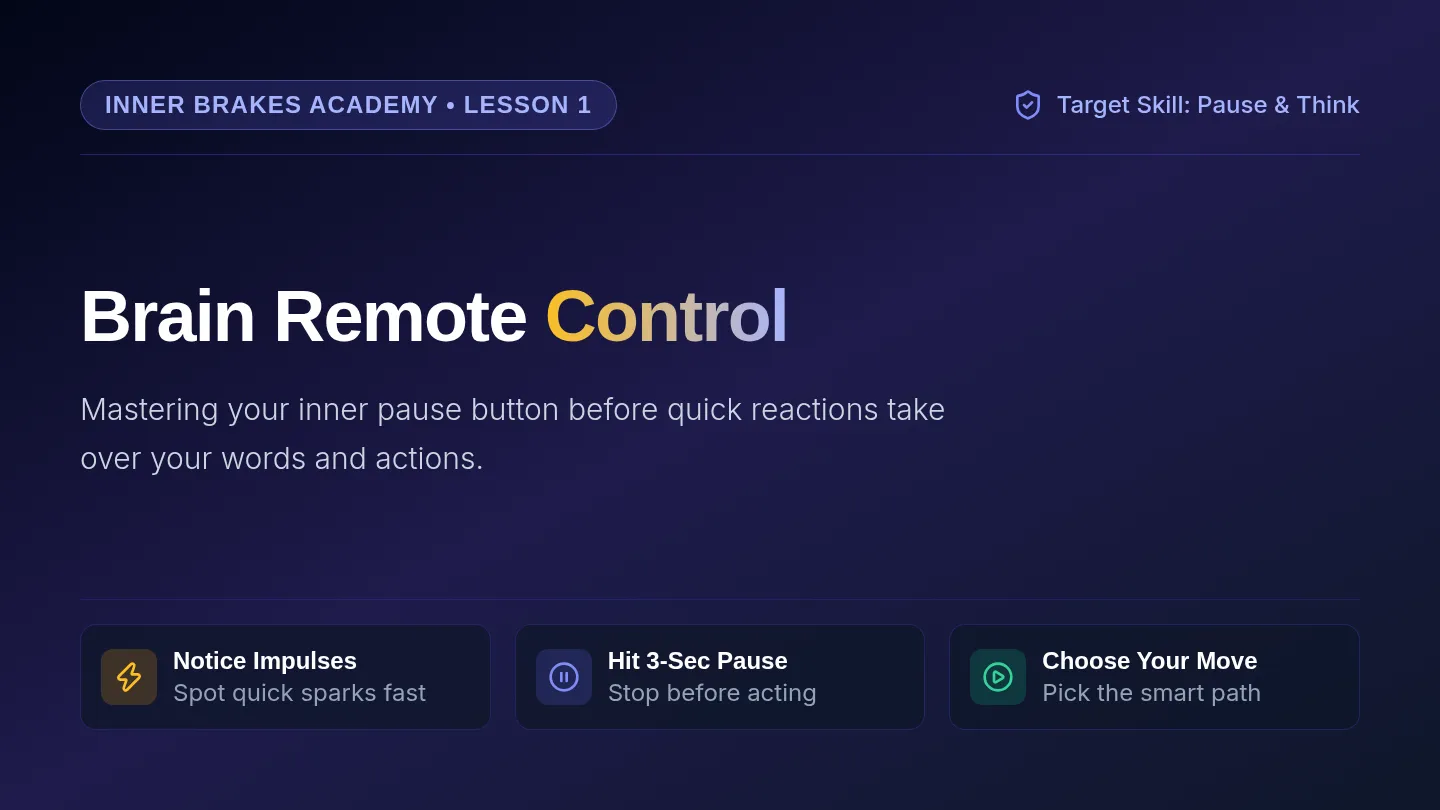
• Emphasize the "3-Second Pause" before speaking to neutralize aggressive tone.
• Check for open, relaxed hands rather than clenched fists.
Observation & Assessment Rubric 4-Point Quick Metric
1 - Emerging Relies on passive silence or aggressive outbursts; avoids eye contact.
2 - Developing Can write an "I" statement with heavy scaffolding; body language wavers.
3 - Proficient Speaks clearly with upright posture; delivers calm, respectful boundary.
4 - Exemplary Naturally de-escalates peer conflict; actively encourages peers to speak up.
Speak Up Strong Teacher Guide • Page 2 of 2 Post classroom anchor chart in the calm-down corner!