Pause Engine Lesson Plan SEL • Executive Function Grades 3–5 • 50 Minutes
Kinesthetic Braking Series
Pause Engine Lesson Plan
Building physical and cognitive impulse-braking reflexes to manage spontaneous reactivity and ease unstructured transitions.
Primary Objective
Students identify physical warning signals of impulsivity and execute 3 discrete braking mechanisms within 2 seconds of a stimulus.
Kinesthetic Motor Cues
Anchor hands onto thigh pads ("Anchor Down"), execute 4-count piston exhalation, and vocalize a cognitive friction phrase ("Name the Curve").
Key Materials
Pause Engine Slide Deck, Brake Pads Challenge Cards, Impulse Operator Blueprint sheets, floor boundary cones/tape.
The Three-Piston Braking Architecture
1. Body Brake (Piston 1)
Immediate motor stillness. Feet glued, palms locked flat onto thighs ("Emergency Clamps"). Halts motor momentum.
2. Breath Brake (Piston 2)
Exhaust release: deep 3-second inhale through nose, loud 4-second hissed exhale ("Releasing Steam"). Down-regulates heart rate.
3. Brain Brake (Piston 3)
Cognitive self-talk formula: "Clear road or crash zone?" Restores prefrontal executive control before verbal or motor action.
Stage 1: The Runaway Go-Kart Hook
10 Minutes
The Demonstration: Have students stand behind desks. Invite them to mimic revving a race engine with high-knees and steering arm motions. Suddenly call "HAIRPIN CURVE!" without brakes; observe the body collisions and giggles.
Script: “Our brains possess twin engines: the High-Speed Accelerator (impulse, excitement, survival) and the Brake Pads (prefrontal cortex). An engine without brake pads doesn't win races—it totals the car. Today, we install custom brake pads.”
Stage 2: Precision Kinesthetic Modeling
12 Minutes
Use the Slide Deck to project the physical braking sequences. Guide deliberate muscle engagement:
Body Lock Drill: Call "Clamp!" Students freeze mid-movement, dropping hands heavy onto thighs. Check for zero wobble.Exhaust Valve Drill: Synchronize class breath with an auditory hiss sound like hydraulic bus brakes releasing air.Internal Query: Whisper choral check: "Pause the motor, scan the track."
Pause Engine Facilitation Blueprint Page 1 of 2
2
Simulation, Transition Scripts & Accommodations
Execution Guide
Stage 3: Brake Pads Kinesthetic Arena
15 Minutes
Transition students to open carpet space using the Brake Pads Movement Game cards. Run 4 simulated high-friction classroom scenarios:
Recess Whistle Drill:
Sudden freeze while in active locomotion; measure silent braking time within 3 seconds.
Line-Cut Impulse Trigger:
Simulate someone stepping ahead in line; execute verbal Brain Brake instead of shoving or shouting.
Stage 4: Blueprinting & Calibration
13 Minutes
Distribute the Impulse Operator Activity Sheet . Students diagnose their unique somatic triggers (e.g., clenched fists, fidgety legs, buzzing chest) and customize their personal Brake Formula. Students cut out and keep the pocket dashboard token for daily desk use.
Teacher Verbal Braking Callouts for Unstructured Transitions Classroom Cues
"Shift to Neutral"
Called during loud free work: all hands leave materials, eyes pivot to teacher, zero voices.
"Clamp the Pads"
Called when physical rowdiness spikes: immediate palm-to-thigh anchor with 3-second hiss.
"Slow Roll to Line"
Replaces unstructured line rushes with deliberate heel-to-toe pacing (speed limit 5 MPH).
Differentiation & Inclusive Accommodations
ADHD & High Motor Drive:
Replace rigid frozen stillness with isometric pressure (pressing palms together firmly or squeezing an under-desk resistance band). This provides required proprioceptive input while fulfilling the pause.
Sensory Over-Responsivity:
Transitions trigger auditory overwhelm. Allow noise-muffling headphones during transitions and use visual cue cards (red brake disk paddle) rather than loud whistles or sudden verbal shouts.
Formative Success Indicators
Emerging (1): Requires multiple repeated verbal prompts; motor momentum carries 5+ seconds past cue.
Proficient (2): Locks body brake within 2 seconds; independently regulates breath during transition cue.
Mastery (3): Preemptively initiates braking at transition triggers without teacher cue; assists peers.
Pause Engine Facilitation Blueprint Page 2 of 2
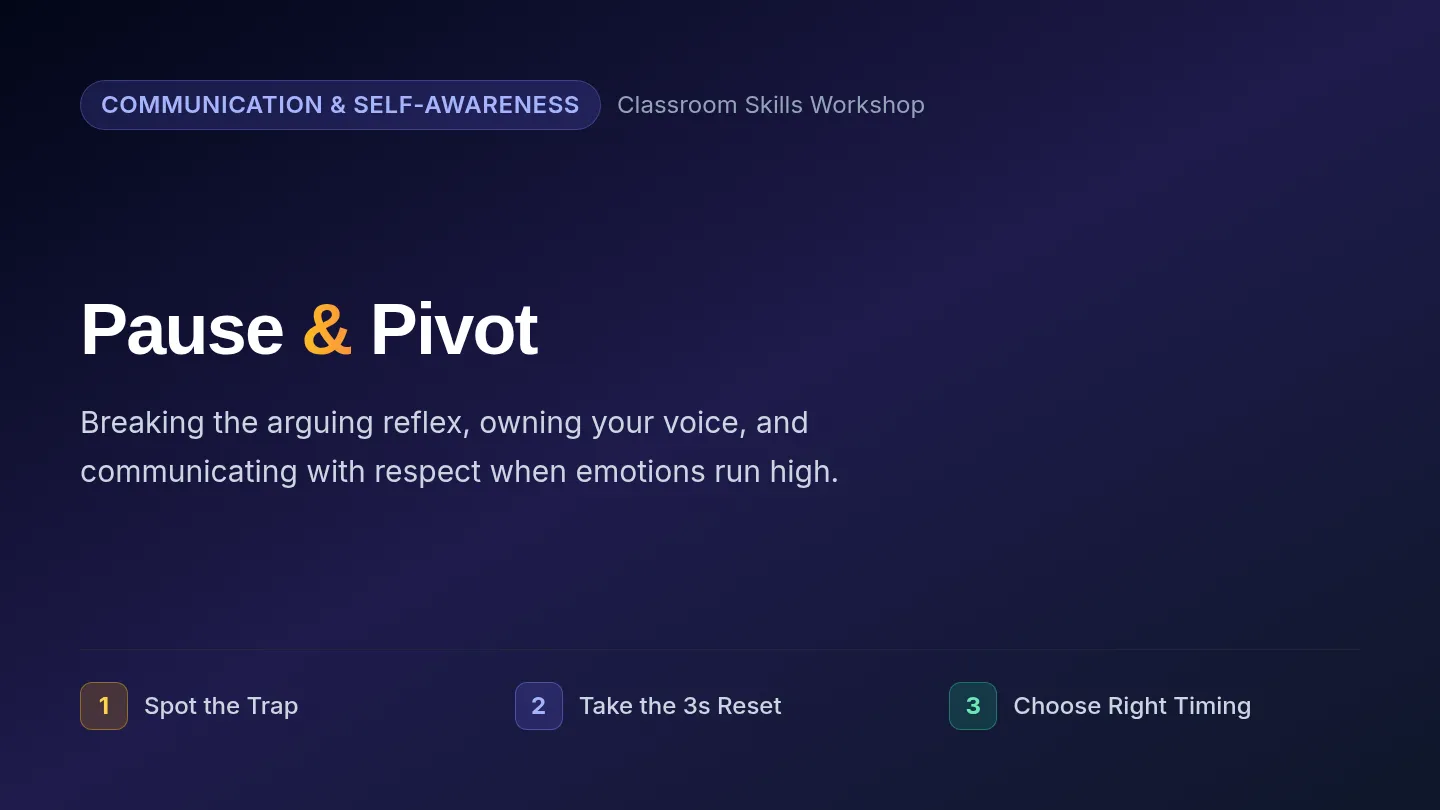
Pause Engine Slides Kinesthetic Self-Regulation
Grades 3–5 • Executive Function
Self-Control Lab
THE PAUSE ENGINE
High horsepower means nothing without high-performance brakes. Learn the physical moves to stop impulses before you crash.
Ready to tune your internal brakes
Slide 1 / 6
Brain Mechanics
Two Engines Inside Your Mind
The Accelerator
Instant Impulse Engine
Wants to sprint, shout, and grab right now
Fires in less than half a second
Can steer directly into trouble if left alone
Danger: Hairpin turns and collision warnings!
The Brake Pads
Executive Control Center
Takes 2 extra seconds to lock down
Scans ahead to protect you and classmates
Gives YOU the steering wheel, not the impulse
Power: Smooth steering through tricky transitions!
Who is driving your car today? Slide 2 / 6
The Kinesthetic Formula
The Three-Piston Brake System
Body • Breath • Brain
1
BODY BRAKE
“Anchor Down”
Slam palms heavy onto your thighs. Plant feet into the floor like glued concrete blocks.
Motor momentum stops cold.
2
BREATH BRAKE
“Release Steam”
Deep 3-second nose inhale, followed by a 4-second slow hydraulic hiss out through your teeth.
Cools your racing pulse.
3
BRAIN BRAKE
“Scan the Track”
Ask yourself silently: “Is this a clear road or a crash zone? What is my best move?”
Restores smart executive control.
Practice the full 3-second sequence Slide 3 / 6
Somatic Awareness
High-Friction Trigger Zones
The Recess Whistle
Body is running at 100 MPH. Whistle blows. Urge to get one more kick or tag.
Move: Anchor Down instantly
The Doorway Stampede
Everyone squeezes toward the door at once. Backpack bumping, pushing, and rushing.
Move: Shift to Neutral (5 MPH)
The Blurt Impulse
You know the answer and your hand shoots up while your mouth already started shouting.
Move: Breath Brake (Hiss steam)
The Line Cutting Provocation
Someone steps right in front of you. Fists tighten, heartbeat jumps, urge to shove.
Brake Pads Movement Game Kinesthetic Simulation Game 2–30 Players • 15–20 Min
Brake Pads Movement Game
Train split-second physical and cognitive braking under real classroom motion, sensory distraction, and transition pressure.
The Objective
Drivers maneuver through transition zones at variable throttle and lock into total motor stillness within 1.5 seconds of a hazard signal.
Track Roles
Drivers: Students executing movement.Pit Inspectors: Student referees checking for body wobble, vocal quiet, and exhaust hiss.
Brake Badges
Earn 1 "Brake Pad Token" for zero momentum drift, 1 token for deep sync hiss, and 1 token for identifying the hazard correctly.
Four Precision Kinesthetic Arenas
Arena 1: The Yellow Flag Slalom Agility & Freeze
Students weave around floor tape marks at high walking pace. On sudden whistle or call “OIL SLICK!” , drivers slam palms to thighs with feet glued. Zero sliding permitted.
Pass Condition: Complete statue freeze under 1.5s with eyes fixed ahead.
Arena 2: The Doorway Funnel Trap Spatial Spacing
Simulate lining up at the classroom doorway. Students must keep a 2-foot imaginary bumper zone. If bumper contact occurs, student must say “Re-engaging brake” and step back 2 paces.
Pass Condition: Entire group transitions through tape threshold without touching.
Arena 3: The False Alarm Decoy Auditory Inhibition
Teacher calls random words (“Bridge!”, “Spark!”, “Turbo!” ). Students MUST keep moving smoothly. They only brake when they hear the true secret brake trigger: “RED ROTOR!”
Pass Condition: Resisting false triggers without flinching or stuttering.
Arena 4: The Soundwave Dampener Vocal Control
Students engage in lively structured conversation with a partner about a high-interest topic. When chime rings, all talk drops to zero within 1 second followed by synchronized hydraulic hiss out.
Pass Condition: Instant vocal cut-off without lingering whisper chatter.
Pit Crew Referee Checklist (For Student Judges) Scoring Standard
• Check 1: Motor Freeze Feet locked? Knees stable? Hands heavy on thighs or desks? No giggling drift.
• Check 2: Audio Exhaust Did the driver release air through teeth (Tssss ) to dump impulsive physical energy?
• Check 3: Track Scan Are eyes looking toward the teacher or next instruction, ready for smart steering?
Impulse Operator Activity Sheet Pilot Name:
Date:
Cabin / Rm:
Impulse Operator Activity Sheet
Section 1 • Personal Engine Diagnostics & Custom Brake Blueprint
Diagnostics Mode
Part 1: Early Warning Sensor Check
Check the physical sensations you feel right before acting on impulse:
Racing Heart Chest thumping like a motor revving up
Tight Fists / Claws Fingers clenching or gripping objects hard
Buzzing Feet Legs tapping, bouncing, or itching to sprint
Hot Cheeks / Neck Sudden heat rising into face or ears
Jaw Lock Teeth clamping together tightly
Tunnel Vision Only seeing what I want; ignoring directions
Personal Trigger Reflection: In your own words, describe the exact situation where your engine overheats the fastest:
Part 2: Calibrating My Three Personal Brakes
Customize the physical actions you will use
1 Body Brake (My Physical Anchor Move) Example: Slap palms to thighs, press shoes flat, or clasp hands
2 Breath Brake (My Steam Release Move) Example: 4-second hydraulic hiss, slow birthday candle blow, or nose count
3 Brain Brake (My Track-Scanning Phrase) Example: "Clear or crash?", "Step back first", "Slow the roll"
Impulse Operator Self-Regulation Blueprint Page 1 of 2
Part 3: Transition Road Test & Pocket License
Apply your calibrated brakes to real classroom transition hazards.
Execution Test
Hazard A: The Noisy Hallway Stampede Transition Friction
Your class is walking down the hall. Kids are whispering loudly, tapping lockers, and speeding up. You feel the urge to push forward and run.
My Braking Action Plan:
Hazard B: The Disappointment Flare Reactivity Friction
You lined up for your turn at the swings or computers, but right before you sit down, free time is called over. Your fists ball up tight.
My Braking Action Plan:
Hazard C: The Sudden Schedule Pivot Cognitive Flexibility
You were in the middle of a fun science build when the teacher announces: “Clean up immediately, we have a surprise visitor.”
My Braking Action Plan:
Official Pause Engine Operator License
Cut out along dashed line • Tape to desk or carry in pocket
Certified
Body Anchor:
Steam Release:
Brain Motto:
Pilot Signature:
“I control the accelerator. I command the brakes.”
Impulse Operator Self-Regulation Blueprint Page 2 of 2