Pause Power Slides Conflict Resolution Lab
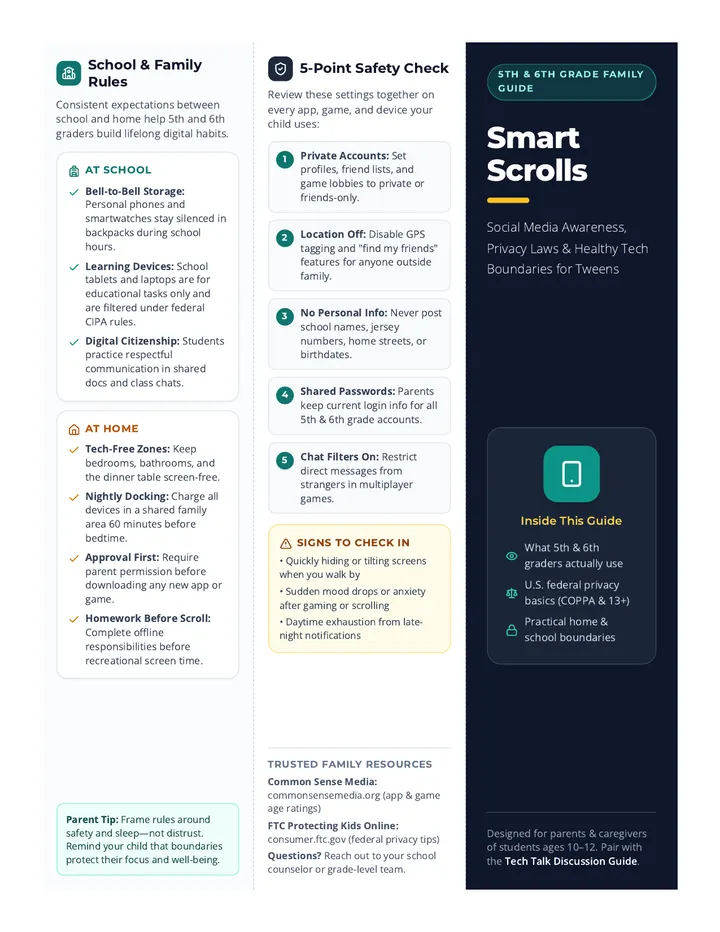
Pause Before Reacting
How to spot your emotional triggers, read your body's warning signals, and choose a smart response when conflict heats up.
1. Spot the Trigger
2. Read the Signal
3. Choose Your Reset
Warm-Up: What Pushes Your Buttons?
5 Minutes
Today's Goal
I can notice what triggers me and use a cool-down strategy before I say or do something I regret.
Think & Share
Think of a time someone annoyed you at school or online.
What happened right before you got mad?
Did you react right away, or wait?
Tip: Everyone has different triggers—knowing yours gives you control.
Key Concept
The Power of the Pause
1. Trigger
A comment, look, or unfair moment.
2. Signal
Your body heats up or tenses up.
3. PAUSE
Buy 5 seconds before acting.
4. Reset
Pick a tool to calm your brain.
5. Respond
Speak or act with control.
Reacting is automatic. Responding is a choice you make inside the pause.
Early Warning System
Spot Your Body's Heat Signals
Heart & Face
Racing heartbeat, hot cheeks, or fast, shallow breathing.
Muscles & Jaw
Clenched fists, tight jaw, or shoulders creeping up.
Focus & Thoughts
Tunnel vision, racing thoughts, or wanting to snap back fast.
Voice & Energy
Voice getting louder, talking faster, or feeling restless.
Notice the signal early—that is your cue to hit pause before words fly.
Strategy Menu
Your 4-Tool Reset Kit
1. Box Breathing (4-4-4)
Inhale 4 seconds, hold 4 seconds, exhale 4 seconds. Slows your heart rate fast.
2. Step-Back Script
Say: "I need a minute before we talk about this," or step away from your phone.
3. Reframe Question
Ask yourself: "Will this matter tomorrow?" or "What is another reason they did that?"
4. 3-2-1 Grounding
Notice 3 things you see, 2 things you feel, and 1 sound around you to get out of tunnel vision.
You do not need all four—pick the 1 or 2 tools that actually work for you.
Guided Practice
Scenario: The Group Chat Screenshot
You open your phone after school and see someone shared an embarrassing photo of you in a 12-person group chat. People are dropping laughing emojis. Your face feels hot and your thumbs are ready to type an angry clapback.
1. Trigger & Signal
What is the trigger? What body signal showed up?
2. Reset Tool
Which tool helps before you type anything?
3. Cool Response
What is a firm, smart next step?
Turn to a partner for 60 seconds and map out all 3 steps.
Your Turn
Conflict Crossroads Challenge
1
Trigger Tracker
Complete your personal Trigger Tracker and pick your top 2 reset tools.
2
Scenario Cards
In your group, analyze 2 Conflict Crossroads cards and plan a cool response.
3
Exit Ticket
Before you leave, name one trigger and the reset tool you will test this week.
Remember: Strong people do not react fastest—they choose best.
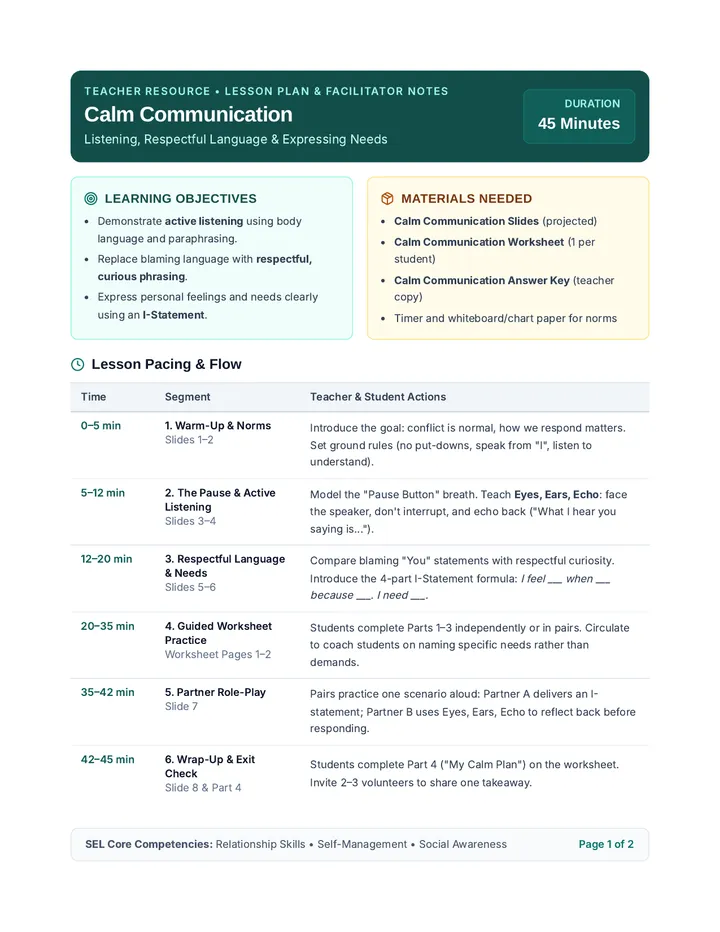
Pause Power Teacher Guide Teacher Facilitation Guide
Pause Before Reacting
Grades 6–8 • Advisory / SEL
45-Minute Lesson
Learning Objective
Students will identify personal emotional triggers and physical warning signs, then apply a chosen cool-down strategy before responding to peer conflict.
Lesson Materials
• Pause Power Slides (7 slides)
• Trigger Tracker Worksheet (1 per student)
• Conflict Crossroads Cards (1 set per group of 3–4)
• Cool Down Exit Ticket (half-sheet per student)
45-Minute Pacing Plan
Time
Phase
Teacher & Student Actions
0–5 min
Warm-Up (Slides 1–2)
Introduce learning target. Pair-share: "What pushes your buttons?" Take 2–3 quick examples without naming names.
5–15 min
Mini-Lesson (Slides 3–5)
Walk through the 5-step Trigger-to-Response chain, body heat signals, and the 4-Tool Reset Kit. Model 1 round of Box Breathing.
15–22 min
Guided Practice (Slide 6)
Read "The Group Chat Screenshot" aloud. Pairs map Trigger, Body Signal, Reset Tool, and Cool Response in 60 seconds; debrief as a class.
22–32 min
Individual Tracker
Students complete the Trigger Tracker Worksheet independently (heat signals, top 3 triggers, and personal reset plan).
32–41 min
Group Crossroads
Groups of 3–4 draw 2 Conflict Crossroads Cards and complete the Group Recording Sheet. Share 1–2 group solutions aloud.
41–45 min
Wrap-Up & Exit Ticket
Students complete the Cool Down Exit Ticket before dismissal.
Facilitation Notes: Slides 1–4
Slide 2 (Warm-Up): Keep it low-stakes & anonymous.
Remind students: "Share the situation, not anyone's name." Normalizing triggers helps middle schoolers drop their guard.
Slide 3 (The Power of the Pause): Emphasize the 5-second gap.
Ask: "Why is Step 3 (Pause) the hardest step?" Point out that our brains want to defend ourselves fast, but 5 seconds lets the thinking brain catch up.
Slide 4 (Heat Signals): Normalize physical cues.
Have students silently raise a finger if they notice clenched fists, hot face, or loud voice when annoyed. Reinforce that body signals are helpful alarms, not flaws.
Pause Before Reacting — Teacher Guide Page 1 of 2
Facilitation, Differentiation & Answer Notes
Page 2
Slide 5 (4-Tool Reset Kit): Practice one tool live.
Lead the class in one 12-second cycle of Box Breathing (4-4-4). Ask which tool feels realistic in a hallway vs. at home on a phone.
Slide 6 (Group Chat Scenario): Debrief smart vs. escalating moves.
Highlight that firing back in the group chat gives the drama more oxygen. Smart responses include locking the phone, using 3-2-1 grounding, screenshotting for an adult if needed, or talking 1-on-1 later.
Differentiation Supports
ELL / Multilingual: Pre-teach trigger, signal, pause, reframe with gestures; allow sentence starters ("When I feel ___, I will ___").Sensory / Neurodivergent: Offer a quiet corner or doodle space during Trigger Tracker; allow drawing body signals instead of writing sentences.Extension: Challenge early finishers to write a realistic 4-line dialogue showing a de-escalated peer conversation.
Common Misconceptions
"Pausing means I'm weak." Clarify that pausing protects your reputation and keeps you from getting in trouble for someone else's provocation."I shouldn't feel angry at all." Anger is a normal signal; regulation is about choosing what you do with it, not pretending you don't care."One tool works for everything." Different settings need different tools (e.g., Step-Back Script works in person; putting the phone down works online).
Sample Responses & Key Notes
Cool Down Exit Ticket — Item 1 (Multiple Choice):
Correct Answer: B ("Notice your body signal and take a 5-second pause before speaking or typing"). Options A, C, and D represent reactive or escalating behaviors.
Conflict Crossroads Cards — What to Look For:
• Card 1 (Blamed in Class): Trigger = unfair accusation; Reset = Box Breathing or Reframe; Cool Response = "I didn't do that, can we check after class?"
• Card 2 (Lunch Line Cut): Trigger = disrespect/unfairness; Reset = 3-2-1 Grounding; Cool Response = Calmly say "Hey, the line starts back there," or move on.
• Card 3 (Group Project Slacker): Trigger = carrying all the work; Reset = Step-Back Script; Cool Response = "Let's split the last two slides right now so we're both ready."
• Card 4 (Sideline Trash Talk): Trigger = public embarrassment; Reset = Reframe ("Will this matter tomorrow?"); Cool Response = Ignore the bait and focus on the game.
Pause Before Reacting — Teacher Guide Page 2 of 2
Trigger Tracker Worksheet Student Worksheet Pause Before Reacting
My Trigger Tracker
Name: ____________________________________ Date: ___________________
1
Spot Your Body's Heat Signals
Check the signals you notice in your body right before you lose your cool:
Racing heart or fast breathing
Hot face or ears
Clenched fists or tight jaw
Voice getting louder or faster
Stomach knots or tense shoulders
Tunnel vision / wanting to snap back
Another signal I notice in myself:
2
My Top 3 Conflict Triggers
List three situations at school, at home, or online that push your buttons. Rate the heat level from 1 (mild) to 5 (explosive).
Trigger #1 Heat Level (1–5): ______
Trigger #2 Heat Level (1–5): ______
Trigger #3 Heat Level (1–5): ______
Page 1 of 2
3
Build Your Reset Toolkit
Review the four reset tools and choose the two that feel most realistic for you.
1. Box Breathing: Inhale 4s, hold 4s, exhale 4s.
2. Step-Back Script: "I need a minute before we talk."
3. Reframe Question: "Will this matter tomorrow?"
4. 3-2-1 Grounding: 3 sights, 2 feels, 1 sound.
My #1 Go-To Reset Tool and when I will use it:
My #2 Backup Reset Tool and when I will use it:
4
Real-Life Rewind
Think of a recent disagreement (or a situation that might happen this week). Map out how you can handle it using the pause.
The Trigger (What happened?):
My Body's Heat Signal:
Reset Tool I Would Use:
My Cool Response (What I would say or do after pausing):
Page 2 of 2
Conflict Crossroads Cards Small-Group Activity
Conflict Crossroads Cards
Cut along dashed lines
Card 1
Blamed in Class
The teacher hears talking behind you and tells you to stop interrupting, even though you were silent. Two classmates snicker.
Group Discussion:
1. What is the trigger & likely heat signal?
2. Which reset tool works best right here?
3. What is a respectful, cool response?
Card 2
Cut in the Lunch Line
You have been waiting in the lunch line for 10 minutes. An older student walks up, steps right in front of you, and pretends not to see you.
Group Discussion:
1. What is the trigger & likely heat signal?
2. Which reset tool works best right here?
3. What is a firm, cool response?
Card 3
Group Project Slacker
Your science project is due tomorrow. Your partner has not done their two slides and texts you: "Just finish mine, you're better at it anyway."
Group Discussion:
1. What is the trigger & likely heat signal?
2. Which reset tool works best right here?
3. What is a smart, cool response?
Card 4
Sideline Trash Talk
During PE, you miss an easy shot. Someone on the other team yells, "Bro, just sit down!" and a few kids start laughing.
Group Discussion:
1. What is the trigger & likely heat signal?
2. Which reset tool works best right here?
3. What is a confident, cool response?
Page 1 of 2 — Scenario Cards
Group Recording Sheet Conflict Crossroads
Our Group's Cool-Down Plan
Group Names: ______________________________________ Date: _______________
Choose two Conflict Crossroads cards with your group and map out your plan below.
Scenario #1 Card Number / Title: _________________________
Trigger & Body Signal:
Reset Tool Chosen:
Our Cool Response (Exact words or actions):
Scenario #2 Card Number / Title: _________________________
Trigger & Body Signal:
Reset Tool Chosen:
Our Cool Response (Exact words or actions):
Page 2 of 2 — Group Recording Sheet
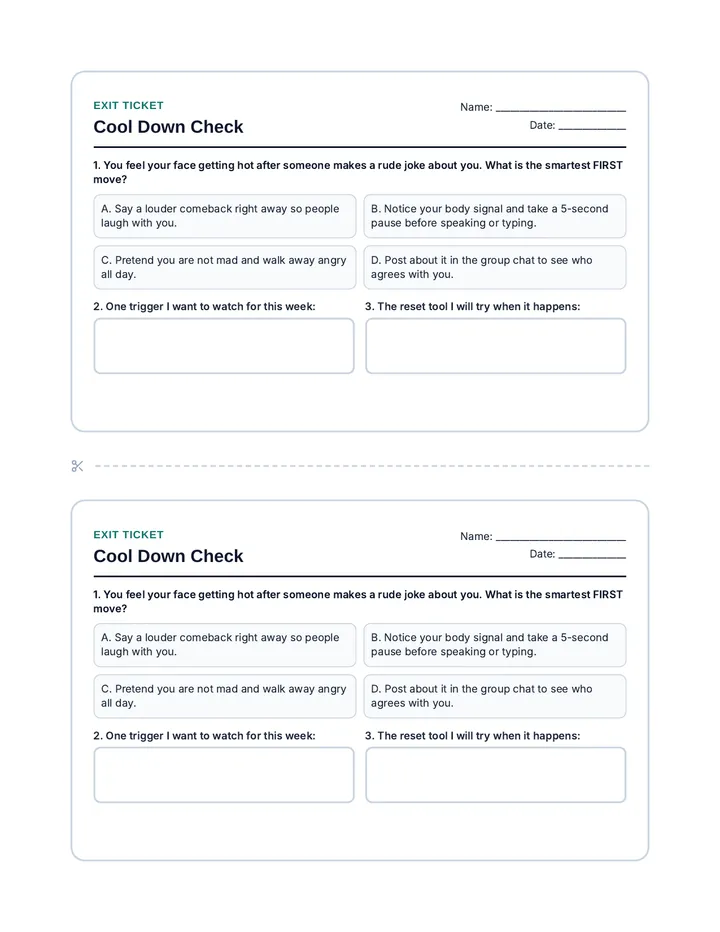
Cool Down Exit Ticket Exit Ticket
Cool Down Check
Name: ___________________________
Date: ______________
1. You feel your face getting hot after someone makes a rude joke about you. What is the smartest FIRST move?
A. Say a louder comeback right away so people laugh with you.
B. Notice your body signal and take a 5-second pause before speaking or typing.
C. Pretend you are not mad and walk away angry all day.
D. Post about it in the group chat to see who agrees with you.
2. One trigger I want to watch for this week:
3. The reset tool I will try when it happens:
Exit Ticket
Cool Down Check
Name: ___________________________
Date: ______________
1. You feel your face getting hot after someone makes a rude joke about you. What is the smartest FIRST move?
A. Say a louder comeback right away so people laugh with you.
B. Notice your body signal and take a 5-second pause before speaking or typing.
C. Pretend you are not mad and walk away angry all day.
D. Post about it in the group chat to see who agrees with you.
2. One trigger I want to watch for this week:
3. The reset tool I will try when it happens: