Owning It Lesson Plan Virtue of the Month • Grade 8 Advisory • Duration: 30 Min
Lesson Plan: Owning Responsibility
Focus Virtue
RESPONSIBILITY
Learning Objectives
• Define "Virtue": Understand moral excellence practiced through habitual, repeated action.
• Analyze Responsibility: Differentiate what is inside vs. outside the Circle of Control.
• Collaborate & Reflect: Debate peer scenarios on Google Classroom and submit personal reflections.
Materials & Prep
• Slides: Virtue in Action
• Google Classroom prompt & doc ready
• Post-Discussion Task digital/print
• 1:1 Chromebooks logged in
30-Minute Instructional Procedure
1 Direct Instruction: The Concept of "Virtue" 10 Min
Teacher Presentation Points:
Virtue defined: Greek arete (excellence). A positive character habit shaped by daily practice, not a passive label.Responsibility: Response-ability—owning one's choices, actions, and reactions.
Circle of Control Framework:
I Control: My effort, language, attitude, and how I fix mistakes.I Don't Control: Others' rumors, past mistakes, external rules.
2 Small Group: Google Classroom Discussion Prompts 12 Min
Students form groups of 3–4, open Google Classroom, and collaborate on real-world dilemmas:
Scenario A: Projects A teammate ghosts their portion right before the due date. What is responsible action?
Scenario B: Chat Drama An embarrassing picture is forwarded in a group thread. Who holds bystander responsibility?
Scenario C: Excuses Blaming a strict teacher or bad Wi-Fi for missing work. How to pivot to full ownership?
Teacher prompts: "Listen actively to your peers—you will need to record what a peer stated on your reflection sheet!"
3 Independent Reflection: Post-Discussion Task Template 8 Min
Students independently complete and submit their document on Google Classroom:
1. Teacher said Synthesize definition of virtue & control circles.
2. Peer/s said Summarize a teammate's perspective on the scenarios.
3. I said (Crucial) Personal contribution & actionable pledge for the month.
Facilitation Tips
Emphasize that virtue is about integrity when no one is watching. Encourage students to celebrate teammates who admitted mistakes during group discussion.
Formative Check
Review submitted Post-Discussion Tasks on Google Classroom. Check the "I said" box for substantive reflection rather than superficial one-word answers.
Virtue In Action Slides Virtue of the Month
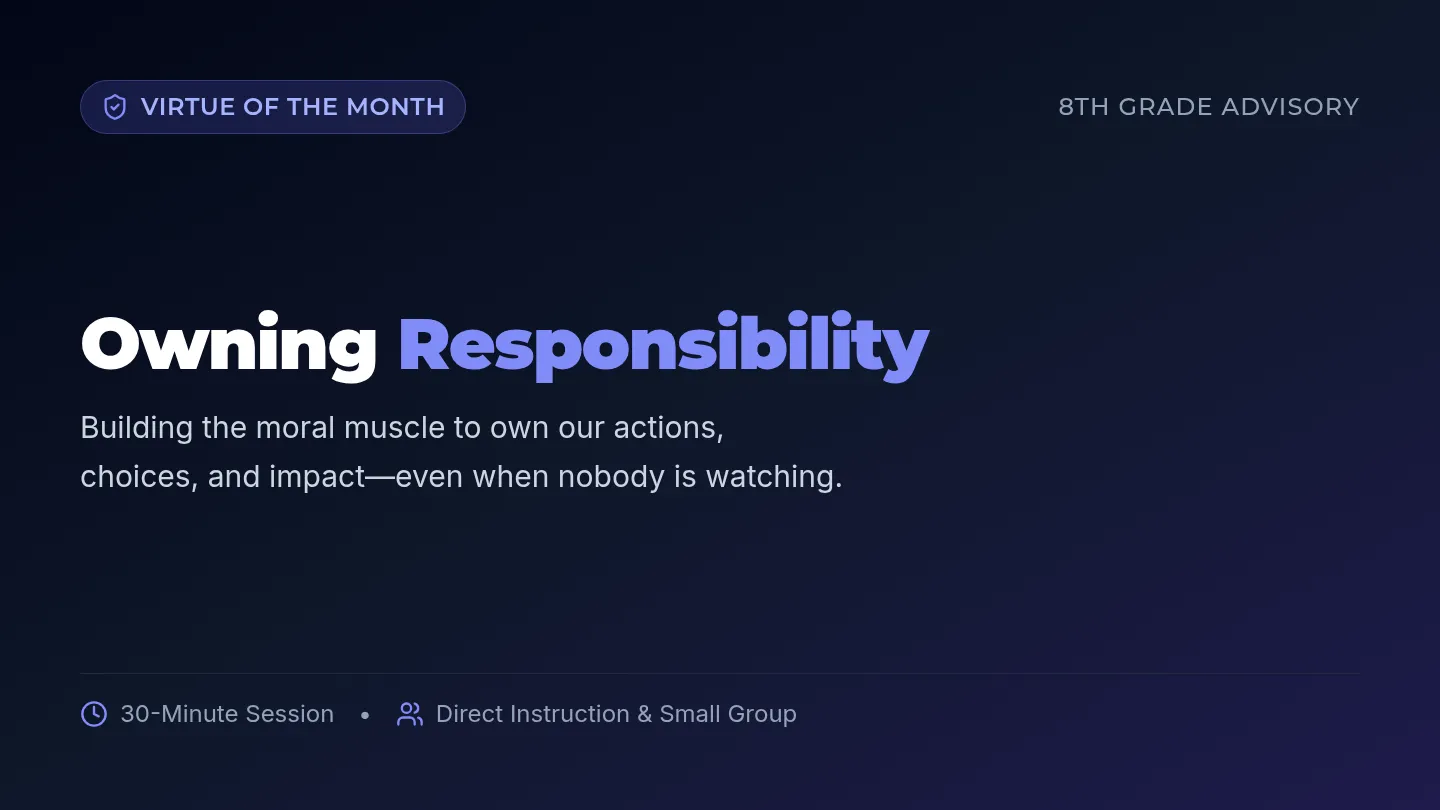
8th Grade Advisory
Owning Responsibility
Building the moral muscle to own our actions, choices, and impact—even when nobody is watching.
30-Minute Session • Direct Instruction & Small Group
1
What is a "Virtue"?
Direct Instruction
Ancient Roots: Aretē
In Greek philosophy, virtue means excellence of character. It is moral fitness.
A virtue isn't what you say you believe—it's how you actually behave.
Virtue is a Habit
You don't become responsible by knowing the definition. You build virtue through repeated, deliberate daily practice.
"We are what we repeatedly do." — Will Durant
Key Note: Listen closely for ideas to record under "Teacher said" on your reflection sheet.
2
The Anatomy of Responsibility
Core Concept
Word Breakdown
Response + Ability
Your ability to choose your reaction between a stimulus and your response.
Reaction: Immediate impulse.
Mindset Shift
Ownership vs. Blame
Blame gives away your control to other people or circumstances.
Blame: "It's their fault I failed."
When you take 100% responsibility, you gain 100% control over your future.
3
The Circle of Control
Mental Model
Inside My Control
Where my responsibility lives:
My effort & study habits
Words I say online and in person
How I respond when I make a mistake
Asking for help when I am stuck
Outside My Control
What I must release:
What other people say about me
Past mistakes that already happened
How other people choose to act
School rules or grading rubrics
Virtue is choosing to pour your energy only into what is Inside Your Control.
4
Small Group: Google Classroom
12 Minutes
Open Google Classroom with your group of 3–4. Read and debate your scenario:
Scenario 1
The Group Project
Your partner fails to turn in their slides before the group presentation. Who is responsible for what happens next?
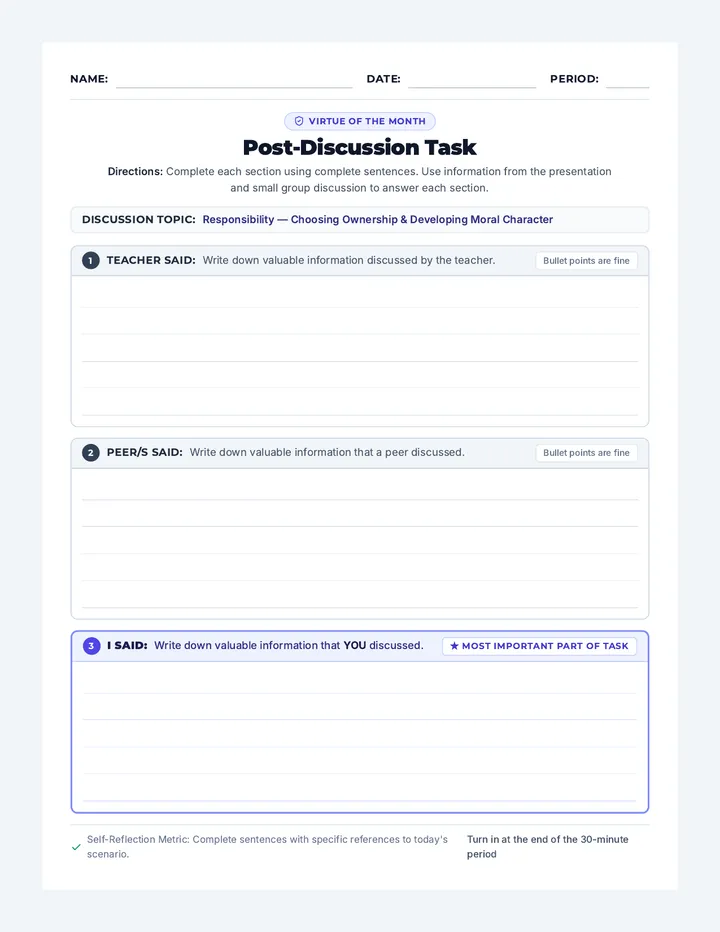
Post Discussion Task Worksheet Name:
Date:
Period:
Virtue of the Month
Post-Discussion Task
Directions: Complete each section using complete sentences. Use information from the presentation and small group discussion to answer each section.
Discussion Topic: Responsibility — Choosing Ownership & Developing Moral Character
1 Teacher said: Write down valuable information discussed by the teacher.
Bullet points are fine
2 Peer/s said: Write down valuable information that a peer discussed.
Bullet points are fine
3 I said: Write down valuable information that YOU discussed.
★ Most important part of task
Self-Reflection Metric: Complete sentences with specific references to today's scenario. Turn in at the end of the 30-minute period