Teacher Note: Set an active, introspective atmosphere. Emphasize that there are no wrong answers today; this is self-discovery, not a graded academic test.
PACING: 5-10 MINS
Talking Points: "What exactly is an internal compass? It consists of three primary coordinates: Your Core Values (what keeps you upright and gives you purpose), your Mindset Blocks (the invisible walls or 'Gremlins' we build in our minds), and your Inherent Strengths (your operating style). When these align, career choices and big life moves stop feeling like wild guesses."
Action: Direct students to review the schematic on their worksheet cover. Discuss briefly how values differ from interests (interests change, values are stable).
PACING: 10-25 MINS
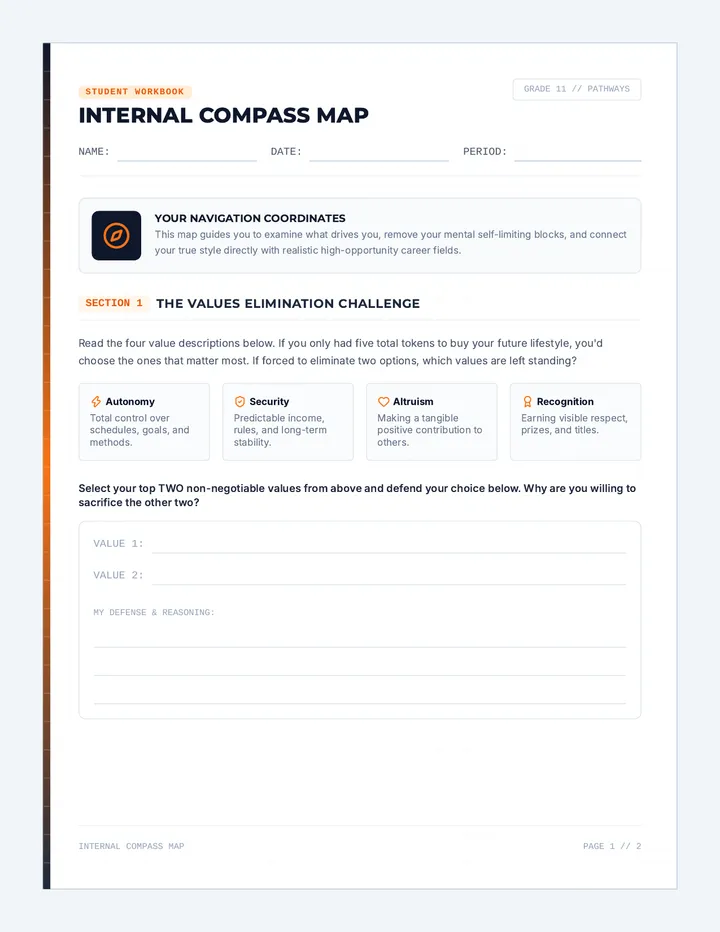
Talking Points: "Let's play a high-stakes scenario. Look at the four core drivers on the screen: Autonomy, Security, Altruism, and Recognition. If I handed you 5 tokens, you could invest them. But now, you must throw two drivers away completely. If your future career had Altruism but zero Autonomy, would you stay? If you had absolute Autonomy but no Security, how would you sleep?"
Facilitation Key: Give students 3 minutes to complete Section 1 of the Workbook. Then, poll the class: "Who kept Altruism over Security? Why?" Force students to actively articulate their logic.
PACING: 25-35 MINS
Talking Points: "An internal compass isn't just about sunny aspirations; we also have to map the terrain of our minds. Meet the 'Gremlins'—the Imposter, the Fixed Label, and the Protectionist. These are defensive voices we invent to avoid failure. Which one sounds loudest in your mind when you look at college guides or challenging AP classes?"
Common Roadblock: Students may resist admitting self-limiting beliefs. Normalize this by sharing a personal example of your own "Imposter" or "Protectionist" moments from when you were their age.
INTERNAL COMPASS TEACHER GUIDE PAGE 2 // 3
SECTION 3 // FACILITATION SCRIPTS & SYSTEMS
PACING: 35-45 MINS
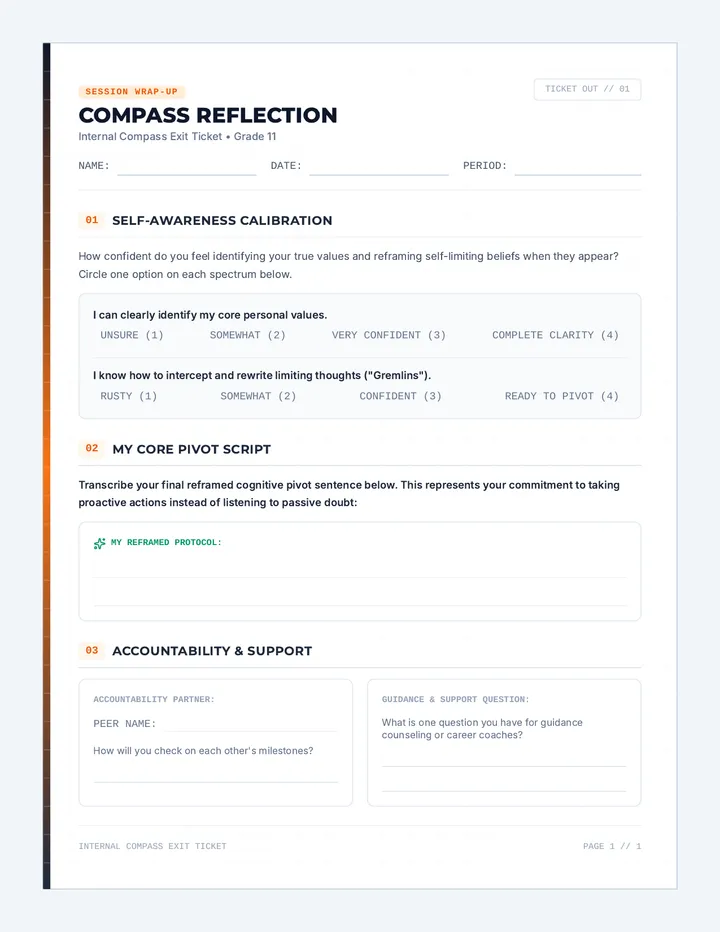
Talking Points: "How do we beat a Gremlin? We don't yell at it—we cross-examine it. Look at the Pivot Method on the screen. We isolate the anchor, demand objective physical evidence of its claims, and then construct a protocol-based pivot. We turn 'I can't do college science' into 'I will practice 3 strategy habits to study biology next week.' Action dismantles doubt."
Workbook Connection: Monitor the room closely as students complete Section 2 of their workbook. Help students write actionable "pivots" instead of just passive positive-thinking statements.
PACING: 45-55 MINS
Talking Points: "Now let's bridge our findings to reality. Look at the four occupational cohorts: Creative, Analytical, People, and Enterprise. Which cohort matches your value set best? If your highest value is Autonomy, a rigid Enterprise environment might wear you out. If you thrive on Altruism, how can you infuse that into the Analytical cohort?"
Class Connection: Guide students to match their selected "top values" from the worksheet with the profiles. Ensure they see that values are the foundation of healthy alignment.
PACING: 55-60 MINS
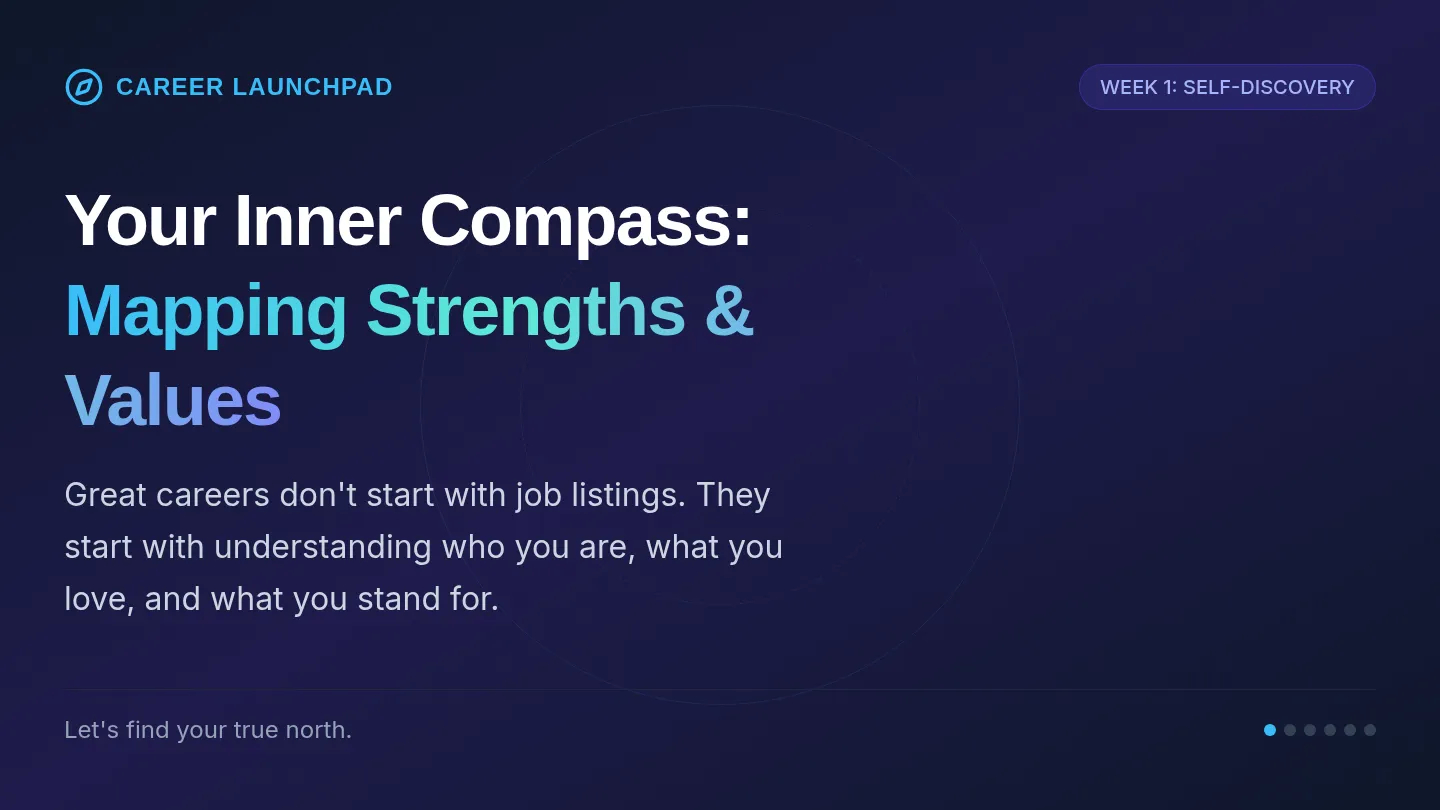
Talking Points: "We've mapped our values, named our limiting beliefs, and aligned them with real-world pathways. Today is just step one. Before you leave, share one reframed pivot sentence with a partner, and make sure to turn in your Takeaway Exit Ticket. Your compass is set—now let's start navigating."
For Scaffolded Learners:
Provide pre-printed sentence starters for the cognitive reframing pivot. Offer a word bank of 10 values for students who struggle with open-ended selections.
For Accelerated Learners:
Have students complete the full profile and research a real-world local internship or job listing that explicitly satisfies all of their top 3 core values.
INTERNAL COMPASS TEACHER GUIDE PAGE 3 // 3