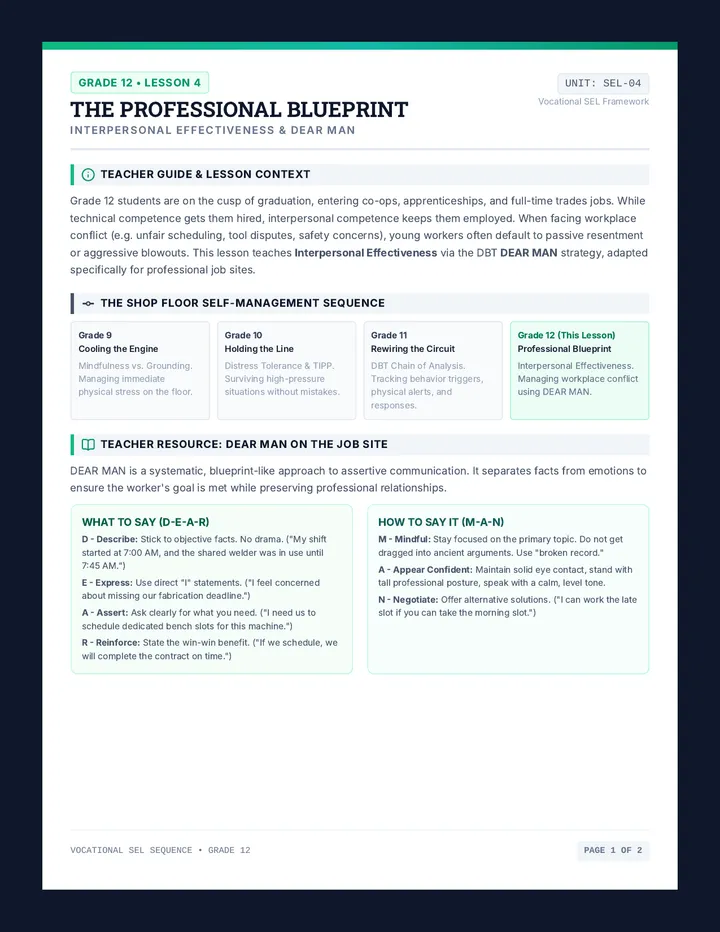
A four-part Social-Emotional Learning (SEL) unit designed specifically for grades 9-12 vocational shop classes. It teaches self-management, distress tolerance, behavioral chain analysis, and interpersonal effectiveness using practical, real-world trades scenarios to enhance shop safety and professionalism.
In professional environments, shifts end with reports and safety logs. Complete this log honestly to verify you have acquired the self-management competencies required for shop floor access.
1. Self-Rating Scale
How confident are you that you can detect your "engine redline" state before you make a safety mistake?
1 Clueless
2 Hard to Tell
3 I Notice It
4 Consistent
5 Expert
2. Concrete Application Scenario Imagine you have exactly 10 minutes left to finish a fabrication project and your supervisor tells you that you did it incorrectly and have to start over. Outline your immediate 30-second action plan to prevent a physical meltdown.
3. Core Lesson Takeaway Write, in your own words, the single biggest difference between Mindfulness and Grounding. When should you use each one?
STUDENT SIGNATURE:
INSTRUCTOR APPROVED:
UNIT 1 • SHIFT REPORT COMPLETED PAGE 3 OF 3
TEACHER SCRIPT & DISCUSSION
Facilitator Instructional Guide
UNIT: SEL-02
Vocational SEL Framework
Phase 1: Crisis (5m) Survival vs. Wrecking
Phase 2: Somatic TIPP (10m) Biology-Based Override
Phase 3: Case Studies (10m) Shop Scenarios Practice
Instructional Script (Read aloud or adapt)
Teacher Script: "Alright squad, listen up. Mistakes happen. I don't care if you're a Master Plumber, a Michelin-star Chef, or an Aerospace Machinist—you are going to mess up. You will cut a wire too short, ruin a sauce during dinner rush, or shear a bolt on a block. That is a shop crisis. In that exact millisecond, your survival instinct screams at you to do something physical: kick a cabinet, throw your socket wrench, or scream."
"If you do that, you didn't fix the problem—you doubled down on it. Throwing a tool breaks the tool, or worse, hits your coworker in the safety glasses. Hurrying to fix a mistake while panicking leads to catastrophic injuries. Today, we're practicing Distress Tolerance. Your goal isn't to feel happy or calm right now. Your goal is simply to 'Hold the Line'—to get through the next two minutes without making the crisis worse. We do this with TIPP. It's like resetting a tripped breaker in an electrical panel. We're overriding your brain's alarm circuits physically."
Teacher-Led Discussion Questions
Discussion Prompt 1: The Cost of Impulse
"What is the literal shop cost of reacting impulsively to a mistake (e.g. throwing a tool or rushing a repair)?"
Expected Student Answers: Broken tools (which are expensive), ruined materials, failing grades, immediate suspension, and severe injury to yourself or others.
Discussion Prompt 2: Tooling TIPP
"If you're in a hot, stressful kitchen or on an active construction site, which TIPP skill can you realistically use immediately without leaving your station?"
Expected Student Answers: Paced breathing (inhaling and exhaling slowly while standing at the station) or Paired muscle relaxation (tensing hands into fists for 5 seconds and letting them go, or pushing down firmly on a counter, then letting go).
Vocational Facilitator Tips
Destigmatize physical reactions: Tell them that getting angry is natural biology. TIPP skills aren't "calming exercises"—they are physical overrides to discharge aggressive adrenaline safely.
Connect to Professionalism: Remind students that employer feedback consistently ranks emotional regulation under pressure as more important than technical speed.
VOCATIONAL SEL SEQUENCE • GRADE 10 PAGE 2 OF 2
RESOLVE THE ERROR SAFELY SLIDE 4
P - Paired Muscle Relaxation (Tension Bleeder Valve) Target: Squeeze and Release
Choose a specific muscle group related to your trade (e.g. your hands gripping your boots or clenching your toes in your steel-toe boots). How will you squeeze and release?
UNIT 2 • TIPP EMERGENCY ACTION SCHEME PAGE 2 OF 3
Grade 10 • Exit Ticket
SHIFT REPORT: EXIT TICKET
FORM: ER-02
Crisis Management Sign-Off
Before completing this workshop rotation, log your self-assessment of your TIPP skills. A high-performance workforce relies on steady operators who do not crash during mechanical or culinary failures.
1. Self-Rating Scale
How ready are you to execute a TIPP override during a stressful inspection or shop disaster?
1 Fragile
2 Impulsive
3 Steady
4 Resilient
5 Unyielding
2. Concrete Application Scenario Describe a real stress point you experienced this month in your specific trade. How will you apply "Holding the Line" specifically if that same event happens again next week?
3. Core Lesson Takeaway Why are distress tolerance skills considered "biology hacks" rather than simple positive thinking? What happens to the heart rate and blood flow during TIPP?
STUDENT SIGNATURE:
INSTRUCTOR APPROVED:
UNIT 2 • SHIFT REPORT COMPLETED PAGE 3 OF 3
Step 1: The Circuit (5m) Behavioral Chains Concept
Teacher Script: "Bring it in, Grade 11s. Think about an electrical system. If there's a short circuit in a junction box, you don't just put tape on the charred wires and turn the power back on. You have to trace that circuit from the source. You have to figure out where the surge occurred, why the circuit breaker failed to trip, and what caused the system to overload."
"Your behavior in this shop is exactly the same. When an apprentice has an unsafe blowout—like getting defensive with a client or cutting a live wire because they were rushing—that didn't 'just happen.' It was a chain of reactions. DBT calls this a Behavioral Chain Analysis. We're going to think of it as 'Rewiring the Circuit.' Today, we will deconstruct an unsafe shop reaction. We'll find every single link in the chain—from how much sleep you got last night (vulnerability) to the prompt that set you off (trigger), to the thoughts, physical feelings, actions, and long-term fallout. Then, we will find where we could have installed a 'circuit breaker' to stop the overload before the explosion occurred."
Teacher-Led Discussion Questions
Discussion Prompt 1: The Invisible Surge
"Why is it essential to check your 'vulnerability factors' before you touch high-power shop equipment in the morning?"
Expected Student Answers: If you are exhausted, dehydrated, or angry about a family issue, your internal resistance is extremely low. A minor tool glitch that you'd usually ignore will easily trigger a massive surge of anger or distraction.
Discussion Prompt 2: Placing Circuit Breakers
"Where in the chain of thoughts -> sensations -> actions is the easiest spot to insert a 'circuit breaker' (like taking a deep breath or calling a timeout)?"
Expected Student Answers: Right between physical sensations and actions. When you feel your face flush or your grip tighten, that's your warning lamp. If you step back and pause right then, you prevent the destructive action.
Vocational Facilitator Tips
Stay analytical: Deconstruct a real incident with cold, hard facts. Avoid being accusatory. Treat the behavior like an autopsy of a mechanical part that failed under excessive load.
Address apprentice rights: Emphasize that knowing how to pause and check yourself is what separates professional journeypersons from dangerous, low-skilled operators.
VOCATIONAL SEL SEQUENCE • GRADE 11 PAGE 2 OF 2
EXPLICIT STATE DECLARATION
State the fact aloud or inside your head: "My heartbeat is high. I am reacting. I need to take a step back before I make a cut."
SHUT DOWN THE OVERLOAD BEFORE THE DAMAGE OCCURS SLIDE 4
REPROGRAMMING: My Circuit Breaker Intercept
Identify the exact point in the chain where you could have intervened. What "circuit breaker" skill (disconnect, ground, declaration) will you program to stop this exact chain from completing in the future?
UNIT 3 • BEHAVIORAL REWIRING SYSTEM PAGE 2 OF 3
Grade 11 • Exit Ticket
SHIFT REPORT: EXIT TICKET
FORM: ER-03
Incident Prevention & Blueprint Sign-Off
Before completing your junior year rotation, verify you can identify and interrupt behavior patterns that compromise shop safety and job retention. Tracing failures is what builds a master mechanic.
1. Self-Rating Scale
How ready are you to hit your internal "circuit breaker" when stress surges in the middle of a high-stakes team build?
1 Unstable
2 Volatile
3 Wired
4 Regulated
5 Grounded
2. Concrete Application Scenario Why is analyzing "near misses" (errors that almost caused severe accidents or firings) just as important as analyzing actual failures in a professional shop?
3. Core Lesson Takeaway Write, in your own words, why pausing is considered a technical skill rather than a waste of active working time on a fast-paced shop floor.
STUDENT SIGNATURE:
INSTRUCTOR APPROVED:
UNIT 3 • SHIFT REPORT COMPLETED PAGE 3 OF 3
Grade 12 • Lesson 4
TEACHER SCRIPT & DISCUSSION
Facilitator Instructional Guide
UNIT: SEL-04
Vocational SEL Framework
Step 1: The Blueprint (5m) Job Site Interpersonal Skills
Step 2: DEAR MAN (10m) The Scripting Protocol
Step 3: Roleplay (10m) Navigating Boss Feedback
Instructional Script (Read aloud or adapt)
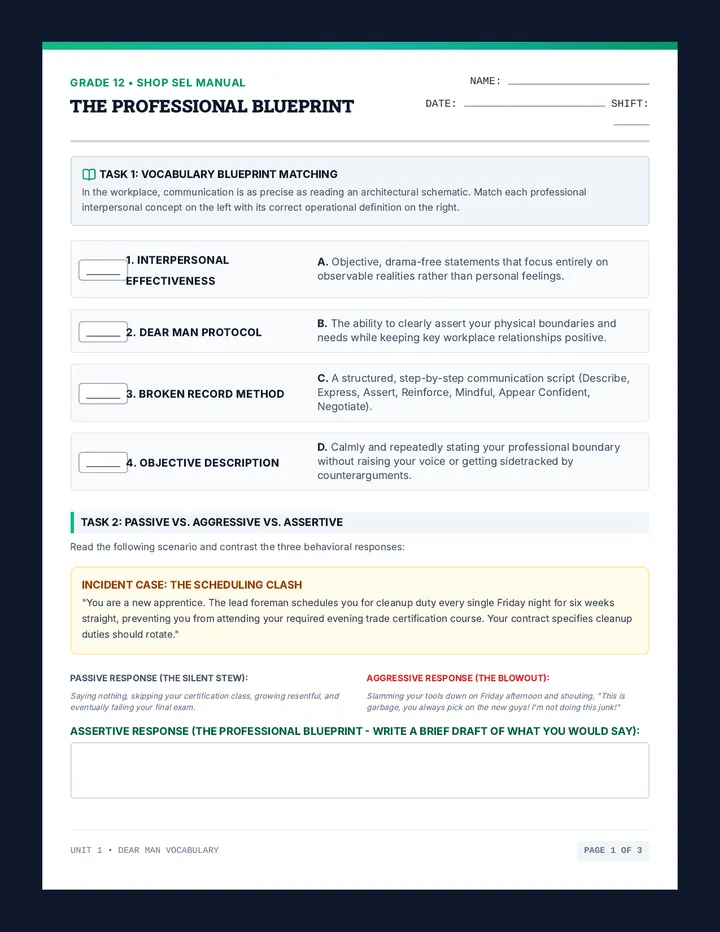
Teacher Script: "Seniors, huddle up. This is our final SEL sprint before graduation. You are about to enter real job sites as first-year apprentices or crew members. On a real job, you are the low person on the totem pole. You are going to get the worst shifts, get stuck with the prep work, and have supervisors who tell you your work isn't up to snuff, sometimes with some pretty colorful language."
"How you handle that conflict determines whether you last a week or make a career. If you get defensive, talk back, or quit in a huff, you're blacklisted from the local union. If you stay silent and stew, you get taken advantage of or make a safety error. We need a professional blueprint for communication. It's called DEAR MAN. Think of it as a structural plan for hard conversations. It removes the emotional noise, lays down the facts, asserts what you need, and secures a win-win deal. Today, we're drafting this blueprint so you can stand up for yourself professionally on any job site."
Teacher-Led Discussion Questions
Discussion Prompt 1: The Drama-Free Fact Check
"Why is it absolutely critical to 'Describe' using only objective facts, rather than opinions or emotions, when addressing an issue with a crew boss?"
Expected Student Answers: Because bosses hate drama. If you say, "You're always giving me the worst schedule and it's unfair," they get defensive and shut down. If you say, "I have worked the Sunday night shift for the last four weeks," they can't argue with facts.
Discussion Prompt 2: The Art of Negotiating
"Why must an apprentice be willing to 'Negotiate' (give to get) rather than just demand things?"
Expected Student Answers: Because as an apprentice, you don't have the leverage to make unilateral demands. Offering a compromise shows you care about the company's productivity, which earns respect and gets your core needs met.
Vocational Facilitator Tips
Roleplay with real grit: Don't make the roleplays easy. Act like a blunt, busy shop foreman. Force students to practice staying mindful ("broken record") and appearing confident under pressure.
Frame as a trade power move: Emphasize that being aggressive is easy; any low-skilled laborer can scream. Being calm, professional, and getting your way using DEAR MAN is a high-level trade power move.
VOCATIONAL SEL SEQUENCE • GRADE 12 PAGE 2 OF 2
No whispering, muttering under your breath, or hostile posturing. Stand tall.
N GIVE TO GET
Negotiate
Be prepared to give in order to get. Offer alternative solutions that still protect your safety or boundaries.
"If I work the Saturday morning shift, can I have Sunday off entirely?"
THE DELIVERY SHAPES THE OUTCOME • CONTROL YOUR MANNER SLIDE 4
Do not blame. "I feel frustrated because untangling them takes 15 minutes off my morning run time."
A ASSERT (State your professional demand clearly):
Be explicit. "I need everyone at the station to coil their hoses before clocking out."
R REINFORCE (Win-win value statement):
Explain the benefit. "This keeps the shop floor tidy, saves setup time, and avoids safety trips."
N NEGOTIATE (What is a compromise you can offer?):
UNIT 1 • MY DEAR MAN BLUEPRINT PAGE 2 OF 3
Grade 12 • Exit Ticket
SHIFT REPORT: EXIT TICKET
FORM: ER-04
End-of-Shift Safety & Professionalism Sign-Off
Before completing this four-part Vocational Self-Management unit, demonstrate your readiness to enter the professional trades by answering the final programmatic evaluations.
1. Self-Rating Scale: Professional Assertiveness
How confident are you in your ability to stand up for your safety, boundaries, and schedule professionally on a real job site?
1 Passive/Slam
2 Anxious
3 Can Assert
4 Steady/Calm
5 Master Assertive
2. The "Mindful" Under Fire Challenge Imagine you are delivering your DEAR MAN script to a busy foreman who cuts you off and says, "Apprentices don't make requests. Just do the work or pack your bags." How do you apply the "Mindful" (Broken Record) and "Appear Confident" guidelines to stay professional and de-escalate?
3. Core Program Takeaway Looking back over the entire 4-year sequence (Grade 9: Grounding, Grade 10: TIPP Distress Tolerance, Grade 11: Behavioral Chain Analysis, Grade 12: Interpersonal Assertiveness), how do these self-management tools contribute to making you a high-earning, high-safety trades professional?