PCC Profiling Slides PCC Pathway Accelerator
MODULE 1 / SLIDE 1
Discovering Self,
Skills & Lifestyle
Building your personal profile for the Preparing for College and Careers (PCC) exam. Learn how your internal values, personality, and skills directly shape your future earnings.
Focus: Self-Evaluation & Standard 1
PCC EXAM PREP
L1: Self-Discovery
MODULE 1 / SLIDE 2
The Personal Profile
The PCC Exam starts with Self-Evaluation. To plan a career, you must assess:
Core Values: What matters most to you.Interests: Activities you enjoy doing.Aptitudes: Natural talents you possess.
Holland Codes (RIASEC)
A standard career framework assessing six personality types:
Realistic
Investigative
Artistic
Social
Enterprising
Conventional
Key Exam Concept: RIASEC Alignment to Career Clusters
NEXT: SKILLS
L2: Skills and Strengths
MODULE 1 / SLIDE 3
Hard Skills
Technical, teachable abilities
Acquired through formal education, credentials, or training. They are specific to jobs.
Coding & Data Analysis
Machinery & Tech Repair
Bilingualism / Translation
Soft Skills
Interpersonal, behavioral traits
How you interact with others, solve problems, and manage tasks. Highly transferable!
Clear Communication
Collaboration & Teamwork
Time & Resource Management
Transferability: Soft skills transfer across ALL career clusters.
NEXT: FINANCES
L3: Earning and Lifestyle
MODULE 1 / SLIDE 4
The Golden Rule of Economics
Higher Education = Higher Potential Income
There is a direct correlation between the educational/training level you achieve and your average lifetime earnings.
However, look out for Cost of Living! A high salary in New York City may buy a simpler lifestyle than a moderate salary in Indiana.
Level vs. Median Salary
High School Diploma $44,000/yr
Associate / Trade $58,000/yr
Bachelor's Degree $78,000/yr
Master's / Professional $95,000+/yr
Budget Factor: Gross Pay vs. Net (Take-home) Pay after taxes.
NEXT: REVIEW
Standard Checkpoint
MODULE 1 / SLIDE 5
Unit 1 Recap
Standard 1 requires analyzing how values, interests, and personalities construct your Personal Profile .
Standard 6 highlights the necessity of distinguishing and developing Hard vs. Soft Skills .
Connecting lifestyle targets with education path prevents financial misalignment.
Sample Exam Question
"Which of the following describes a transferable soft skill that is highly sought across all 16 Career Clusters?"
A) Programming in Python
B) Operating an ultrasound machine
C) Collaborative problem solving
D) Preparing financial profit sheets
Ready to take notes? Check out your Guided Notes booklet next!
MODULE 1 COMPLETE
PCC Profiling Guided Notes PCC Prep Course • Module 1
PCC Profiling Guided Notes
STANDARD 1
Student:
Date:
Part 1: Self-Evaluation & The Personal Profile
Fill in the blanks as your instructor progresses through the presentation slides.
1. A Personal Profile is a comprehensive assessment of your internal drivers, including:
Values: Beliefs and principles that are ________________________________ to you (e.g., security, creativity, independence).Interests: Activities you ________________________________ doing in your free time.Aptitudes: Your natural ________________________________ or capabilities (e.g., spatial awareness, mathematical reasoning).
2. The Holland Codes (RIASEC) is a standardized system that aligns career paths with six distinct personality types.
The RIASEC Framework Matrix
Type Key Characteristics Aligned Cluster Example R - Realistic "The Doers" — Prefer concrete, hands-on, practical tasks. Agriculture / Tech I - Investigative "The Thinkers" — Prefer analytical, scientific, and research problems. STEM / Health Science A - Artistic "The Creators" — Prefer self-expression, original and intuitive designs. Arts, AV Tech & Comm S - Social "The Helpers" — Prefer teaching, healing, assisting, and caring for others. Education / Human Serv E - Enterprising "The Persuaders" — Prefer leading, selling, managing, and business roles. Business / Marketing C - Conventional "The Organizers" — Prefer structured, systematic, numbers, and data tasks. Finance / Administration
Reflecting on Your Profile
Based on the descriptions above, what are your top TWO Holland Code letters? Why?
My RIASEC Combination:
PCC Pathway Accelerator • Module 1 Page 1 of 2
PCC Prep Course • Module 1
Skills & Economic Foundations
STANDARD 6
Part 2: Skills and Strengths
Hard Skills
Specific, ______________________ abilities acquired through training, education, or experiences.
My Brand Blueprint Activity Module 1 Performance Assignment
My Personal Brand Blueprint
SUMMATIVE
Student Name:
Date:
Objective: Synthesize your self-evaluation results (Holland Codes, values, skills) into a cohesive personal brand statement and project how this brand aligns with an educational track and earning potential.
Part 1: Identity Dashboard
Top Holland Type
Core Career Value
Key Transferable Skill
Part 2: Personal Brand Emblem
Sketch a visual logo, icon, or symbol in the space below that represents your career values and personality. (No words inside the box, let your design speak for you!)
Part 3: Target Career Alignment
1. Aligned Target Career Title:
2. Required Education/Credential:
3. Expected Gross Annual Salary:
Brand-Career Alignment Justification:
Explain how this prospective career fits your Holland Personality type and your top transferable soft skills.
PCC Pathway Accelerator • Module 1 Performance Assignment Page 1 of 1
Career Cluster Slides PCC Pathway Accelerator
MODULE 2 / SLIDE 1
Navigating Career
Clusters & Pathways
Demystifying the National Career Clusters Framework, learning how to research professional occupations, and analyzing major job market shifts.
Focus: Career Cluster Alignment & Standard 2
PCC EXAM PREP
L4: Cluster Framework
MODULE 2 / SLIDE 2
What is a Career Cluster?
A Career Cluster is a grouping of occupations and broad industries based on shared commonalities.
• The framework contains exactly 16 National Clusters .
• Each cluster is divided into specific Career Pathways .
• Pathways contain individual Occupations (specific jobs).
The Nested Hierarchy
Level 1: Career Cluster Health Science
Level 2: Career Pathway Therapeutic Services
Level 3: Target Occupation Physical Therapist
Exam Key: Knowing which careers fit which of the 16 clusters.
NEXT: INVESTIGATION
L5: Investigation
MODULE 2 / SLIDE 3
Researching Careers
To successfully evaluate a profession, you must locate reliable data on O*NET OnLine or the Bureau of Labor Statistics (BLS).
Focus on finding concrete, localized data rather than relying on general assumptions.
Job Outlook
The projected growth or decline of an occupation over a 10-year span.
Credentials
Degrees, certifications, or licenses legally required to practice.
Median Pay
The midpoint salary where half earn more and half earn less.
Environment
The physical settings, schedules, hazards, and demands of the job.
Source Check: O*NET OnLine is sponsored by the US Dept of Labor.
NEXT: MODERN TRENDS
L6: Workplace Trends
MODULE 2 / SLIDE 4
Automation & Technology
Certain fields face high risks of automation. Routine, repetitive tasks are increasingly performed by software or robotics.
Adaptation strategy: Focus on higher-order, creative, or relational human skills.
Hybrid & Remote Work
The modern office is no longer tied to one desk. Remote-capable careers expand hiring possibilities globally.
Critical requirement: Demands strong self-management, written communication, and tech literacy.
Trend Focus: Healthcare and technology remain the fastest-growing sectors.
Career Cluster Guided Notes PCC Prep Course • Module 2
Career Cluster Foundations
STANDARD 2
Student Name:
Date:
Part 1: National Career Clusters Framework
1. The US Department of Education organizes the economy into exactly _______ national Career Clusters . This system groups jobs with similar ________________________ and skill requirements.
2. The hierarchy is organized in a nested structure:
Career Cluster: The broadest category (e.g., Information Technology).Career Pathway: A sub-grouping of careers sharing cohesive training (e.g., Network Systems).Target Occupation: A specific, individual job role (e.g., Computer Network Architect).
Cluster-to-Career Identification
Match the following specific occupations with their correct National Career Cluster in the space provided:
A) Pediatrician Correct Cluster:
B) Corporate Accountant Correct Cluster:
C) Sound Engineer Correct Cluster:
D) Mechanical CAD Designer Correct Cluster:
PCC Pathway Accelerator • Module 2 Page 1 of 2
PCC Prep Course • Module 2
Investigating the Job Market
STANDARD 2 / TRENDS
Part 2: Official Career Research Metrics
Define the following crucial terms used when researching a prospective occupation:
Job Outlook:
The projected rate of change in employment over a _________-year period (e.g., "growing faster than average").
Credentials:
The legally required high school diplomas, university degrees, specialized ___________________, or state licenses.
Working Environment:
The physical settings (indoor/outdoor), weekly schedules, level of travel, and physical ____________________.
Part 3: Technology and Automation Impacts
1. Automation refers to the substitution of human labor with machine processes. Tasks that are highly ________________________ and routine have the highest statistical probability of being automated.
2. To insulate your future career from automation risks, you should develop strong cognitive skills , including:
________________________________ (working with cross-functional teams)
________________________________ (navigating complex, unscripted problems)
________________________________ (designing unique systems or strategies)
PCC Pathway Accelerator • Module 2 Page 2 of 2
Career Investigation Activity Module 2 Performance Assignment
O*NET Investigative Report
SUMMATIVE
Student Name:
Date:
Task: Log on to the official federal database onetonline.org . Search for a specific career of interest, research its structure, metrics, and tech outlook, and complete this blueprint report.
Part 1: Career Architecture
Target Occupation
Aligned Career Cluster
Aligned Career Pathway
Part 2: Economic Metrics and Credentials
National Median Salary
Projected 10-Yr Growth
Required Degree/License
Part 3: Skill Frameworks
Top 2 Hard/Technical Skills Required
Top 2 Soft/Interpersonal Skills Required
Part 4: Future Outlook and Technology Trends
Typical Work Environment Describe the location (office, outdoors, lab, hybrid) and normal working schedules.
Tech Impact Risk Score Estimate the automation risk (Low, Medium, High). Explain the reasons.
PCC Pathway Accelerator • Module 2 Performance Assignment Page 1 of 1
Post-Secondary Slides PCC Pathway Accelerator
MODULE 3 / SLIDE 1
Post-Secondary
Pathways & Financing
Decoding higher education options, analyzing modern college admission criteria, and demystifying financial aid and educational ROI.
Focus: Higher Education Options & Standard 3
PCC EXAM PREP
L7: Educational Degrees
MODULE 3 / SLIDE 2
The Academic Ladder
High school graduation is the launchpad. Post-secondary paths differ significantly by duration and professional goal:
Certificates: Technical focus, 6-18 months.Associate Degree: 2-year college credentials.Bachelor's Degree: 4-year undergraduate standard.Post-Grad Degrees: Master's, PhD, MD, or JD.
Alternative Routes
Universities are not the only route to success.
Registered Apprenticeships
Paid on-the-job training program paired with academic instruction, highly applicable to skilled trades.
Industry Certifications
Credentials earned by passing professional tests (like AWS, CompTIA, or the PCC Exam!).
Rule of Thumb: Align educational pathways with target career credentials.
NEXT: ADMISSIONS
L8: Admission Criteria
MODULE 3 / SLIDE 3
The Admissions Portfolio
Admissions boards evaluate a student's profile systematically. They review multiple factors to estimate academic preparedness:
Rigorous Coursework: AP, IB, or Dual Credit.Cumulative GPA: Grade Point Average (Weighted/Unweighted).Standardized Tests: SAT or ACT (if required).
Extracurriculars & Portfolios
Universities seek well-rounded students who demonstrate leader characteristics outside of the classroom:
• Student Leadership: Club officer, athletic captain.
• Community Service: Consistent, impactful volunteering.
• Career Portfolios: Projects, resumes, certifications.
Exam Key: High school transcripts are the primary admissions record.
NEXT: FINANCING
L9: Financial Aid
MODULE 3 / SLIDE 4
Demystifying Financial Aid
To qualify for student aid, you must complete the FAFSA (Free Application for Federal Student Aid).
Post-Secondary Guided Notes PCC Prep Course • Module 3
Post-Secondary Pathways
STANDARD 3
Student Name:
Date:
Part 1: Higher Education Credentials
1. Post-secondary paths differ based on duration, academic rigor, and job requirements. Match the credential with its standard duration:
Technical Certificate Duration: ______________
Associate Degree Duration: ______________
Bachelor's Degree Duration: ______________
2. A Registered Apprenticeship is an alternative "earn-while-you-learn" pathway that combines paid ________________________ training with formal technical instruction.
Part 2: College Admissions Portfolios
Admissions boards review multiple metrics on a student's high school transcript:
• Cumulative GPA: The average of all grades earned in high school. An unweighted GPA is on a 4.0 scale, while a weighted GPA accounts for course ____________________ (AP, IB, or Dual Credit classes).
• Transcript Rigor: Admissions boards prioritize students who challenge themselves with ________________________ courses, rather than taking the easiest possible route.
• Extracurricular Profile: Universities assess student leadership, athletic commitments, arts portfolios, and dedicated ________________________ service hours to gauge character.
PCC Pathway Accelerator • Module 3 Page 1 of 2
PCC Prep Course • Module 3
Higher Education Financing
STANDARD 3 / AID
Part 3: The Financial Aid Gateway
1. FAFSA stands for the _____________________ Application for _____________________ Student Aid. It is the mandatory form required to unlock all federal assistance.
2. The primary categories of student aid are divided below. Define their repayment requirements:
Aid Category Key Definition Requires Repayment? Grants Need-based free aid awarded based on family income guidelines. ___________________ Scholarships Merit-based free aid awarded for athletics, academics, or art. ___________________ Work-Study Part-time jobs provided on-campus to earn money during school. ___________________ Federal Loans Borrowed money from the government. Must pay back with interest.
Post-Secondary Comparison Chart Module 3 Performance Assignment
Post-Secondary ROI Analysis
SUMMATIVE
Student Name:
Date:
Task: Select two different post-secondary institutions or training options (e.g., local trade school, community college, or 4-year public university). Research their costs and calculate the Return on Investment (ROI) relative to your target career.
Target Career Profession:
Projected Starting Annual Salary:
Part 1: Comparative College Costs
Variable Option A: _________________ Option B: _________________ 1. Annual Tuition & Fees
|
| 2. Program Duration (Years) |
|
|
| 3. Estimated Gift Aid (Grants/Scholarships) |
|
|
| 4. Total Net Cost (Tuition x Years - Aid) |
|
|
Part 2: ROI Evaluation
Debt-to-Income Feasibility Check
Will your total debt (Tuition x Years - Aid) exceed your expected starting gross annual salary? Show estimates.
Strategic Career Decision
Based on starting salary, debt profile, and career longevity, which option represents the higher Return on Investment (ROI)? Explain.
PCC Pathway Accelerator • Module 3 Performance Assignment Page 1 of 1
Life Navigation Slides PCC Pathway Accelerator
MODULE 4 / SLIDE 1
Critical Thinking &
Professional Life
Building high-order decision-making skills, practicing active listening and conflict resolution, and managing credit and personal adaptability.
Focus: Life Navigation & Standards 4 & 7
PCC EXAM PREP
L10: Critical Thinking
MODULE 4 / SLIDE 2
Strategic Decision Making
Critical thinking (PCC Standard 4) demands utilizing decision-making models rather than relying purely on instinct or emotion.
The systematic approach allows you to balance immediate desires with long-term impacts on your career goals.
The 4-Step Matrix
01 Define the Problem
02 List and Brainstorm Options
03 Analyze Consequences (Pros/Cons)
04 Select and Evaluate the Outcome
Rule: Identifying biases and evaluating multiple sources prevents error.
NEXT: PROFESSIONALISM
L11: Professional Life
MODULE 4 / SLIDE 3
Active Listening
The foundation of clear communication in collaborative teams.
• Focus fully: Avoid interruptions or crafting responses.
• Clarify: Paraphrase or ask questions to confirm.
• Acknowledge: Node or signal receipt of information.
Conflict Resolution
Professional conflicts are natural; resolving them constructively protects productivity.
• Focus on the issue: Separate people from the issue.
• Find common ground: Identify shared objectives.
• Win-Win: Focus on joint gains rather than win-lose battles.
Social Note: Digital footprints permanently impact professional reputation.
NEXT: RESILIENCE
L12: Real-World Resilience
MODULE 4 / SLIDE 4
Financial Adaptability
Navigating life (PCC Standard 7) requires building long-term security.
Understanding Credit Scores and Interest Rates represents a core requirement to participate in the modern economy.
Core Financial Pillars
Credit Foundations
Numerical score of creditworthiness. Dictates interest rates for major life loans.
Career Adaptability
The capability to adapt, retrain, and transition as work demands evolve.
Resilience: An emergency fund of 3-6 months is standard financial defense.
Life Navigation Guided Notes PCC Prep Course • Module 4
Critical Decision Making
STANDARD 4
Student Name:
Date:
Part 1: Rational Decision-Making Framework
1. High-order Critical Thinking requires using rational models rather than impulsive feelings. Fill in the missing steps of the standard decision-making matrix:
Step 1 Define the
Step 2 List the
Step 3 Analyze
Step 4 Select &
Part 2: Active Listening and Communication
Active listening is a critical soft skill required for productive professional teams. Outline the primary steps of the active listening framework:
A
Fully Focus:
Pay complete attention to the speaker. Avoid crafting your response or ________________________ while they speak.
B
Paraphrase and Clarify:
Restate the key points in your own words (e.g., "It sounds like you are saying...") and ask ________________________ questions.
C
Provide Non-Verbal Acknowledgement:
Maintain ________________________ contact, nod constructively, and maintain open body language.
PCC Pathway Accelerator • Module 4 Page 1 of 2
PCC Prep Course • Module 4
Professional Life Navigation
STANDARD 7
Part 3: Conflict & Digital Footprints
1. In professional conflicts, mediators prioritize Win-Win solutions over win-lose outcomes. This requires separating the ________________________ from the substantive issue.
2. Your Digital Footprint is the trail of data left by your online activities. It is ________________________ and can be permanently reviewed by college recruiters or target corporate managers.
Part 4: Foundations of Personal Finance
Explain the core concepts of basic financial literacy required to maintain economic resilience:
Credit Score:
A numerical rating (typically 300 to 850) that indicates your creditworthiness. It determines the _____________________ rate you will pay when borrowing money.
Credit Bureaus:
The three major national reporting bureaus that track credit files are Equifax, ________________________, and ________________________.
Part 5: Career Adaptability
PCC Standard 7 emphasizes Career Adaptability . What are TWO methods to maintain career adaptability in response to industrial disruption or job elimination?
Real-World Case Study Activity Module 4 Performance Assignment
Real-World Decision Cases
SUMMATIVE
Student Name:
Date:
Scenario: The Tech Transition Sarah is a medical transcriptionist earning $48,000 in a local hospital. Her hospital is introducing an AI-automated transcription system, placing her role at risk. She has two offers:Option A: Retrain as a Medical Coder (High-demand, remote role) for $52,000, requiring a $3,000 certification course she must fund herself.Option B: Shift to a local administrative assistant role in a retail company for $45,000, which has zero automation risk but no growth pathways.
Step 1: Define the Problem
What is Sarah's primary professional issue, and how does it connect to career adaptability?
Steps 2 & 3: List Options and Analyze Consequences
Option A: Medical Coding Retraining
Pros (Consequences):
Cons (Consequences):
Option B: Administrative Assistant
Pros (Consequences):
Cons (Consequences):
Step 4: Select and Justify the Decision
Recommend either Option A or Option B for Sarah. Justify your choice based on career outlook, return on investment (ROI), and resilience.
PCC Pathway Accelerator • Module 4 Performance Assignment Page 1 of 1
Goal Setting Slides PCC Pathway Accelerator
MODULE 5 / SLIDE 1
Goal Mapping &
Exam Preparation
Mastering the SMART goal framework, mapping multiple post-secondary career pathways, and completing final certification test diagnostics.
Focus: Personal Goals & Standard 5
PCC EXAM PREP
L13: SMART Framework
MODULE 5 / SLIDE 2
Goal Architecture
Standard 5 of the PCC Blueprint requires configuring structured SMART Goals.
Unstructured goals (e.g., "I want to be rich") fail to establish actionable high school milestones.
S
Specific
State exactly what you want to accomplish.
M
Measurable
Establish concrete trackable numbers.
A
Attainable / Actionable
Verify you have the capability to execute it.
R
Realistic / Relevant
Aligns logically with your brand blueprint.
T
Time-Bound
Create a strict terminal deadline.
Milestones: Short-term (< 1 yr), Medium-term (1-5 yrs), Long-term (> 5 yrs).
NEXT: PATH MAP
L14: Goal Mapping
MODULE 5 / SLIDE 3
Why Map Multiple Paths?
The global economy shifts rapidly. Planning a single linear career pathway leaves you exposed to technological or economic disruptions.
A Multi-Path Goal Map charts parallel academic and technical tracks to secure backup options.
Blueprint Timeline Elements
High School Milestones: Course rigor, GPA targets, extracurricular credentials.
Branching Pathways: Path A (Vocational / Trade) and Path B (Undergraduate University degree).
Earning Targets: Projected salary and lifestyle outcomes of both tracks.
Backup Factor: Parallel options optimize lifelong career safety.
NEXT: EXAM REVIEW
L15: Exam Strategy
MODULE 5 / SLIDE 4
Cracking the PCC Exam
The Preparing for College and Careers exam validates your understanding of life preparations.
Review the seven standards and utilize diagnostic tests to target weak areas before exam day.
Test-Taking Tactics
Process of Elimination (eliminate 2 incorrect)
Highlight key terms (e.g. "not", "except")
Manage time (60 seconds per question)
Goal Setting Guided Notes PCC Prep Course • Module 5
Goal Mapping Foundations
STANDARD 5
Student Name:
Date:
Part 1: SMART Goal Setting Architecture
Fill in the definitions for each standard of the SMART framework:
S
________________________ :
State exactly what is to be done. Avoid generalized statements.
M
________________________ :
Include precise, numerical parameters so you can track progress.
A
________________________ / Actionable :
Ensure you have the skills, resources, and control required to succeed.
R
________________________ / Relevant :
Verify that this goal aligns with your core personal values and target cluster.
T
________________________ :
Establish a clear deadline or target completion date.
Goal Workshop Draft
Draft a quick, actionable SMART goal targeting your academic GPA for the end of the next grading cycle:
PCC Pathway Accelerator • Module 5 Page 1 of 2
PCC Prep Course • Module 5
Milestones & Exam Mastery
STANDARD 5 / EXAM
Part 2: Goal Planning Time Horizons
List the time horizons for goals and provide a typical milestone example for each:
ST
Short-Term Goals:
Standard duration of less than _________ year . Example: Earning a high grade on the next exam.
MT
Medium-Term Goals:
Standard duration of _________ to _________ years . Example: Graduating high school with dual credits.
LT
Long-Term Goals:
Standard duration of greater than _________ years . Example: Becoming a Licensed Nurse Practitioner.
Part 3: Test Day Tactics and Exam Review
To maximize pass rates on the PCC Industry Certification, practice the following test-taking mechanics:
1. Use the Process of Elimination to systematically remove at least __________ options that are obviously incorrect or unrelated.
2. Scan questions for absolute keywords like NOT , EXCEPT , or ALWAYS , which alter the core meaning.
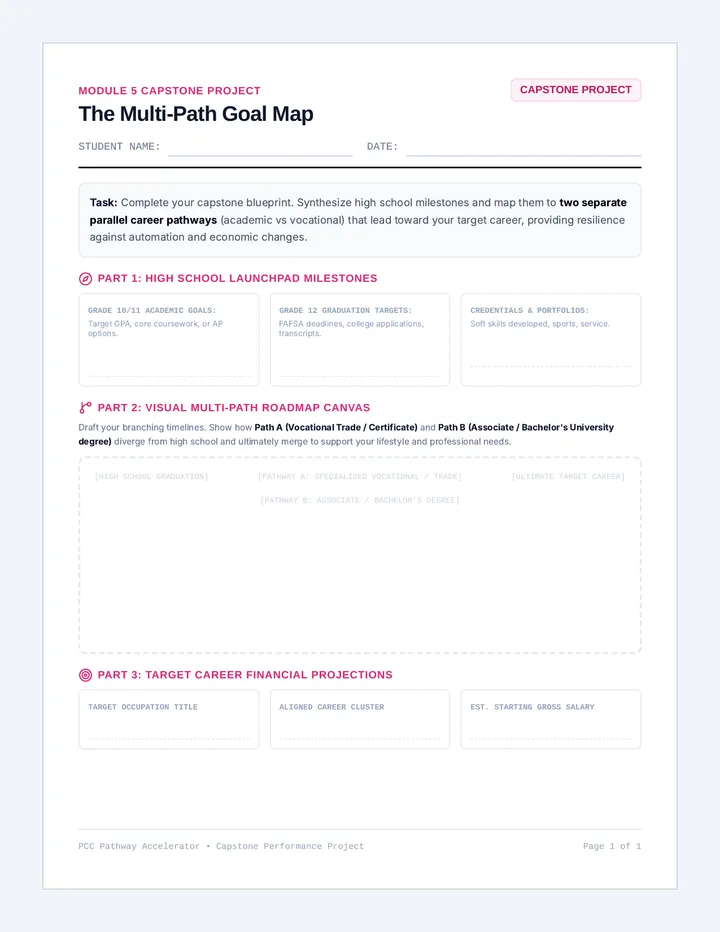
Multi Path Goal Map Project Module 5 Capstone Project
The Multi-Path Goal Map
CAPSTONE PROJECT
Student Name:
Date:
Task: Complete your capstone blueprint. Synthesize high school milestones and map them to two separate parallel career pathways (academic vs vocational) that lead toward your target career, providing resilience against automation and economic changes.
Part 1: High School Launchpad Milestones
Grade 10/11 Academic Goals: Target GPA, core coursework, or AP options.
Grade 12 Graduation Targets: FAFSA deadlines, college applications, transcripts.
Credentials & Portfolios: Soft skills developed, sports, service.
Part 2: Visual Multi-Path Roadmap Canvas
Draft your branching timelines. Show how Path A (Vocational Trade / Certificate) and Path B (Associate / Bachelor's University degree) diverge from high school and ultimately merge to support your lifestyle and professional needs.
[HIGH SCHOOL GRADUATION] [PATHWAY A: SPECIALIZED VOCATIONAL / TRADE]
[PATHWAY B: ASSOCIATE / BACHELOR'S DEGREE] [ULTIMATE TARGET CAREER]
Part 3: Target Career Financial Projections
Target Occupation Title
Aligned Career Cluster
Est. Starting Gross Salary
PCC Pathway Accelerator • Capstone Performance Project Page 1 of 1