Inner Calm Lesson Plan Your Inner Calm: ADHD Edition
Self-Regulation & Impulse Management
30
Minutes
Objective
Students will learn to identify common emotional and behavioral triggers and apply at least two self-regulation strategies to manage their responses effectively.
Why This Matters
Developing self-regulation skills is crucial for students with ADHD to navigate challenges, improve focus, and build positive relationships. This lesson provides practical tools for managing impulses and emotions.
Prep & Materials
Review lesson plan, script, and slides
Print toolkit worksheet & exit tickets
Set up projector for slide deck
Whiteboard and markers
Instructional Steps
5'
Warm-Up: Super Sleuth
Begin with the Self-Regulation Super Sleuth Warm-Up . Ask students to think about a time they felt a strong emotion and what they did. Use Slides 1-2.
5'
Intro to Self-Regulation
Use Slides 3-4 and the script to define self-regulation as "being the boss of your brain." Facilitate a brief discussion on its importance for navigating ADHD challenges daily.
10'
Building the Toolkit
Distribute My Regulation Toolkit Worksheet . Guide students through identifying personal triggers and brainstorming coping strategies. Use Slides 5-7.
8'
Scenario Spin Activity
Present real-world scenarios. Have students practice selecting tools from their new toolkit to manage the situations presented. Use Slides 8-9.
Done
Cool-Down: Reflection
Conclude with the Regulation Reflection Cool-Down . Students share one new strategy they plan to use this week. Use Slide 10.
Self-Regulation Slide Deck ADHD Edition
Your Inner Calm
Understanding and Managing Yourself Better
Unleash Your Brain Boss
How Are You Feeling Today?
Quick check-in! What's one feeling you're experiencing right now?
"No need to share with the group unless you want to!"
What is Self-Regulation?
"Being the boss of your brain and body!"
Managing your emotions
Controlling your actions
Staying focused when you need to
Why is it a Superpower?
Self-Reg Helps You:
Think before you act
Handle strong emotions
Focus even on boring tasks
Feel more in control!
Unstoppable Focus
Spotting Your Triggers
What makes you feel overwhelmed, frustrated, or like you want to burst?
Loud Noises
Unfairness
Boredom
Triggers: Things that set off strong feelings or urges.
Building Your Toolkit
Once you spot a trigger, what can you do?
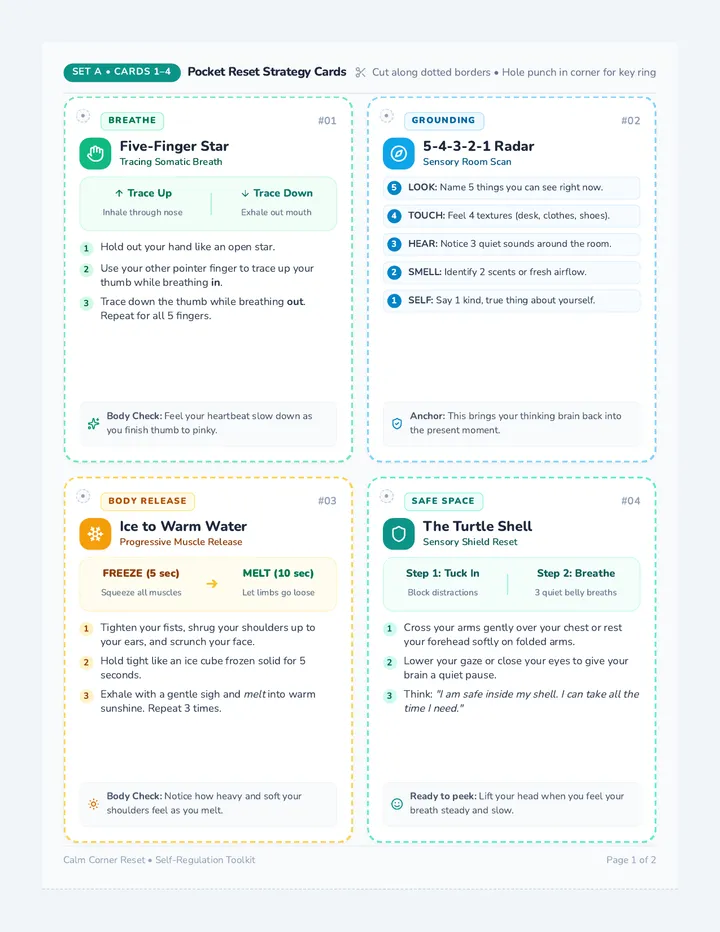
Deep breathing
Counting to ten
Taking a break
Listening to music
Talking to someone
Squeezing a stress ball
My Personal Toolkit
Use your worksheet to list your triggers and choose the tools that work for you.
Work on: Part 1 & 2
Scenario Spin
01
Read the situation.
02
Identify the trigger.
03
Choose a tool from your toolkit.
Scenarios to Try:
"You're working on a challenging math problem, and you keep getting stuck. You feel your frustration growing."
"During group work, one classmate is being very loud and distracting, and you're finding it hard to focus."
"You're super excited about a game, and it's hard to wait for your turn."
Your Regulation Superpower!
1
Spot Triggers
2
Pick a Tool
3
Take Control
What's one thing you'll try to use this week?
Complete Reflection Cool-Down
Self-Regulation Script Self-Regulation Facilitator Script
Your Inner Calm: ADHD Edition
5 Minutes
Warm-Up: Super Sleuth
Teacher Dialogue:
"Welcome, everyone! Let's start with a quick warm-up to get our brains tuned in. We're going to play 'Self-Regulation Super Sleuth.' I'm going to give you a scenario, and I want you to tell me what emotion you might feel and a quick action you might take. No right or wrong answers, just your initial thoughts!"
(Present scenarios from the warm-up, encouraging quick responses.)
"Great job! That warm-up ties perfectly into what we're talking about today: self-regulation. Thinking about our feelings is the first step!"
5 Minutes
Intro to Self-Regulation
Slide 3: What is Self-Regulation?
"Alright, let's talk about 'self-regulation.' It sounds like a big word, but it just means being the boss of your own brain and body. It's about managing your emotions, controlling your actions, and staying focused when you need to. Think about it like a remote control for yourself!"
"Why do you think being able to 'regulate' yourself is important, especially for us, and sometimes even more so for people with ADHD?" (Pause for student responses. Guide the discussion if needed, linking to everyday experiences.)
Slide 4: Why is Self-Regulation a Superpower?
"Exactly! For students with ADHD, self-regulation can be a real superpower. It helps you to think before you act – which means less impulsivity! It helps you handle those really strong emotions, whether it's frustration, anger, or even super high excitement. Ultimately, it helps you feel more in control of yourself and your day."
10 Minutes
Building My Regulation Toolkit
Slide 5: Spotting Your Triggers
"Now, before we can use our superpowers, we need to know what situations might make us need them. We call these 'triggers.' Triggers are things that set off strong feelings or urges in us. Let's brainstorm some ideas together as a group and write them down on our My Regulation Toolkit Worksheet."
Slide 6: Building Your Regulation Toolkit
"Okay, once we can spot a trigger, the next step is knowing what to do. These are your 'coping strategies,' or the tools in your personal regulation toolkit. These are things you can do to help you stay calm and in control."
"When you start to feel triggered, what are some things you can do? Let's fill out the second part of our worksheet. Next to your triggers, I want you to write down some coping strategies that you think might work for you."
8 Minutes
Scenario Spin Activity
Slide 8: Scenario Spin
"Fantastic! Now that we have our toolkits, let's practice using them. I'm going to read out a few different situations. For each one, I want you to: 1) identify the trigger, and 2) choose a strategy from your toolkit that could help. We'll discuss our ideas as a group."
Super Sleuth Warm-Up Self-Regulation Super Sleuth
Name: __________________________
Date: ___________________________
Instructions: Listen to the scenarios. Think about how you might feel and what you might do in that situation. There are no right or wrong answers!
01
You're building a tall tower with blocks, and just as you're about to put the last block on, it all crashes down!
How might you feel?
What might be your first reaction?
02
You're playing your favorite video game, and you lose a level right at the very end.
How might you feel?
What might you feel like doing?
03
Your friend accidentally bumps into your desk and knocks your papers everywhere.
How might you feel?
What might you want to say or do?
04
You're super excited because it's almost time for a fun event, and you have to wait just a little bit longer.
How might you feel?
What might you do while you wait?
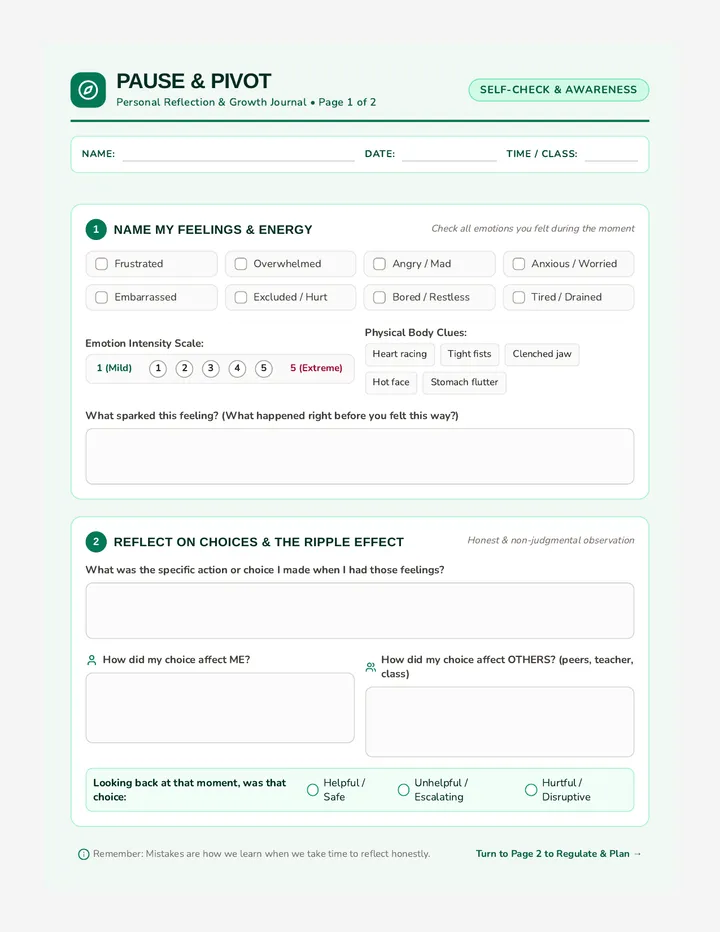
My Regulation Toolkit Worksheet My Regulation Toolkit
Being the boss of your brain and body means knowing what triggers big emotions and having the tools to manage them.
NAME: __________________
DATE: ___________________
1
Spotting My Triggers
What situations, feelings, or thoughts make you feel overwhelmed or frustrated? List at least 3.
Trigger 01
Example: When my little sibling takes my things.
Trigger 02
Example: When I have too much homework.
Trigger 03
Example: When a game isn't fair.
Trigger 04
2
My Coping Strategies (Tools)
What can you do to help yourself calm down or focus? List at least 3 tools.
Strategy 01
Strategy 02
Strategy 03
My Go-To Strategy
If you could only pick ONE strategy to try this week when you feel a trigger, what would it be and why?
Scenario Spin Activity Scenario Spin Activity
Putting Your Tools to the Test
Instructions: Read each scenario. As a group, identify the likely trigger and then discuss which coping strategies from your toolkit would be helpful. Explain why that strategy would work in this situation.
Scenario 01
You are trying to finish an assignment, but your sibling keeps interrupting you, asking you to play. You feel your patience wearing thin.
Possible Trigger(s)
Helpful Strategy(ies)
Scenario 02
Your teacher gives instructions for a new project, and you feel confused and overwhelmed. Your mind starts racing.
Possible Trigger(s)
Helpful Strategy(ies)
Scenario 03
You are playing a board game with friends, and someone accuses you of cheating, even though you know you didn't.
Possible Trigger(s)
Helpful Strategy(ies)
Scenario 04
You have to give a short presentation in class, and you feel really nervous. Your heart is pounding.
Possible Trigger(s)
Helpful Strategy(ies)
Scenario 05
It's snack time, and you're really hungry, but the teacher says you have to wait five more minutes.
Possible Trigger(s)
Helpful Strategy(ies)
Self-Regulation Discussion Prompts Self-Regulation Discussion Prompts
Teacher Facilitation Guide
Prompt 01
"What does being the 'boss of your brain and body' mean to you?"
Follow-up:
"Can you think of a time when you really wished you were more in charge of your feelings or actions?"
Goal: To help students internalize the metaphor of self-regulation and connect it to personal agency.
Prompt 02
"Why do you think learning to self-regulate is an important skill for everyone, especially for someone with ADHD?"
Follow-up:
"How might better self-regulation make your day at school or at home a little easier?"
Goal: To build motivation and awareness of how these skills directly benefit their daily lives.
Prompt 03
"When you feel a strong emotion (like frustration or excitement), what's one thing your body usually wants to do?"
Follow-up:
"How can knowing that feeling help you choose a different, more helpful action?"
Goal: To connect physical sensations (urges) with the opportunity for a regulated choice.
Facilitation Tips
Normalize big emotions—everyone has them!
Validate the extra effort students with ADHD put into regulation.
Encourage specific, concrete examples over abstract ideas.
Use "Think-Pair-Share" if students are hesitant to speak to the whole group.
Regulation Reflection Cool-Down Regulation Reflection
Think about everything we discussed today about self-regulation, triggers, and coping strategies.
NAME: ___________________________________
DATE: ____________________
Your Exit Ticket
What is one specific self-regulation strategy you learned or revisited today that you plan to try and use this week?
Briefly explain when and how you might use it (e.g., "I will use deep breathing when I feel frustrated during math").
Unlock Your Superpower