A family-focused guide to building daily routines and understanding the academic impact of school attendance. Includes a presentation for parent meetings, a student-friendly routine tracker, and a family partnership pledge.
A social-emotional learning lesson focusing on mindfulness and impulse control when interacting with adults, using "If/Then" mapping to trace how impulsive verbal reactions escalate consequences.
A lesson focusing on the power of expressing appreciation to build a positive community. 3rd-5th grade students reflect on school-year supporters and create physical 'tokens of thanks' to display in a classroom gallery walk, facilitating a positive transition to the next grade.
An operational guide and student handbook for West Lee Middle School Pride, providing comprehensive rules, procedures, and logistical information for families and students.
A social-emotional learning lesson for 2nd and 3rd graders based on the book 'Bully Beans' by Julia Cook. Students learn to distinguish between 'mean moments' and 'bullying' and practice active strategies to stand up for themselves and others.
Day 4 guides students in assembling their personalized Stress-Management Blueprint, practicing high-temperature cooling tools, and completing the identical post-test.
Day 3 teaches students how to match specific coping strategies (cooling tools) to their current temperature zones, with hands-on sorting and practice.
Day 2 guides students in mapping their physical body cues (heart rate, muscle tension, breath) and identifying specific situational triggers that elevate their emotional temperature.
Day 1 focuses on introducing the 1-5 emotional thermometer scale, establishing small group norms, and conducting the identical pre-test to assess baseline emotion regulation self-awareness.
An assessment-focused lesson that evaluates third-grade students' ability to apply the 'Stop, Think, Act' framework to common social conflicts. Students complete a scenario-based workbook, and teachers score their responses using a clinical rubric focusing on emotional regulation and green choice actions.
Day 4 of the Skill Matchers unit. Students demonstrate mastery of emotional self-regulation in various situations through scenario roleplay and complete the post-unit assessment.
Day 3 of the Skill Matchers unit. Students match specific coping tools to different physical environments (such as quiet libraries or active recess) to understand situational appropriateness.
Day 2 of the Skill Matchers unit. Students explore personal coping strategies and design a personalized, multi-sensory booklet of tools mapped to different energy levels.
Day 1 of the Skill Matchers unit. Students learn to identify their internal emotional state (energy and feeling) and analyze their external environment's rules and volume levels.
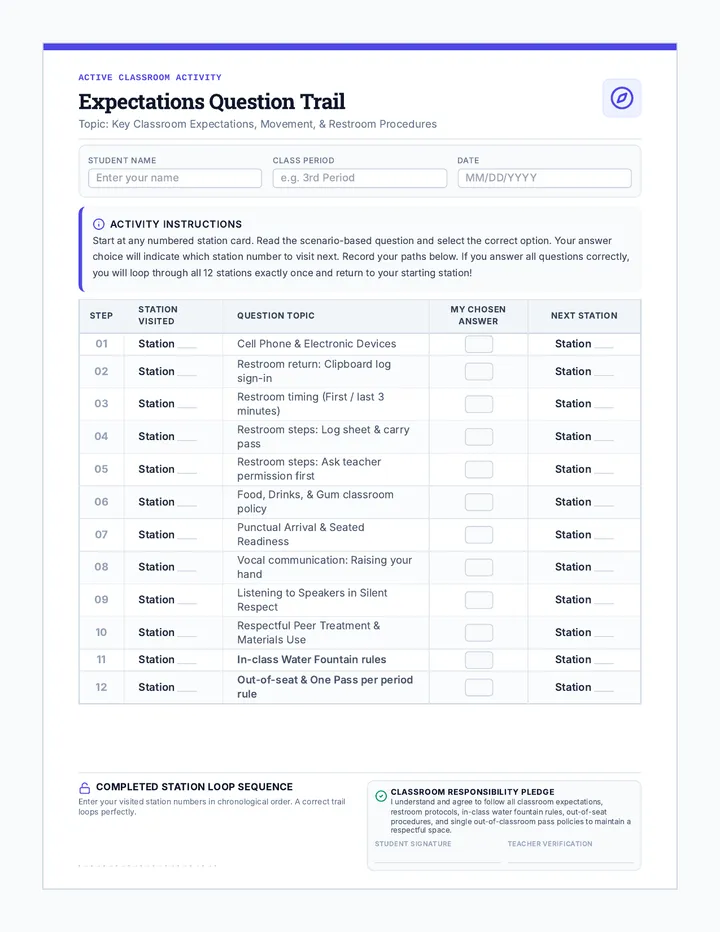
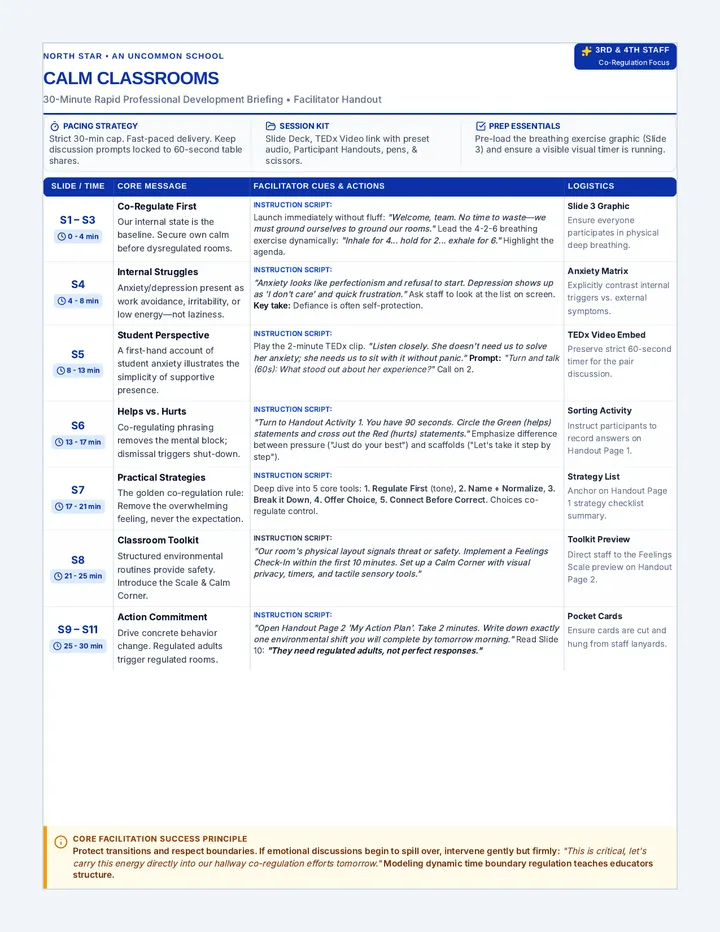
A comprehensive classroom expectations rollout for Week 1 of the school year. Includes a teacher guide and three separate grade-band slide decks (K-2, 3-5, 6-8) designed with a Marley Park green and yellow superhero theme.
A restorative peer-mediation lesson designed for 4th graders to resolve conflict through perspective-taking, active listening, and empathetic repair. Includes a clear facilitator guide for teachers or counselors and printable, step-by-step interview cards for students.
A nurturing social story and coloring book set designed for toddlers and preschoolers. Teaches the power of deep belly breaths to handle disappointments and hear 'no' calmly.
A comprehensive kindergarten classroom management lesson that uses the fun metaphor of space bubbles to teach students how to line up, respect personal space, keep hands to themselves, and maintain physical distance.
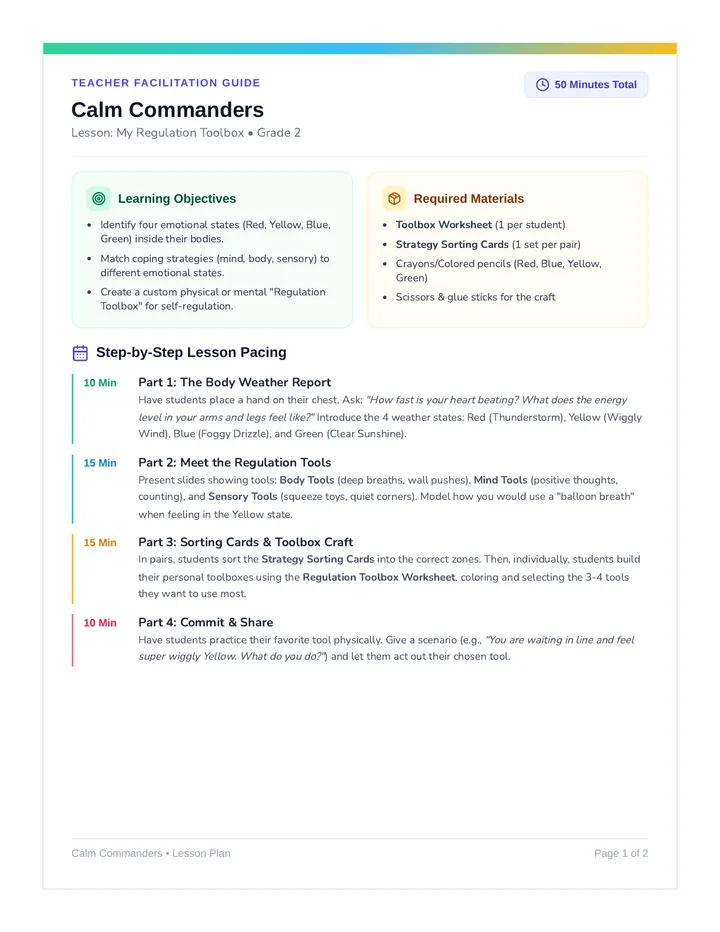
A lesson focusing on self-regulation, interoceptive awareness, and coping strategy mastery. It provides third-grade students with visual, child-friendly tools to connect physical body clues to emotional zones and identify calming strategies.
A counseling lesson for first graders based on the book 'Salt in His Shoes'. Students explore resilience, learning that setbacks and practice are how we grow, and design their own 'Bounce Back Sneakers' to show how they overcome challenges.
Day 4 of the Calm Co-Pilots intervention. A final review where students assemble their personal Calm Kit, practice choosing a strategy with adult prompting, and complete the post-assessment.
Day 3 of the Calm Co-Pilots intervention. Focuses on requesting a 5-minute break and practicing structured rest using sensory supports, cards, and timers with adult prompts.
Day 2 of the Calm Co-Pilots intervention. Focuses on deep breathing using physical, tactile tracing mats to anchor their focus and regulate their physical response to big emotions.
Day 1 of the Calm Co-Pilots intervention. Students explore different emotional states, complete their pre-assessment, and learn to identify when their engines are running too hot, too cold, or just right.
A 3-day small-group social-emotional learning series for middle schoolers on impulse control. Students learn to recognize high-stress triggers and apply the 'override codes' (deep breaths, walking away, and taking a break) to self-regulate.
Students apply calming strategies to real-school scenarios, sign their personal Pause Power Calming Contract, and complete the post-test.
Students learn and practice three concrete, school-appropriate calming strategies: taking a deep breath, taking a break, and resting for 5 minutes.
Students take their pre-test, explore what an 'impulse' is, and learn the concept of the 'Brain Brake'—the physical act of pausing before reacting.