Kind Pals Lesson Guide Grades K–1 Facilitator Guide
Kind Pals: Making & Keeping Friends
Duration: 45–50 Mins
Social-Emotional Learning
Making Friends
Smile, say names, and ask: "Want to play with me?"
Friendship Glue
Turn-taking, gentle hands, and active listening with eye contact.
Space & Fix-Its
Honor personal bubbles and use calm words to patch up little bumps.
Materials: Kind Pals Classroom Slides • 1 Soft Toss Ball or Puppet • Floor Tape / Sit Spots
1
Circle Warm-Up: The Hello Sparkle (10 min)
Gather & Chant: Seat learners in a circle. Teach the call-and-response chant:
"Look, smile, give a wave! Friendship makes us kind and brave!"
Teacher Script: "Friends aren't people we just sit near—friends are people we welcome in. Today we are learning how to invite others, share our favorite games, and fix little mix-ups!"
2
Direct Modeling: The 3 "Hello" Steps & Friendship Glue (15 min)
Skill 1: The 3-Step Friendship Launch
Step 1: Look & Smile Face the peer, give soft eye contact, and flash a warm smile.
Step 2: Say Names "Hi, I'm Maya! What's your name?" (Listen and repeat it).
Step 3: The Golden Ask "Do you want to play blocks with me?" or "Can I join?"
Skill 2: Applying the "Friendship Glue"
Taking Turns: Use the "One for you, one for me" timer or song.Spotting Loneliness: Scan the playground. If a classmate is sitting alone, walk over together and say: "We have room for you!" Cheering Words: Practice saying "Good try!" and "You made a great tower!"
Kind Pals Lesson Guide • Part 1 of 2 Turn page for Conflict Repair, Boundaries & Practice Games
Lesson Delivery Continued
Fix-It Words, Space Bubbles & Playground Practice
Grades K–1
3
Handling Conflict: The 3 "Fix-It" Steps (10 min)
1. Balloon Breath
Stop hands, put hands on belly, blow out a slow gentle breath like a giant bubble.
2. "Bug & Wish" Words
Model: "It bugged me when you took the truck. I wish you would ask first."
3. The Fix-It Question
Instead of just "Sorry", say: "I'm sorry. How can we make this better?"
4
Boundaries & Shifts: The Invisible Hula Hoop (8 min)
The Personal Space Bubble:
Have students extend their arms in a circle. "This is your comfort bubble. We ask before hugs, and we give space when someone steps back."
When Friends Want to Play Something Else:
Teach normalization: "If Leo wants to run and you want to draw, Leo is still your friend! You can play together at snack or try a new buddy today."
5
Movement Activity: The Common Ground Hop (10 min)
How to Play: Teacher calls out a favorite: "Hop to the right line if you love coloring animals! Hop to the left if you love building blocks!"
Partner Connection: When on the same side, partners turn, high-five, and say: "We both like that! Let's play that soon!"
Teacher Recess & Centers Observation Checklist
Friendship Skill Look-For Behavior Status Initiation Approaches peers with eye contact and an invitation Emerging / Mastered Sharing & Turn-Taking Shares materials willingly or offers alternative toys Emerging / Mastered Repairing Friction Uses calm "Bug & Wish" words instead of shouting or tears Emerging / Mastered Personal Boundaries Respects peer's space bubble and accepts "no thank you" Emerging / Mastered
Kind Pals Lesson Guide • Social-Emotional Learning Follow up with Kind Pals Classroom Slides
Kind Pals Slides Grades K–1 • SEL
Everyday Kindness
Kind Pals: The Friendship Adventure
How we make new buddies, share the fun, and fix little bumps along the way!
Look • Listen • Share • Care Ready to begin! 🌟
Skill 1 • Making Friends
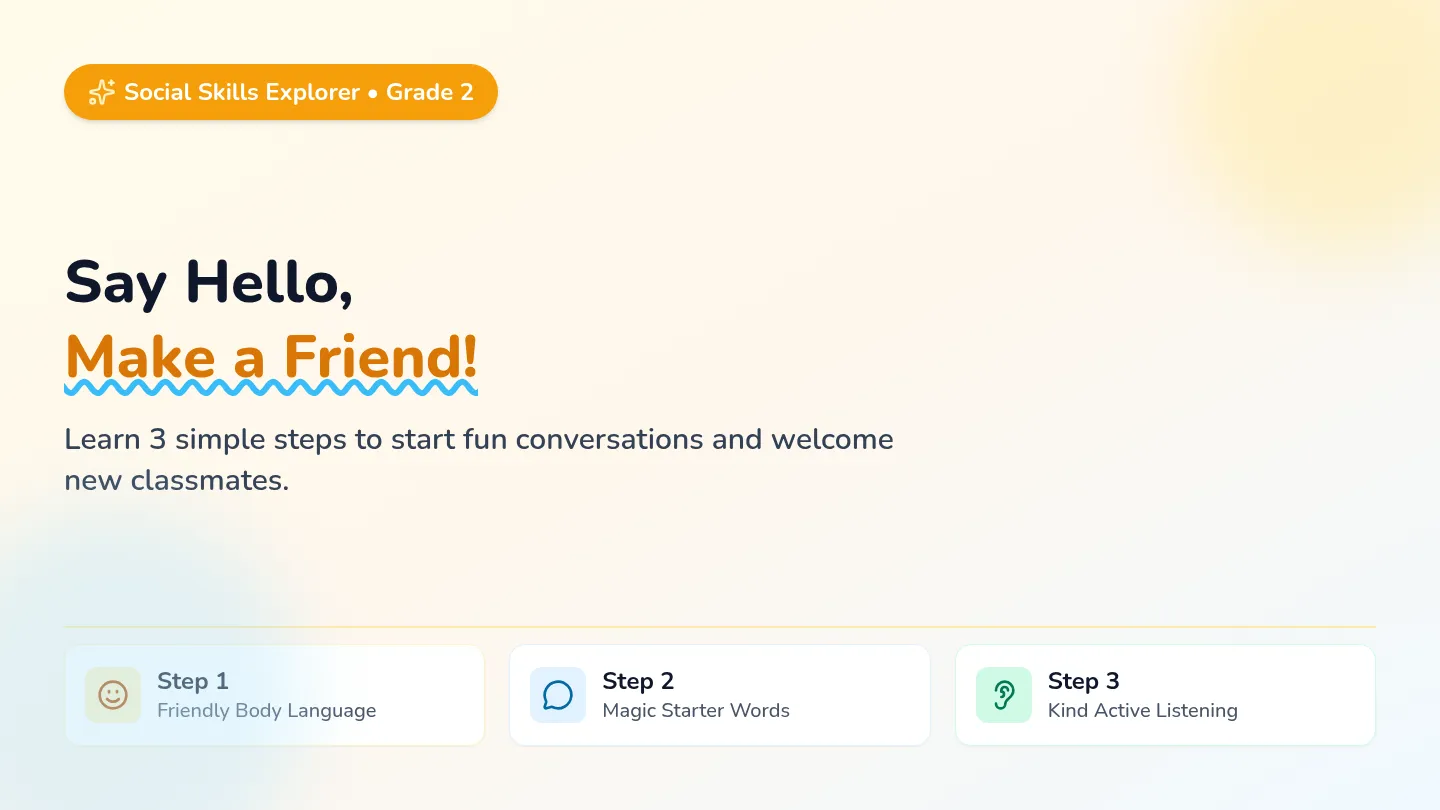
The 3 "Hello" Steps
1
Look & Smile
Face your classmate with gentle eyes and a friendly warm smile!
2
Say Your Name
"Hi, I'm Sam! What is your name?"
3
Ask to Play
"Do you want to play blocks with me?"
Let's practice! Turn to a neighbor, smile, and say: "Hi! Want to play?"
Shared Interests
What Do We Both Like?
Friends don't have to like everything the same, but finding one match is magic!
Drawing
Coloring animals & painting stars
Building
Giant block towers & race tracks
Tag & Run
Running fast and playground games
Stories
Looking at picture books together
Raise a hand if you see a favorite! Tell a friend: "I like that too!"
Skill 2 • Keeping Friends
The "Friendship Glue" Superpowers
Taking Turns Fairly
"Your turn on the swing first, then my turn!" Sharing keeps everyone smiling.
Listening with Your Whole Body
Eyes looking, quiet mouths, and warm ears when a pal is speaking.
Making Room for Everyone
If someone is alone, wave them in: "Come sit by us! There is room!"
Kind words stick like glue! They hold friends together.
Skill 3 • Handling Big Feelings
The 3 "Fix-It" Steps
1. Balloon Breath
Hands on tummy. Breathe in slow... blow out the giant balloon to calm down.
2. Bug & Wish
"It bugged me when the crayon broke. I wish you would share."
3. Make It Right
Say: "I'm sorry. How can we fix this together?" Then rebuild or share.
Disagreements happen to every friend! Kind words help us rebuild.
Skill 4 • Boundaries & Changes
Space Bubbles & Changing Games
Your Invisible Bubble
Everyone has a personal bubble around their body.
Ask before giving hugs or high-fives.
"No thank you" means stop right away with a smile.
When Friends Want a New Game
Sometimes a friend wants to swing while you want to draw.
They are still your friend!
Say: "Have fun swinging! Let's play at snack!"
Our hearts have room for lots of friends, and games can always change!
Our Classroom Pledge
The Kind Pals Promise
1
I will smile, say hello, and invite others to play.
2
I will listen, take turns, and share my smiles.
3
I will use calm Fix-It words when feelings are big.
4
I will respect personal space and cheer on everyone!
Raise your hand and repeat: "I am a Kind Pal!" 🌟
Friendship Navigator Lesson Guide Grades 2–4 Facilitator Guide
Friendship Navigator: Connect, Trust & Repair
Duration: 50–60 Mins
Social-Emotional Learning
1. Connect
Curiosity questions, shared affinities, and open body language.
2. Trust Bank
Active listening, loyalty against gossip, celebrating peer wins.
3. Conflict Repair
4-part I-statements, intent vs. impact, and genuine restitution.
4. Boundaries
Honoring limits, accepting "no", and coping with shifting groups.
Core Learning Targets:
Initiate peer dialogue using open-ended questions.
Identify daily trust-building vs. trust-eroding actions.
Construct a 4-part I-statement during disagreements.
Key Vocabulary:
Active Listening: Listening to understand, not just respond.Restitution: Action taken to make things right after harm.Boundary: A clear limit that keeps someone safe and comfortable.
1
Hook: The Trust Bank Account Metaphor (8 min)
Concept Intro: "Every friendship has a bank account. Kindness, keeping promises, and listening are deposits . Gossiping, breaking trust, or ignoring friends are withdrawals . When deposits are high, friendships can weather storms."
Prompt: Ask pairs: "What is one deposit someone made in your friendship account this week?"
2
Skill Modules: Making Friends & Keeping Trust (15 min)
The 3-Step Social Launch: Observe, Open, Offer
1. Observe & Calibrate Notice body language. Are they open to conversation or focused elsewhere?
2. Open with Curiosity Ask: "What book are you reading?" or "How did you build that design?"
3. Offer Common Ground Share a genuine reaction: "I like fantasy novels too—have you read Percy Jackson?"
Trust Deposits vs. Withdrawals
Trust Deposits (Do These):
Keep private confidences private.
Cheer when your friend succeeds (no jealousy).
Include newcomers in lunch and playground games.
Trust Withdrawals (Avoid These):
Talking behind a friend's back or joining rumors.
Excluding someone to look "cool" to other peers.
Breaking promises or sharing private secrets.
Friendship Navigator Lesson Guide • Page 1 of 2 Turn over for Conflict Protocols, Scenarios & Rubric
Lesson Delivery Continued
Conflict Resolution, Boundary Tools & Scenario Cards
Grades 2–4
3
Handling Conflict: The De-escalation & Repair Sequence (15 min)
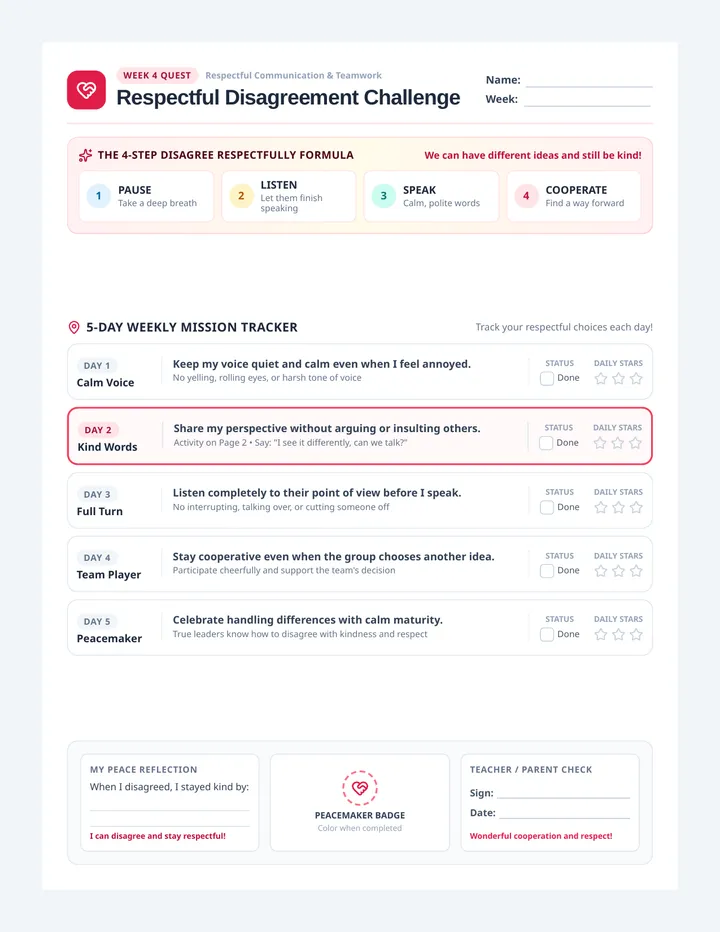
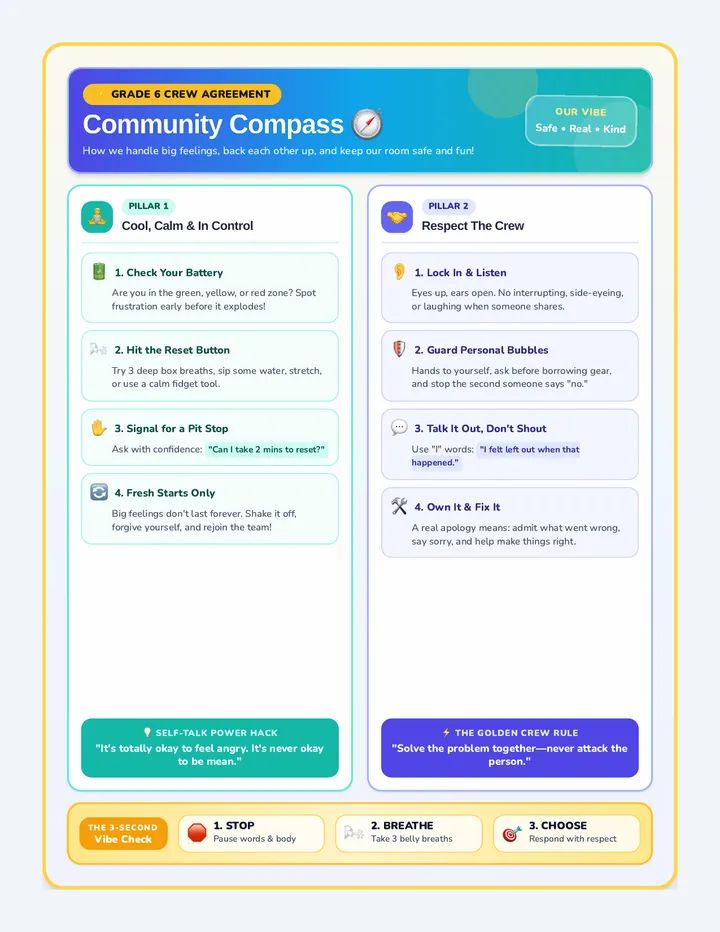
The 4-Part "I-Statement" Formula
1. "I feel..." (name the emotion: frustrated, left out)
2. "When you..." (name specific behavior, not character)
3. "Because..." (explain impact on you)
4. "Next time, can we..." (propose a concrete fix)
The 4-Part Genuine Apology
1. Responsibility: "I am sorry that I [action]."
2. Acknowledge Impact: "I see it hurt your feelings."
3. Restitution: "How can I help fix this?"
4. Future Commitment: "Next time, I will ask first."
4
Boundaries & Changing Groups: "Friendship Weather" (8 min)
Setting & Respecting Boundaries: "Saying 'I need quiet reading time right now' is not rejecting a friend—it is communicating a boundary. A real friend respects your limits without getting angry."
Coping with Changing Interests: "Friendships can shift as hobbies evolve. You do not have to be best friends forever to treat each other with dignity and warmth."
5
Small-Group Scenario Practice (12 min)
Scenario A: The Lunchroom Squeeze
A new student sits at your usual table. A classmate whispers, "Tell them this table is full."
Challenge: How do you show inclusive leadership?
Scenario B: The Kickball Disagreement
Your close friend insists the ball was out. You are sure it was in. Tempers flare.
Challenge: Apply the 4-part I-statement to calm it down.
Scenario C: Broken Confidence
You accidentally told another classmate about your friend's low quiz score. They are hurt.
Challenge: Script a 4-part genuine apology.
Scenario D: Different Interests
Your friend only wants to play four-square, but you want to do art club. They feel abandoned.
Challenge: Set a boundary while affirming the friendship.
Friendship Competency Rubric
Skill Proficient Criteria Evaluation Connection Asks curiosity questions; actively invites peers into play and projects. 1 2 3 4 Trust Building Respects secrets, rejects gossip, and demonstrates reliable follow-through. 1 2 3 4 Conflict Repair Articulates feelings using I-statements; offers constructive solutions. 1 2 3 4 Boundaries Communicates limits calmly; respects when others express "no". 1 2 3 4
Friendship Navigator Lesson Guide • Social-Emotional Learning Pair with Friendship Navigator Slides
Friendship Navigator Slides Grades 2–4 • Social Skills
Social-Emotional Learning
The Practical Guide to Peer Relationships
Friendship Navigator:
Connect, Keep & Repair
Master conversation starters, build unbreakable trust, handle disagreements with calm words, and respect personal boundaries.
Ready to Navigate: 4 Core Friendship Skills Let's Dive In →
Pillar 1 • Making Friends
The 3-Step Social Launch
1
Observe & Notice
Look for open cues: Are they looking around? What activity are they working on?
Tip: Smile and uncross your arms.
2
Open with Curiosity
Ask an open question instead of just "hey":"What game are you setting up?"
Tip: Open questions start with "What" or "How".
3
Offer Common Ground
Bridge the conversation:"I love drawing graphic novels too—want to collaborate?"
Tip: Invite them into a specific activity.
Great friendships start with curiosity about another person!
Pillar 2 • Keeping Friends
The Trust Bank Account
Daily Deposits (Do These)
Active Listening: Listening without interrupting or checking out.Loyalty: Keeping secrets and speaking up when friends are teased.Cheering Success: Celebrating a friend's victory without jealousy.
Costly Withdrawals (Avoid)
Gossiping: Repeating rumors or talking behind someone's back.Exclusion: Making secret clubs or leaving someone out on purpose.Broken Promises: Saying you will do something and ditching them.
Trust takes weeks to build, but only seconds to break. Protect your accounts!
Pillar 3 • Handling Conflict
The 4-Part "I-Statement" Formula
Part 1
"I feel..."
State your emotion clearly without blame: frustrated, left out, hurt, overwhelmed.
Part 2
"When you..."
Describe the specific action—do not insult character: "When plans changed without telling me."
Part 3
"Because..."
Explain why it affected you: "Because I was waiting alone and thought we agreed."
Part 4
"Next time..."
Propose a solution: "Next time, can you let me know before lunch starts?"
Put it all together: "I feel frustrated when my ideas are cut off because I want to contribute. Can we take turns speaking?"
Pillar 3 Repair • Apologies That Heal
Beyond Just Saying "Sorry"
1
Own the Exact Action
"I am sorry that I laughed when you tripped during the relay race." (No excuses!)
2
Name the Emotional Impact
"I realize that made you feel embarrassed in front of the class."
3
Offer Restitution (Make It Right)
"How can I make this right? Can I walk with you to next period?"
4
Future Commitment
"Next time someone stumbles, I will step in to help instead of laugh."
A true apology focuses on repairing the friendship—never on defending yourself.
Pillar 4 • Boundaries & Changes
Setting Boundaries & Navigating Shifts
Healthy Personal Limits
Boundaries protect your energy and comfort:
• Saying "I need quiet reading time" is not rejection.
• Hearing "No" means stop immediately without guilt-tripping.
• Good friends respect boundaries without getting defensive.
When Friendships Shift
Interests change as we grow older:
• If a friend explores new hobbies, let them grow.
• You can have multiple circles of friends.
• Even if you drift apart, kindness and respect never expire.
You don't have to be best friends forever to treat everyone with dignity today.
Navigator Lab • Group Discussion
Scenario Spotlight: The Recess Split
?
The Situation:
Your longtime friend Jordan joined a new kickball team and invited two other classmates to sit at lunch. Your table is crowded, and your friend Taylor whispers:
Navigator Question 1:
How do you respond to Taylor without attacking them?
Navigator Question 2:
What specific words can you use to welcome the newcomers?
Take 2 minutes to discuss with your partner. Be ready to share your response!
Our Daily Commitment
The Friendship Navigator Code
1. I will seek common ground and invite peers into conversation.
2. I will protect trust: no gossip, no secret exclusions.
3. I will use 4-part I-statements and apologize with genuine repair.
4. I will honor personal boundaries and celebrate my friends' growth.
Friendship is a daily practice. Navigate with kindness! 🚀