Friendship Building Fun Plan Friendship Building Fun
Individual (Tier 3) Lesson Plan
Target Audience
9-year-old (ADHD Focus)
Time
15 Minutes
Objective
Recognize social cues & build friendship skills.
Approach
Interactive & Hands-on
Why This Matters
This lesson is important as it equips the student with social skills that enhance their ability to build relationships, boosting confidence and overall social development. For students with ADHD, explicit instruction in recognizing cues helps navigate social complexity with more ease.
Teacher Preparation
Review the Friendship Building Fun Slide Deck and Script .
Ensure interactive components are set up and ready to engage the student.
Familiarize with ADHD-friendly strategies (short tasks, visual support).
Prepare any necessary equipment (computer/projector) for digital materials.
Lesson Flow
1
Introduction & Review
3 mins
Introduce friendship and social cues.
Use Slide Deck visuals to capture interest.
Ask simple questions to gauge understanding.
2
Interactive Activity
6 mins
Play the Social Cues Detective Game .
Complete the Friendship Worksheet .
Provide active prompts and encouragement.
3
Discussion & Reflection
4 mins
Use the Discussion Guide to reflect on learning.
Ask for real-life application examples.
Finish with the Friendship Quiz .
Friendship Building Fun Slides Welcome to Friendship Building Fun!
Today we're going to learn about friendship and social cues.
Teacher Note: Introduce the session and set a friendly tone. Smile, introduce yourself, and give a simple welcome message to capture the student's attention.
What is Friendship?
Friendship is about caring, listening, and having fun together.
Detective Challenge:
What are some things you like about your friends?
Teacher Note: Explain friendship basics. Use engaging questions to allow the student to share thoughts about what makes someone a friend.
Recognizing Social Cues
Social cues are hints people give through their actions.
A Smile
A Frown
A Wave
Can you think of ways people show they are happy or need help?
Teacher Note: Explain the concept of social cues. Give examples like body language and tone of voice to clarify.
Interactive Activity Time!
1
Friendship Game
2
Fun Worksheet
Teacher Note: First, talk through the activity using the interactive game, then work together on the worksheet. Provide support and encouragement.
Discussion & Quiz
Reflect:
What did you enjoy today?
How can you use these skills?
Get ready for a quick quiz!
Teacher Note: Ask the student to share one thing they learned. Wrap up with a quick quiz question on main points.
Friendship Building Fun Script Friendship Building Fun Script
Instructional Script for 15-Minute Session
1. Introduction
3 Minutes
Teacher: "Hi there! Welcome to our Friendship Building Fun session. I'm really happy to see you today. Today, we're going to talk about friendship and learn how to recognize social cues. Does that sound fun?"
Teacher: "So, what do you think it means to be a good friend? What are some things you like about your friends?"
(Allow the student time to respond, encouraging them to share their thoughts. Use positive reinforcement.)
Teacher: "Great answers! Remember, friendship means caring, listening, and having fun together."
2. Interactive Activity
6 Minutes
Teacher: "Now, let's have some fun with our interactive activity. First, I’m going to show you some slides from our Friendship Building Fun Slide Deck. (Click to show slide 'Interactive Activity Time!')"
Teacher: "We're going to play a little game where we'll look at different social cues. Sometimes, people show how they feel with a smile, a frown, or even a wave. Can you think of a time you saw someone smile because they were happy?"
(Engage in conversation and give prompts if needed.)
Teacher: "Awesome! Now, let's try a game. In this game, I will show some pictures or expressions and I want you to tell me what you think the person is feeling. Ready?"
(Guide the student through examples with encouraging prompts: "What do you think this smile means? How does that make you feel?")
Teacher: "Great job! Now, let's work together on a fun worksheet. Follow along with me as we fill it out. I'll ask some questions and you can tell me your ideas."
3. Discussion and Reflection
4 Minutes
Teacher: "Now that we had some fun with our activities, let's talk a little about what we learned. What was your favorite part of our friendship game today?"
Teacher: "Can you share one example of how you can use the friendship skills we talked about when you're with your friends? For example, noticing when someone might be sad, happy, or need a buddy?"
(Allow response time. Use phrases like: "That’s a wonderful idea!" or "I love how you think about others.")
Teacher: "Before we finish, let's quickly see what we've remembered with a little quiz. Here's a question: What are two things a good friend does?"
Teacher: "Fantastic work today! Remember, a good friend listens, cares, and has fun with others. I’m really proud of you!"
Friendship Building Fun Worksheet Friendship Building Fun
Social Cues Detective Worksheet
Name:
Date:
1. My Friends and Me
Think about what makes a friend a good friend. Write down two things that you like about your friends.
2. Recognizing Social Cues
Look at these examples and write what each social cue might mean:
a) A big smile on someone's face
b) A frown on someone's face
3. Let's Draw!
Draw a picture of a time when you or someone you know was being a really good friend. What happened? How did it make you feel?
4. My Friendship Promise
Write one thing you promise to do to be a better friend.
Friendship Building Fun Reading Friendship Stories
A Day of New Friends
Today at school, Mia felt excited and a little nervous about playing with new classmates. She remembered that being a good friend means caring, listening, and having fun together. As she walked into the playground, Mia saw a boy named Liam sitting alone on a bench. His shoulders were a bit slumped, and he wasn’t smiling like the other kids.
Mia thought, "Maybe Liam needs a friend." She walked over and said with a warm smile, "Hi, I’m Mia! Would you like to play with me?" Liam looked up and smiled, his frown turning into a happy expression. This small act of kindness made Mia realize how important it is to pay attention to others’ feelings.
Recognizing Social Cues
As Mia and Liam played a game of tag, they noticed many different ways that people show their feelings. When a friend laughed out loud, it meant they were really enjoying the moment. When someone crossed their arms, it sometimes showed that they were feeling upset or needed some space. Mia learned that by watching these little hints, she could understand her friends better and know when someone might need help or just a smile.
By the end of the day, Mia and Liam had made many new friends, all because they paid attention to the little messages each person showed by their actions. Mia realized that understanding social cues isn’t hard when you care about others. Being kind, smiling, and sharing a game or a laugh can always bring people together.
Remember...
Just like Mia, you can look out for your friends and make a big difference in their day with small acts of kindness and by noticing how they feel.
Discussion Prompt: If you were Mia, what other social cues might you look for on the playground?
Friendship Building Fun Discussion Guide Friendship Building Fun Discussion Guide
Facilitation Guidelines
Comfortable Environment: Remind the student that all answers are welcome.Encourage Sharing: Use open-ended questions and provide wait time.Visual Prompts: Refer back to the slides or reading to spark ideas.Supportive Tone: Praise contributions and validate feelings.
Discussion Questions
1. What did you like most about our activity today?
Follow-up: Can you tell me one thing you learned about what makes someone a good friend?
2. Can you share an example of a time when you noticed someone’s feelings without them saying it out loud?
Follow-up: How did you know how they were feeling? What did you do to help them?
3. Why do you think noticing social cues, like a smile or a frown, is important in friendship?
Follow-up: How can understanding these cues help you be a better friend?
4. If you saw a friend who looked sad or lonely today, what are some things you could do to help them?
Follow-up: Which of these ideas feels easiest for you to try?
Reflection Prompts
Reflect on Today: Think about what you learned and how you felt. What was your favorite part?Plan for Tomorrow: Think of one way to use these skills next time you're with a friend.Visualize Success: Describe a situation where a friend needs help and you notice their cues.
Closing the Discussion
Summarize: Recap how cues make us more connected.Encourage: Congratulate the student on their thoughtfulness.Final Check: Ask if they have any remaining questions about friendship. Friendship Building Fun Activity Top Secret
Mission: Social Cues Detective
Case File: Friendship-01
Mission Overview
In this activity, you will play a game called "Social Cues Detective". Your goal is to recognize different social cues by matching facial expressions and body language to feelings. This will help you understand your friends better!
1. Setup
Your teacher will show you pictures or prompts of different expressions (like a smile, frown, or crossed arms). Each one is a clue!
2. How to Play
Look closely at the expression or posture.
Tell your teacher: "What is this person feeling?"
Explain why you think that (e.g., "They are smiling!").
3. Reflection
After a few rounds, talk with your teacher about:
Which cues were easiest to spot?
Which ones were tricky?
When have you seen these in real life?
Detective Wrap-Up
Discuss how you might use this knowledge in real life to help your friends feel understood. Remember—every facial expression and action tells a story!
Friendship Building Fun Game Social Cues Detective Game
Your mission to decode emotions!
1
Watch the Prompt
Your teacher will show you an image or prompt with a facial expression or body language.
2
Make Your Guess
Think about what the person might be feeling. Are they happy? Sad? Surprised?
3
Share Your Answer
Tell your teacher what you think! Explain your reasoning for extra detective points.
4
Keep Playing
Notice which cues are easy or tricky. Practice makes you a master detective!
"Every facial expression tells a story about our feelings!"
Friendship Building Fun Quiz Friendship Building Quiz
Show what you know about being a great friend!
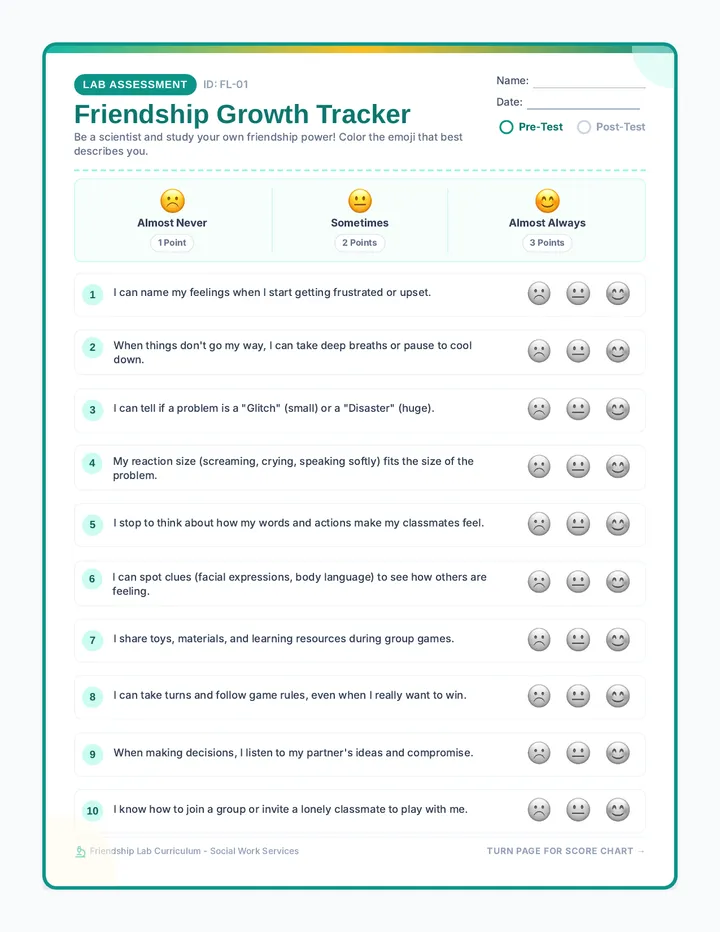
Name:
Date:
1
Which of the following is a social cue that shows someone might be happy?
A big smile
A frown
Crossed arms
2
Name one thing a good friend does.
3
How easy is it for you to recognize when someone is showing a happy expression?
Circle the face that matches how you feel!
Very Easy
Easy
A Little Difficult
Very Difficult
Awesome job! You are a friendship star!