Feelings Radar Slides System Status: Active
SEL Unit 1: Emotion Decoding
FEELINGS RADAR
Building your emotional detection system. Learn to scan your vocabulary, track your body signals, and map emotional intensity.
LATITUDE: INNER WORLD
LONGITUDE: MIDDLE SCHOOL LIFE
SCANNING CHANNELS
SCAN 01: VOCABULARY OVERHAUL
SYSTEM CALIBRATION
Beyond "Good" & "Bad"
Middle school is complicated. If we only have basic words, we misinterpret our own systems. We need high-definition data.
RADAR RULE:
"If you can name it, you can tame it." Precision in labeling emotions actually lowers their physical threat level in your brain.
ANGRY
Excluded Frustrated
SAD
Lonely Overwhelmed
FINE
Peaceful Indifferent
REF: EMOTIONAL DICTIONARY PAGE 02 OF 05
SCAN 02: PHYSIOLOGICAL RADAR
SENSORY TELEMETRY
Your Body is
the Receiver
Your body detects emotions before your conscious brain does.
Physical symptoms aren't malfunction alerts—they are structural notifications. Learning your signals helps you catch emotional waves before they crash.
The Heat Channel
Fists clenching, face feeling warm, rapid heartbeat, heavy breathing. (Usually signals: anger, panic)
The Freeze Channel
Heavy shoulders, shallow breathing, feeling hollow or cold, low energy. (Usually signals: sadness, grief)
The Buzz Channel
Fidgety hands, pacing, stomach butterflies, rapid-fire talking. (Usually signals: excitement, anxiety)
The Grounded Channel
Slow steady breathing, soft shoulders, loose grip, steady gaze. (Usually signals: calm, security)
REF: BIOMETRIC TELEMETRY PAGE 03 OF 05
SCAN 03: INTENSITY CALIBRATION
SIGNAL GAIN LEVEL
How Strong
is the Signal?
Not all signals require the same defense protocols.
An emotion can start at a Level 2 (Whisper) and escalation transforms it to a Level 10 (Siren). Knowing where you are on the dial tells you what strategies to apply.
01-03
Level 1-3: Whisper (Low Intensity)
Slight change in mood. Easily ignored or shrugged off. Mild distraction.
EASY MONITOR
04-07
Level 4-7: Rumble (Moderate Intensity)
Takes mental effort to focus. Difficult to think cleanly. Heavy breathing starts.
INTERVENTION NEEDED
08-10
Level 8-10: Siren (High Intensity)
System overload. Danger zone. High risk of reactiveness. Hard to control words or body.
EMERGENCY PROTOCOL
REF: SIGNAL AMPLITUDE MATRIX PAGE 04 OF 05
LIVE SCAN: DECIPHER THE SIGNALS
ACTIVE SCENARIO
Read the
Telemetry
Let's practice reading the system logs. What is happening underneath the surface?
DISCUSSION DEBRIEF:
What is the precise high-definition emotion?
What body signal was the key indicator?
What level is this on the intensity scale?
LOG #204 THE GROUP CHAT
"You open your phone and see screenshots of a group chat you were excluded from. You immediately feel a sudden cold pit in your stomach, your shoulders drop, and you want to lock your screen and stare at the wall."
LOG #502 THE CLASS PRESENTATION
"You are up next to present your science slide. Your heart begins to race, your hands are sweating so much you can't hold your index cards steady, and your throat feels completely tight."
REF: SYSTEM DEPLOYMENT READY PAGE 05 OF 05
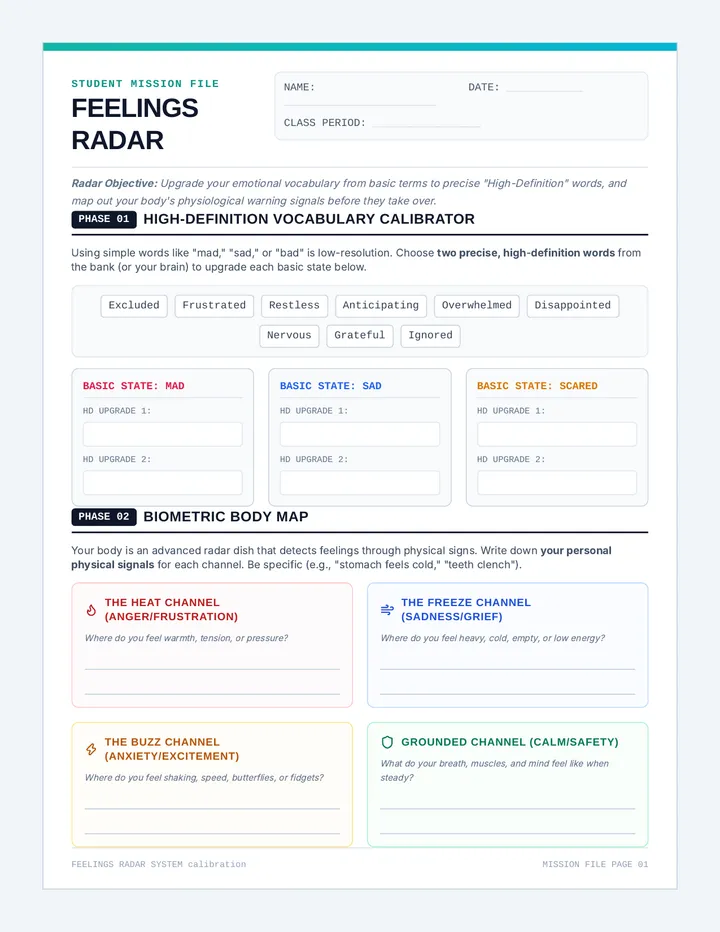
Feelings Radar Worksheet Student Mission File
FEELINGS RADAR
NAME: ________________________
DATE: ____________
CLASS PERIOD: _________________
Radar Objective: Upgrade your emotional vocabulary from basic terms to precise "High-Definition" words, and map out your body's physiological warning signals before they take over.
PHASE 01
High-Definition Vocabulary Calibrator
Using simple words like "mad," "sad," or "bad" is low-resolution. Choose two precise, high-definition words from the bank (or your brain) to upgrade each basic state below.
Excluded Frustrated Restless Anticipating Overwhelmed Disappointed Nervous Grateful Ignored
BASIC STATE: MAD
HD UPGRADE 1:
HD UPGRADE 2:
BASIC STATE: SAD
HD UPGRADE 1:
HD UPGRADE 2:
BASIC STATE: SCARED
HD UPGRADE 1:
HD UPGRADE 2:
PHASE 02
Biometric Body Map
Your body is an advanced radar dish that detects feelings through physical signs. Write down your personal physical signals for each channel. Be specific (e.g., "stomach feels cold," "teeth clench").
The Heat Channel (Anger/Frustration)
Where do you feel warmth, tension, or pressure?
The Freeze Channel (Sadness/Grief)
Where do you feel heavy, cold, empty, or low energy?
The Buzz Channel (Anxiety/Excitement)
Where do you feel shaking, speed, butterflies, or fidgets?
Grounded Channel (Calm/Safety)
What do your breath, muscles, and mind feel like when steady?
FEELINGS RADAR SYSTEM calibration MISSION FILE PAGE 01
Interactive Logs
ACTIVE RADAR INTERPRETER
MISSION SYSTEM ACTIVE
PHASE 03
Telemetry Scenario Analysis
Read the active logs and decipher the details. Identify the high-definition emotion, find the body clues, and plot the intensity on our 1-10 Radar Scale .
LOG SYSTEM #204 Middle School Hallway
"As you walk to your locker, you wave at two of your classmates. They look directly at you, whisper to each other, and laugh as they walk away. Your throat immediately feels dry, your shoulders hunch over, and you suddenly feel like pulling your hood over your head and hiding."
HD EMOTION PROBED:
BODY SIGNAL DETECTED:
INTENSITY LEVEL (1-10):
LOG SYSTEM #502 Science Lab Project
"The teacher is announcing project groups. She calls out your name paired with the newest student in class. Instantly, your chest expands, your lips turn up, your legs feel light and ready to bounce, and you can't stop smiling as you look around the room."
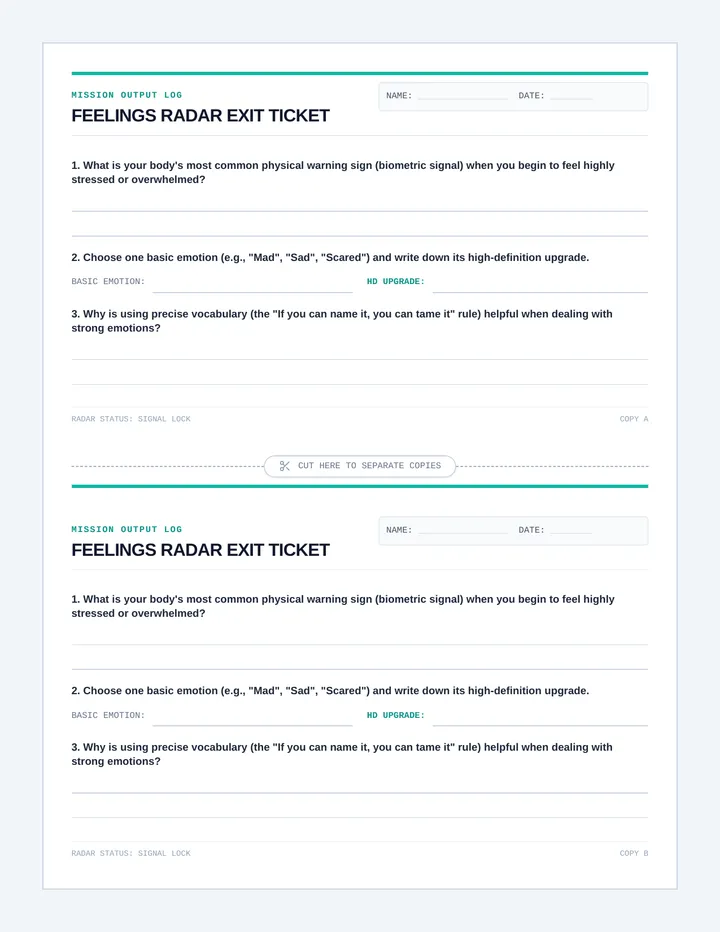
Feelings Radar Exit Ticket Mission Output Log
FEELINGS RADAR EXIT TICKET
NAME: _________________
DATE: ________
1. What is your body's most common physical warning sign (biometric signal) when you begin to feel highly stressed or overwhelmed?
2. Choose one basic emotion (e.g., "Mad", "Sad", "Scared") and write down its high-definition upgrade.
BASIC EMOTION:
HD UPGRADE:
3. Why is using precise vocabulary (the "If you can name it, you can tame it" rule) helpful when dealing with strong emotions?
RADAR STATUS: SIGNAL LOCK COPY A
CUT HERE TO SEPARATE COPIES
Mission Output Log
FEELINGS RADAR EXIT TICKET
NAME: _________________
DATE: ________
1. What is your body's most common physical warning sign (biometric signal) when you begin to feel highly stressed or overwhelmed?
2. Choose one basic emotion (e.g., "Mad", "Sad", "Scared") and write down its high-definition upgrade.
BASIC EMOTION:
HD UPGRADE:
3. Why is using precise vocabulary (the "If you can name it, you can tame it" rule) helpful when dealing with strong emotions?
RADAR STATUS: SIGNAL LOCK COPY B
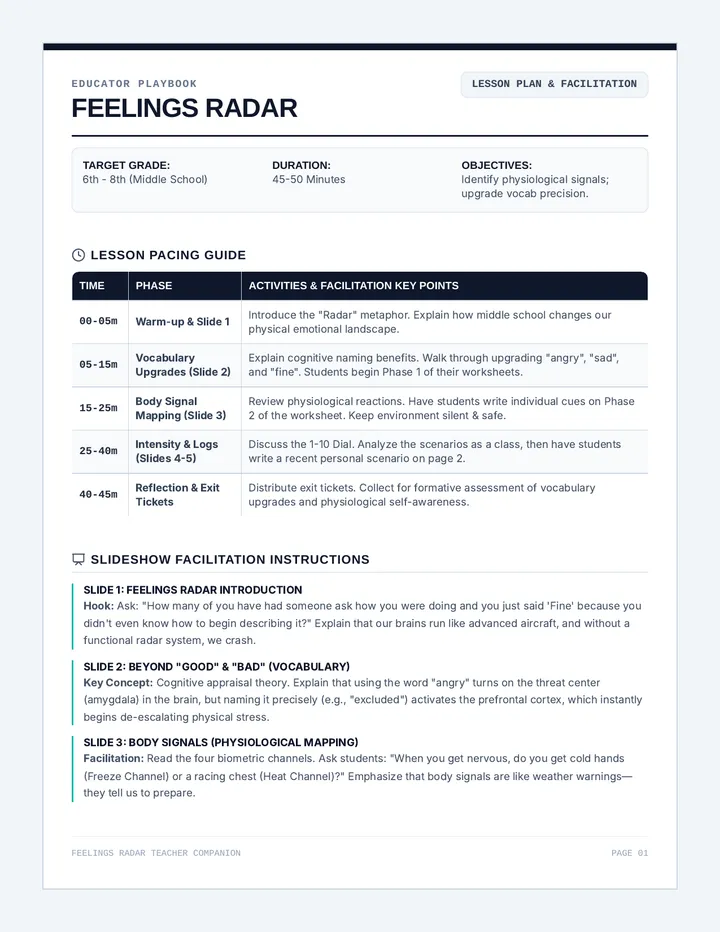
Feelings Radar Teacher Guide Educator Playbook
FEELINGS RADAR
LESSON PLAN & FACILITATION
TARGET GRADE: 6th - 8th (Middle School)
DURATION: 45-50 Minutes
OBJECTIVES: Identify physiological signals; upgrade vocab precision.
Lesson Pacing Guide
TIME PHASE ACTIVITIES & FACILITATION KEY POINTS 00-05m Warm-up & Slide 1 Introduce the "Radar" metaphor. Explain how middle school changes our physical emotional landscape. 05-15m Vocabulary Upgrades (Slide 2) Explain cognitive naming benefits. Walk through upgrading "angry", "sad", and "fine". Students begin Phase 1 of their worksheets. 15-25m Body Signal Mapping (Slide 3) Review physiological reactions. Have students write individual cues on Phase 2 of the worksheet. Keep environment silent & safe. 25-40m Intensity & Logs (Slides 4-5) Discuss the 1-10 Dial. Analyze the scenarios as a class, then have students write a recent personal scenario on page 2. 40-45m Reflection & Exit Tickets Distribute exit tickets. Collect for formative assessment of vocabulary upgrades and physiological self-awareness.
Slideshow Facilitation Instructions
Slide 1: Feelings Radar Introduction
Hook: Ask: "How many of you have had someone ask how you were doing and you just said 'Fine' because you didn't even know how to begin describing it?" Explain that our brains run like advanced aircraft, and without a functional radar system, we crash.
Slide 2: Beyond "Good" & "Bad" (Vocabulary)
Key Concept: Cognitive appraisal theory. Explain that using the word "angry" turns on the threat center (amygdala) in the brain, but naming it precisely (e.g., "excluded") activates the prefrontal cortex, which instantly begins de-escalating physical stress.
Slide 3: Body Signals (Physiological Mapping)
Facilitation: Read the four biometric channels. Ask students: "When you get nervous, do you get cold hands (Freeze Channel) or a racing chest (Heat Channel)?" Emphasize that body signals are like weather warnings—they tell us to prepare.
FEELINGS RADAR TEACHER COMPANION PAGE 01
Implementation Notes
PEDAGOGY & KEYS
SYSTEM STATUS: ARCHIVED