Mindset Focus Planner Mats Mindset & Focus Companion
Academic Self-Regulation & Cognitive Flow
Student ID / Initials:
Cognitive & Physiological Check-in
Acknowledge your state without judgment
Low Battery Fatigued • Disengaged • Understimulated
Optimal Flow Calm • Attentive • Analytical
Hyper-Alert Restless • Agitated • Overstimulated
Overwhelmed Highly Anxious • Frustrated • Blocked
Cognitive Toolkits & Grounding Practices
Re-Energize Focus
Kinesthetic reset: Rotate ankles, wrists, and shoulders twice.Hydrate with cold water to stimulate the vagus nerve.
Posture check: Align spine, look up toward wall ceiling connection.
Maximize Cognitive Flow
Micro-Goals: Break work blocks into distinct 20-minute chunks.Identify exactly 1 specific objective to finish in this period.
Minimize visual distractors (close irrelevant browser tabs).
Regulate Restlessness
5-4-3-2-1 Grounding: Name objects in room to quiet amygdala.Physiological Sigh: Two deep inhales followed by one slow exhale.Jot down active mental distractions on scratch paper to clear mind.
De-Escalate Stress
Cognitive Reframing: Ask "Is this stress temporary or permanent?"Advocate: Request a quiet 2-minute reset or drink of water.Isolate the very next step. Ignore the overall scale of assignment.
The Physiological Sigh Protocol
The fastest bio-hack to reduce autonomic arousal in high-stress moments
Inhale 1 Deep Nose
Inhale 2 Sharp Sip
Exhale Slow Mouth
Metacognitive Commitment & Stress Plan
My ideal study conditions look like:
e.g., quiet room, white noise, tasks color-coded
When my cognitive load gets too heavy, I can:
e.g., prioritize the top 3 items, request extension
Emotional intelligence and self-regulation are key drivers of collegiate and career success. Keep in binder or folder
Daily Reflections Exit Slips High School Advisory/Focus Slips: Cut along dotted lines for 4 individual slips
Mindset Reflections
Reflect & Refocus
📊 Cognitive Load Check
CLASS/PERIOD:
DATE:
1. Current Cognitive State:
Low Battery (Tired)
Optimal Flow (Calm)
Hyper-Alert (Anxious)
Overwhelmed (Stressed)
2. Primary Focus Blocker today:
Academic Workload
Fatigue/Lack of Sleep
Digital/Phone Distractions
Internal/Personal Stress
3. Private Metacognitive Notes / Action plan:
Reflect & Refocus
📊 Cognitive Load Check
CLASS/PERIOD:
DATE:
1. Current Cognitive State:
Low Battery (Tired)
Optimal Flow (Calm)
Hyper-Alert (Anxious)
Overwhelmed (Stressed)
2. Primary Focus Blocker today:
Academic Workload
Fatigue/Lack of Sleep
Digital/Phone Distractions
Internal/Personal Stress
3. Private Metacognitive Notes / Action plan:
Reflect & Refocus
📊 Cognitive Load Check
CLASS/PERIOD:
DATE:
1. Current Cognitive State:
Low Battery (Tired)
Optimal Flow (Calm)
Hyper-Alert (Anxious)
Overwhelmed (Stressed)
2. Primary Focus Blocker today:
Academic Workload
Fatigue/Lack of Sleep
Digital/Phone Distractions
Internal/Personal Stress
3. Private Metacognitive Notes / Action plan:
Reflect & Refocus
📊 Cognitive Load Check
CLASS/PERIOD:
DATE:
1. Current Cognitive State:
Low Battery (Tired)
Optimal Flow (Calm)
Hyper-Alert (Anxious)
Overwhelmed (Stressed)
2. Primary Focus Blocker today:
Academic Workload
Fatigue/Lack of Sleep
Digital/Phone Distractions
Internal/Personal Stress
3. Private Metacognitive Notes / Action plan:
Encourage honest metacognitive checks to build long-term emotional intelligence. Advisory Reflection Slips
Emotional Zones Anchor Chart Cognitive Regulation Scale
Understanding our stress response & optimizing our focus
1. Low Battery
Hypo-Arousal State
Fatigued • Apathetic • Sluggish
Physiological Signs:
Heavy eyelids, slumped posture, slow processing, brain fog.
Classroom Impact:
Difficulty initiating tasks, spacing out, low comprehension.
Protocol Action: Hydration • Desk Stretches • Oxygen Boost
2. Optimal Flow
Focused/Attentive
Engaged • Analytical • Quietly Alert
Physiological Signs:
Controlled heart rate, upright posture, active eye contact.
Classroom Impact:
High comprehension, deep processing, consistent output.
Protocol Action: Maintain focus • Time-block tasks
3. Hyper-Alert
Mild Hyper-Arousal
Restless • Distracted • Over-excited
Physiological Signs:
Fidgeting, scanning the room, shallow breathing, racing thoughts.
Classroom Impact:
Task switching, chatting, missing spoken directions.
Protocol Action: 5-4-3-2-1 Rule • Physiological Sigh
4. Overwhelmed
Severe Hyper-Arousal
Highly Anxious • Agitated • Blocked
Physiological Signs:
Elevated heart rate, muscle tension, mental paralysis, flight fight drive.
Classroom Impact:
Inability to work, sensory shutdown, intense frustration.
Protocol Action: Cognitive Reframe • Private Reset
Our Mindset Commitment
We respect private regulation choices without judgment or labeling.
We understand that cognitive states change, and we practice proactive self-advocacy.
We take responsibility for our focus environments and minimize peer disruptions.
Classroom Regulation Scale Base Board Metacognition is a critical executive functioning skill.
Private Desk Markers & Focus Cards
Instead of public clipping, high schoolers use these printable discrete desk markers and planning bookmarks.
Interactive Assets
Part A: Desk Tent "Privacy Sliders" (Cut & fold in half)
Faced Downward Optimal Flow
Focus Mode: Please leave to work
Faced Upward Need Space
Regulating: Will request assistance shortly
FOLD LINE IN MIDDLE
Faced Downward Independent
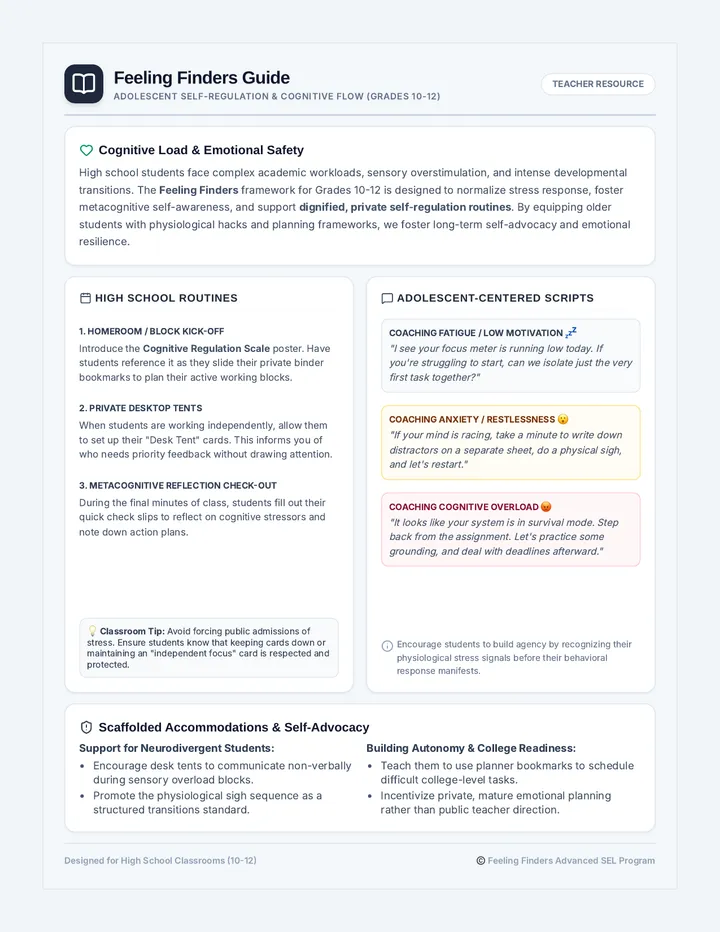
Feeling Finders Teacher Guide Feeling Finders Guide
Adolescent Self-Regulation & Cognitive Flow (Grades 10-12)
Teacher Resource
Cognitive Load & Emotional Safety
High school students face complex academic workloads, sensory overstimulation, and intense developmental transitions. The Feeling Finders framework for Grades 10-12 is designed to normalize stress response, foster metacognitive self-awareness, and support dignified, private self-regulation routines . By equipping older students with physiological hacks and planning frameworks, we foster long-term self-advocacy and emotional resilience.
High School Routines
1. Homeroom / Block Kick-off
Introduce the Cognitive Regulation Scale poster. Have students reference it as they slide their private binder bookmarks to plan their active working blocks.
2. Private Desktop Tents
When students are working independently, allow them to set up their "Desk Tent" cards. This informs you of who needs priority feedback without drawing attention.
3. Metacognitive Reflection Check-out
During the final minutes of class, students fill out their quick check slips to reflect on cognitive stressors and note down action plans.
💡 Classroom Tip: Avoid forcing public admissions of stress. Ensure students know that keeping cards down or maintaining an "independent focus" card is respected and protected.
Adolescent-Centered Scripts
Coaching fatigue / low motivation 💤
"I see your focus meter is running low today. If you're struggling to start, can we isolate just the very first task together?"
Coaching anxiety / restlessness 😮
"If your mind is racing, take a minute to write down distractors on a separate sheet, do a physical sigh, and let's restart."
Coaching cognitive overload 😡
"It looks like your system is in survival mode. Step back from the assignment. Let's practice some grounding, and deal with deadlines afterward."
Encourage students to build agency by recognizing their physiological stress signals before their behavioral response manifests.
Scaffolded Accommodations & Self-Advocacy
Support for Neurodivergent Students:
Encourage desk tents to communicate non-verbally during sensory overload blocks.
Promote the physiological sigh sequence as a structured transitions standard.
Building Autonomy & College Readiness:
Teach them to use planner bookmarks to schedule difficult college-level tasks.
Incentivize private, mature emotional planning rather than public teacher direction.
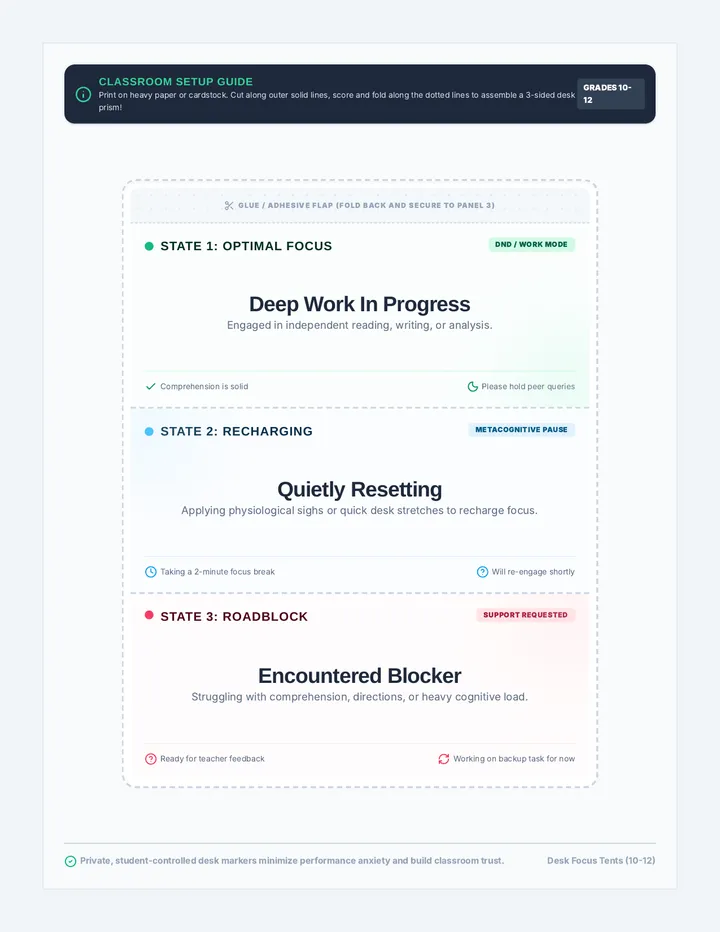
Focus Privacy Desk Tents Classroom Setup Guide
Print on heavy paper or cardstock. Cut along outer solid lines, score and fold along the dotted lines to assemble a 3-sided desk prism!
Grades 10-12
GLUE / ADHESIVE FLAP (Fold back and secure to Panel 3)
STATE 1: OPTIMAL FOCUS
DND / Work Mode
Deep Work In Progress
Engaged in independent reading, writing, or analysis.
Comprehension is solid Please hold peer queries
STATE 2: RECHARGING
Metacognitive Pause
Quietly Resetting
Applying physiological sighs or quick desk stretches to recharge focus.
Taking a 2-minute focus break Will re-engage shortly
STATE 3: ROADBLOCK
Support Requested
Encountered Blocker
Struggling with comprehension, directions, or heavy cognitive load.
Ready for teacher feedback Working on backup task for now
Private, student-controlled desk markers minimize performance anxiety and build classroom trust. Desk Focus Tents (10-12)