Fairness Detectives Lesson Plan Fairness Detectives
Official Lesson Plan: Case #101
Grades 3-5
Duration: 45 Minutes
Why This Matters
Understanding fairness is crucial for building a just society, fostering empathy, and resolving conflicts peacefully. This lesson helps students develop critical thinking skills and promotes a more inclusive classroom and community by distinguishing needs-based fairness from simple equality.
Objective
Students will be able to differentiate between fairness and equality, analyze scenarios to identify fair and unfair situations, and propose solutions that consider individual needs to achieve equitable outcomes.
Prep (15 mins)
Review the lesson plan and digital materials.
Set up the projector for the Fairness Detectives Slide Deck .
Print copies of the Fairness Scenarios Worksheet (1 per student).
Gather construction paper, markers, and drawing tools for the project.
Materials
Slide Deck
Scenarios Worksheet
Discussion Guide
Project Guide
Art Supplies
Instructional Steps
5m
Warm-Up: What is Fair?
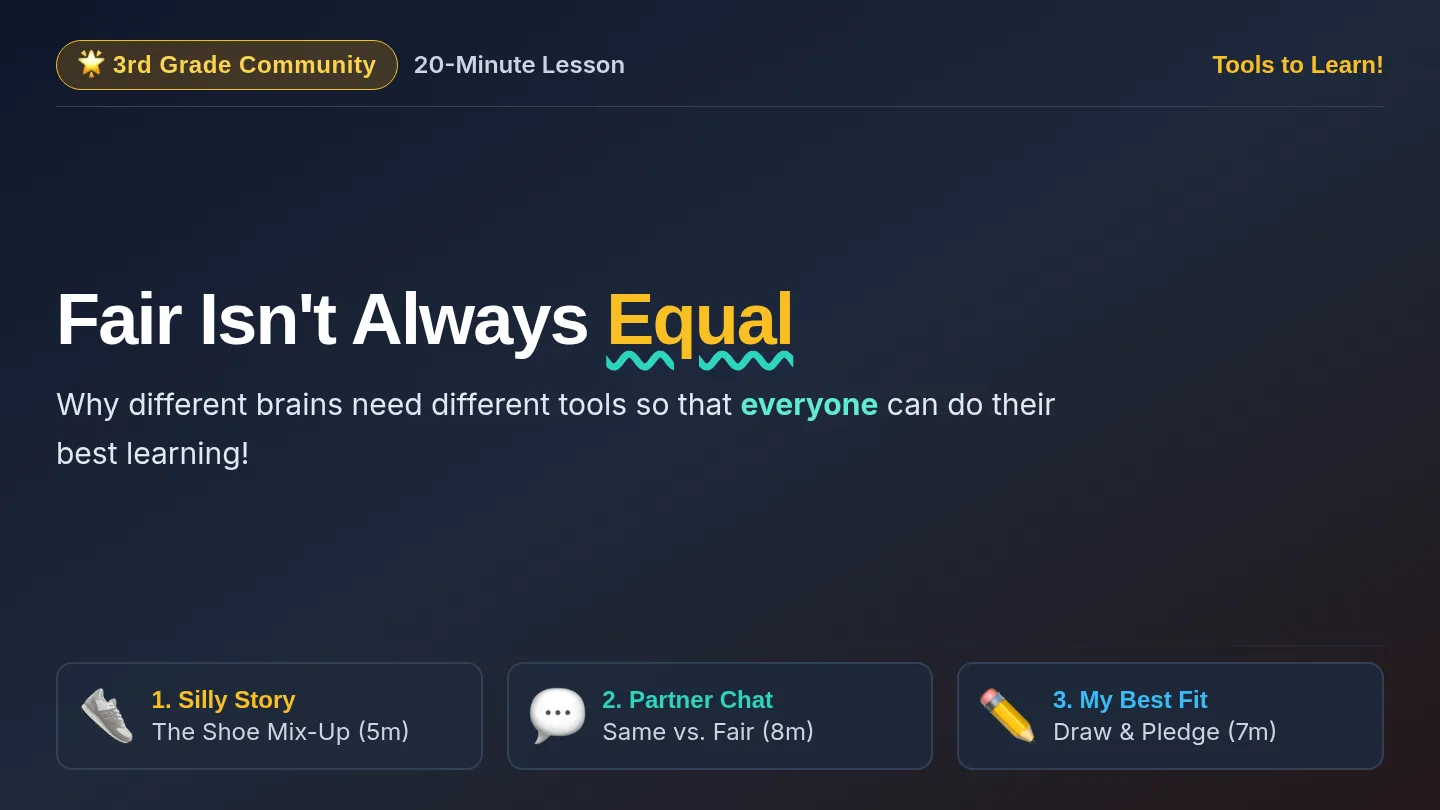
Begin by asking: "What does 'fair' mean to you?" Write keywords on the board. Introduce the idea that fairness isn't always about treating everyone exactly the same. Refer to Slides 1-2 .
10m
Equality vs. Fairness: The Big Reveal
Use Slides 3-5 to define terms.Equality: Everyone gets the same thing.Fairness: Everyone gets what they need to succeed.
15m
Fairness Scenarios: Detective Work
Distribute the Fairness Scenarios Worksheet . Students act as detectives to analyze Case 1-4. They must categorize the situation (Equal vs. Fair) and propose a solution that meets specific needs. (Slide 6 )
15m
Fairness in Action: Creative Project
Students use the Project Guide to create a visual (poster, comic, or digital slide) showing a "Fairness in Action" solution for a real-world problem. Conclude with Slides 7-8 .
Fairness Detectives Slide Deck Confidential Case File #101
Fairness
Detectives
Seeking Justice & Understanding: A Mission for Grades 3-5
What Does "Fair" Mean to You?
Think about it:
Share your ideas with a partner or the class!
1
Equality: Same for Everyone
Equality means giving everyone the exact same thing.
Example: Everyone gets one cookie, no matter how hungry they are.
🍪
🍪
🍪
2
Fairness: What You Need
Fairness means giving people what they need to be successful.
"Giving everyone size 7 shoes isn't fair if some people need size 3 or size 10."
Need size 3? Get size 3!
Need size 10? Get size 10!
Equality vs. Fairness
Equality
Each friend gets one box to stand on. But the shortest friend still can't see!
Fairness
The short friend gets two boxes, and the tall friend needs none. Everyone can see!
Detective Mission!
Investigate cases and decide:
Explain your reasoning and propose a fair solution for every case.
Fairness in Action Project
Now that you've practiced, you'll create a project to show what fairness looks like in the real world!
Poster
Comic Strip
Digital Slides
Mission Accomplished!
EQUALITY Same for everyone
FAIRNESS What people need to succeed
Keep looking for fairness in the world, Detective!
Fairness Scenarios Worksheet Fairness Scenarios
Case Investigation Log
Detective:
Date:
Detective Brief
Read each case carefully. For each case, decide if the situation is about Equality , Fairness , Both , or Neither . Then, explain your reasoning and propose a Fair Solution that helps everyone succeed!
1
Case 1: The Library Books
"The teacher gives every student in the class two books to read for their book report. Some students are fast readers, and two students struggle with reading and need more time or easier books."
Is this situation:
Equal
Fairness
Both
Neither
Explain Your Reasoning:
Propose a Fair Solution:
2
Case 2: Lunchtime Seating
"At lunchtime, all students are told they can sit wherever they want. One group of friends always rushes to get the biggest table, leaving smaller tables for everyone else. Some students are left feeling left out or crammed at tiny tables."
Is this situation:
Equal
Fairness
Both
Neither
Explain Your Reasoning:
Propose a Fair Solution:
3
Case 3: Art Supplies
"The art teacher gives every student a brand new set of 12 colored pencils. One student accidentally breaks several of their pencils during their first art project and is upset because they don't have enough colors."
Is this situation:
Equal
Fairness
Both
Neither
Explain Your Reasoning:
Propose a Fair Solution:
4
Case 4: Playground Time
"The teacher announces that everyone gets 20 minutes of free play on the playground. One student uses a wheelchair and has difficulty accessing some of the equipment, so they spend most of their time watching others play."
Is this situation:
Equal
Fairness
Both
Neither
Explain Your Reasoning:
Propose a Fair Solution:
Is It Fair Discussion Handout Is It Fair?
Class Discussion & Detective Brainstorm
Detective Brief: Now that we've learned about Equality (treating everyone the same) and Fairness (giving everyone what they need to succeed), let's put on our detective hats and discuss some everyday situations. Record your thoughts below during our class conversation.
1 Scenario: The Art Project Supplies
"Imagine your class is doing an art project, and the teacher gives every single student the exact same amount of glitter, glue, and paper."
Is this equal? Why or why not?
Is this fair? Why or why not?
Can you think of a situation where giving everyone the same supplies might NOT be fair? What would a fair solution look like then?
2 Scenario: Playground Equipment
"During recess, there's a big slide, a swing set, and a quiet corner with drawing materials. The teacher says, 'Everyone must spend the first 10 minutes on the slide to make sure everyone gets a turn.'"
Is this equal? Why or why not?
Is this fair? Why or why not? Think about different students' needs.
Propose a more FAIR way to manage the first 10 minutes of recess:
Detective Discussion Rules
Listen with respect
Share your evidence
Value different ideas
Fairness in Action Project Guide Fairness In Action
Equitable World Project
Your Final Mission
You've investigated many scenarios and learned the difference between equality and fairness. Now it's time to put your understanding into action! Your final mission is to create a project that shows what a truly fair world looks like.
Objective
Demonstrate your understanding of fairness by proposing a solution that considers individual needs to achieve equitable outcomes.
1
Choose Your Scenario (10 minutes)
Think about a situation (at school, home, or in the community) where fairness is important, and simply treating everyone the same might not be the best solution.Choose ONE scenario that you want to focus on. It could be a real problem you've noticed or a situation you want to make better.
2
Plan Your Project (15 minutes)
Think About:
Who: Who is involved?Needs: What are the different needs?Equality: Why is "same" not working?
Fair Solution:
How does your solution address individual needs so that everyone can succeed?
3
Create Your Project (20 minutes)
Choose ONE of the following formats to present your "Fairness in Action" plan:
Project Poster
Draw the "Before" (Equality) and "After" (Fairness).
Comic Strip
Tell a story about a character solving a fairness problem.
Digital Presentation
Create 3-4 slides explaining your scenario and solution.
Detective Skit
Perform a brief scene showing a fair outcome.
Detective Checklist
Does your project show these 3 things?
Clear Needs
Fair Solution
Success for All
Fairness Scenarios Answer Key Answer Key
Fairness Scenarios Investigation
Teacher Resource
1
Case 1: The Library Books
Classification: Equal (but not Fair)
Reasoning:
It is equal because everyone received exactly the same thing (2 books). However, it is not fair because it doesn't account for individual reading levels or speed, which prevents some students from succeeding.
Fair Solution:
The teacher could set a time goal (e.g., "read for 20 minutes") rather than a book count, or provide books at different difficulty levels so everyone has a challenge they can actually complete.
2
Case 2: Lunchtime Seating
Classification: Neither Equal nor Fair
Reasoning:
It's not equal because some students get more space (big tables) while others get less (small/crammed). It's not fair because the outcome depends on who can run the fastest, not on student needs.
Fair Solution:
Assign tables by class or rotating groups so everyone gets to sit at a big table sometimes, or create a rule that tables are filled based on group size (big groups at big tables).
3
Case 3: Art Supplies
Classification: Equal (at first)
Reasoning:
Starting with 12 pencils each is equal. However, if a student has an accident (broken pencils), strictly following "equality" would mean not helping them, which isn't fair since they now can't finish the project.
Fair Solution:
The teacher could have a "community supply" box where students can replace broken items, or provide a pencil sharpener so the broken ones can be used again.
4
Case 4: Playground Time
Classification: Equal (in time only)
Reasoning:
Everyone getting 20 minutes is equal. But it is not fair because the playground design prevents the student in a wheelchair from actually using the time to play like everyone else.
Fair Solution:
The school could install adaptive equipment (like a wheelchair-accessible swing) or the teacher could organize games that everyone can play together on a flat surface.