Building Bridges Lesson Plan Building Bridges
Lesson Plan: Empathy & Understanding
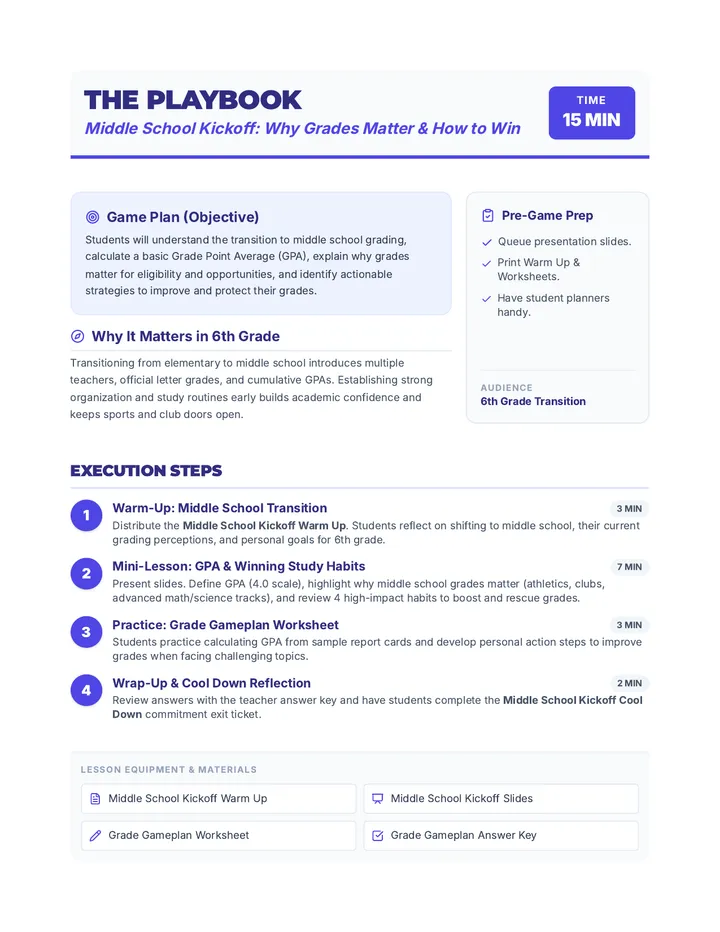
Audience
7th Grade Group
Time
60 Minutes
Approach
Interactive Scenarios
Why This Matters
Understanding others' perspectives is vital for a harmonious school environment. This lesson will equip students with the skills to relate to their peers, resolve conflicts constructively, and build stronger, more inclusive relationships, making school a better place for everyone.
Learning Objective
Students will be able to identify and describe different perspectives in various scenarios, demonstrating an understanding of empathy and its role in fostering a positive school climate.
Materials
Small whiteboards or brainstorming paper
Markers or pens
Stepping Into Their Shoes Slides
Bridge Builder Scenario Cards
Perspective Puzzle Worksheet
Prep (15 min)
Review the Stepping Into Their Shoes slide deck.
Print and cut out Scenario Cards (one set per group).
Print copies of Perspective Puzzle for each student.
Gather whiteboards/paper and markers.
Instructional Sequence
1
Warm-Up: Defining Empathy
10 Minutes
Discuss: Begin by asking students: "What does 'empathy' mean to you? How is it different from sympathy?"Brainstorm: Facilitate a brief group discussion to gather initial thoughts and definitions on the whiteboards/paper.Define: Use Slides 1-2 to present a clear definition and relatable examples of empathy.
2
Scenario Exploration: "If I Were You"
20 Minutes
Group Up: Divide students into small groups of 3-4.Analyze: Distribute Scenario Cards . Each group chooses 2-3 cards to dive into.Perspective Check: For each card, discuss:
"What is actually happening here?"
"How might each person be feeling?"
"What is their logic or reason for their actions?"
"How would an empathetic response look?"
Circulate: Listen to discussions and ask probing questions like: "What if that person was having a bad day before this happened?"
3
Individual Activity: Perspective Puzzle
15 Minutes
Share Out: Briefly bring groups together to share one key insight from their discussions.Reflect: Distribute the Perspective Puzzle worksheet to each student.Complete: Students work individually to put themselves in the shoes of different characters.Mindset: Remind them: "There are no right or wrong answers, just thoughtful reflections on different views."
4
Wrap-Up: Empathy in Action
15 Minutes
Group Dialogue: Facilitate a discussion based on the worksheet results.Key Questions:
"Was it hard to imagine specific perspectives? Why?"
"How does practicing this change how we treat each other at lunch or in the halls?"
Challenge: Encourage students to actively look for one opportunity to practice empathy before tomorrow. Stepping Into Their Shoes Slides Session 01
What is Empathy?
Think & Share
What does "empathy" mean to you?
How is it different from "sympathy" ?
Building Bridges of Understanding
The Empathy Connection
Empathy is when you understand and share the feelings of another person.
It's like putting yourself in someone else's shoes.
Real Examples
Scenario A: Your friend's pet is sick. You feel sad with them because you know how much they care.Scenario B: A classmate is struggling with a locker. You remember your own struggle and offer help.
Activity: If I Were You
In your small groups, you will discuss real-life scenarios. This is your chance to "blue-print" an empathetic response.
The Goal
Understand everyone's perspective, not just the one you agree with.
The Questions
How do they feel? What is their reason? How can I help?
Perspective Puzzle
Time to reflect individually.
No "right" or "wrong" answers.
Focus on thoughtful insights.
Worksheet Time
Building Bridges
How will you use your empathy skills today?
"Empathy is seeing with the eyes of another, listening with the ears of another, and feeling with the heart of another."
Support
Include
Connect
Bridge Builder Scenario Cards Bridge Builder Scenario Cards
Small Group Discussion Activity
Material ID: SC-7-EMP
Instructions for Groups
Choose 2-3 scenario cards below to discuss. For each card, use the "Architect's Guide" questions to analyze the situation from multiple angles.
Architect's Guide Questions:
• What is actually happening in this situation?
• How might each person involved be feeling?
• What is their perspective or reason for their actions?
• How would an empathetic response look?
Cut along the dashed lines
Card 01
The Group Project
Your group has a big project due tomorrow. One member, Maya , hasn't contributed much, and you've had to pick up her slack. You're feeling frustrated and a bit angry.
During class, you notice Maya looking down, drawing quietly in her notebook instead of working. When you ask for her part, she just shrugs and says, "I'm not finished yet."
Perspective Practice
Card 02
The Lunch Table
You see a new student, David , sitting alone at a lunch table. He's quietly eating and looking at his phone.
Your friends are at your usual table, laughing and having a great time. You notice David looks up at your group for a second, then quickly looks back down at his phone and sighs.
Perspective Practice
Card 03
The Broken Promise
Your best friend, Sam , promised to go to the park with you after school to practice basketball. You've been looking forward to it all day.
An hour before school ends, Sam texts you: "Hey, can't make it today. Something came up. Sorry." You feel let down and ignored. You see Sam walking quickly toward the bus loop with a worried expression.
Perspective Practice
Card 04
The Test Result
You and your friend Jordan both studied hard for a math test. When you get the results back, you got an A, but you see Jordan looking upset and shoving their paper into their bag.
You want to celebrate your grade, but Jordan is being very quiet and won't make eye contact. You're starting to think Jordan is just being a "sore loser" and isn't happy for you.
Perspective Practice
Perspective Puzzle Worksheet Perspective Puzzle
Empathy Builders • Student Reflection
Name:
Date:
Part 1: Through Their Lens
Case Study #1: The Quiet Hallway
"You see a student drop their books in the crowded hallway. Everyone walks around them, and some people are even laughing or complaining that they are in the way. The student is turning red and moving very slowly to pick everything up."
What are they likely feeling?
What might they be thinking?
How could you build a "bridge" (empathetic action)?
Case Study #2: The Team Tryouts
"Your friend just found out they didn't make the school basketball team. They've been practicing for months. They tell you, 'It doesn't matter anyway, the team is lame,' but they won't look at you and their voice sounds shaky."
What is the "hidden" feeling here?
Why might they say it's "lame"?
What would an empathetic response sound like?
Part 2: Personal Reflection
Thinking about your own life, when was a time you felt misunderstood because someone didn't see your perspective?
What is one "blueprint" action you can take this week to show empathy to someone at school?
Building Bridges • 7th Grade Tier 2 Social-Emotional Learning
Perspective Puzzle Key Perspective Puzzle: Teacher Guide
Answer Key & Facilitation Tips
Purpose
This guide provides sample responses and discussion points for the Perspective Puzzle Worksheet . Note that there are no "correct" answers, but rather "high-empathy" vs "low-empathy" responses.
Case Study #1: The Quiet Hallway
"Student drops books, others laugh/complain, student turns red."
Expected Feelings:
Embarrassment, shame, panic, feeling invisible or targeted, overwhelmed.
Expected Thoughts:
"Everyone is watching me," "I'm so clumsy," "I just want to disappear," "Nobody cares enough to help."
Bridge (Empathetic Action):
Stopping to help pick up books; making eye contact and saying "That happens to me all the time, don't worry about it"; standing between the student and the crowd to give them space.
Case Study #2: The Team Tryouts
"Friend didn't make the team, says it's 'lame', voice is shaky."
Hidden Feeling:
Disappointment, sadness, rejection, feeling "not good enough," fear of being judged by peers.
Why say it's "lame"?
To protect their ego; "sour grapes" strategy (if I don't want it, it doesn't hurt as much that I didn't get it).
Empathetic Response:
"I know how hard you worked for this, and I'm really sorry it didn't work out. It sucks right now." (Avoid: "You'll make it next year" or "It's fine, let's play video games.")
Facilitation Blueprints
1
Validate the Emotion: If a student says "They should just get over it," ask: "What if they had a really rough morning before that happened? How does that change the view?"
2
Watch for Sympathy: Empathy isn't just "pitying" someone (sympathy). It's "feeling with" them. Guide students away from "Poor David" and toward "David probably feels like I did when I was the new kid."
3
The Role of Neutrality: Remind students they don't have to agree with someone's actions to empathize with their feelings. They might think Maya is wrong for not helping, but can still empathize with her feeling overwhelmed.