Emotion Detectives Slides
Social Observation Academy
SEL Skills Lab
EMOTION DETECTIVES
Cracking the Non-Verbal Code: How faces, voices, and body language reveal what words don't say.
Facial Clues
Eyes, brows & mouth
Vocal Clues
Tone, volume & pace
Body Clues
Posture & movement
Observation Rule #1
Words Tell Only Part of the Story
Over 70% of emotional communication happens without speaking words.
Verbal Message
"I'm completely fine."
The literal words say everything is fine, but vocabulary alone can hide real distress.
Clue Depth: Surface level
Non-Verbal Reality
Face: Downcast eyes, trembling lower lip
Voice: Barely audible whisper, cracked pitch
Body: Slumped shoulders, hugging stomach
Actual Feeling: Hurt, sad, or overwhelmed
When spoken words and non-verbal cues disagree, trust the non-verbal clues.
Clue Zone 1
Facial Expressions: The Headline Clues
Over 40 facial muscles instantly react to our thoughts and feelings.
Brows & Forehead
- • Pulled Down: Anger or frustration
- • Raised/Wrinkled: Fear or shock
- • Smooth: Calm or focused
Eyes & Gaze
- • Wide Open: Excitement or alarm
- • Narrowed: Suspicion or annoyance
- • Looking Away: Shyness, guilt, or fear
Mouth & Jaw
- • Upturned Corners: Genuine joy
- • Clenched Tight Jaw: Stress or anger
- • Downturned Lips: Sadness or hurt
Detective Tip: Look at the entire face together—a real smile crinkles the outer corners of the eyes!
Clue Zone 2
Voice Clues: Volume, Tone & Pace
How someone sounds carries emotional data long before the sentence finishes.
Volume
Loudness or softness
Whisper / Murmur
Insecurity, grief, or fear
Loud / Booming
Excitement, urgency, or rage
Tone & Pitch
Musical mood of speech
High & Upbeat
Surprise, thrill, or panic
Flat / Monotone
Boredom, exhaustion, or grief
Pace & Rhythm
Speed and pauses
Rapid & Rushed
Anxiety, excitement, or panic
Slow with Long Pauses
Sadness, hesitation, or fatigue
Try saying "Thanks a lot" in three different tones: thrilled, sarcastic, and sad. Notice the difference!
Clue Zone 3
Body Language: Posture & Movement
Physical posture signals comfort, stress, defensiveness, or engagement.
Open Posture
✔ Arms uncrossed, relaxed hands
✔ Leaning toward the speaker
✔ Comfortable, upright spine
Signals: Friendly, confident, engaged
Closed Posture
✘ Tightly crossed arms
✘ Slumped shoulders, head down
✘ Angling body away from group
Signals: Defensive, upset, or insecure
Restless Motion
⚡ Tapping pencil, bouncing knees
⚡ Clenched fists or fidgeting
⚡ Shifting weight repeatedly
Signals: Anxious, impatient, or stressed
Space Detective: Stepping back signals needing room; leaning in signals interest or intensity.
Case Investigation
Case Files: Spot the Non-Verbal Clues
Read each scene with your detective team. What feelings are revealed?
CASE FILE A Class Presentation
Marcus grips his index cards with white knuckles. He looks down at his shoes, shifts from foot to foot, and whispers in a quick, breathy rush.
Questions to Discuss:
• What face, voice, and body clues do you see?
• How is Marcus feeling? How can peers support him?
CASE FILE B Group Project Table
Sofia sits with arms crossed, jaw tightly clenched, and eyebrows pulled low. When asked for a marker, she snaps in one loud, sharp syllable: "NO!"
Questions to Discuss:
• Which clues reveal anger versus mere tiredness?
• What response would de-escalate the tension?
Discussion: How does noticing these clues change how you respond to your classmates?
Detective Creed
The Emotion Detective's 3 Golden Rules
Observation powers should always be used with empathy, respect, and kindness.
1
Look for Clusters
Never judge by one single clue. Look for 2 or 3 matching clues together across face, voice, and body.
2
Check the Context
Consider the surroundings. Noise, cold temperatures, and personal cultural norms all shape how people express themselves.
3
Check In with Care
Don't assume or accuse! Offer friendly support: "Hey, you seem a bit quiet today. Is everything going okay?"
Ready for the next step? Grab your Clue Decoder Worksheet and put your detective skills to the test!
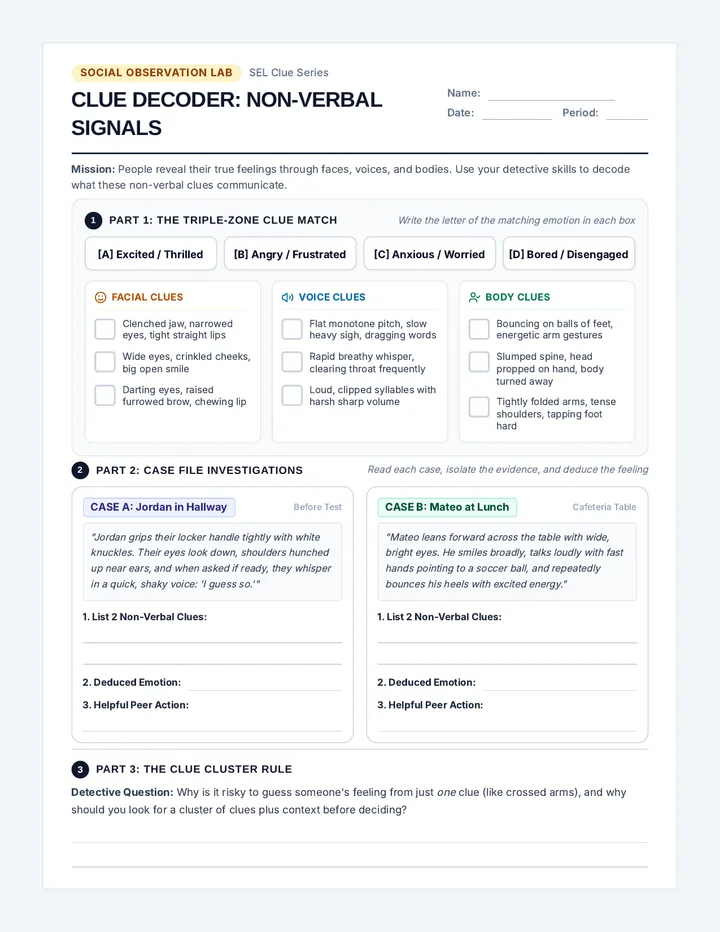
Clue Decoder Worksheet
Social Observation Lab SEL Clue Series
CLUE DECODER: NON-VERBAL SIGNALS
Name:
Date: Period:
Mission: People reveal their true feelings through faces, voices, and bodies. Use your detective skills to decode what these non-verbal clues communicate.
1 Part 1: The Triple-Zone Clue Match
Write the letter of the matching emotion in each box
[A] Excited / Thrilled
[B] Angry / Frustrated
[C] Anxious / Worried
[D] Bored / Disengaged
Facial Clues
Clenched jaw, narrowed eyes, tight straight lips
Wide eyes, crinkled cheeks, big open smile
Darting eyes, raised furrowed brow, chewing lip
Voice Clues
Flat monotone pitch, slow heavy sigh, dragging words
Rapid breathy whisper, clearing throat frequently
Loud, clipped syllables with harsh sharp volume
Body Clues
Bouncing on balls of feet, energetic arm gestures
Slumped spine, head propped on hand, body turned away
Tightly folded arms, tense shoulders, tapping foot hard
2 Part 2: Case File Investigations
Read each case, isolate the evidence, and deduce the feeling
CASE A: Jordan in Hallway Before Test
"Jordan grips their locker handle tightly with white knuckles. Their eyes look down, shoulders hunched up near ears, and when asked if ready, they whisper in a quick, shaky voice: 'I guess so.'"
1. List 2 Non-Verbal Clues:
2. Deduced Emotion:
3. Helpful Peer Action:
CASE B: Mateo at Lunch Cafeteria Table
"Mateo leans forward across the table with wide, bright eyes. He smiles broadly, talks loudly with fast hands pointing to a soccer ball, and repeatedly bounces his heels with excited energy."
1. List 2 Non-Verbal Clues:
2. Deduced Emotion:
3. Helpful Peer Action:
3
Part 3: The Clue Cluster Rule
Detective Question: Why is it risky to guess someone's feeling from just one clue (like crossed arms), and why should you look for a cluster of clues plus context before deciding?