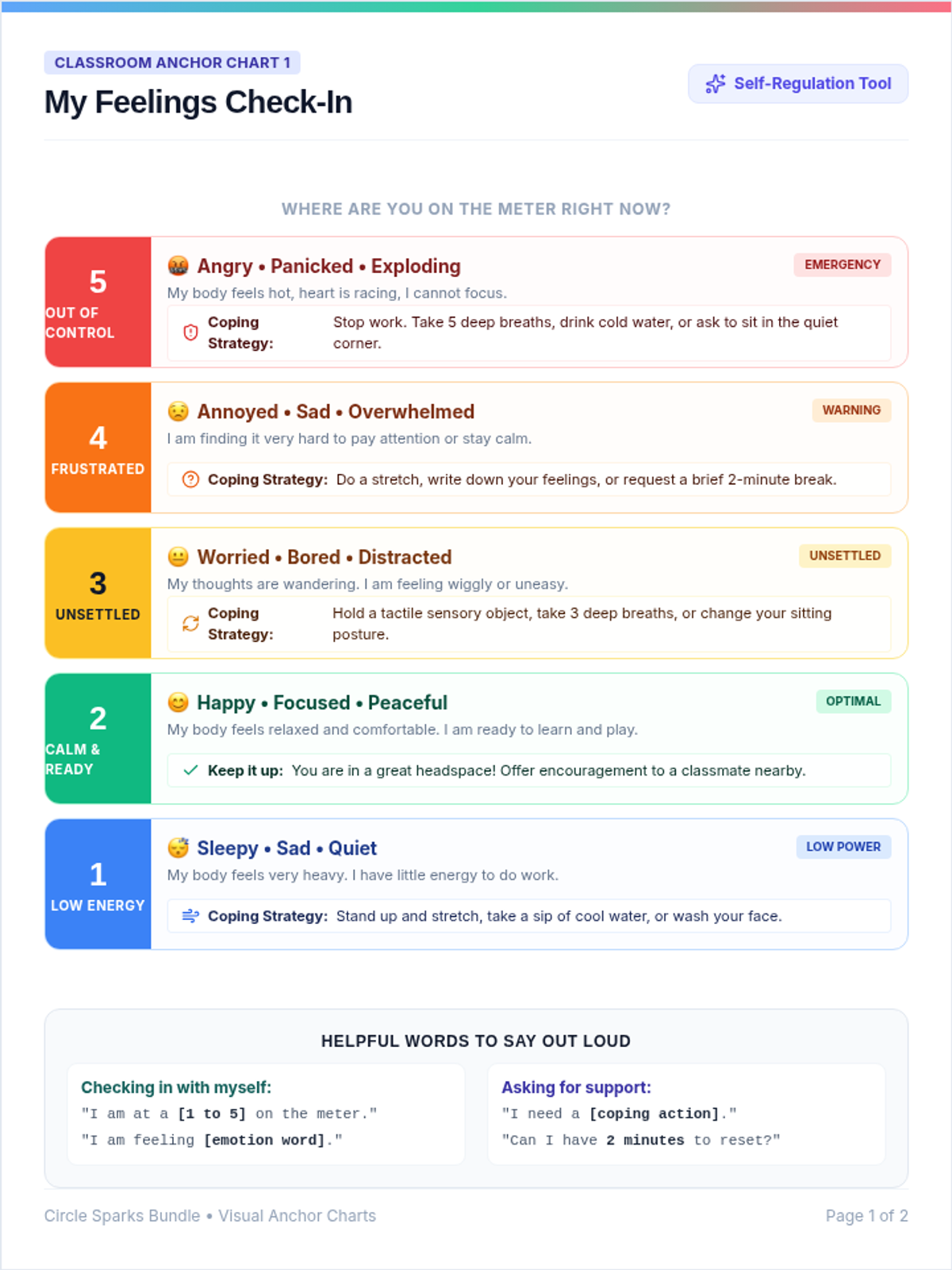
Pulse Check SlidesBellwork Daily Pulse Take a moment to check in with yourself before we begin. Today's Reflection The High What is one good thing that happened today? The Low What is one challenge or "bad" thing from today? The Feeling How did those things make you feel? Sentence Starters "A highlight of my day was..." "One thing that didn't go well was..." "This made me feel _______ because..." "Even though _______ happened, I still feel..." How do you feel? Expand your vocabulary beyond "good" or "fine." Energetic Excited Motivated Proud Grateful Relieved Calm Thoughtful Content Focused Peaceful Bored Challenged Frustrated Overwhelmed Anxious Tired Disappointed
Pulse Check LogDaily Pulse Log Weekly Reflection Tracker NAME: WEEK OF: Monday Overall Mood: The High (The Good) The Low (The Challenge) The Feeling (Emotions) Tuesday Overall Mood: The High (The Good) The Low (The Challenge) The Feeling (Emotions) Wednesday Overall Mood: The High (The Good) The Low (The Challenge) The Feeling (Emotions) Thursday Overall Mood: The High (The Good) The Low (The Challenge) The Feeling (Emotions) Friday Overall Mood: The High (The Good) The Low (The Challenge) The Feeling (Emotions) "Don't just name the feeling; try to understand why it's there."
Daily Pulse Facilitation GuideFacilitation Guide Daily Pulse Reflection Grades 7–8 Purpose & Objectives The Daily Pulse is a Social-Emotional Learning (SEL) bellwork routine designed to help middle schoolers develop self-awareness and emotional literacy. By identifying "Highs" and "Lows," students practice evaluating their experiences and connecting events to specific emotional states. Scaffolding & Accommodations Visual Supports Use the Feeling Word Bank slide to provide options for students who struggle to name emotions. The Sentence Starters provide a formulaic way to begin writing, reducing the cognitive load of starting from scratch. Alternative Responses Allow students to draw their reflection if they are stuck. For students with dysgraphia or writing anxiety, allow a 1-minute audio recording or a quick 1-on-1 check-in. Implementation Tips 1 Routine is Key Display the slide as soon as students enter. Consistency reduces transition time and helps students settle into a reflective mindset. 2 Model Vulnerability Occasionally share your own High/Low first. Keeping it age-appropriate but honest builds trust (e.g., "My high was finally drinking my coffee while it was hot; my low was the traffic on the way here.") 3 Safety First Clarify that these logs are private between you and the student. If a "Low" raises a red flag regarding safety, follow your school's reporting protocols immediately. Closure Discussion Questions Optional 2-minute wrap-up questions for the class: Did anyone find it hard to pick just one thing today? Why? Can a "Low" event actually lead to a "High" feeling later on? How many different feelings did we have in the room today? Does identifying a challenge make it feel smaller or bigger?