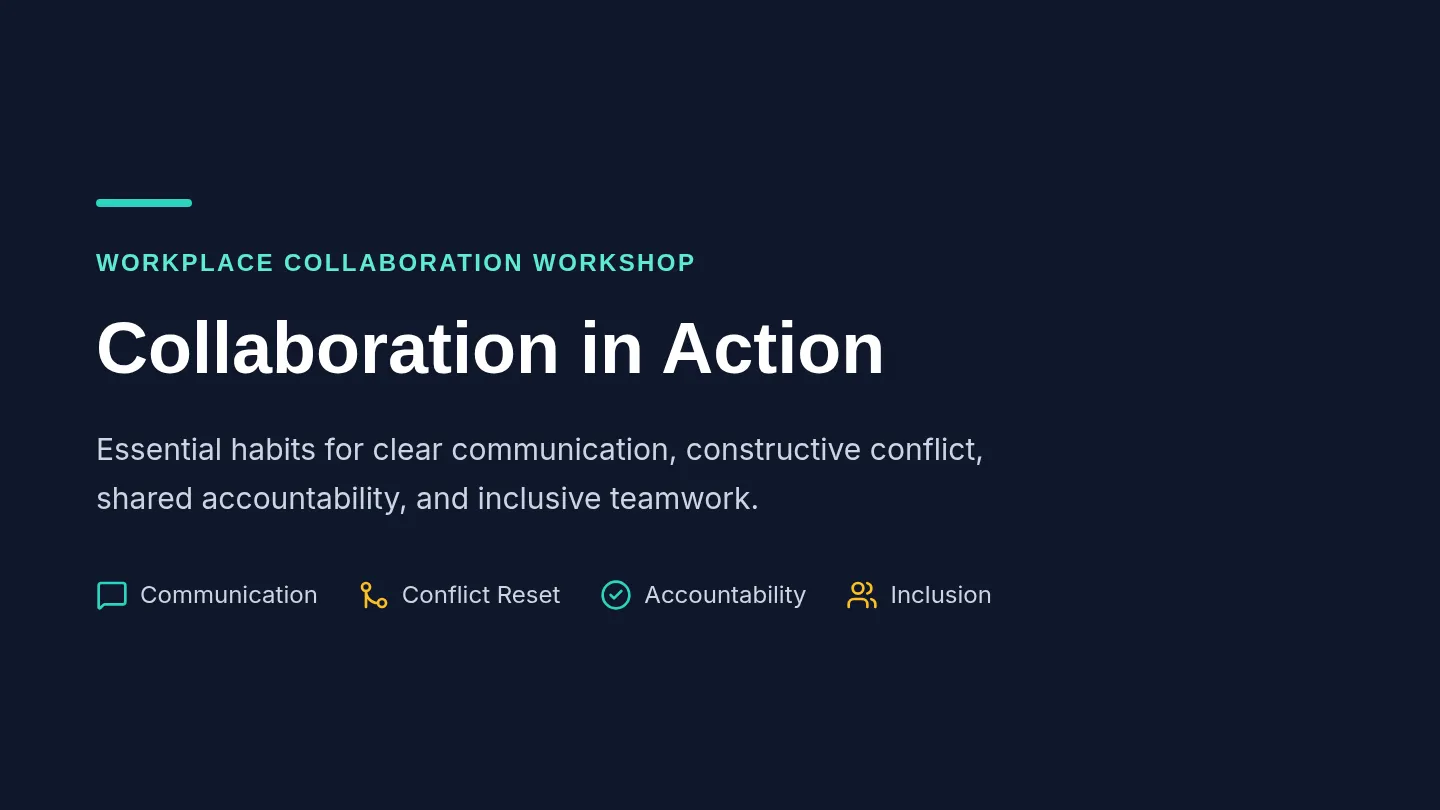
Culture Code Workshop Slides Workplace Culture Lab Session Module 01
Professional Collaboration Series
Culture Code Reset
Building high-trust collaboration through everyday civility, clean candor, and intentional team habits.
Focus
Team Dynamics
Duration
60-Minute Workshop
Outcome
Team Civility Compact
The Evidence Base
The Hidden Tax of Incivility
Source: Porath & Pearson (HBR Research)
66%
Intentionally decreased their work effort after experiencing uncivil treatment.
78%
Reported that their organizational commitment and loyalty markedly declined.
80%
Lost productive billable hours worrying about the interaction and its aftermath.
12%
Ultimately quit their roles entirely to escape toxic or dismissive team dynamics.
Key Insight: Incivility is rarely dramatic hostility—it is usually subtle micro-dismissals, interruptions, passive-aggressive digital comments, and missed credit.
Behavioral Architecture
The Four Civility Anchors
Habits of High-Performing Units
1. Focused Presence
Eliminate stealth multitasking during discussions. Eye contact, closed laptops in check-ins, and active listening validate team members' time and dignity.
2. Generous Attribution
Default to assuming positive intent before diagnosing incompetence or malice. Separate the message from emotional assumptions.
3. Clean Candor
Disagree directly with the idea while actively preserving respect for the colleague. Tough on the problem, warm on the human.
4. Micro-Validation
Proactively attribute ideas to their original author, celebrate peer contributions publicly, and deliver constructive feedback privately.
Civility is not conflict avoidance—it is the psychological runway that makes robust debate safe and productive.
Tactical Scripts
In-the-Moment Pivots
De-escalate & Recenter
When Interrupted
"Hold on, let's make sure Priya finishes that thought before we pivot—I want to hear where that was going."
Restores space without shaming.
When Digital Chat Sharpens
"Tone is easy to misread in chat. Let's jump on a quick 3-minute voice huddle so we stay aligned."
Cuts asynchronous friction fast.
When Attribution Is Missed
"That builds directly on the baseline data Jordan pulled together yesterday—great synergy."
Re-anchors shared credit collegially.
When Debate Gets Personal
"We both want what's best for this launch. Let's pull back to our core objective and assess options."
Decouples identity from trade-offs.
Golden Rule of Intervention: Intervene early, neutrally, and with curiosity. Practice makes reflex.
Application Phase
Putting Civility Into Practice
Breakout Activity
1
Analyze Scenarios
Examine 3 workplace friction dilemmas in your Scenario Playbook: meeting interruptions, Slack blowups, and credit theft.
15 Minutes Group Work
2
Draft Team Norms
Formulate explicit working agreements for your team across meetings, asynchronous chat, and critical feedback loops.
15 Minutes Co-Creation
3
Sign The Compact
Commit to personal accountability benchmarks and ratify your team's living civility charter as an ongoing operational standard.
10 Minutes Debrief & Sign
Reference your printed Team Civility Scenario Playbook now.
Let's Begin →
Culture Code Facilitator Guide Facilitator Instructional Guide
Culture Code Reset
LEADER RESOURCE
Professional Civility Workshop
Audience Intact Teams & Leads
Duration 60 Minutes
Format Interactive Workshop
Core Deliverable Team Civility Compact
Learning & Operational Objectives
1. Reveal Cost of Incivility
Connect subtle disrespect (interrupting, texting in meetings) to measurable drops in team productivity and retention.
2. Master Pivot Scripts
Practice neutral, immediate verbal interventions to defuse snark, credit theft, and conversational hijacking.
3. Establish Shared Norms
Co-create an enforceable, written behavioral charter that governs meetings, Slack, and critical debates.
Workshop Agenda & Timing Breakdown
Time
Module
Facilitator Action & Participant Experience
00–10m
Hook & The Data
Present Porath research (Slide 2). Contrast overt bullying vs micro-incivilities. Frame as team efficiency, not policing politeness.
10–25m
4 Civility Anchors
Deconstruct presence, attribution, candor, and micro-validation (Slide 3). Model pivot scripts (Slide 4) with a volunteer co-worker.
25–45m
Scenario Playbook
Break into pairs/trios. Teams dissect Dilemmas A, B, and C on page 1 of the Playbook and formulate immediate pivot interventions.
45–55m
Team Charter Draft
Full group reconvenes. Populate Playbook page 2 (Meeting, Asynchronous, and Disagreement Norms). Reach unanimous agreement.
55–60m
Commitment & Close
Each member records personal commitment benchmark and signs the Compact. Designate a team custodian to log into team wiki.
Psychological Safety Guardrails
This session examines behaviors, not moral character. Emphasize early: "We are not holding a retrospective on past personal grievances. We are designing forward-looking standards that make this team unstoppable and energizing to work in."
• Forward-Focused Framing: Focus on "What do we need going forward?" rather than "Who did what last quarter?"
• No Sarcasm Rule: Sarcasm during civility discussions signals defensiveness. Kindly call it out in real time.
Culture Code Reset • Facilitator Instructional Guide Page 1 of 2
Facilitator Coaching Toolkit
Facilitation Moves & Pushback Defense
INSTRUCTIONAL TACTICS
Handling Common Participant Defenses
“Aren't we all just being overly sensitive? People should have thicker skin.” The Skeptic
Facilitator Pivot: "This isn't about delicate feelings—it's about cognitive bandwidth. The data shows that when people feel disrespected, their problem-solving ability drops by 61%. High standards require low friction. Civility is a performance strategy, not a charm school."
“We work at breakneck speed. Politeness slows down delivery.” The Speed Driver
Facilitator Pivot: "Incivility causes backchannel drama, passive resistance, and rework. Taking 5 seconds to frame feedback respectfully prevents days of team paralysis. Slowness is clean; haste with sharp elbows is expensive."
“What if someone repeatedly violates these norms anyway?” The Realist
Facilitator Pivot: "That's why we co-create written, explicit norms today. When norms are implicit, holding someone accountable feels subjective. Once everyone signs the compact, reminding someone of the agreement is objective and peer-driven."
Playbook Breakout Debrief Prompts
Scenario A: The Silent Hijack
Focus: Meeting interruptions and uncredited ideas.
“Who holds the responsibility to intervene—the meeting chair, the victim, or peer bystanders?”
Scenario B: Asynchronous Flare
Focus: Public Slack thread critique and defensive snark.
“At what threshold of disagreement is digital chat banned in favor of voice/video?”
Scenario C: Exclusionary Silo
Focus: Private backchannel sidebars undermining colleagues.
“How do side DMs erode psychological safety across the wider department?”
Post-Workshop 30-Day Embedding Protocol
Day 1:
Digitize the signed Team Compact and pin it to the top of your team's Slack/Teams channel and documentation hub.
Day 14:
Conduct a 10-minute retro check: "Which civility norm did we uphold best this sprint? Where did old habits resurface?"
Day 30:
Incorporate civility behaviors into peer recognition moments and leadership 1-on-1 development check-ins.
Culture Code Reset • Facilitator Instructional Guide Page 2 of 2
Team Civility Scenario Playbook Interactive Case Studies
Team Civility Scenario Playbook
PRACTICE ACTIVITY
Participant Name
Department / Team
Session Date
Breakout Task: Analyze each workplace friction dilemma. Formulate an actionable, professional pivot response.
15 Minutes
1 Dilemma A: The Meeting Steamroller (Interruption & Dismissal) Live Meeting
During sprint review, Elena begins explaining an automated testing protocol. Four words in, Carlos interrupts loudly: “That's purely theoretical; we don't have budget for QA rabbit holes,” and moves the slide deck forward. Elena falls silent and withdraws for the rest of the hour.
Your Pivot Script (Peer Ally or Meeting Lead Intervention):
2 Dilemma B: The Public Digital Ambush (Asynchronous Sharpness) Slack / Teams
In an open team Slack channel with 30 members, Marcus posts in response to Maya's draft proposal: “Did anyone with actual industry experience read this before posting? These numbers are completely out of touch with reality 🤦♂️.”
Your Pivot Script (Public Redirection & Constructive Channel Shift):
3 Dilemma C: The Attribution Theft (Silent Credit Grab) Stakeholder Sync
In front of department leadership, Devon presents a solution that Nina spent the entire weekend prototyping. When the Director praises the initiative, Devon says: “Thank you, I put significant thought into architecting this workflow,” never mentioning Nina.
Your Pivot Script (Graceful & Firm Attribution Re-Anchoring):
Team Civility Scenario Playbook • Case Studies Page 1 of 2
Behavioral Working Agreement
Our Team Civility Compact
OPERATIONAL NORMS
Explicit norms eliminate subjective misunderstandings. Co-create your team's standard operating rules across the three core collaboration environments below.
1. Meeting & Live Collaboration Norms E.g., camera etiquette, laptop policy, handling interruptions
Our specific team commitments for in-person / virtual meetings:
2. Digital & Asynchronous Communication Norms E.g., Slack tone, after-hours expectations, public vs. 1:1 channels
Our rules for written chat, emails, and response turnaround:
3. Constructive Disagreement & Feedback Protocol E.g., debate the idea not the person, escalation steps, cool-down periods
How we challenge ideas vigorously while protecting team dignity:
My Personal Civility Benchmark Individual Commitment
The one micro-habit I personally commit to adopting or improving immediately:
Team Ratification & Mutual Accountability Sign-Off Living Team Document
Team Member Name
Signature & Commitment
Date Ratified
Team Civility Scenario Playbook • Norm Charter Page 2 of 2