Connection Compass Workbook
CONNECTION COMPASS
DBT Interpersonal Effectiveness Skills
NAME:
DATE:
Module 1: Objective Effectiveness (DEAR MAN)
Getting what you want or saying "no" while keeping relationships healthy is key. In medical settings, asserting your needs clearly to doctors, specialists, or caregivers is vital to your health and peace of mind.
The DEAR MAN Toolkit
D
Describe: Stick to the clear facts. Avoid emotional exaggeration.
M
Mindful: Stay focused on your goal. Don't get off-track.
E
Express: Share your feelings or opinions using "I feel" statements.
A
Appear Confident: Maintain eye contact, stand/sit up, speak clearly.
A
Assert: Ask clearly for what you need or state your boundary.
N
Negotiate: Offer alternatives; be open to a compromise.
R
Reinforce: Explain how getting what you need helps the doctor or caregiver too (e.g., "If I take this dose, I can avoid the dizziness and stay out of the clinic").
Scenario: Navigating a Rushed Doctor's Appointment
Your specialist seems in a hurry. You have three detailed questions about a new medication's side effects. Draft a brief script using Describe, Express, and Assert to ensure your questions are answered.
Write your script draft here:
Describe:
Express:
Assert:
Reinforce:
Connection Compass • Interpersonal Effectiveness Group Page 1
CONNECTION COMPASS
DBT Interpersonal Skills Practice
MODULE 2
Module 2: Relationship Effectiveness (GIVE Skills)
How do we maintain family relationships while adjusting to changing roles? As we age, adult children or grandchildren may take on caregiving mindsets. Using GIVE helps us protect the warmth and connection in our family bonds.
The GIVE Checklist
G — Gentle Manner
Avoid verbal attacks, threats, or mocking tones. Keep your volume down and respect personal space.
I — Act Interested
Listen to their underlying care or worry. Maintain patient body posture. Don't cut them off mid-sentence.
V — Validate
Acknowledge their worry is real. (e.g., "I know you're calling because you care deeply about my safety.")
E — Easy Manner
Use light-hearted humor if appropriate. Smile and try to keep a relaxed, collaborative attitude.
Scenario: Worry vs. Independence
Your daughter calls you multiple times a day to check on you, asking detailed questions about your diet, medications, and stairs. You appreciate her love, but you feel stifled and feel your independence is being overlooked.
1. Write a validating statement recognizing her care:
2. Propose a collaborative boundary gently:
Connection Compass • Interpersonal Effectiveness Group Page 2
CONNECTION COMPASS
DBT Interpersonal Skills Practice
MODULE 3
Module 3: Self-Respect Effectiveness (FAST Skills)
How do we navigate loneliness or seek new connections without feeling needy? It is natural to want companions. The FAST skills protect our self-respect, reminding us that our needs are valuable and we shouldn't apologize for existing.
The FAST Principles
F Fair
Be fair to both yourself and the other person's context.
A No Apologies
No over-apologizing for having values or asking to connect.
S Stick to Values
Don't compromise your integrity or values to fit in.
T Truthful
Speak honestly. Don't exaggerate or play the victim.
Apology Detox Activity
Over-apologizing lowers our self-respect. Re-write the passive, apologetic sentences below into clear, self-respecting FAST invitations.
Over-Apologetic Phrasing "I'm sorry to bother you, but I don't suppose you'd want to go to the community center lunch with me? It's fine if not."
FAST Re-write:
Over-Apologetic Phrasing "Excuse me, I'm sorry to take up your time, but is anyone sitting here? I can easily sit somewhere else if it's too crowded."
FAST Re-write:
Connection Compass • Interpersonal Effectiveness Group Page 3
CONNECTION COMPASS
DBT Interpersonal Skills Practice
MODULE 4
Module 4: Finding the Middle Path
The Middle Path helps us balance acceptance and change. It reminds us that life is rarely black-and-white. In later life, finding a balance between fiercely protecting our independence and gracefully accepting help is a powerful dialectic.
Balancing Opposites
A "Dialectic" exists when two seemingly opposing thoughts are both true. Connect these opposites to find peace:
1
I am capable and independent & I can accept support and worry from family with love.
2
I trust my physicians' expertise & I trust my body's signals and have a right to question medical plans.
3
I miss the companionships of the past & I can still forge fresh, beautiful connections today.
My Personal Middle Path Practice
Identify a situation in your life where you feel stuck in black-and-white thinking (e.g., "Either I do it all myself, or I have lost my dignity"). Draft a balanced Middle Path statement.
Action Goal for This Week:
Choose one conversation style (DEAR MAN, GIVE, or FAST) and target a specific person (a doctor, family member, or neighbor) to practice with this week.
Practice Target:
Connection Compass • Interpersonal Effectiveness Group Page 4
Connection Compass Clinician Guide
CONNECTION COMPASS
Clinician Facilitation & Discussion Guide
CLINICIAN GUIDE
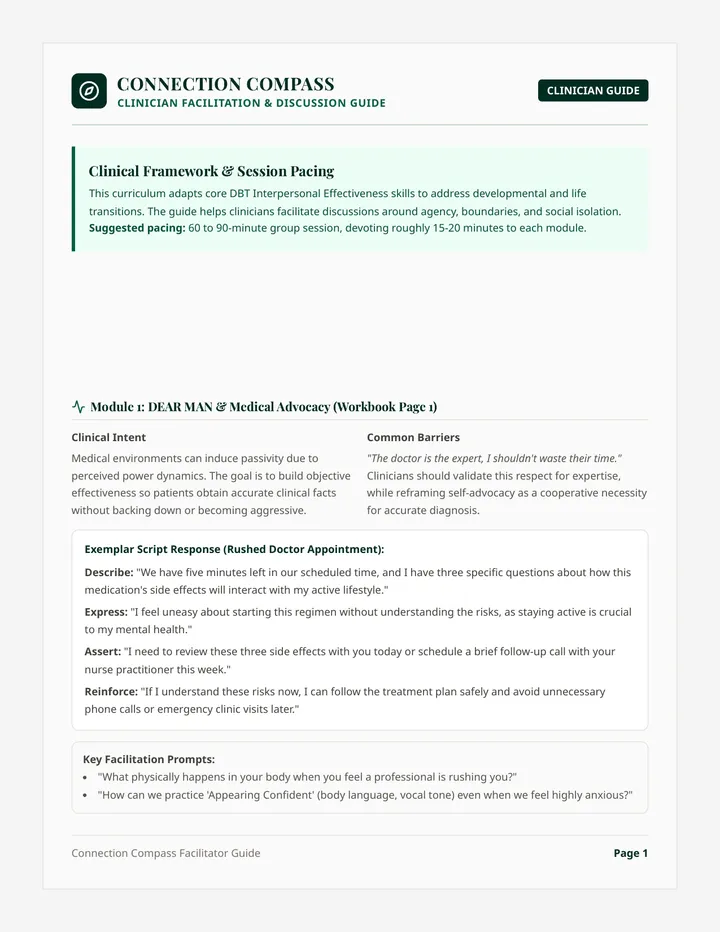
Clinical Framework & Session Pacing
This curriculum adapts core DBT Interpersonal Effectiveness skills to address developmental and life transitions. The guide helps clinicians facilitate discussions around agency, boundaries, and social isolation. Suggested pacing: 60 to 90-minute group session, devoting roughly 15-20 minutes to each module.
Module 1: DEAR MAN & Medical Advocacy (Workbook Page 1)
Clinical Intent
Medical environments can induce passivity due to perceived power dynamics. The goal is to build objective effectiveness so patients obtain accurate clinical facts without backing down or becoming aggressive.
Common Barriers
"The doctor is the expert, I shouldn't waste their time." Clinicians should validate this respect for expertise, while reframing self-advocacy as a cooperative necessity for accurate diagnosis.
Exemplar Script Response (Rushed Doctor Appointment):
Describe: "We have five minutes left in our scheduled time, and I have three specific questions about how this medication's side effects will interact with my active lifestyle."
Express: "I feel uneasy about starting this regimen without understanding the risks, as staying active is crucial to my mental health."
Assert: "I need to review these three side effects with you today or schedule a brief follow-up call with your nurse practitioner this week."
Reinforce: "If I understand these risks now, I can follow the treatment plan safely and avoid unnecessary phone calls or emergency clinic visits later."
Key Facilitation Prompts:
- "What physically happens in your body when you feel a professional is rushing you?"
- "How can we practice 'Appearing Confident' (body language, vocal tone) even when we feel highly anxious?"
Connection Compass Facilitator Guide Page 1
CONNECTION COMPASS
Clinician Facilitation & Discussion Guide
CLINICIAN GUIDE
Module 2: GIVE & Family Boundaries (Workbook Page 2)
Clinical Intent
Family members often act out of unmanaged anxiety, which can register as control or infantilization. The **GIVE** skill balances protecting our own autonomy with preserving warm, loving family dynamics.
Exemplar Answers
1. Validation: "I know you're calling me three times a day because you love me, and you want to be absolutely sure I'm safe and eating well."
"I want to catch up, but multiple daily calls make me feel crowded. Let's set up a scheduled call every evening at 6:00 PM."