Conflict Resolution Masterclass Lesson Plan Conflict Resolution Masterclass
Lesson Plan • Adult Education
Duration
60 Minutes
Why This Matters
Effective communication and conflict resolution are crucial life skills. This lesson provides adults with the tools to navigate disagreements constructively, fostering healthier personal and professional relationships and reducing stress.
Audience
Adult Learners
Preparation
Time: 15 Minutes
• Review the Navigating Difficult Conversations Slide Deck and test tech.
• Print copies of the Active Listening Practice Activity .
• Print Decoding Body Language Warm-Up for each participant.
• Review the Empathy-Driven Dialogue Starters Script .
• Arrange seating in pairs/small circles for interaction.
Materials Needed
Projector & Slide Deck
Warm-Up & Activity Handouts
Facilitator Script
Pens & Markers
Whiteboard
Learning Objective
Participants will learn and practice strategies for effective communication, conflict resolution, and active listening to transform disagreements into opportunities for understanding and stronger relationships.
Instructional Sequence
1
Warm-Up: Decoding Body Language
10 Min
Begin with the Decoding Body Language Warm-Up to get participants thinking about non-verbal cues in communication.
Facilitate a brief discussion on initial observations and personal experiences. Use the Empathy-Driven Dialogue Starters Script for specific prompts.
2
Introduction to Conflict Resolution
10 Min
Use the first few slides of the Navigating Difficult Conversations Slide Deck to introduce the concept of conflict as an opportunity for growth.
Discuss common communication pitfalls and the importance of healthy conflict resolution. Create a safe space for participants to share initial thoughts.
3
Active Listening Deep Dive
15 Min
Transition to the Active Listening section of the slide deck. Introduce the 5 key components: Attention, Visual cues, Feedback, Deferring judgment, and Appropriate response.
Distribute the Active Listening Practice Activity . Circulate to provide feedback as pairs practice.
4
Empathy & Role-Playing
15 Min
Present empathy-driven dialogue concepts from the slides. Review the Dialogue Starters Script for practical phrases.
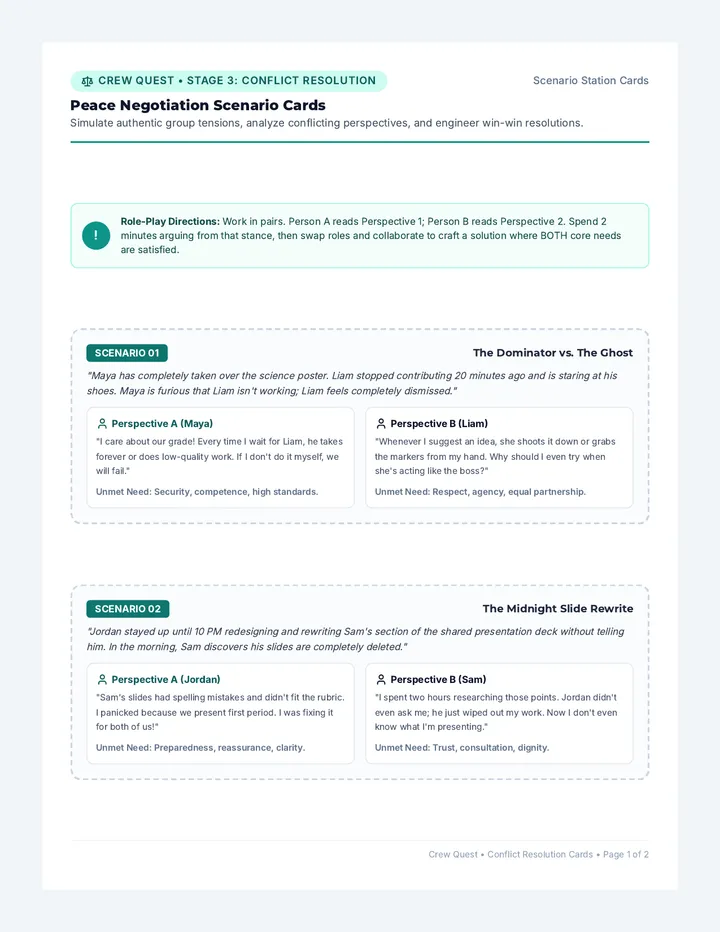
Lead a role-playing session using hypothetical scenarios. Debrief each, highlighting effective strategies.
5
Wrap-Up and Takeaways
10 Min
Summarize key strategies: active listening, empathetic framing, and constructive problem-solving. Invite participants to share one commitment to implement this week.
Navigating Difficult Conversations Slides Masterclass
Navigating Difficult Conversations
Transforming Disagreements into Opportunities
Conflict is natural
It isn't always negative
Growth is the goal
What Makes a Conversation Difficult?
Identifying the obstacles is the first step to overcoming them.
Differing opinions
Strong emotions
High stakes
Fear of misunderstanding
Past negative experiences
Skill 1: Active Listening
1
Pay Attention
Give your full focus. Eliminate distractions.
2
Show You're Listening
Use non-verbal cues like nodding and eye contact.
3
Provide Feedback
Summarize and reflect what you heard.
...and defer judgment until the speaker finishes.
Skill 2: Empathy-Driven Dialogue
Acknowledge
"I hear that you're feeling frustrated about the deadline..."
Perspective
"From my side, I see the challenge as a resource issue..."
"I" Statements
"I feel overwhelmed when I don't have clear instructions."
Common Ground
"We both want this project to succeed. Let's start there."
Managing Emotions
Staying calm under pressure allows logic to prevail.
Take a Pause
Breathe and count to ten.
Identify Triggers
Know what sets you off.
Validate Others
Acknowledge their feelings.
Focus on the Issue
Solve the problem, not the person.
Roadmap for Resolution
1
Prepare
Set clear goals
2
Initiate
Right time & place
3
Listen
Seek understanding
4
Express
Use "I" statements
5
Explore
Brainstorm solutions
6
Agree
Plan next steps
Practice Makes Progress!
These skills improve with consistency.
Every conversation is an opportunity to learn.
You've got this!
Active Listening Practice Activity Active Listening Practice
Communication Skills Workshop
Participant Name
Objective
To practice the core components of active listening—attention, feedback, and deferred judgment—in a supportive pair environment.
1
Setup & Roles
Find a partner. Decide who will be the Speaker (Person A) and who will be the Listener (Person B) for the first round.
2
Round 1: Sharing & Listening
5 MINUTES TOTAL
Speaker (3 mins): Share a brief experience (a challenge, a fun event, or a decision).Listener: Give full attention. Use non-verbal cues. Do not interrupt or offer advice.
Listener Notes (Reflect on facts and emotions heard):
3
Round 1: Reflection & Feedback
Listener: Summarize what you heard. Start with "What I hear you saying is..." Speaker: Provide feedback. Did you feel understood? Was the summary accurate?
Speaker Feedback:
Switch Roles & Repeat Steps 2 and 3
Group Debrief & Personal Reflection
1. How did it feel to be the Speaker and be actively listened to (or not)?
2. What was the most challenging part of being the Listener? What was easy?
3. What did you learn about your own listening habits today?
4. How can you apply one specific active listening technique in your daily life this week?
"Most people do not listen with the intent to understand; they listen with the intent to reply." — Stephen R. Covey
Decoding Body Language Warm Up Decoding Body Language
Warm-Up Activity: What are they really saying?
10 MINUTES
Communication is more than just words. Over 70% of our communication is non-verbal. Take a moment to analyze the following scenarios. What emotions or messages do you think each person is conveying?
Scenario 1: The Barrier
Description: A person standing with arms tightly crossed across their chest, eyebrows furrowed, and a slight frown.
What do you see?
What message might they be sending?
Scenario 2: The Open Door
Description: A person leaning slightly forward, hands open with palms visible, and a genuine, relaxed smile.
What do you see?
What message might they be sending?
Scenario 3: The Withdrawal
Description: A person slumped deep in a chair, shoulders rounded, looking down at their hands and avoiding eye contact.
What do you see?
What message might they be sending?
Reflection Question
Why is it critically important to pay attention to body language—both yours and others'—when communicating during a potential conflict?
Did you know?
When someone's body language contradicts their words (e.g., saying "I'm fine" while arms are crossed and they are frowning), we are hard-wired to believe the body language over the speech. This is called the Communication Congruence .
Empathy-Driven Dialogue Starters Script Facilitator Script
Empathy-Driven Dialogue Starters
Teacher
Part 1: Warm-Up Debrief
"Alright everyone, thank you for those insightful observations on body language! It's amazing how much we communicate without saying a word. To kick us off today, let's connect that to our main topic: communicating without conflict. Based on our warm-up, how might understanding body language help us navigate a potentially difficult conversation? Take a moment to share your thoughts with a partner, and then we'll hear from a few groups."
Part 2: Framing Conflict
"Today, we're going to dive into how we can communicate without conflict, transforming those challenging moments into opportunities for deeper understanding and stronger relationships. Often, we see conflict as a negative thing, something to avoid. But what if we could shift that perspective? What if conflict, when handled effectively, could actually be a good thing? How might that be true?"
Pause for responses
"That's right! It can lead to growth, clarity, and stronger bonds. Our goal today is to equip you with practical tools to make that shift."
Part 3: Coaching Active Listening
"As you work through the Active Listening Practice Activity , remember your role as the listener. Your only job is to understand. Resist the urge to interrupt, judge, or solve. Just listen and then reflect back what you hear. Speakers, try to be clear about your experience. After each round, I'll ask you to provide feedback to your listener. Did you feel truly heard?"
Part 4: Skill Introduction
"Now that we've practiced active listening, let's layer on another crucial skill: empathy-driven dialogue . This is about choosing words that show you understand, even if you don't agree. It's about opening the door for a productive conversation, rather than shutting it down. Here are some starter phrases that can really help:"
Starter Phrase Reference Card
To Acknowledge Feelings/Perspective
"It sounds like you're feeling [emotion] about [situation]."
"I can see why you might feel that way."
"From your perspective, it seems like..."
"I hear that this is really important to you."
To State Your Perspective (I-Statements)
"I feel [emotion] when [action/situation] because [need/impact]."
"My concern is [specific concern]."
"I need [specific need] in order to [outcome]."
To Invite Further Dialogue
"Can you tell me more about that?"
"Help me understand what you mean by..."
"What would a good outcome look like for you?"