Blind Maze Facilitator Guide Crew Quest • Stage 1: Trust & Cooperation Duration: 40-50 Mins
Blind Maze Facilitator Guide
Empowering students to build dependable verbal communication, deep active listening, and reciprocal peer trust.
Group Size 3-4 Students
Energy Level Moderate / Focused
Space Needed Open Classroom / Gym
Materials Blindfolds, Cones, Cups
Instructional Objectives
Demonstrate active, clear directional coaching without shouting or using vague gestures.
Cultivate emotional safety and physical awareness when relying entirely on a partner's guidance.
Practice patience and positive reinforcement when missteps or boundary touches occur.
Role Architecture (Rotate Every 8 Minutes)
1
The Explorer
Wears blindfold or keeps eyes shut. Moves step-by-step listening strictly to their Navigator. Communicates when anxious or unsure.
2
The Navigator
Stands outside the boundary. Uses calm, precise instructions (e.g., "Rotate 45 degrees left, take two half-steps forward"). No touching!
3
The Guardian
Shadows closely in silence with hands raised like bumpers. Only speaks the safety word "FREEZE" if a collision is imminent.
Facilitation Flow
Phase 1 (10m)
Calm Calibration:
Pairs practice on an open strip without obstacles. Focus on standardizing vocabulary (e.g., foot distance, clock angles, stop commands).
Phase 2 (20m)
The Obstacle Minefield:
Scatter foam blocks, cones, and cups across a 15x20ft zone. If an Explorer touches a hazard, team takes 1 deep breath, takes 2 steps back, and continues.
Phase 3 (10m)
Whisper Mode Twist:
All Navigators can only speak in quiet whispers. Teams must filter through background room noise, testing intense concentration and vocal trust.
Crew Quest • Lesson 1 Facilitation Guide • Page 1 of 2
Safety Framework, Guided Debrief & Rubric
Crew Quest • Stage 1
Non-Negotiable Safety Protocols
1. Universal Freeze Command
If ANY student or teacher yells "FREEZE", all Explorers immediately stop in place. No movement until the facilitator resets.
2. Safe Pace Only
Explorers must move at a heel-to-toe or deliberate walking pace. Running, sliding, or diving results in immediate role disqualification.
Circle Debrief Questions (Post-Activity Reflection)
Question 1: Trust Vulnerability
"Explorers: What specific words or vocal tones made you feel safe to step forward? What caused you to hesitate?"
Look for: Calm cadences, precise metric distances, consistent reassurance over frantic shouting.
Question 2: Navigating Errors
"When an Explorer clipped a cone, how did the Navigator respond? Did blame help or hurt progress?"
Look for: Recognizing that criticism spikes anxiety and paralyzes teammate confidence.
Question 3: Classroom Transfer
"How does being 'blindfolded' in this game mirror joining a new project group without knowing what to do?"
Look for: Need for clear peer onboarding, step-by-step guidance, and welcoming team culture.
Teacher Observational Rubric
Cooperation Skill Emerging Mastered Direction Clarity Vague shouts ("Over there!", "No, left!"); speaks over other teammates. Clear units ("Turn 90 degrees right; take two small steps forward"). Patience Under Error Expresses irritation when partner steps out; sighs or abandons role. Instantly encourages partner ("You're okay; let's reset two steps back"). Active Guardianship Distracted; talks to other teams; late to catch stumbling explorer. Hyper-focused; stays within arm reach; executes safe freeze alerts.
Facilitator Pro-Tip:
Pair hesitant students with naturally gentle communicators for their first exploration round. Success in Round 1 builds the psychological safety required for bolder risk-taking in Rounds 2 & 3.
Crew Quest • Lesson 1 Facilitation Guide • Page 2 of 2
Crew Contract Activity Sheet Crew Quest • Activity Sheet
Crew Contract & Trust Pact
Stage 1: Cooperation & Trust
Collaborative Team Charter
Crew Name:
Date:
Table / Pod:
Crew Members:
Part 1: Crew Strengths & Contributions
Identify what each member uniquely brings to our team.
Member 1 Name:
My Superpower:
Member 2 Name:
My Superpower:
Member 3 Name:
My Superpower:
Member 4 Name:
My Superpower:
Part 2: Our 3 Core Working Agreements
Agree on concrete behaviors your team will live by.
Agreement 1: Active Listening & Voice Equality How will we ensure all voices are heard?
Agreement 2: Responding to Mistakes or Missteps What will we say instead of blaming?
Agreement 3: Supporting Teammates Under Pressure How will we check in when someone looks stressed?
Part 3: The 3-Step "Pause & Reset" Pact
Our safety valve when disagreements heat up.
1. Call a "Time-Out"
Any member makes the T-sign; everyone stops talking for 20 seconds.
2. Take 3 Breaths
Breathe in for 4 counts, hold for 4, exhale for 4 together.
3. One-Sentence Share
Each member states what they need using "I feel... I need..."
We solemnly commit to uphold this contract and back each other up:
Signature 1
Signature 2
Signature 3
Signature 4
Crew Quest Collaborative Learning Framework • Keep this charter accessible at your workstation!
Tower Tangle Slides Crew Quest • Stage 2 Self-Regulation Challenge
Tower Tangle
Mastering Calm When the Pressure Cooks
Can your crew build under ticking clocks, surprise twists, and sudden frustration without losing your cool?
18 Minutes Build Time
Skill: Emotional Self-Regulation
Teams of 3 to 4
The Mission & Ground Rules
Mission Goal
The Objective
Construct the tallest free-standing tower using only 30 index cards and 12 paper clips.
✓ Must stand on its own for 10 seconds without human touch!
Strict Rules
• No tape, glue, or foreign weights allowed.
• Every teammate must place at least 4 cards.
• If your tower collapses, no shouting or blaming!
Watch out: The facilitator will announce Surprise Twist Cards during construction!
Expect the Unexpected: Twist Cards
Frustration Triggers
When the buzzer sounds, your team must instantly adapt to one of these sudden conditions:
Total Silence
Zero talking for 3 minutes. Communicate only through non-verbal gestures and eye contact.
Tests: Patience
One-Hand Only
Tuck your dominant hand behind your back. Every card must be placed using only your non-dominant hand.
Tests: Coordination
Architect Swap
One member leaves to advise another table for 2 minutes. Welcoming new ideas without defensiveness.
Tests: Flexibility
💡 The real test is not how high you build—it is how calmly you handle the chaos!
The Internal Thermometer: Reset Your Engine
Coping Strategies
Zone Green: Balanced
In Flow
Breathing slow, listening well, encouraging teammates when errors occur.
Action: Keep steady cadence & praise effort.
Zone Yellow: Simmering
Tension Spiking
Jaw clenching, voice speeding up, starting to feel annoyed or rushed.
Action: Name it! "I am feeling rushed. Let's pause."
Zone Red: Overheated
Shutdown / Blame
Snapped words, stepping away angrily, giving up on the challenge.
Action: Universal Time-Out + 3 Box Breaths.
Remember: Frustration is a normal biological signal. What matters is how quickly you reset!
Mission Debrief: What Did We Learn?
Circle Reflection
1. Identifying the Trigger Point
Pressure Reset Tracker Crew Quest • Stage 2
Pressure Reset Tracker
Self-Regulation & Resilience
Post-Challenge Reflection Log
Student Name:
Date:
Crew Name:
Part 1: Emotional Zone Map
Check which zone you experienced at each stage.
Challenge Moment Green (Calm/Flow) Yellow (Tense/Rushed) Red (Overwhelmed) 1. Initial Planning & Card Distribution 2. The Sudden Twist Constraint (Silence/One Hand) 3. Final 60 Seconds Countdown
Part 2: My Physical Stress Cues
Check the signals your body sent when pressure peaked:
Heart beating fast Clenched fists / jaw Talking louder / fast Wanted to walk away Tunnel vision / panic Sighing or eye rolling Blaming teammates Freezing / go quiet
Part 3: What Regulation Technique Did I Try?
Describe how you managed the tension in the room.
Specific strategy I used (or tried to use):
How my teammates helped me stay regulated:
Part 4: Personal Growth Commitment
One action step for when project stress happens next.
"The next time I feel myself moving into Zone Yellow or Zone Red during group work, I will immediately:"
Crew Quest Self-Regulation Module • Turn this tracker in for teacher feedback or keep in your leadership portfolio.
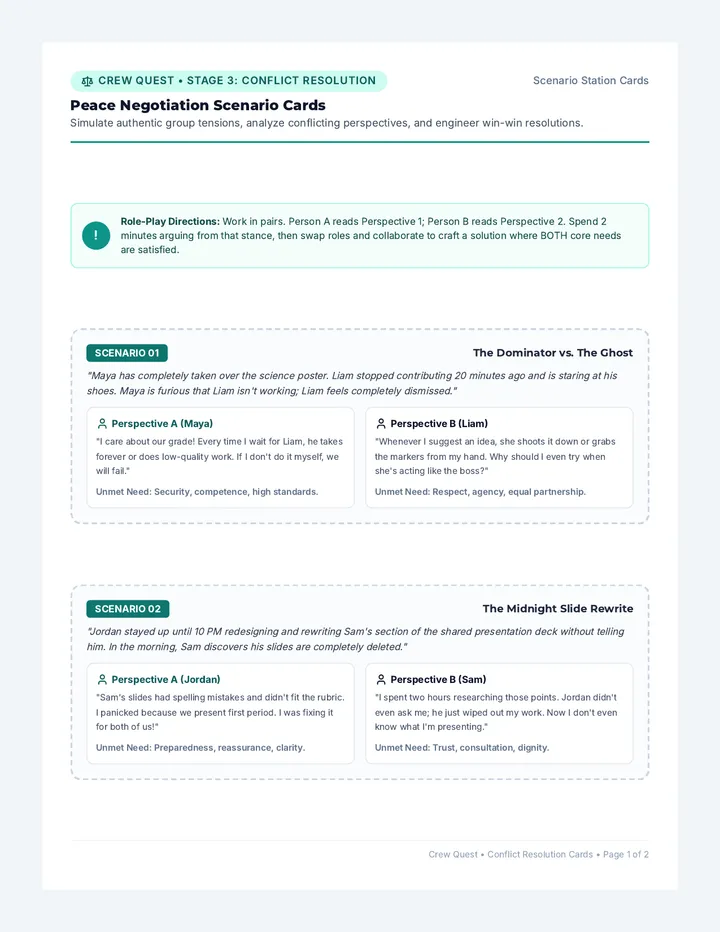
Peace Negotiation Scenario Cards Crew Quest • Stage 3: Conflict Resolution Scenario Station Cards
Peace Negotiation Scenario Cards
Simulate authentic group tensions, analyze conflicting perspectives, and engineer win-win resolutions.
!
Role-Play Directions: Work in pairs. Person A reads Perspective 1; Person B reads Perspective 2. Spend 2 minutes arguing from that stance, then swap roles and collaborate to craft a solution where BOTH core needs are satisfied.
Scenario 01 The Dominator vs. The Ghost
"Maya has completely taken over the science poster. Liam stopped contributing 20 minutes ago and is staring at his shoes. Maya is furious that Liam isn't working; Liam feels completely dismissed."
Perspective A (Maya)
"I care about our grade! Every time I wait for Liam, he takes forever or does low-quality work. If I don't do it myself, we will fail."
Unmet Need: Security, competence, high standards.
Perspective B (Liam)
"Whenever I suggest an idea, she shoots it down or grabs the markers from my hand. Why should I even try when she's acting like the boss?"
Unmet Need: Respect, agency, equal partnership.
Scenario 02 The Midnight Slide Rewrite
"Jordan stayed up until 10 PM redesigning and rewriting Sam's section of the shared presentation deck without telling him. In the morning, Sam discovers his slides are completely deleted."
Perspective A (Jordan)
"Sam's slides had spelling mistakes and didn't fit the rubric. I panicked because we present first period. I was fixing it for both of us!"
Unmet Need: Preparedness, reassurance, clarity.
Perspective B (Sam)
"I spent two hours researching those points. Jordan didn't even ask me; he just wiped out my work. Now I don't even know what I'm presenting."
Unmet Need: Trust, consultation, dignity.
Crew Quest • Conflict Resolution Cards • Page 1 of 2
Crew Quest • Stage 3 Scenario Cards & Script
Advanced Dilemmas & Mediation Protocol
Scenario 03 The Creative Stalemate
"Elena wants to film a dramatic historical skit for the social studies project. Marcus wants to build an interactive digital map. Both insist their approach is better, and 15 minutes of work time has been wasted arguing."
Elena's Need: Creative expression & high-energy performance.
Marcus's Need: Logical structure, technical polish & stage fright avoidance.
The 4-Step "Bridge" Repair Script
Use this exact syntax when negotiating!
Step 1: Neutral Observation
"When I notice that..."
State objective facts only; zero accusations, exaggerations, or name-calling.
Conflict Repair Action Plan Crew Quest • Stage 3
Conflict Repair Action Plan
Restorative Mediation Protocol
Team Negotiation Worksheet
Partner A:
Partner B:
Date:
Conflict / Scenario Topic:
Step 1: Mapping Both Perspectives
State your experience honestly without blaming.
Partner A's Point of View & Feelings:
Partner A's Core Unmet Need:
Partner B's Point of View & Feelings:
Partner B's Core Unmet Need:
Step 2: The Empathy Switch
Summarize the OTHER person's view in your own words.
Partner A confirms: "What I heard Partner B need is..."
Partner B confirms: "What I heard Partner A need is..."
Step 3: Our Agreed Compromise (Win-Win Solution)
Must give something to both sides.
Specific agreement both of us commit to right now:
Partner A will specifically do:
Partner B will specifically do:
Partner A Signature
Partner B Signature
Check-in Date & Time:
We will evaluate progress in 24 hours.
Crew Quest Restorative Action Framework • Keep filed with teacher or group facilitator.