Calm Canvas Slides
6TH GRADE MINDFULNESS
Calm Canvas Workshop
Calm Canvas
A sensory painting journey to breathe, express, and release stress.
Grounding
Expression
Release
Ready to paint? →
WHY WE PAINT
Somatic Grounding
How Painting
Calms Your Brain
When stress makes your amygdala (the brain's alarm system) go into overdrive, hands-on rhythm resets it.
Sensing the wet paper, smelling the watercolor, and watching colors bloom tells your nervous system: "You are safe here."
Visual Focus
Blocks distracting anxious thoughts.
Tactile Rhythm
Lowers physical tension in shoulders & hands.
Breath Sync
Triggers the relaxation response immediately.
Focus on the sensation, not the final artwork.
Next: Color Meanings →
THE COLOR MAP
Emotional Expression
Your Personal Feelings Palette
Colors and shapes let us say what words cannot. There are no right or wrong definitions—only what feels true to you today.
Cool & Quiet
Calm, peace, deep sadness, heavy thoughts, or safety.
Warm & Vivid
Energy, creativity, excitement, anxiety, or focus.
Fierce & Bold
Anger, intense passion, love, frustration, or strength.
Grounded & Fresh
Growth, healing, feeling stable, restart, or relaxation.
What colors are calling your name right now?
Next: Mindful Breathing →
SENSORY EXERCISE
Wave Breathing Paint Along
Breath & Wave
Paint Along
Let’s sync our physical movements with our breathing. We will paint simple, continuous waves across our pages.
The Goal: To quiet the mind by matching your hand's stroke directly with your lung's expansion.
1
Breathe In (4 Seconds):
Slowly sweep your wet brush UPWARD in a smooth curve.
2
Breathe Out (4 Seconds):
Slowly sweep your brush DOWNWARD, completing the wave.
3
Observe the Transition:
Notice where the two colors mix at the crest of each wave.
Repeat 5 times. Feel the brush move your hand.
Next: Free Release Painting →
CREATIVE FREEDOM
No-Rules Release
Now... Paint with No Rules
We are not painting objects, people, or landscapes. We are painting feelings, energy, and patterns.
Let Go of "Good"
Messy, wet, dark, bright—everything is allowed and perfect.
Experiment
Use water drips, splatters, staccato taps, or slow swirls.
Stay Sensory
Listen to the brush. Look at the water changing color.
Your paper is a space to offload whatever is heavy today.
Next: Mindful Share →
CLOSING REFLECTION
Mindful Share & Debrief
Let’s Reflect
Together
Sharing is optional, but taking a moment to acknowledge how your state shifted is incredibly powerful.
Notice any changes in your breathing, posture, or physical tension.
PROMPT 1
What was the most relaxing sensation or technique today?
PROMPT 2
How did the colors you painted match or shift your feelings?
PROMPT 3
How can you use this "brushstroke focus" in daily life?
Thank you for sharing your creative self with us!
Fill out your Reflection Sheets
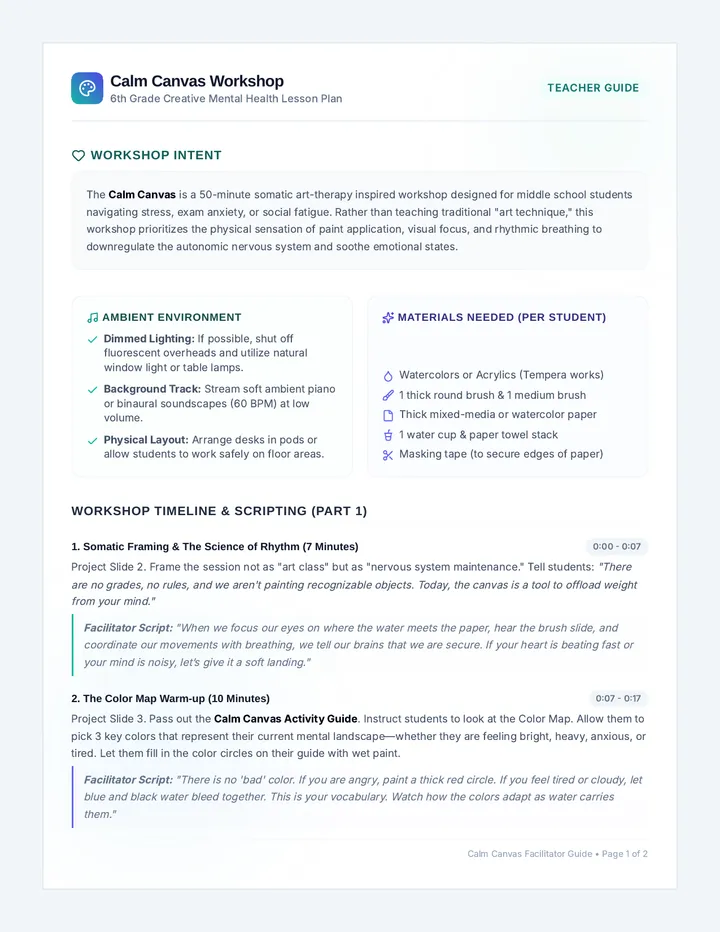
Calm Canvas Teacher Guide
Calm Canvas Workshop
6th Grade Creative Mental Health Lesson Plan
TEACHER GUIDE
Workshop Intent
The Calm Canvas is a 50-minute somatic art-therapy inspired workshop designed for middle school students navigating stress, exam anxiety, or social fatigue. Rather than teaching traditional "art technique," this workshop prioritizes the physical sensation of paint application, visual focus, and rhythmic breathing to downregulate the autonomic nervous system and soothe emotional states.
Ambient Environment
- Dimmed Lighting: If possible, shut off fluorescent overheads and utilize natural window light or table lamps.
- Background Track: Stream soft ambient piano or binaural soundscapes (60 BPM) at low volume.
- Physical Layout: Arrange desks in pods or allow students to work safely on floor areas.
Materials Needed (Per Student)
- Watercolors or Acrylics (Tempera works)
- 1 thick round brush & 1 medium brush
- Thick mixed-media or watercolor paper
- 1 water cup & paper towel stack
- Masking tape (to secure edges of paper)
Workshop Timeline & Scripting (Part 1)
1. Somatic Framing & The Science of Rhythm (7 Minutes)
0:00 - 0:07
Project Slide 2. Frame the session not as "art class" but as "nervous system maintenance." Tell students: "There are no grades, no rules, and we aren't painting recognizable objects. Today, the canvas is a tool to offload weight from your mind."
Facilitator Script: "When we focus our eyes on where the water meets the paper, hear the brush slide, and coordinate our movements with breathing, we tell our brains that we are secure. If your heart is beating fast or your mind is noisy, let’s give it a soft landing."
2. The Color Map Warm-up (10 Minutes)
0:07 - 0:17
Project Slide 3. Pass out the Calm Canvas Activity Guide. Instruct students to look at the Color Map. Allow them to pick 3 key colors that represent their current mental landscape—whether they are feeling bright, heavy, anxious, or tired. Let them fill in the color circles on their guide with wet paint.
Facilitator Script: "There is no 'bad' color. If you are angry, paint a thick red circle. If you feel tired or cloudy, let blue and black water bleed together. This is your vocabulary. Watch how the colors adapt as water carries them."
Calm Canvas Facilitator Guide • Page 1 of 2
Calm Canvas Workshop
Calm Canvas Activity Guide
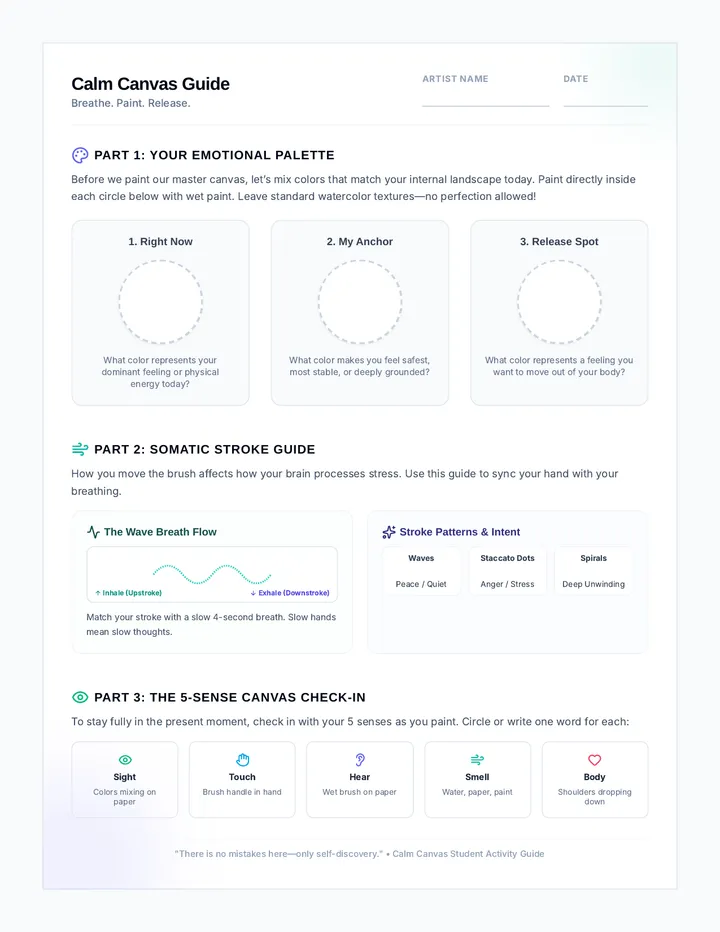
Calm Canvas Guide
Breathe. Paint. Release.
Artist Name
Date
Part 1: Your Emotional Palette
Before we paint our master canvas, let’s mix colors that match your internal landscape today. Paint directly inside each circle below with wet paint. Leave standard watercolor textures—no perfection allowed!
1. Right Now
What color represents your dominant feeling or physical energy today?
2. My Anchor
What color makes you feel safest, most stable, or deeply grounded?
3. Release Spot
What color represents a feeling you want to move out of your body?
Part 2: Somatic Stroke Guide
How you move the brush affects how your brain processes stress. Use this guide to sync your hand with your breathing.
The Wave Breath Flow
Inhale (Upstroke)
Exhale (Downstroke)
Match your stroke with a slow 4-second breath. Slow hands mean slow thoughts.
Stroke Patterns & Intent
Waves Peace / Quiet
Staccato Dots Anger / Stress
Spirals Deep Unwinding
Part 3: The 5-Sense Canvas Check-In
To stay fully in the present moment, check in with your 5 senses as you paint. Circle or write one word for each:
Sight Colors mixing on paper
Touch Brush handle in hand
Hear Wet brush on paper
Smell Water, paper, paint
Body Shoulders dropping down
"There is no mistakes here—only self-discovery." • Calm Canvas Student Activity Guide
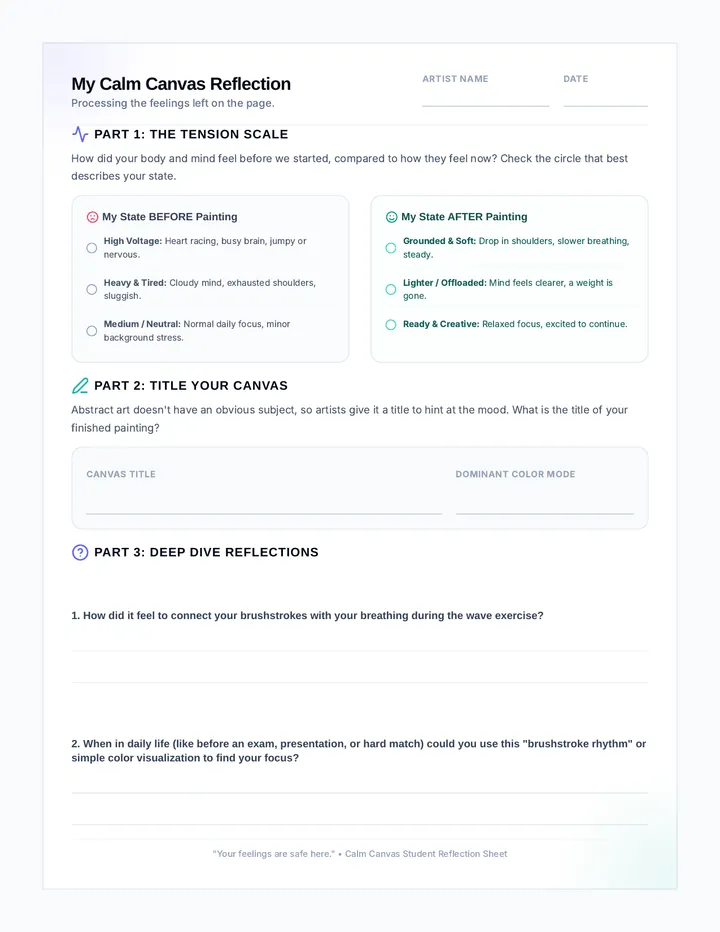
Calm Canvas Reflection Sheet
My Calm Canvas Reflection
Processing the feelings left on the page.
Artist Name
Date
Part 1: The Tension Scale
How did your body and mind feel before we started, compared to how they feel now? Check the circle that best describes your state.
My State BEFORE Painting
High Voltage: Heart racing, busy brain, jumpy or nervous. Heavy & Tired: Cloudy mind, exhausted shoulders, sluggish. Medium / Neutral: Normal daily focus, minor background stress.
My State AFTER Painting
Grounded & Soft: Drop in shoulders, slower breathing, steady. Lighter / Offloaded: Mind feels clearer, a weight is gone. Ready & Creative: Relaxed focus, excited to continue.
Part 2: Title Your Canvas
Abstract art doesn't have an obvious subject, so artists give it a title to hint at the mood. What is the title of your finished painting?
Canvas Title
Dominant Color Mode
Part 3: Deep Dive Reflections
1. How did it feel to connect your brushstrokes with your breathing during the wave exercise?
2. When in daily life (like before an exam, presentation, or hard match) could you use this "brushstroke rhythm" or simple color visualization to find your focus?
"Your feelings are safe here." • Calm Canvas Student Reflection Sheet