Guild Charter Lesson Plan The Explorer's Guild • Year Voyage
Day 1: Guild Charter
Teacher Guide • Lesson 1
Guild Charter & Routines
Establishing procedures, building community, and charting our shared values.
Pacing 50 Minutes
Objectives
Students will explain 3 essential routines and co-create an 'Explorer's Creed' for group accountability.
Materials
Guild Charter Handouts, Crew Connection Cards, chart paper, markers, bell/chime.
SEL Focus
Relationship skills, social awareness, and establishing physical and emotional safety.
Step-by-Step Lesson Pathway
10 min
Warm-Up: Entering the Outpost & Crew Meet Procedure Focus
Entry Routine: Stand at the doorway. Greet each student warmly by name (or introduce yourself) and hand them a Crew Connection Card. Instruct them to find their seat silently according to the seating chart.
Activity: Students share their card prompt with their immediate desk partner ("co-explorer"). This introduces the lesson's thematic voice: "We are travelers on a journey through history."
15 min
Establishing the Guild Rules & Routines Direct Instruction
Explain that a successful expedition requires rigorous communication and routines. Model, practice, and test 3 core routines:
The Explorer's Attention (Call to Order): Raise hand and call out, "Attention Explorers!" Students stop writing, hands off materials, make eye contact, and echo "Guild Alert!"Transition Protocol: Move cleanly from seat work to group activities in 15 seconds. Practice moving chairs silently.The Exit Check: Clean table, push in chairs, wait for hand-release signal.
20 min
Co-Creating the Explorer's Creed Active Collaboration
Instead of reading rules, groups of 4 brainstorm and draft 1 core value. Prompt: "What does it take to make our classroom feel like a supportive, exciting guild?"
Collect cards, write ideas on chart paper, and synthesize into the class "Creed" (e.g., respect, grit, active listening). Hand out student sheets to record.
Unit: Back to School • Day 1 Page 1 of 2
The Explorer's Guild • Year Voyage
Day 1: Guild Charter
Teacher Guide • Lesson 1
Guild Charter • Facilitation Notes
Teacher Script Suggestions & Prompts
To introduce the theme: "Welcome, adventurers! This year, we aren't just memorizing facts about ancient history or memorizing capital cities on a map. We are cartographers of the human experience. To make it through the challenging terrain, we need to operate like a Guild—a closely connected squad who looks out for one another and guarantees everyone's safety."
When enforcing routine practice: "Let's pause. We just transitioned back to our desks, but it took us 42 seconds and there was quite a lot of physical clatter. A true guild moves like shadows. Let's push our chairs back in, stand at our groups, and try that transition one more time. Goal: under 15 seconds, dead silent. Ready? Go."
Common Pitfalls & Traps
Assuming they know: Even if they did this routine in 5th grade, model it explicitly. Over-explaining on Day 1 saves 100 hours of correction later.Letting 'minor slipups' slide: If students whisper during 'Explorer's Attention', wait patiently. Setting the bar high on Day 1 is crucial.
Pacing & Differentiation
Support: Provide visually simplified procedure checklists or print the 3 routines directly onto index cards for desks.Extension: Have advanced students sketch visual symbols representing each class routine to post around the classroom walls.
Assessment & Exit Ticket (5 min)
Distribute the Day 1 Student Handout. Before leaving, students must answer the Guild Oath Agreement Check . Assess their compliance by noting down which groups correctly transition and execute the Exit Check procedure as they leave.
Entering Silent finding, card reading
Attention Chime 3-sec response, silent gaze
Exit Cleared Tidy desk, clean floor
Unit: Back to School • Day 1 Page 2 of 2
Guild Charter Handout The Explorer's Guild • Expedition Dossier
Student Logbook
Explorer Name
Date
Crew Squad (Period)
The Explorer's Guild Charter
Welcome to Social Studies! To survive the high seas and rocky mountains of history, our expedition squad must operate with trust, safety, and mutual respect. Let's build our Guild rules together!
Part I: Charting Our Core Routines
Routine 1
Entering the Outpost
Pick up materials, check the seating board, sit quietly, and immediately begin the Warm-Up card on your desk.
Routine 2
Guild Alert Attention
When the guide calls, stop writing, look up, and stand alert. Let's practice checking in with our leader in 3 seconds flat .
Routine 3
Silent Departure
Clear your map desk, recycle materials, tuck your chair in silently, and stand behind it until your row is officially cleared for departure.
Part II: Brainstorming Guild Values
What helps us discover & learn?
Actions that build safety and learning (e.g. listening, sharing):
What slows down our crew?
Behaviors that make work feel unsafe or unproductive:
Part III: Our Explorer's Creed
As a crew, we have agreed to uphold the following standards for this entire academic voyage. Record our class's co-created Creed in the fields below:
Valour I
Valour II
Valour III
"I, the undersigned explorer, pledge to stand by my crew, respect the charter, and contribute to our learning adventure."
Signature of Explorer
Signature of Guild Leader (Teacher)
Unit: Back to School • Day 1 Document: Student Logbook 1.1
Guild Icebreaker Cards The Explorer's Guild • Equipment Manifest
Icebreaker Connection Deck
Crew Connection Cards
Teacher Instructions: Print on heavy cardstock. Cut along the dashed guidelines. Hand one card to each student as they enter the room to prompt immediate thematic discussion.
#01
Coordinate Alpha
The Voyage Begins
"If you could travel in a time machine to any century or civilization in human history, where would you stop and why?"
Crew Mission
Find someone who chose a different historical era and shake hands.
#02
Coordinate Beta
The Pack Checklist
"If you were stranded on an uncharted, deserted island and could only bring three items, what would they be?"
Crew Mission
Combine your list with your partner. Agree on a final list of 4 items total.
#03
Coordinate Gamma
The Anchor Point
"Who is one historical figure, explorer, or family ancestor that you admire for their extreme courage or grit?"
Crew Mission
Name the quality that figure had that you would most like to have yourself.
#04
Coordinate Delta
High Peaks
"What is a personal 'mountain' or goal you hope to successfully climb or master during your time in 6th grade?"
Crew Mission
Say out loud: 'I believe we can make it to the summit together!'
#05
Coordinate Epsilon
The Safe Harbor
"What can other people in this room do to make you feel comfortable and excited to share your ideas out loud?"
Crew Mission
Give your partner a polite high-five or fist-bump to seal the agreement.
#06
Coordinate Zeta
Claiming Ground
"If you could start a brand new country from scratch, what is the very first laws or rights you would write down?"
Crew Mission
Draw a miniature 1-inch flag on a piece of scratch paper for your new country.
Unit: Back to School • Day 1 Card Pack: 1.1 (6 Printable Cards)
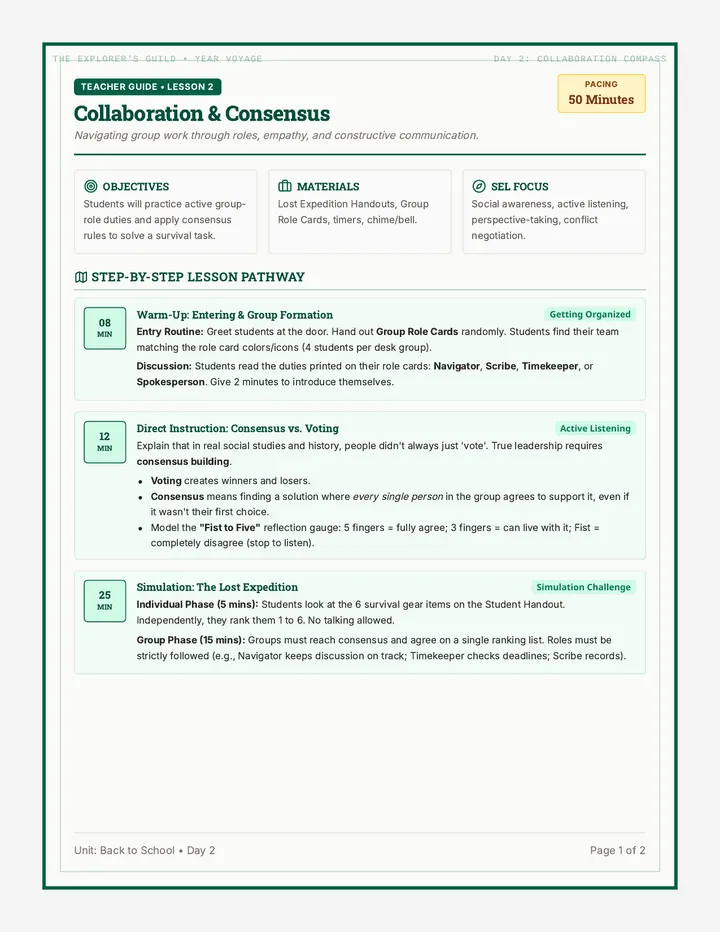
Collaboration Compass Lesson Plan The Explorer's Guild • Year Voyage
Day 2: Collaboration Compass
Teacher Guide • Lesson 2
Collaboration & Consensus
Navigating group work through roles, empathy, and constructive communication.
Pacing 50 Minutes
Objectives
Students will practice active group-role duties and apply consensus rules to solve a survival task.
Materials
Lost Expedition Handouts, Group Role Cards, timers, chime/bell.
SEL Focus
Social awareness, active listening, perspective-taking, conflict negotiation.
Step-by-Step Lesson Pathway
08 min
Warm-Up: Entering & Group Formation Getting Organized
Entry Routine: Greet students at the door. Hand out Group Role Cards randomly. Students find their team matching the role card colors/icons (4 students per desk group).
Discussion: Students read the duties printed on their role cards: Navigator , Scribe , Timekeeper , or Spokesperson . Give 2 minutes to introduce themselves.
12 min
Direct Instruction: Consensus vs. Voting Active Listening
Explain that in real social studies and history, people didn't always just 'vote'. True leadership requires consensus building .
Voting creates winners and losers.Consensus means finding a solution where every single person in the group agrees to support it, even if it wasn't their first choice.Model the "Fist to Five" reflection gauge: 5 fingers = fully agree; 3 fingers = can live with it; Fist = completely disagree (stop to listen).
25 min
Simulation: The Lost Expedition Simulation Challenge
Individual Phase (5 mins): Students look at the 6 survival gear items on the Student Handout. Independently, they rank them 1 to 6. No talking allowed.
Group Phase (15 mins): Groups must reach consensus and agree on a single ranking list. Roles must be strictly followed (e.g., Navigator keeps discussion on track; Timekeeper checks deadlines; Scribe records).
Unit: Back to School • Day 2 Page 1 of 2
The Explorer's Guild • Year Voyage
Day 2: Collaboration Compass
Teacher Guide • Lesson 2
Consensus Facilitation & Pacing
The 'Survival Key' & Historical Context
Collaboration Compass Handout The Explorer's Guild • Tactical Map
Student Logbook 2.1
Explorer Name
Date
Assigned Group & Role
The Lost Expedition Simulation
The Scenario: Your hot-air balloon has blown off course and crash-landed in the arid expanse of the Sahara Desert. You have 6 salvageable items remaining. Your goal is to survive and get rescued.
Expedition Survival Equipment List Goal: Rank from 1 (Most Critical) to 6 (Least Critical)
| Item Details & Context | My Rank
|
|
| Heavy Canvas Tarp An 8x8 foot piece of reinforced woven fabric. Weatherproof. |
|
|
|
| Signal Mirror A highly reflective hand glass with a small center sighting hole. |
|
|
|
| Emergency First Aid Kit Contains bandages, insect ointment, tweezers, and aspirin. |
|
|
|
| Magnetic Brass Compass A basic mechanical navigation device pointing directly North. |
|
|
|
| Waterproof Box of Matches A slide-box containing 25 wax-sealed strike matches. |
|
|
|
Part II: Personal Expedition Debrief
1. What specific action did your crew take that helped everyone reach a consensus?
2. Reflect on your assigned role. How did your role duties support the survival of the team today?
Unit: Back to School • Day 2 Activity Dossier: The Lost Expedition
Collaboration Role Cards The Explorer's Guild • Classroom Equipment
Group Role Cards
Explorer Guild Role Cards
Teacher Instructions: Print on heavy cardstock, cut into 4 rectangular table tents, and fold them in half. Distribute to establish immediate structured cooperative group work!
The Navigator
Duty: Facilitator & Consensus Chief
"Guiding the expedition pathway, keeping our group safe and united."
Your Key Duties:
Keep the team focused on the prompt.
Actively invite quieter crew members to speak.
Lead the "Fist to Five" consensus check.
Navigator's Dialogue Prompt
"Let's pause and hear from our Scribe. What is your view on this item?"
The Scribe
Duty: Recorder & Cartographer
"Recording details accurately, drafting our maps, and spelling names right."
Your Key Duties:
Record the final group answers on the handout.
Take neat notes on ideas discussed by the crew.
Read back the lists to double-check consensus.
Scribe's Dialogue Prompt
"I have written down Water as #1. Does everyone agree I should finalize that?"
The Timekeeper
Duty: Pacing Chief & Scout
"Monitoring the horizon of time, ensuring we don't miss our windows."
Your Key Duties:
Keep an eye on the clock or teacher's digital timer.
Give friendly alerts: "Halfway point!" or "3 minutes left!"
Keep team members focused on moving to the next item.
Timekeeper's Dialogue Prompt
"Excellent work, but we have 2 minutes left and 3 items left to rank. Let's pick up our pace."
The Spokesperson
Duty: Liaison & Herald
"Carrying our group's unified voice, announcing discoveries to the Guild."
Your Key Duties:
Ask the Guild Leader questions on behalf of the team.
Speak clearly and proudly during class-wide shares.
Represent the group's final consensus points honestly.
Spokesperson's Dialogue Prompt
"In our group, we reached consensus that Water was #1 because..."
Unit: Back to School • Day 2 Card Pack: 2.1 (4 Table Roles)
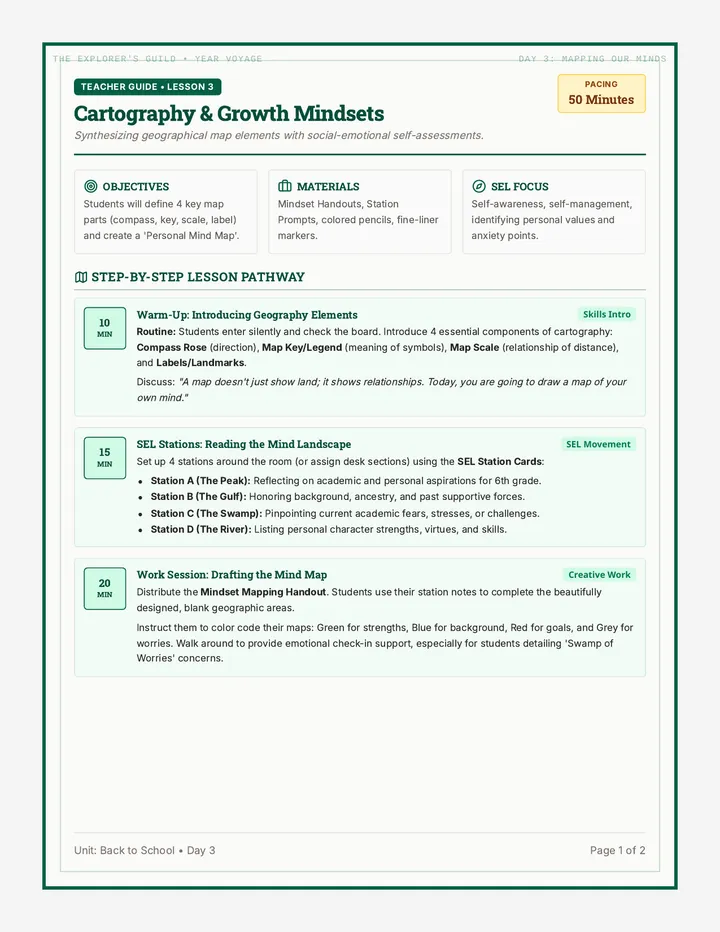
Mapping Minds Lesson Plan The Explorer's Guild • Year Voyage
Day 3: Mapping Our Minds
Teacher Guide • Lesson 3
Cartography & Growth Mindsets
Synthesizing geographical map elements with social-emotional self-assessments.
Pacing 50 Minutes
Objectives
Students will define 4 key map parts (compass, key, scale, label) and create a 'Personal Mind Map'.
Materials
Mindset Handouts, Station Prompts, colored pencils, fine-liner markers.
SEL Focus
Self-awareness, self-management, identifying personal values and anxiety points.
Step-by-Step Lesson Pathway
10 min
Warm-Up: Introducing Geography Elements Skills Intro
Routine: Students enter silently and check the board. Introduce 4 essential components of cartography: Compass Rose (direction), Map Key/Legend (meaning of symbols), Map Scale (relationship of distance), and Labels/Landmarks .
Discuss: "A map doesn't just show land; it shows relationships. Today, you are going to draw a map of your own mind."
15 min
SEL Stations: Reading the Mind Landscape SEL Movement
Set up 4 stations around the room (or assign desk sections) using the SEL Station Cards :
Station A (The Peak): Reflecting on academic and personal aspirations for 6th grade.Station B (The Gulf): Honoring background, ancestry, and past supportive forces.Station C (The Swamp): Pinpointing current academic fears, stresses, or challenges.Station D (The River): Listing personal character strengths, virtues, and skills.
20 min
Work Session: Drafting the Mind Map Creative Work
Distribute the Mindset Mapping Handout . Students use their station notes to complete the beautifully designed, blank geographic areas.
Instruct them to color code their maps: Green for strengths, Blue for background, Red for goals, and Grey for worries. Walk around to provide emotional check-in support, especially for students detailing 'Swamp of Worries' concerns.
Unit: Back to School • Day 3 Page 1 of 2
The Explorer's Guild • Year Voyage
Day 3: Mapping Our Minds
Teacher Guide • Lesson 3
Mindset Mapping Facilitation
Linking Geography to Social-Emotional Baselines
Mapping Minds Handout The Explorer's Guild • Personal Chart
Student Logbook 3.1
Explorer Name
Date
Expedition Crew
Mapping My Mind Expedition
In social studies, cartographers use maps to guide voyages. Today, you are the mapmaker. You will draft a personal map of your strengths, goals, history, and worries.
Part I: The Cartographer's Tools
Compass Rose Shows directions (N, S, E, W) to stay oriented.
Map Key / Legend Explains symbols, icons, or color codes used.
Map Scale Shows distances relative to real-world sizes.
Landmark Labels Specifies name locations of unique geography.
Part II: Charting My Personal Geography
The Gulf of Heritage
Where do you come from? Write down 1-2 roots, family beliefs, traditions, or values that keep you anchored and strong.
The Range of Strengths
What are your biggest assets? Write 2 internal skills or positive traits you possess (e.g. patience, focus, creativity).
The Swamp of Worries
What makes you feel stuck, lost, or worried in 6th grade? Write down 1-2 academic fears or social anxieties.
The Summit of Goals
What is your peak milestone for this class? Write 1 specific thing you want to accomplish or discover this year.
Your Compass Scale Assignment:
Blue = History Green = Power Grey = Obstacle Amber = Peak
Unit: Back to School • Day 3 Activity Dossier: Mindset Mapping Grid
Mapping Minds Task Cards The Explorer's Guild • Mapmaking Stations
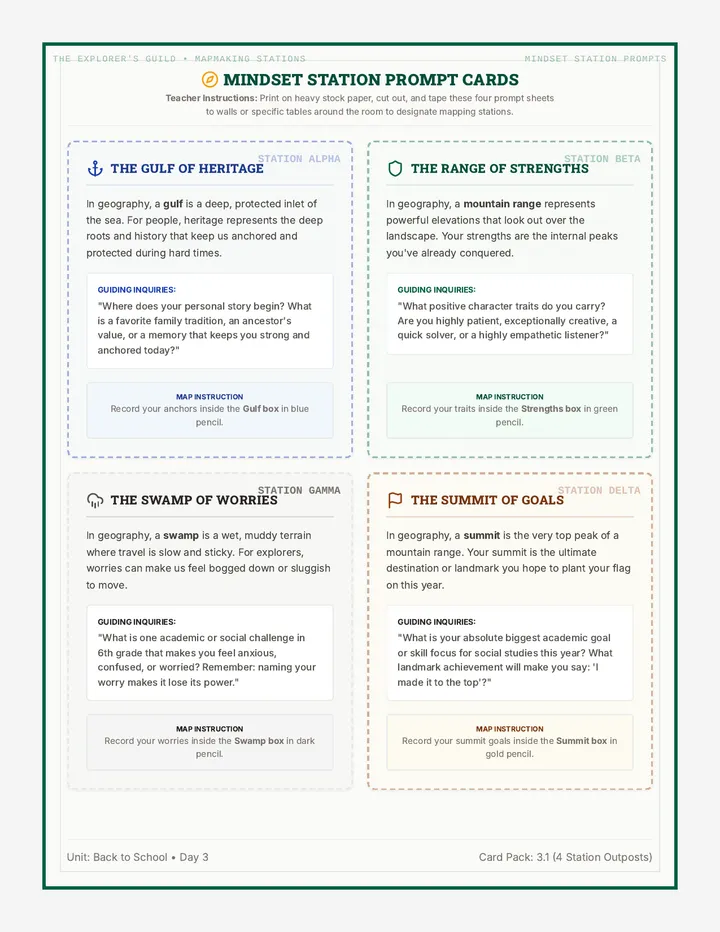
Mindset Station Prompts
Mindset Station Prompt Cards
Teacher Instructions: Print on heavy stock paper, cut out, and tape these four prompt sheets to walls or specific tables around the room to designate mapping stations.
STATION ALPHA
The Gulf of Heritage
In geography, a gulf is a deep, protected inlet of the sea. For people, heritage represents the deep roots and history that keep us anchored and protected during hard times.
Guiding Inquiries:
"Where does your personal story begin? What is a favorite family tradition, an ancestor's value, or a memory that keeps you strong and anchored today?"
Map Instruction
Record your anchors inside the Gulf box in blue pencil.
STATION BETA
The Range of Strengths
In geography, a mountain range represents powerful elevations that look out over the landscape. Your strengths are the internal peaks you've already conquered.
Guiding Inquiries:
"What positive character traits do you carry? Are you highly patient, exceptionally creative, a quick solver, or a highly empathetic listener?"
Map Instruction
Record your traits inside the Strengths box in green pencil.
STATION GAMMA
The Swamp of Worries
In geography, a swamp is a wet, muddy terrain where travel is slow and sticky. For explorers, worries can make us feel bogged down or sluggish to move.
Guiding Inquiries:
"What is one academic or social challenge in 6th grade that makes you feel anxious, confused, or worried? Remember: naming your worry makes it lose its power."
Map Instruction
Record your worries inside the Swamp box in dark pencil.
STATION DELTA
The Summit of Goals
In geography, a summit is the very top peak of a mountain range. Your summit is the ultimate destination or landmark you hope to plant your flag on this year.
Guiding Inquiries:
"What is your absolute biggest academic goal or skill focus for social studies this year? What landmark achievement will make you say: 'I made it to the top'?"
Map Instruction
Record your summit goals inside the Summit box in gold pencil.
Unit: Back to School • Day 3 Card Pack: 3.1 (4 Station Outposts)