Bounce Back Teacher Guide Teacher Lesson Plan • SEL & Growth Mindset
Bounce Back Power: The Perseverance Lab
Whole-Class Social-Emotional Learning • Grade 4
Duration 20–30 Min
Format Whole Class
Lesson Purpose
Guide 4th graders through the emotional cycle of productive struggle. Students discover that frustration is a natural biological signal of brain growth, learn cognitive self-talk pivots using "The Power of Yet", and build an actionable 3-step personal persistence routine.
Key Objectives
Distinguish between giving up vs. productive pausing .
Reframe 3 fixed roadblock thoughts using "Yet".
Commit to a personal 3-step "Bounce Back" routine.
Required Materials:
Bounce Back Slides Student Action Sheet (1 per kid) Pencils & Optional Highlighters
Timed Instructional Flow (25 Minutes Total)
4 MIN Warm-Up
The "Finger Lock" Struggle Experiment
Students attempt a rapid bilateral finger-switching challenge. Prompt: Notice the instant urge to quit or laugh when fingers tangle. Label that moment: The Learning Spark .
6 MIN Mini-Lesson
The Two P's & The Power of "Yet"
Define Persistence (sticking with today's tricky task) and Perseverance (chasing big goals over time). Introduce the 3-step Bounce Back formula: Pause, Pivot, Push.
10 MIN Guided Work
The Brain Bend Puzzle & Roadblock Reframe
Students tackle the reverse-logic challenge on their Action Worksheet. When stuck, partners coach each other through one verbal "Yet" pivot before drafting their 3-step persistence pledge.
5 MIN Closing
Classroom Resilience Launch & Exit Whisper
Volunteers share their reframed thoughts. Establish the whole-room "Yet Bell" or high-five cue whenever a classmate tackles a tough problem during math or reading.
Hook Facilitation Tip: The 15-Second Finger Switch
Have students put their right thumb up and left pinky out. On "Switch!", swap: left thumb up, right pinky out. Repeat 5 times rapidly. 90% of students will freeze or giggle. Immediately ask: "Did your brain feel like it hit a wall? That warmth and clumsiness is neural pathways firing up to learn something brand new!"
Bounce Back Power • Teacher Facilitation Guide Page 1 of 2
Facilitation Toolkit
Teacher Script & Response Moves
Grade 4 Delivery
Direct Instruction Script: Reframing The Dip Minutes 4–8
"Fourth graders, when video games get too easy, you get bored. When games get hard and you lose a level, what do you do? You don't throw your hands in the air and say 'I guess my brain can never play video games.' You study the pattern, try a different move, and try again. School is the exact same game. That uncomfortable feeling when a math problem looks like alien hieroglyphics is called productive struggle . It means you're leveling up."
Circulation Prompts During Worksheet Activity Minutes 11–18
When a student says:
"I'm stuck on this challenge. I can't figure it out."
Teacher asks:
"What have you tried so far, and what is one small strategy you haven't tested yet?"
When a student rushes:
"I'm already done. It was super easy."
Teacher prompts:
"Can you create a harder version of this roadblock to challenge your partner's bounce-back plan?"
Fourth Grade Misconception Busters
Misconception 1
"Persisting means never asking for help."
Truth: Knowing when and how to ask a targeted question is an expert persistence strategy!
Misconception 2
"If I'm smart, everything should come fast."
Truth: Speed is not intelligence. The deepest neural pathways build when working through difficult, slow puzzles.
Misconception 3
"Perseverance means doing the same thing harder."
Truth: Repeating an ineffective strategy leads to burnout. Persistence requires pivoting your approach.
Differentiation & Follow-Through Strategies
Scaffolding / Striving Learners
Provide sentence stems on sticky notes: "Right now I am struggling with ___, but I can try ___." Allow oral partner sharing prior to independent writing on the action sheet.
Week-Long Transfer Activity
Create a classroom "Grit Wall of Fame" where students post sticky notes describing an obstacle they hit during the week and how they pivoted around it.
Bounce Back Power • Teacher Facilitation Guide Page 2 of 2
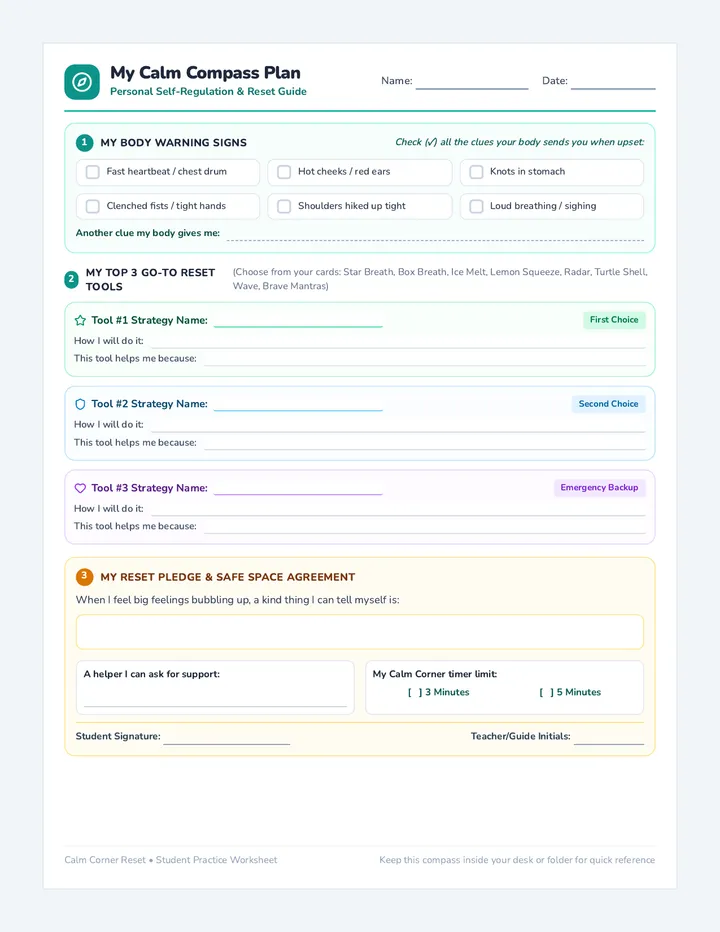
Bounce Back Action Worksheet Bounce Back Action Sheet
The 4th Grade Resilience Lab • Brain Training Blueprint
Name:
Date:
1 Mission 1: The 60-Second Brain Bend Productive Struggle Test
Quick Riddle: "What gets wetter and wetter the more it dries?" If you don't know it instantly, freeze! Pay attention to how your brain responds when stuck.
Your Answer:
How did getting stuck feel? Frustrated Curious Wanted to quit
2 Mission 2: Roadblock Reframes (Add "YET" + A Next Step) Reframe The Voice
When things get tough, our inner voice tells us to give up. Rewrite each fixed thought into a persistence thought using "YET" and one specific move.
Roadblock A: Math Frustration
"I can't do this 3-digit multiplication problem. I'm just terrible at math."
Write Your Bounce-Back Reframe:
Roadblock B: Writing Essay
"My opening paragraph sounds messy. I might as well throw this away."
Write Your Bounce-Back Reframe:
3 Mission 3: Build Your Personal 3-Step Bounce-Back Plan Action System
Step 1: PAUSE
What physical move helps you calm your brain when frustrated? (e.g. 3 deep breaths, shoulder roll)
My Pause Strategy:
Step 2: PIVOT
What new strategy will you test instead of doing the same thing? (e.g. draw a picture, check notes)
My Pivot Strategy:
Step 3: PUSH
Who or what can you ask for help if you're still stuck? (e.g. ask partner, re-read directions)
My Push Strategy:
My Official Perseverance Pledge
"When a task feels hard, I will not give up. I will remember that my brain is building new pathways. I will pause, pivot, and remember the power of YET !"
My Signature:
My Partner Witness:
Bounce Back Power • Student Resilience Worksheet Grade 4 • Printable Action Sheet
Bounce Back Slides Grade 4 SEL • Brain Training
The Resilience Lab
Bounce Back Power
How champions train their brains to stick with tough challenges and crush the quit urge.
Persistence • Productive Struggle • The Power of "Yet"
20–30 Minute Whole-Class Workshop
Warm-Up Experiment Step 1 of 4
Can Your Brain Handle The Switch?
Ready Position
👉 Right hand: Thumb pointing UP Pinky pointing OUT
Hold it steady for 3 seconds...
When Teacher Says: "SWITCH!"
👈 Left thumb goes UP OUT
Do it fast 5 times in a row!
Brain Check: Did your fingers freeze, tangle, or make you giggle? That feeling is your brain making brand-new connections!
Core Vocabulary Step 2 of 4
Meet The Dynamic Duo: The Two P's
Persistence
"Trying again right now!"
Sticking with a tricky math problem, an art sketch, or a game level when it gets tough today.
Sprint power for today's roadblocks.
Perseverance
"Never giving up on the big dream!"
Continuing toward long-term goals over weeks, months, or years—like learning guitar or sports.
Marathon endurance for your future self.
Both superpowers require one secret skill: embracing the struggle!
Brain Science The Learning Pit
Frustration Is Not A Stop Sign!
ZONE 1
The Comfort Zone
Everything feels easy, automatic, and super fast.
Brain growth: 0% (Cruising)
ZONE 2 THE DIP
Productive Struggle
You feel stuck, slow, or clumsy. You make mistakes.
Brain growth: 100% (Upgrading!)
ZONE 3
The Mastery Zone
What used to be impossible is now your new normal!
Brain growth: Leveled Up!
Rule #1 in 4th Grade: Struggling means you're doing something worth doing.
Secret Weapon Step 3 of 4
Flip The Script With Three Letters: YET
The Fixed Mindset Voice
"I can't do fractions. This makes no sense."
Result: You close your book and quit.
The Bounce-Back Reframe
"I can't do fractions... YET!"