Barber Code Reflection Worksheet
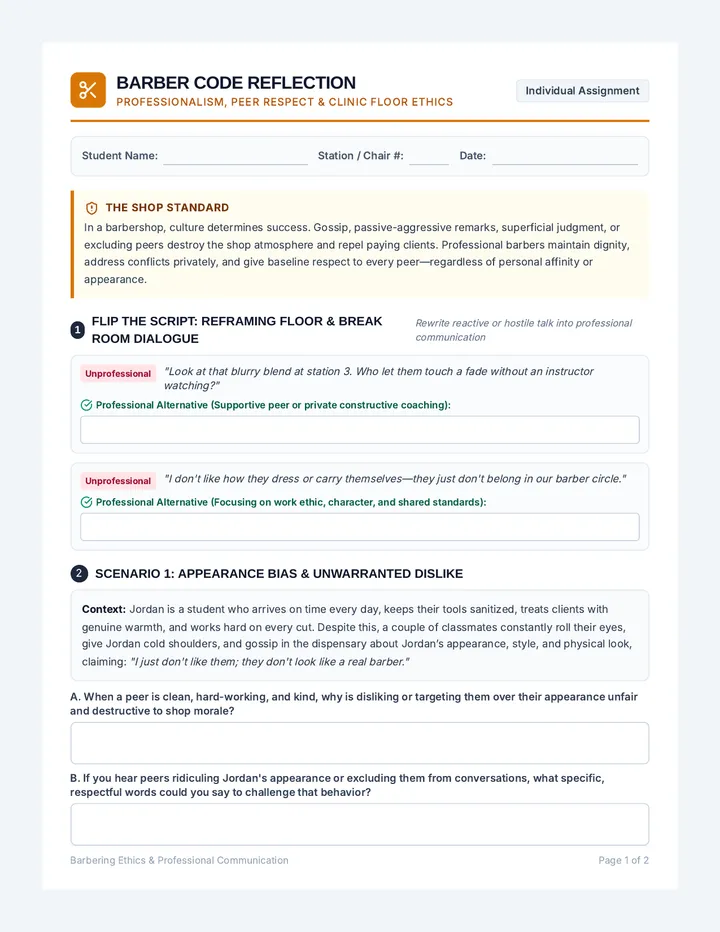
Barber Code Reflection
Professionalism, Peer Respect & Clinic Floor Ethics
Individual Assignment
Student Name:
Station / Chair #:
Date:
The Shop Standard
In a barbershop, culture determines success. Gossip, passive-aggressive remarks, superficial judgment, or excluding peers destroy the shop atmosphere and repel paying clients. Professional barbers maintain dignity, address conflicts privately, and give baseline respect to every peer—regardless of personal affinity or appearance.
1 Flip the Script: Reframing Floor & Break Room Dialogue
Rewrite reactive or hostile talk into professional communication
Unprofessional
"Look at that blurry blend at station 3. Who let them touch a fade without an instructor watching?"
Professional Alternative (Supportive peer or private constructive coaching):
Unprofessional
"I don't like how they dress or carry themselves—they just don't belong in our barber circle."
Professional Alternative (Focusing on work ethic, character, and shared standards):
2
Scenario 1: Appearance Bias & Unwarranted Dislike
Context: Jordan is a student who arrives on time every day, keeps their tools sanitized, treats clients with genuine warmth, and works hard on every cut. Despite this, a couple of classmates constantly roll their eyes, give Jordan cold shoulders, and gossip in the dispensary about Jordan’s appearance, style, and physical look, claiming: "I just don't like them; they don't look like a real barber."
A. When a peer is clean, hard-working, and kind, why is disliking or targeting them over their appearance unfair and destructive to shop morale?
B. If you hear peers ridiculing Jordan's appearance or excluding them from conversations, what specific, respectful words could you say to challenge that behavior?
Barbering Ethics & Professional Communication Page 1 of 2
Barber Code Reflection • Page 2
Clinic Floor Protocols & Self-Discipline
3
Scenario 2: When Personalities Clash on Adjacent Chairs
Context: You are assigned chair #4 for the next 8 weeks. Chair #3 is operated by a peer whose personality, social opinions, and volume irritate you. You have zero personal interest in being friends with this person outside school, but your chairs share the same floor mirror and sanitizing bar.
A. Distinguish between liking a classmate and treating them with professional courtesy. What does professional detachment look like in daily practice?
B. How does visible tension or cold hostility between adjacent barbers impact the client sitting in your chair?
4
Conflict Resolution Protocol
1 Private Address
Address friction one-on-one away from clients and peers. Never spar on the floor.
2 Focus on Facts
Describe specific behaviors (e.g., shared towel warmer clean-up), not personal character attacks.
3 Instructor Escalation
If boundary violations or bullying persist, schedule private mediation with an instructor.
Reflection: What is one personal communication habit or reaction you need to manage when someone irritates you at school?
My Clinic Floor Professional Pledge
I will never criticize, mock, or gossip about a peer in front of clients or other students.
I will treat every peer with respect, even when our personalities do not align.
I will address disagreements privately and professionally or seek instructor mediation.
I will protect the integrity, reputation, and positive atmosphere of our barber shop floor.
Barber Trainee Signature:
Date:
Barbering Ethics & Professional Communication Page 2 of 2
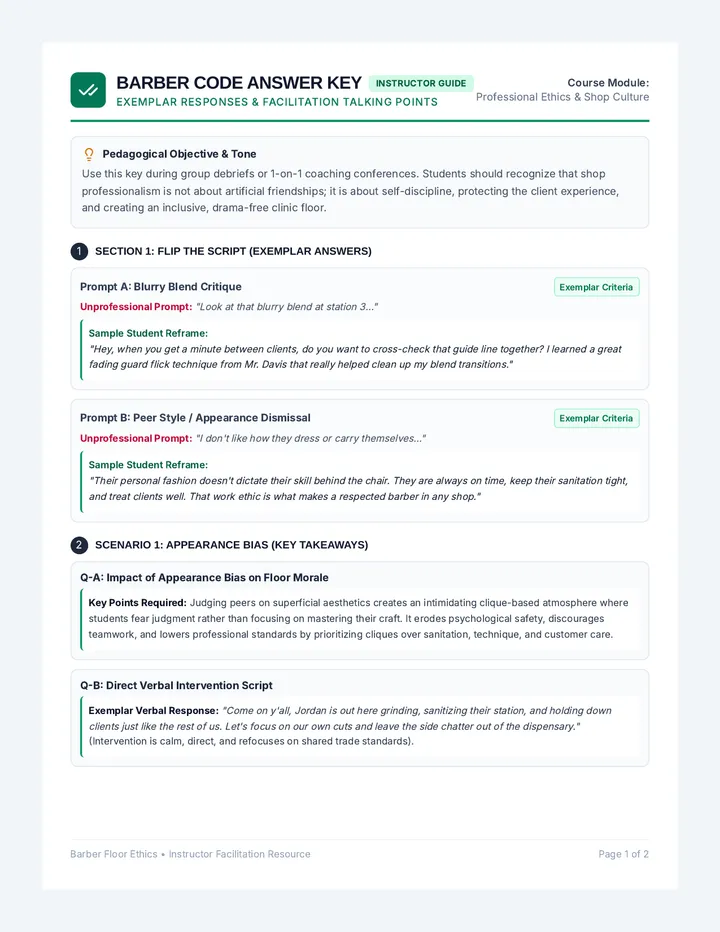
Barber Code Answer Key
Barber Code Answer Key
Instructor Guide
Exemplar Responses & Facilitation Talking Points
Course Module: Professional Ethics & Shop Culture
Pedagogical Objective & Tone
Use this key during group debriefs or 1-on-1 coaching conferences. Students should recognize that shop professionalism is not about artificial friendships; it is about self-discipline, protecting the client experience, and creating an inclusive, drama-free clinic floor.
1
Section 1: Flip the Script (Exemplar Answers)
Prompt A: Blurry Blend Critique Exemplar Criteria
Unprofessional Prompt: "Look at that blurry blend at station 3..."
Sample Student Reframe:
"Hey, when you get a minute between clients, do you want to cross-check that guide line together? I learned a great fading guard flick technique from Mr. Davis that really helped clean up my blend transitions."
Prompt B: Peer Style / Appearance Dismissal Exemplar Criteria
Unprofessional Prompt: "I don't like how they dress or carry themselves..."
Sample Student Reframe:
"Their personal fashion doesn't dictate their skill behind the chair. They are always on time, keep their sanitation tight, and treat clients well. That work ethic is what makes a respected barber in any shop."
2
Scenario 1: Appearance Bias (Key Takeaways)
Q-A: Impact of Appearance Bias on Floor Morale
Key Points Required: Judging peers on superficial aesthetics creates an intimidating clique-based atmosphere where students fear judgment rather than focusing on mastering their craft. It erodes psychological safety, discourages teamwork, and lowers professional standards by prioritizing cliques over sanitation, technique, and customer care.
Q-B: Direct Verbal Intervention Script
Exemplar Verbal Response: "Come on y'all, Jordan is out here grinding, sanitizing their station, and holding down clients just like the rest of us. Let's focus on our own cuts and leave the side chatter out of the dispensary." (Intervention is calm, direct, and refocuses on shared trade standards).
Barber Floor Ethics • Instructor Facilitation Resource Page 1 of 2
Barber Code Answer Key • Page 2
Evaluation Benchmarks & Chairside Protocols
3
Scenario 2: Clashing Personalities on Adjacent Chairs
Q-A: Liking vs. Professional Detachment
Core Benchmark: Liking someone is an emotional preference; professional courtesy is an ethical duty. Professional detachment means exchanging polite baseline greetings ("Good morning," "Pardon me," "Station clean for you"), respecting shared space (sanitation bar, cords, mirrors), and staying focused on one's client without cold shoulder body language.