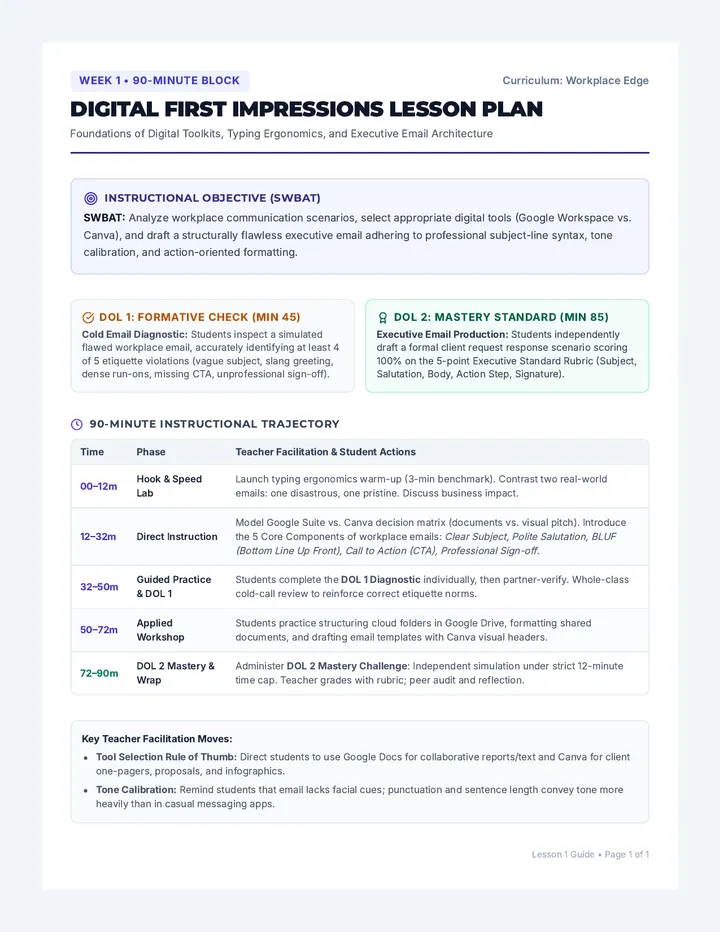
Workplace Habits Slides Launch Pad • Lesson 1
Vocational Training & Independent Employment
Workplace Habits &
Independent Success
Mastering the everyday routines, professional behaviors, and communication skills needed to thrive in your job.
Punctuality Communication Problem-Solving
Life Skills Transition
Foundational Standards
The Core 4 Workplace Habits
1
Arrive 10 Minutes Early
Punctuality shows reliability. Give yourself buffer time for transit, clocking in, and putting your personal items away.
2
Dress for the Role
Follow uniform rules and hygiene standards. Wear appropriate non-slip shoes and keep your badge or name tag visible.
3
Active Communication
Listen carefully to supervisor directions. Speak politely with coworkers and customers, and always ask questions when unsure.
4
Task Follow-Through
Finish assigned tasks completely before taking breaks. Check your work for quality, and take initiative to ask for next steps.
Key Mindset: Consistent habits build trust and open opportunities for more hours or promotion.
Autonomy & Responsibility
Taking Initiative Independently
Follow the Checklist
Use opening, mid-shift, and closing checklists without waiting to be reminded each time.
Self-Management
Spot What Needs Doing
When primary tasks finish, restock supplies, wipe counters, sweep work areas, or organize materials.
Productivity
Silence Distractions
Keep personal phones in your locker or bag during shifts. Focus full attention on job duties and customer safety.
Professionalism
Quick Question: What is one task at work you can do when you have downtime?
Problem-Solving on Shift
What Would You Do?
Scenario A: Running Late Due to Transit
Immediate Action
Your bus is delayed by 20 minutes. You will not make your 9:00 AM start time.
Best Step: Call your supervisor right away, state your estimated arrival time, and apologize respectfully.
Scenario B: Unclear Instructions
Self-Advocacy
The manager asks you to rotate stock in the back storeroom, but you aren't sure which boxes come first.
Best Step: Pause and say: "Could you demonstrate the order for these three boxes so I do it right?"
Asking for clarification is a sign of responsibility , not weakness. Think • Speak Up • Learn
Lesson Review
Your Independence Checklist
Daily Job Readiness
Prepare clothes & badge the night before
Set two alarms for morning travel
Check transit schedule before leaving home
On-the-Job Growth
Greet coworkers with respect and positivity
Accept feedback as a way to improve
Save earned income toward your independent goals
Ready for the next step: Use your earned income to build your independent budget!
Workplace Skills Worksheet Workplace Skills Worksheet
Vocational Independence & Shift Success
Lesson 1 Handout
Name:
Date:
Period:
Part 1
Reading Passage: The Path to Job Independence
Marcus started his new job as an inventory assistant at a local hardware distribution center last month. In the beginning, he felt nervous about managing his schedule and remembering all of his tasks. However, Marcus quickly learned that success at work comes from building dependable daily routines.
Every evening before a shift, Marcus irons his polo shirt, lays out his work pants, and sets two alarms on his phone. He plans his transit route to arrive fifteen minutes before his shift begins. This extra time allows him to put his bag in his locker, punch in accurately, and greet his teammates without rushing.
Independence on the job also means taking initiative and speaking up. When Marcus notices that shelf boxes are empty, he uses his restocking clipboard to fill them without waiting for his supervisor to tell him. When he was unsure how to safely operate the new tape machine, he practiced self-advocacy by asking his lead trainer for a quick review. Marcus’s reliable habits have earned him positive evaluations and steady income toward his personal savings goals.
Part 2
Vocational Vocabulary Match
Match each workplace term with its correct definition by writing the letter in the blank.
1. Punctuality
2. Initiative
3. Self-Advocacy
4. Professionalism
A. Speaking up respectfully for support or clarification.
B. Starting and completing duties without constant reminders.
C. Arriving on time and ready to work your full shift.
D. Appropriate behavior, respectful speech, and dress code.
Part 3
Passage Comprehension
1. What two specific preparation steps does Marcus take the night before his shift?
2. How did Marcus demonstrate self-advocacy when he encountered the new tape machine?
Workplace Problem-Solving & Action Plan
Applying Vocational Skills to Real-World Situations
Page 2 of 2
Part 4
Workplace Scenarios: What Is Your Action?
Scenario A: The Early Completion Dilemma Initiative
You finish sorting packages 25 minutes before your scheduled shift ends. There are no more packages on your assigned cart. Your coworker is playing a game on their phone in the corner.
What is the professional and responsible step you should take?
Workplace Skills Answer Key Workplace Skills Answer Key
Teacher Evaluation & Facilitation Guide
Teacher Resource
Companion resource for Workplace Skills Worksheet . Use for scoring, guided debriefs, and IEP transition progress monitoring.
Part 2 Vocational Vocabulary Solutions
4 Points Total
1. Punctuality C
2. Initiative B
3. Self-Advocacy A
4. Professionalism D
Part 3 Passage Comprehension Model Answers
Short Answer Guidance
Q1: Preparation steps Marcus takes the night before?
Exemplar: Marcus irons his polo shirt and lays out his work pants, and sets two alarms on his phone (also accepts planning his transit route to arrive 15 minutes early).
Q2: How Marcus demonstrated self-advocacy with the tape machine?
Exemplar: Instead of guessing or staying silent, Marcus asked his lead trainer for a quick demonstration and review to make sure he operated the machine safely.
Part 4 Scenario Evaluation & Rubric
Real-World Application
Scenario A: Finishing Early
Full Credit: Student states they will report to their supervisor, state the task is complete, and request another task, or take initiative to clean/restock.
No Credit: Sitting down, checking personal phone, or leaving early without permission.
Scenario B: Calling in Sick
Full Credit: Student specifies calling the supervisor well before the shift (at 6:30 AM), stating their name clearly, explaining illness, and following workplace call-in rules.
No Credit: Having a parent call, texting a coworker only, or waiting until shift start time.
Transition Teacher Coaching Points
Role-Play Activity: Have student pairs practice calling in sick using a telephone script. Focus on vocal clarity, identifying who they are, and confirming receipt of the message.
IEP Goal Alignment: This worksheet directly assesses post-secondary employment readiness benchmarks: self-advocacy, punctuality, and workplace communication protocols.
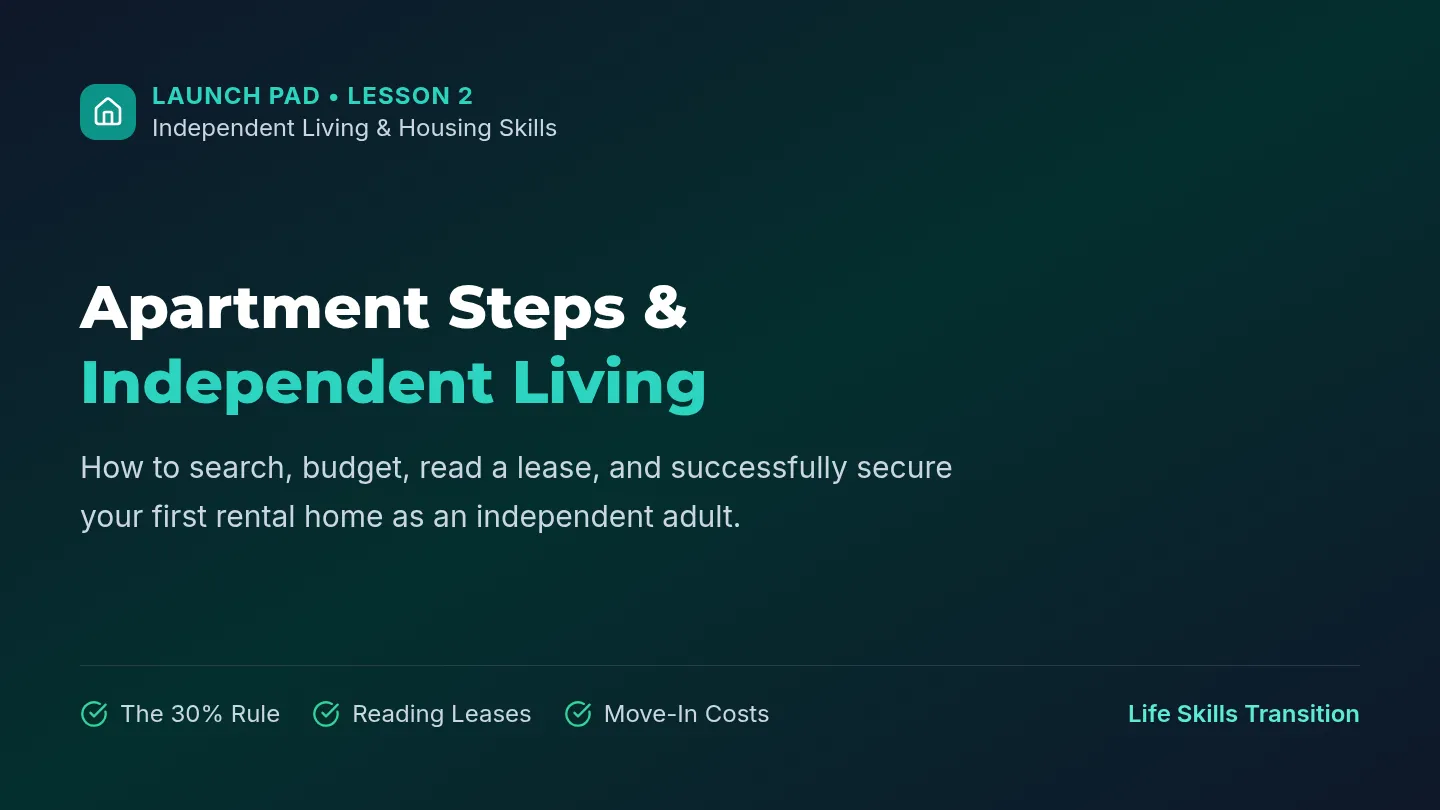
Apartment Steps Slides Launch Pad • Lesson 2
Independent Living & Housing Skills
Apartment Steps &
Independent Living
How to search, budget, read a lease, and successfully secure your first rental home as an independent adult.
The 30% Rule Reading Leases Move-In Costs
Life Skills Transition
The Rental Roadmap
5 Steps to Your First Apartment
1
Budget
Determine monthly income and what rent you can afford.
2
Search & Tour
Compare listings and inspect the actual unit in person.
3
Apply
Submit ID, pay stubs, and landlord references.
4
Sign Lease
Read terms carefully and pay deposit plus 1st month rent.
5
Move In
Complete the walk-through check sheet and set up utilities.
Pro-Tip: Never pay cash or sign without seeing the exact apartment unit first!
Financial Health
The 30% Housing Rule & Expenses
The Golden Budget Rule
Financial experts recommend spending no more than 30% of your gross monthly income on rent.
If you earn: $2,400 / month
Target Max Rent: $720 / month
(Or share with a roommate to split costs!)
Utilities & Hidden Costs
Rent is only one monthly payment. Always plan for extra bills:
Electricity & Heating ($80 - $150)
High-Speed Internet ($50 - $75)
Water, Trash, & Sewer ($30 - $60)
Renter's Insurance ($15 - $25)
Remember: Upfront move-in often requires 1st month rent + security deposit upfront!
Legal Contract
Decoding Your Lease Agreement
Lease Term & Due Date
Usually 12 months. Rent is typically due on the 1st of every month. Late fees begin after a grace period.
Security Deposit
Money held by landlord for damages. It is refunded when you move out if the apartment is clean and undamaged.
Rules & Policies
Guidelines on quiet hours, overnight guests, parking spots, and pet deposits or prohibitions.
Rule of Thumb: Never sign a lease until you have read and understood every single page.
Final Step
Move-In Inspection Walkthrough
What to Document
Take photos and video of all rooms
First Apartment Reading Worksheet First Apartment Reading Worksheet
Life Skills • Housing & Lease Literacy
Lesson 2 Handout
Name:
Date:
Period:
Part 1
Reading: Alexis Takes the Step into Independent Living
After working steadily for over a year at a local medical office, Alexis felt ready to reach a major adult milestone: moving into her very first independent apartment. She knew that living on her own required careful planning, budgeting, and understanding legal contracts.
Alexis remembered the golden 30% housing rule she learned in transition class. With a monthly take-home pay of $2,300, she knew her maximum rent budget was around $700. She decided to look for a studio apartment near a main bus line so she could commute to work easily without the expense of owning a car.
When Alexis found an available apartment at Oak Ridge Commons, she scheduled an in-person tour. She checked the water pressure in the sink, verified the windows locked securely, and tested the kitchen burners. Before signing the 12-month lease agreement, Alexis reviewed every term carefully. The landlord explained that she needed to pay the first month’s rent of $680 and an equal security deposit of $680 before receiving the keys. The security deposit would be held by the landlord and returned when Alexis moves out, provided the apartment remains clean and undamaged. Knowing she had saved enough money, Alexis proudly signed her first lease.
Part 2
Key Apartment Terminology
Match each rental term with its definition by writing the letter in the blank.
1. Lease Agreement
2. Security Deposit
3. Utilities
4. Landlord
A. The property owner or manager who rents out the home.
B. A refundable fee held by the landlord for repairs.
C. Essential services like electricity, water, gas, and heat.
D. A legally binding contract listing rental rules and costs.
Part 3
Reading Comprehension
1. Why did Alexis specifically look for an apartment located near a main bus line?
2. Under what condition will Alexis get her $680 security deposit back when she moves out?
Practical Life Skills: Apartment Math & Decisions
Comparing Rental Listings and Calculating Upfront Move-In Costs
Page 2 of 2
Part 4
Compare Two Real-World Listings
Analyze the two apartment options below to answer the comparison questions.
Option A: Pine Grove Studio $650 / month
Apartment Reading Answer Key Apartment Reading Answer Key
Teacher Evaluation & Housing Math Guide
Teacher Resource
Companion resource for First Apartment Reading Worksheet . Includes exact financial math, exemplar answers, and transition debrief points.
Part 2 Apartment Vocabulary Solutions
4 Points Total
1. Lease Agreement D
2. Security Deposit B
3. Utilities C
4. Landlord A
Part 3 Reading Comprehension Model Answers
Passage Evidence
Q1: Why Alexis chose an apartment near a bus line?
Exemplar: Alexis does not own a car, so being near a main bus route allows her to commute to her job reliably without car payments, gas, or insurance costs.
Q2: Condition for Alexis to receive her $680 security deposit back?
Exemplar: She will receive her refund when she moves out if the apartment is left clean, undamaged, and all lease terms were respected.
Parts 4 & 5 Listing Analysis & Move-In Math Solutions
Calculations
Part 4: Listing Comparison
Correct Choice: Option A (Pine Grove Studio).
Reasoning: At $2,000 monthly income, 30% is $600 (Option A at $650 is close). Option B ($850) is 42.5% of income (unaffordable). Crucially, Option B is 4 miles from transit and unreachable without a car.
Part 5: Move-In Expense Math
First Month Rent: $650.00
Security Deposit: $650.00
Electric Setup Fee: $75.00
Total Move-In Cash: $1,375.00
Part 6 Scenario & Independent Living Coaching
Leaking Sink Action: Place a bucket or towel to prevent wood/floor water damage. Immediately notify the landlord or submit an online maintenance request in writing with photos.
Discussion Prompt: Ask students: "Why is it risky to try fixing landlord plumbing yourself without permission?" Emphasize liability, damage costs, and lease terms.
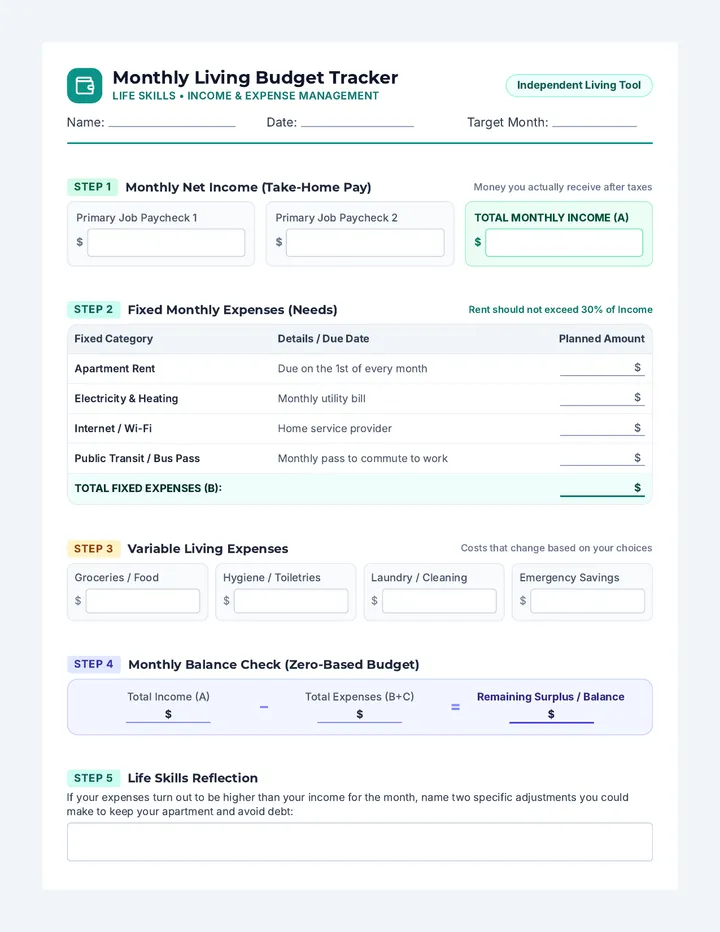
Monthly Living Budget Tracker Monthly Living Budget Tracker
Life Skills • Income & Expense Management
Independent Living Tool
Name:
Date:
Target Month:
Step 1
Monthly Net Income (Take-Home Pay)
Money you actually receive after taxes
Primary Job Paycheck 1
$
Primary Job Paycheck 2
$
TOTAL MONTHLY INCOME (A)
$
Step 2
Fixed Monthly Expenses (Needs)
Rent should not exceed 30% of Income
Fixed Category Details / Due Date Planned Amount Apartment Rent Due on the 1st of every month $ Electricity & Heating Monthly utility bill $ Internet / Wi-Fi Home service provider $ Public Transit / Bus Pass Monthly pass to commute to work $ TOTAL FIXED EXPENSES (B): $
Step 3
Variable Living Expenses
Costs that change based on your choices
Groceries / Food
$
Hygiene / Toiletries
$
Laundry / Cleaning
$
Emergency Savings
$
Step 4
Monthly Balance Check (Zero-Based Budget)
Total Income (A) $
−
Total Expenses (B+C) $
=
Remaining Surplus / Balance $
Step 5
Life Skills Reflection
If your expenses turn out to be higher than your income for the month, name two specific adjustments you could make to keep your apartment and avoid debt: