Signal to Solution Counselor Guide Counselor Facilitation Guide Grades 9–12 • 30–45 Min
Signal to Solution
A guided counseling session helping high school students recognize emotional triggers—situations, hot thoughts, and body signals—before choosing a problem-solving response.
Session Objectives
Identify the 3 parts of a trigger: Situation , Hot Thought , and Body Signal .
Distinguish an automatic reaction from an intentional problem-solving response.
Practice Spot It → Cool It → Solve It on realistic teen scenarios.
Session Materials
Trigger Radar Slides (visual anchor)Trigger Map Worksheet (1 per student)Pens or two highlighters ("heat" vs. "cool")
Setting: 1-on-1 or small group (3–8 students)
Session Flow & Pacing
Phase
Slides / Tools
Counselor Moves
1. Check-In
5 min
Slides 1–2
1–5 scale
Normalize that everyone has "internal alarms." Have students rate their stress battery (1–5) and name one everyday annoyance.
2. Trigger Chain
10 min
Slides 3–4
Worksheet Pt. 1
Introduce Situation → Hot Thought → Body Signal → Choice Point . Have students check their personal body cues and hot thoughts on Part 1.
3. Practice
15 min
Slides 5–7
Worksheet Pt. 2
Model Spot It → Cool It → Solve It on Slide 7 together. Then coach students through Scenarios A & B on their worksheet.
4. Personal Map
10 min
Slide 8
Worksheet Pt. 3
Invite students to map one low-to-medium trigger from their week and choose one 10-second reset tool to test before next session.
Counseling Approach & Emotional Safety
Frame triggers as data, not flaws. High schoolers often shut down if they feel blamed for "overreacting." Emphasize that body signals (tight chest, jaw clench, heat) are the brain's early-warning radar trying to protect them. Let students pick a mild everyday trigger for Part 3 rather than forcing intense disclosure.
Key Discussion Prompts
Spotting the Signal (Slides 3–4)
"Where does frustration or stress show up in your body first—before you even say a word?"
Listen for: Tight shoulders, hot face, racing heart, urge to shut down or snap back. Validate that noticing a body cue 5 seconds earlier gives them back control.
Separating Thought from Fact (Slide 5)
"When someone leaves you on read or a teacher calls you out, what's the automatic 'hot thought'—and what else could be true?"
Listen for: Mind-reading ("They're ignoring me on purpose") or all-or-nothing thoughts ("I'm going to fail"). Help students label it as a draft thought , not a final fact.
Coaching the 3-Step Pivot (Slide 7 Model)
Sample script for Scenario A ("Group project partner hasn't done their part at 9 PM" ):
1. SPOT IT
Name trigger + cue: "Tight chest + 'I'm stuck doing everything.'"
2. COOL IT
Buy 10 seconds: "Put phone down, drop shoulders, 2 slow exhales."
3. SOLVE IT
Pick one step: "Text 2 clear tasks or email the teacher tonight."
Differentiation & Adaptations
For Guarded or Resistant Teens
Focus on the fictional practice scenarios first. Let them critique what a character should do—teens open up more easily when they aren't in the spotlight.
For Sensory or ADHD Learners
Include physical/environmental triggers (loud hallways, sudden schedule changes) alongside social ones. Offer tactile resets like cold water or stretching.
Closing & Next-Session Check-In
Ask each student to star one body signal and one reset move on their Trigger Map. Next session, open with: "Did your radar catch any signals this week—even if you noticed them afterward?"
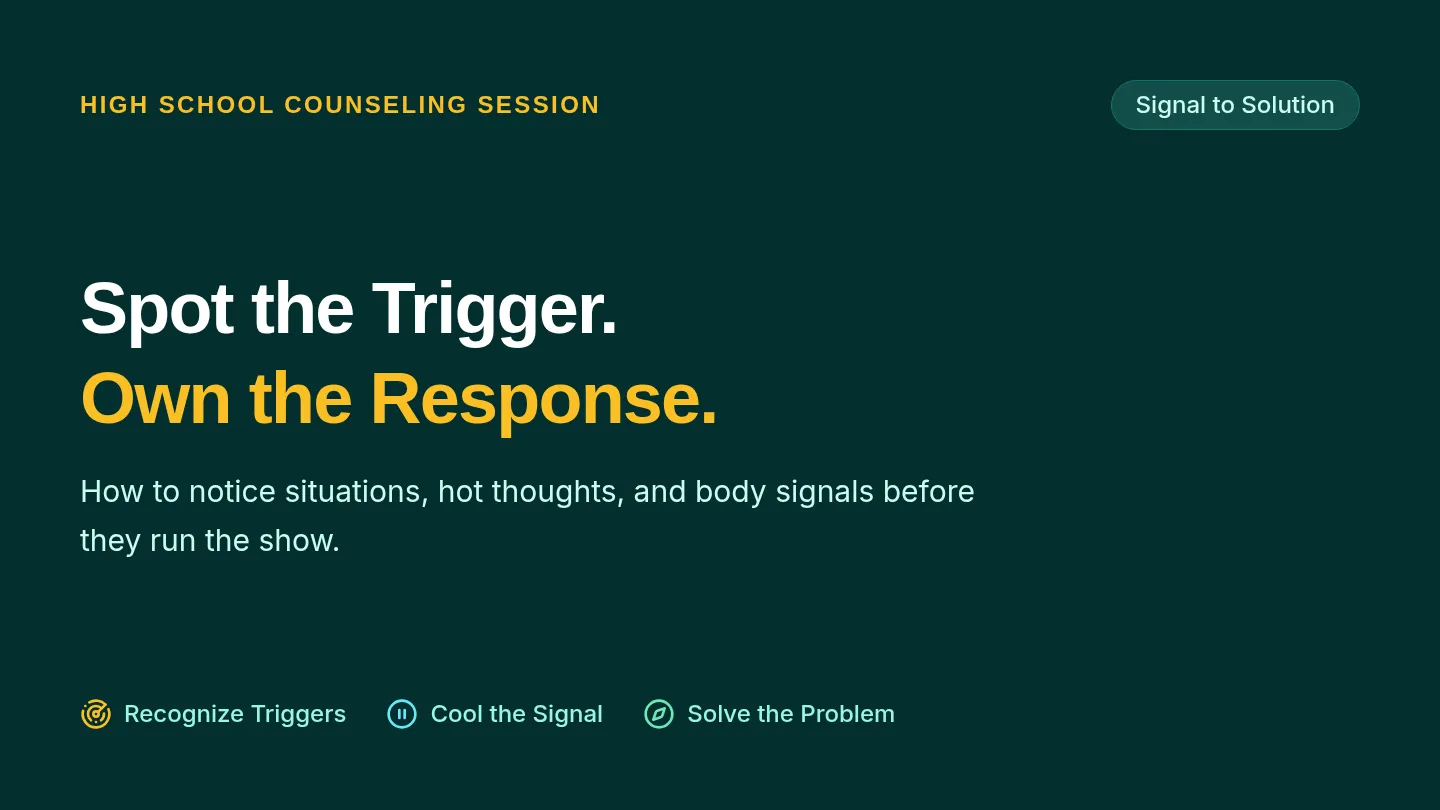
Trigger Radar Slides High School Counseling Session Signal to Solution
Spot the Trigger.
Own the Response.
How to notice situations, hot thoughts, and body signals before they run the show.
Recognize Triggers Cool the Signal Solve the Problem
Check-In
Where's Your Stress Battery Today?
1 Chill Low stress, steady
2 Okay Minor annoyances
3 Simmering Easy to irritate
4 Wired On edge, tense
5 Maxed Ready to snap or shut down
Quick Share: What is one small everyday thing that instantly annoys you?
Core Idea
A Trigger Is Just Early-Warning Radar
Having a trigger doesn't mean something is wrong with you. It means your brain detected a threat—like disrespect, unfairness, or overwhelm—and hit the alarm.
1. Situation
What happened around you
2. Hot Thought
The fast story your brain tells
3. Body Signal
The physical alarm you feel
4. Choice Point
React on autopilot OR pause & solve
Build Your Radar
3 Signals That Show Up Before You React
Situations
Being called out in front of class
Left on read or group chat drama
Feeling blamed or misunderstood
Too many deadlines at once
Hot Thoughts
"They're disrespecting me."
"Nobody ever listens to me."
"I'm going to fail anyway."
"If I don't clap back, I look weak."
Body Signals
Tight chest or shallow breathing
Hot face, clenched jaw, or fists
Stomach drop or restlessness
Brain fog or urge to shut down
The Choice Point
Hot Reaction vs. Cool Solution
Autopilot Reaction
Fast, automatic, driven by the heat of the moment.
Snapping back or sending an angry text
Walking out or shutting down completely
Usually creates a bigger second problem
Problem-Solving Response
Takes 10 seconds of space so you stay in charge.
Notices the body signal before speaking
Tests whether the hot thought is 100% fact
Picks a move that protects your goals
Your Playbook
The 3-Step Pause: Spot → Cool → Solve
1. SPOT IT
Name the signal.
"My jaw is tight and my brain is saying they don't respect me. This is a trigger."
2. COOL IT
Buy 10 seconds.
Drop your shoulders, take 2 slow exhales, or step away from your phone before replying.
3. SOLVE IT
Pick one smart move.
Ask: "What outcome do I actually want here?" Choose one clear, low-drama next step.
Guided Practice
Let's Walk Through One Together
Scenario
It's 9:00 PM. Your group project is due tomorrow, and your partner still hasn't touched their slides—even though they're posting on social media.
1. Spot It
What body signal & hot thought show up first?
2. Cool It
What's a 10-second reset before texting?
3. Solve It
What's one move that protects your grade?
Personal Radar
Map Your Own Signal
On Part 3 of your Trigger Map Worksheet , choose one everyday trigger from this week and map:
Your earliest body signal
Your go-to 10-second reset
One problem-solving move you're willing to test
Goal for this week: Catch the signal 5 seconds earlier—progress, not perfection.
Trigger Map Worksheet Signal to Solution
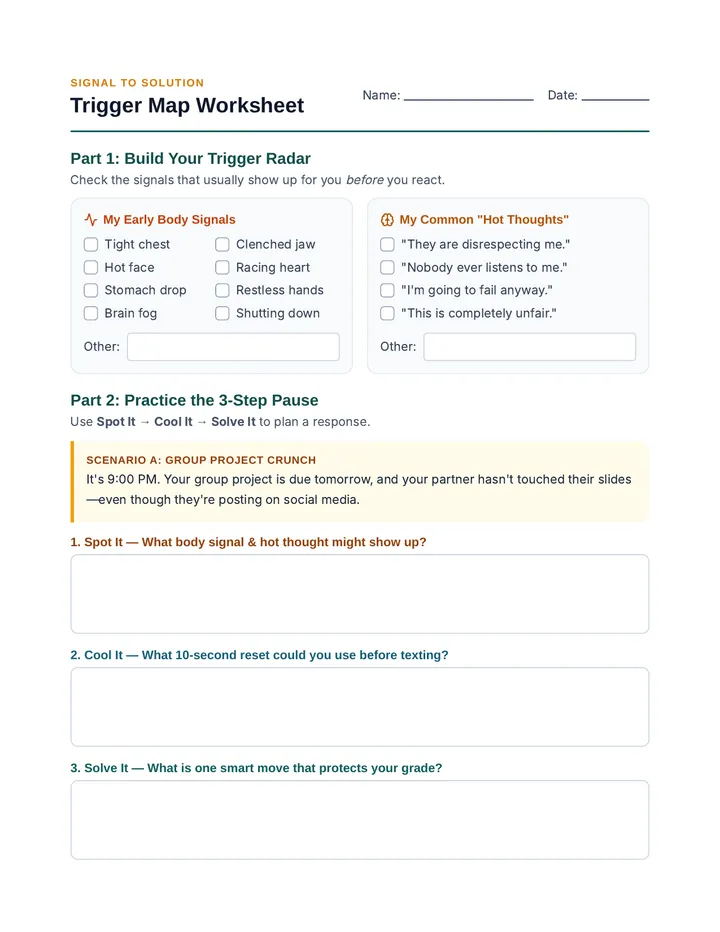
Trigger Map Worksheet
Name: _______________________ Date: ____________
Part 1: Build Your Trigger Radar
Check the signals that usually show up for you before you react.
My Early Body Signals
Tight chest Clenched jaw Hot face Racing heart Stomach drop Restless hands Brain fog Shutting down
Other:
My Common "Hot Thoughts"
"They are disrespecting me." "Nobody ever listens to me." "I'm going to fail anyway." "This is completely unfair."
Other:
Part 2: Practice the 3-Step Pause
Use Spot It → Cool It → Solve It to plan a response.
Scenario A: Group Project Crunch
It's 9:00 PM. Your group project is due tomorrow, and your partner hasn't touched their slides—even though they're posting on social media.
1. Spot It — What body signal & hot thought might show up?
2. Cool It — What 10-second reset could you use before texting?
3. Solve It — What is one smart move that protects your grade?
Scenario B: Called Out in Class
A teacher calls you out in front of the class for talking when you were actually asking a classmate for a pencil. People turn and look.
1. Spot It (Signal + Thought)
2. Cool It (10-Sec Reset)
3. Solve It (Next Move)
Part 3: Map Your Own Signal
Pick one everyday trigger from your week and map out your plan.
Situation (What usually sets off this trigger?)
Earliest Body Signal
Hot Thought That Pops Up
My Go-To 10-Second Reset (Cool It)
One Problem-Solving Move (Solve It)
Weekly Goal: One signal I want to catch 5 seconds earlier this week is...