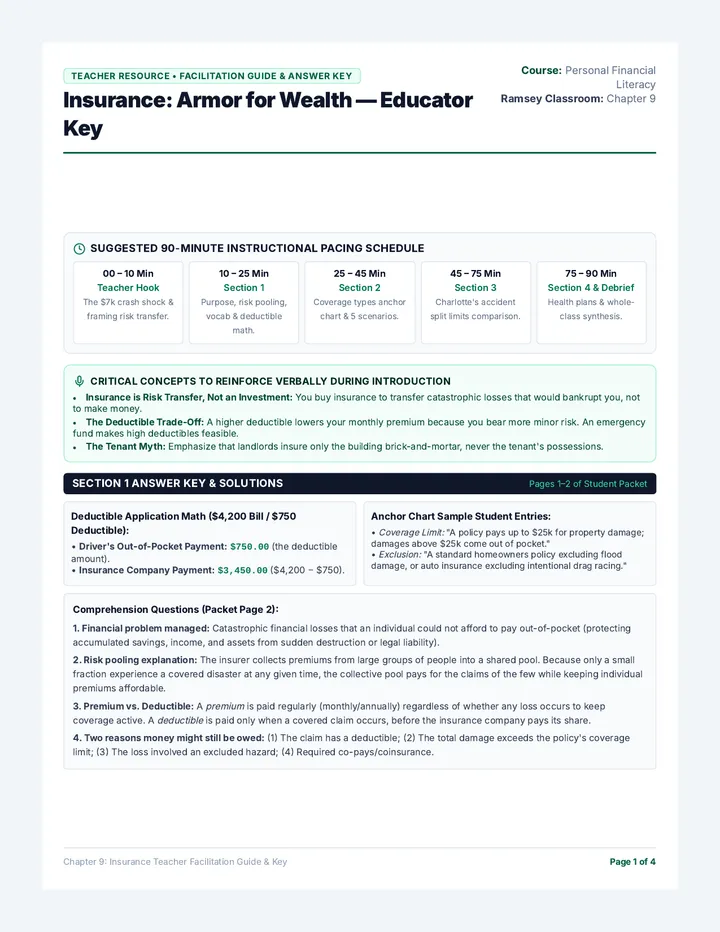
4. Two reasons money might still be owed: (1) The claim has a deductible; (2) The total damage exceeds the policy's coverage limit; (3) The loss involved an excluded hazard; (4) Required co-pays/coinsurance.
Chapter 9: Insurance Teacher Facilitation Guide & Key Page 1 of 4
Answer Key & Rubrics
Pages 3 & 4 of Student Packet
Auto Comprehensive Student Entry: Accept any non-collision loss to the insured vehicle: e.g., "Hail storm dents hood and roof," "Car stolen from parking lot," "Deer jumps into road," "Falling tree branch cracks windshield," or "Vandalism/spray paint."
Disability Insurance Student Entry: Accept any illness or injury preventing employment: e.g., "Construction worker injured in off-work fall unable to do physical labor for 5 months receives 65% of regular salary," or "Nurse recovering from surgery."
Scenario 1: Fallen Tree Limb onto Parked Vehicle Auto Comprehensive Coverage
Why: Falling objects and weather damage are non-collision perils covered specifically by comprehensive insurance. Collision does not apply because the vehicle did not collide with another moving or stationary object while driving; Liability does not apply because liability only repairs damage you cause to other people.
Scenario 2: Apartment Burglary / Stolen Laptop & Tablet Renters Insurance
Why: Renters policies protect the tenant's personal property against theft and fire. The landlord's property policy strictly covers the physical building shell; it explicitly excludes tenant property.
Scenario 3: At-Fault Multi-Car Highway Collision ($8k Damage) Auto Property Damage Liability
Why: Liability covers legal responsibility for damage caused to another person's vehicle or property. Collision repairs the policyholder's own vehicle.
Scenario 4: Worker Medically Unable to Work for 6 Months Disability Insurance
Why: Disability insurance replaces a portion of earned income/paychecks when unable to work due to medical disability. Health insurance pays hospital/doctor bills, but health insurance pays $0 toward everyday grocery and rent expenses.
Scenario 5: Parents Securing Living/College Funds for Children Term Life Insurance
Why: Term life provides a death benefit directly to named beneficiaries (the children/surviving spouse) to replace future lost parental earnings at an affordable premium during dependent-raising years.
Synthesis: Why Single Adults Without Dependents Rarely Need Life Insurance
Acceptable Student Answers: The purpose of life insurance is to replace lost income for people who rely on you financially (children, non-working spouse). If no one depends on your paycheck to survive, there is no income stream that must be replaced upon your death. Paying high premiums provides zero utility. (They only need minimal coverage for modest funeral expenses, which can be covered by a starter emergency fund).
Chapter 9: Insurance Teacher Facilitation Guide & Key Page 2 of 4
Mathematical Solutions
Pages 5 & 6 of Student Packet
1. Property: $95k + $4k = $99,000
2. Injury: $15k + $185k = $200,000
3. Grand Total = $299,000
Uncovered: $229,000
| Claim Item | Actual Damage | Insurance Pays | Charlotte Personally Owes |
|---|---|---|---|
| Property Damage ($95k + $4k) | $99,000 | $25,000 | $74,000 |
| Driver Bodily Injury | $15,000 | $15,000 | $0 |
| Passenger Bodily Injury | $185,000 | $30,000 | $155,000 |
| Total Settlement Breakdown | $299,000 | $70,000 | $229,000 |
*Note: Insurer pays only $30,000 for passenger because of the per-person limit, despite total bodily injuries reaching $200k.
Uncovered: $85,000
| Claim Item | Actual Damage | Insurance Pays | Charlotte Personally Owes |
|---|---|---|---|
| Property Damage ($95k + $4k) | $99,000 | $99,000 | $0 |
| Driver Bodily Injury | $15,000 | $15,000 | $0 |
| Passenger Bodily Injury | $185,000 | $100,000 | $85,000 |
| Total Settlement Breakdown | $299,000 | $214,000 | $85,000 |
Part D Discussion Prompts & Acceptable Answers (Packet Page 6):
1. Additional money paid by Policy 2: $214,000 − $70,000 = $144,000.
2. Why $85,000 uncovered despite $300k limit: The policy has an individual per-person bodily injury cap of $100,000. Even though total accident injuries ($200k) are below $300k, the passenger's $185,000 claim is capped at $100,000, leaving $85,000 uncovered.
3. Catastrophic risks Charlotte faces: Lawsuits, court judgments, wage garnishment for years, bank account levy/seizure, loss of driver's license until judgment is paid, or filing for Chapter 7/13 bankruptcy.
4. Why choose higher limits: State minimums are dangerously obsolete given current medical and vehicle costs. A higher policy provides massive additional asset protection ($144,000 more coverage here) for only a modest increase in monthly premium.
5. Would liability repair Charlotte's car? No. Liability coverage exclusively covers harm caused to others. Charlotte needs Collision coverage to repair her own vehicle.
Chapter 9: Insurance Teacher Facilitation Guide & Key Page 3 of 4
Financial Analysis Key
Page 7 of Student Packet
Part A: Fixed Costs
Plan A: $250 × 12 = $3,000
Plan B: $150 × 12 = $1,800
Difference: $1,200 in guaranteed annual premium savings with Plan B.
Part B: Routine Care (4 Visits)
Plan A: $3k + (4×$20) = $3,080
Plan B: $1.8k + (4×$40) = $1,960
Outcome: Plan B costs $1,120 less overall.
Part C: Major Illness (Max OOP)
Plan A: $3k + $3,000 = $6,000
Plan B: $1.8k + $6,000 = $7,800
Outcome: Plan A saves $1,800 in total annual costs.
Person 1: Jordan Recommendation
Best Fit: Plan B (Lower monthly premium).
Acceptable Numerical Justification: Jordan saves $100/month ($1,200/year) in guaranteed premium expenses. Even with a few routine doctor visits, Plan B remains over $1,100 cheaper annually. As a healthy individual with low expected utilization, Jordan avoids overpaying for unused coverage, provided they have $2,000 saved for an unexpected deductible.
Person 2: Maya Recommendation
Best Fit: Plan A (Lower deductible & out-of-pocket maximum).
Acceptable Numerical Justification: Because Maya anticipates heavy medical care, she will likely hit her plan's out-of-pocket maximum. Plan A caps her total annual combined spending at $6,000 ($3,000 premiums + $3,000 OOP max), whereas Plan B could cost her up to $7,800 ($1,800 + $6,000). Plan A saves her $1,800 in a heavy medical year.
Key Facilitation Insight: Avoiding Simplistic Rules of Thumb
Remind students that health insurance decision-making is not a simplistic formula where "healthy people always pick low premiums" and "sick people always pick high premiums." If someone choosing Plan B lacks an emergency fund and cannot pay the $2,000 deductible, a sudden appendectomy can trigger high-interest medical debt. Conversely, if someone has a well-funded emergency fund ($5,000+), taking a high-deductible plan and saving the $1,200 annual premium difference in a Health Savings Account (HSA) can build substantial long-term wealth.
3 Most Common Student Math Pitfalls on This Assignment:
Chapter 9: Insurance Teacher Facilitation Guide & Key Page 4 of 4