Feeling Faces Activity Sheet Lesson 1 • 20 Min SEL Kind Hearts, Inclusive Minds
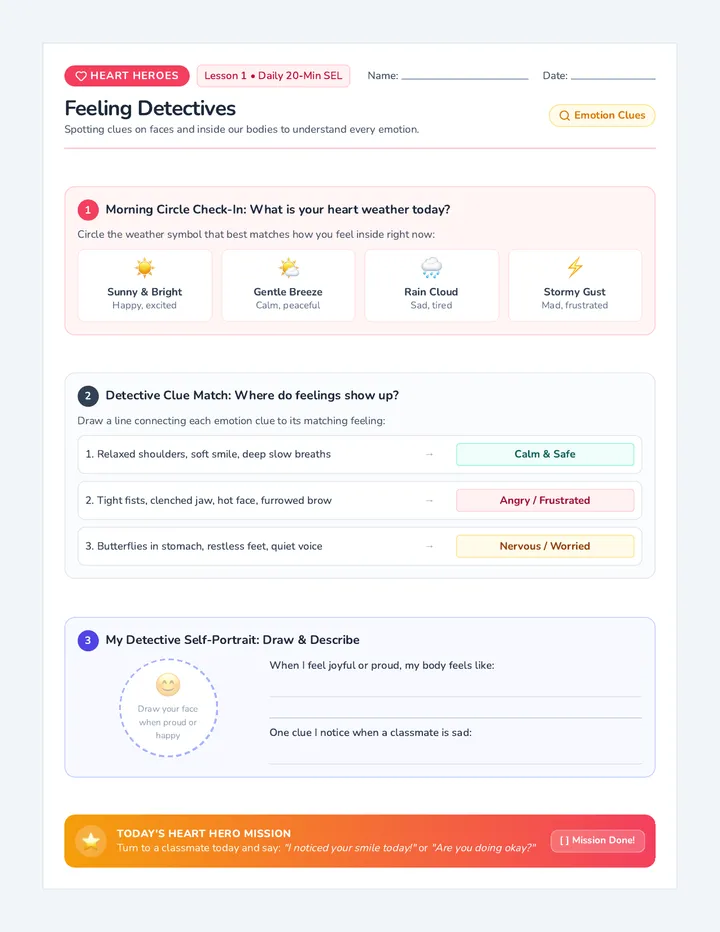
Feeling Faces Detective
Notice how faces show what our friends feel inside!
Name:
Date:
1 How Do They Feel? Circle your feeling today!
5 Min Circle Talk
😊
Happy Big bright smile
😢
Sad Tear or frown
😠
Mad Tight eyebrows
😨
Scared Wide eyes
2 Draw a Feeling Face
10 Min Drawing Practice
Draw eyes, eyebrows, nose, and a mouth to show how your face looks when you feel proud or cheerful.
3 Empathy Choice: If a friend looks sad or lonely...
5 Min Share
Circle what a caring friend can do:
Give a gentle wave
Say: "I am here if you need me"
Ask softly
Say: "Would you like to sit together?"
Teacher Prompt: "Notice someone's eyes and mouth. Our faces are emotion messengers!"
Page 1 of 1
Feeling Faces Slides Lesson 1 • Kind Hearts, Inclusive Minds
😊 😢 😠 😨
Feeling Faces Detective
How do our faces show what we feel inside? Let's look closely and learn together!
20-Minute SEL Routine Goal: Notice feelings in others
Look at the Clues!
Facial Expression Clues
😊
Happy
Bright eyes and a big smile
😢
Sad
Mouth turned down, tears
😠
Mad
Eyebrows pulled low & tight
😨
Scared
Wide eyes and open mouth
Try it now: Turn to your rug partner and make your biggest Happy face!
Empathy Challenge!
Heart Check
🥺 💬
You see a friend sitting on the rug looking sad and quiet.
What caring words can you say to help them?
Option A
"Are you okay? Do you want to sit with me?"
Option B
"I can give you space or share my crayons."
Turn & Talk: Share your caring words with your rug partner!
Feeling Faces Teacher Guide Teacher Lesson Plan • 20 Min Kind Hearts, Inclusive Minds
K–1 SEL Framework
Lesson 1: Feeling Faces Teacher Guide
Core Skill: Recognizing primary feelings in self and others
Target: CASEL Self-Awareness & Social Awareness
Learning Objective: Identify 4 core emotions (happy, sad, mad, scared) using facial cues.
Required Materials: Slide Deck 1, Activity Mats, crayons/pencils, small hand mirrors (optional).
Key Vocabulary: Empathy, expression, facial clues, comfortable / uncomfortable feelings.
Step-by-Step 20-Minute Instructional Flow
1 Hook & Warm-Up (Minutes 0–5): The Emotion Mirror Game 5 Min
Gather students on the rug. Project Slide 1 & 2 . Model making a dramatic happy smile, then a sad frown. Ask: "How did you know what I felt without me saying a word?" Have students turn to a rug partner and mirror each of the 4 emotions as you call them out.
2 Guided Practice & Mat Completion (Minutes 5–15) 10 Min
Transition to table groups. Distribute the Feeling Faces Activity Sheet .
Part 1 Check: Guide children to point to each emoji face and circle their current feeling.Part 2 Drawing: Prompt children to draw their own face or a friend's face inside the oval frame. Emphasize eyebrow shape and mouth curves.
3 Empathy Reflection & Closing Cheer (Minutes 15–20) 5 Min
Project Slide 3 . Discuss Part 3 of the sheet: "When we notice a sad face, what is our superpower?" Practice saying in unison: "I see you, and I care about you!" Give a silent butterfly wave.
Scripted Prompts & Key Questions
Deepening Empathy: "Can two people feel different things about the very same event? Yes! A roller coaster might make you happy and your friend scared."
Observing Subtle Clues: "What do eyebrows do when someone is angry? They point down like little triangles. What happens when someone is surprised?"
Differentiation Strategies
Support: Provide handheld mirrors so students can see their own expressions while drawing.ELL: Use thumbs-up / thumbs-down and nonverbal emotion cards to connect home language terms.Extension: Prompt advanced students to label a second feeling word (e.g., proud, nervous).
Formative Assessment Check
Identifies sad or mad expressions accurately.
Names at least one comforting action for a peer.
Participates respectfully in partner mirroring.
Lesson 1 of 10 Facilitation Guide • Kindergarten & Grade 1 Kind Hearts, Inclusive Minds Curriculum
Body Clues Detective Sheet Lesson 2 • 20 Min SEL Kind Hearts, Inclusive Minds
Body Clues Detectives
Look closely! Our whole bodies tell stories about our feelings.
Name:
Date:
1 Body Detective Clues
5 Min Body Freeze Warm-Up
🙆
Tall & Bouncy
Hands waving, jumps
Excited!
🙇
Curled & Low
Head down, slumped
Sad or Tired
🙅
Stiff & Tight
Crossed arms, fists
Frustrated
2 Draw a Body in Motion
10 Min Drawing Practice
Draw someone feeling calm and peaceful (sitting tall, relaxed hands, gentle breathing).
3 Kindness Mission: If you see someone with head down...
5 Min Share
What clue should you look for? Circle two caring responses:
Offer a Quiet Break
Give space and quiet time
Warm Helping Hand
Ask: "Can I walk with you?"
Teacher Prompt: "Freeze like someone excited! Now freeze like someone tired. Good detectives notice body clues."
Page 1 of 1
Body Clues Slides Lesson 2 • Kind Hearts, Inclusive Minds
🙆 🙇 🙅
Body Clues Detectives
Our whole bodies tell stories! Let's learn how shoulders, hands, and postures show what is inside.
20-Minute SEL Routine Goal: Read physical body signals
Spot the Body Signals!
Detective Clues
🙆
Tall & Bouncy
Moving fast, waving hands = Excited!
🙇
Curled & Low
Slumped shoulders, head down = Sad
🙅
Stiff & Tight
Crossed arms, tight fists = Mad
Body Freeze Game: Freeze like someone who just won a fun game!
Detective in Action
Caring Response
🚶♂️💭
Your classmate is walking with slumped shoulders and their head down.
How can your body show that you care?
Gentle Presence
Walk slowly beside them with a calm smile.
Kind Helper
Ask softly: "Would you like some quiet company?"
Empathy Rule: When we notice body clues, we know when friends need gentle care!
Body Clues Teacher Guide Teacher Lesson Plan • 20 Min Kind Hearts, Inclusive Minds
K–1 SEL Framework
Lesson 2: Body Clues Teacher Guide
Core Skill: Observing whole-body posture and motion clues to foster empathy
Target: CASEL Social Awareness & Relationship Skills
Learning Objective: Notice body language (slumping, fist-clenching, bouncing) to identify emotional needs.
Required Materials: Slide Deck 2, Detective Activity Mats, open rug space for movement.
Key Vocabulary: Posture, tense, relaxed, body language, personal space, comfort.
Step-by-Step 20-Minute Instructional Flow
1 Hook & Movement (Minutes 0–5): The Body Freeze Game 5 Min
Invite all students to stand safely in their carpet spots. Project Slide 1 & 2 . Direct students: "Freeze like a bouncy balloon filled with joy!" Then: "Freeze like a melting ice cube that feels exhausted or down." Notice how their shoulders drop and spines curve.
2 Guided Practice & Detective Mat (Minutes 5–15) 10 Min
Students transition to tables. Distribute the Body Clues Detective Sheet .
Part 1 Clues: Review the 3 poses together (Tall/Bouncy, Curled/Low, Stiff/Tight).Part 2 Drawing: Encourage students to draw a figure feeling calm (breathing belly, soft hands).
3 Detective Mission Wrap-Up (Minutes 15–20) 5 Min
Project Slide 3 . Guide students to check their Part 3 caring action. Ask: "If someone has their arms folded tight, do we crowd them or give gentle space?" Conclude with a classroom deep breath.
Scripted Prompts & Key Questions
Reading Body Signals: "When someone doesn't want to talk yet, their body might show they need quiet time first. How can we respect that signal?"
Physical Comfort Check: "Look at your own shoulders right now. Are they up by your ears? Let's drop them down like gentle pillows."
Differentiation Strategies
Motor Support: For students who struggle with figure drawing, provide stick figure templates.Sensory Needs: Allow students who feel overwhelmed by loud games to observe and whisper their guesses.Kinesthetic Extension: Assign student pairs to act out a mini freeze charade.
Formative Assessment Check
Distinguishes energetic vs. withdrawn body posture.
Caring Words Sunshine Sheet Lesson 3 • 20 Min SEL Kind Hearts, Inclusive Minds
Caring Words Sunshine
Kind words are warm rays of sunshine that brighten everyone's heart!
Name:
Date:
1 Sunshine Rays: Say These Warm Words Together
5 Min Echo Chant
💛
"Great try!"
When someone works hard
🌟
"I like you!"
To make a friend smile
🤝
"You can join!"
To welcome someone in
🌱
"Thank you!"
When receiving help
2 Draw Yourself Giving a Sunshine Compliment
10 Min Drawing Practice
Draw you and a classmate. Add speech bubbles or smiles showing caring words being shared!
3 My Daily Sunshine Goal
5 Min Goal Setting
Choose one kind phrase you will give away like sunshine today:
"Can I help you?"
"I'm glad you're here!"
"You did a great job!"
Teacher Prompt: "Words have power to lift hearts up. Turn to your partner and share one sunshine word!"
Page 1 of 1
Caring Words Slides Lesson 3 • Kind Hearts, Inclusive Minds
☀️ 💛 🗣️
Caring Words Sunshine
Kind words are like warm sunshine rays that lift others up and make our room feel happy!
20-Minute SEL Routine Goal: Practice warm, supportive phrases
Sunshine Words We Can Give
Echo Chant
🌟
"Great try!"
When a friend works hard on a task
🤝
"You can join!"
When someone needs a playmate
👂
"I'm listening"
When a classmate shares ideas
💛
"I like you!"
To spread pure classroom joy
Classroom Echo: Say each sunshine phrase together with warm, friendly voices!
Give Away Some Sunshine!
Partner Practice
☀️ 🗣️ 🎁
Turn to your neighbor and give them one sunshine compliment!
Sentence Starter:
"I like playing with you because..."
Notice: How does your heart feel when someone speaks kindly to you?
Caring Words Teacher Guide Teacher Lesson Plan • 20 Min Kind Hearts, Inclusive Minds
K–1 SEL Framework
Lesson 3: Caring Words Teacher Guide
Core Skill: Spoken kindness, active listening, and heart-lifting compliments
Target: CASEL Relationship Skills & Social Awareness
Learning Objective: Practice verbal praise, supportive phrases, and active listening in pairs.
Required Materials: Slide Deck 3, Caring Words Activity Mats, yellow/warm colored pencils.
Key Vocabulary: Compliment, encourage, sunshine words, warm tone, listen with eyes & ears.
Step-by-Step 20-Minute Instructional Flow
1 Hook & Chanting (Minutes 0–5): The Sunshine Words Echo 5 Min
Project Slide 1 & 2 . Explain: "Have you ever stepped outside into a warm sunbeam? That's how kind words feel to our hearts!" Lead an echo chant: You say a sunshine phrase ("Great try!" "You can join!" ) and students echo back with warm, friendly voices.
2 Guided Practice & Activity Sheet (Minutes 5–15) 10 Min
Distribute the Caring Words Sunshine Sheet .
Part 1 Echo: Point to each sunbeam and read the phrases together.Part 2 Drawing: Prompt children to draw themselves speaking a kind word to someone at their table. Model drawing speech bubbles with hearts or smiling words.
3 Partner Compliment Circle (Minutes 15–20) 5 Min
Project Slide 3 . Have students turn knee-to-knee with a partner and give one genuine compliment using the sentence frame: "I like playing with you because..." . Students circle their goal in Part 3.
Scripted Prompts & Key Questions
Compliment Modeling: "A real compliment notices something true: 'I noticed you shared your crayons,' or 'You always have a friendly smile.'"
Receiving Kind Words: "When someone gives you sunshine words, what is the best thing to say back? Just two words: 'Thank you!'"
Differentiation Strategies
Shy Students: Allow nonverbal compliments like a friendly thumbs-up or handing a drawn flower.ELL Support: Teach 'Thank you' and 'Good job' in multiple classroom home languages.Extension: Have students write their favorite kind word inside their drawing bubble.
Formative Assessment Check
Uses an encouraging phrase during paired practice.
Helping Hands Mission Sheet Lesson 4 • 20 Min SEL Kind Hearts, Inclusive Minds
Helping Hands Mission
Little hands make big differences when we choose to help each other!
Name:
Date:
1 Helpful Choices: Circle the actions that help our class
5 Min Discovery
🖍️
Pick Up Crayons
When dropped on the floor
🚪
Hold the Door
For friends carrying books
🧩
Clean Up Games
Putting puzzle pieces away
2 My Helping Handprint
10 Min Creative Drawing
Trace your hand or draw inside this frame to show yourself doing one helpful classroom job.
3 Today's Helping Mission Pledge
5 Min Commitment
Check the mission you will carry out today:
I will push in pushed-out chairs.
I will help someone put away their coat.
Teacher Prompt: "When everyone helps a little, no one has to do everything alone!"
Page 1 of 1
Helping Hands Slides Lesson 4 • Kind Hearts, Inclusive Minds
🤲 🧹 🚪
Helping Hands Mission
Little hands make a huge difference! How can we make our classroom friendlier and easier for everyone?
20-Minute SEL Routine Goal: Spot everyday ways to lend a hand
Everyday Helping Heroes
Helpful Choices
🖍️
Floor Rescue
Picking up dropped markers and papers
🚪
Door Holder
Holding the door when friends carry bins
🪑
Chair Helper
Gently pushing in untucked chairs
Thumbs Up Check: Show a thumbs up if you helped clean up today!
Today's Helping Mission
Secret Mission
🕵️♂️ 🤝 ✨
Before lunchtime, do ONE helpful deed without being asked!
Deed 1
Help someone put away blocks or toys.
Deed 2
Offer to carry a book basket for a teacher.
Kindness Rule: When we work as a team, our classroom shines!
Helping Hands Teacher Guide Teacher Lesson Plan • 20 Min Kind Hearts, Inclusive Minds
K–1 SEL Framework
Lesson 4: Helping Hands Teacher Guide
Core Skill: Actionable classroom assistance, teamwork, and proactive helping
Target: CASEL Responsible Decision-Making
Learning Objective: Identify and commit to everyday helpful choices without waiting to be asked.
Required Materials: Slide Deck 4, Helping Hands Activity Mats, crayons/pencils.
Key Vocabulary: Helpful, teamwork, proactive, community, classroom responsibility.
Step-by-Step 20-Minute Instructional Flow
1 Hook & Story (Minutes 0–5): The "Dropped Crayon" Mystery 5 Min
Project Slide 1 & 2 . "Accidentally" drop a small box of crayons on the rug. Ask: "What happens if everyone ignores it? What happens if three friends gently pick them up?" Discuss how small actions transform the entire classroom atmosphere.
2 Guided Practice & Handprint Mission (Minutes 5–15) 10 Min
Distribute the Helping Hands Mission Sheet .
Part 1 Choices: Review the three helpful scenarios (picking up crayons, holding doors, cleaning games).Part 2 Handprint: Have students trace their hand or draw inside the handprint frame showing their helpful superpower.
3 Secret Helping Mission Launch (Minutes 15–20) 5 Min
Project Slide 3 . Guide students to check their Part 3 pledge box. Whisper: "Today, you are secret helping agents. Try to complete your deed before lunch without bragging!"
Scripted Prompts & Key Questions
Promoting Initiative: "Do we need a teacher to tell us to pick up a paper off the floor? No! Kind leaders see something that needs doing and do it!"
Celebrating Everyday Helpers: "When you hold the door for someone whose hands are full, you are showing empathy with your actions."
Differentiation Strategies
Visual Support: Post visual icons of classroom jobs near the door for easy reference.Peer Buddies: Pair a hesitant helper with an eager partner for table clean-up.Extension: Invite students to share a helpful action they did at home.
Formative Assessment Check
Identifies positive helping behaviors on activity sheet.
Completes drawing of a helpful classroom act.
Exhibits willingness to assist peers during transitions.
Mending Hearts Repair Sheet Lesson 5 • 20 Min SEL Kind Hearts, Inclusive Minds
Mending Hearts Repair Kit
Mistakes happen! We have the power to fix hurt feelings with care.
Name:
Date:
1 The 3 Steps to Mend a Hurt Feeling
5 Min Role-Play
Step 1
"I am sorry"
Say what happened with kind eyes
Step 2
"How can I fix it?"
Ask how you can help them feel better
Step 3
"Make it right"
Rebuild the block tower or give a hug
2 Draw Two Friends Reconnecting
10 Min Restorative Drawing
Draw two friends smiling and holding hands or sharing toys after solving a problem.
3 Magic Repair Phrases: Circle the one you like best
5 Min Reflection
"I did not mean to bump you."
Honest ownership
"Let's rebuild it together!"
Active repair choice
Teacher Prompt: "Saying sorry takes real bravery. When we fix things, friendship grows even stronger!"
Page 1 of 1
Mending Hearts Slides Lesson 5 • Kind Hearts, Inclusive Minds
❤️🩹 🤝 💬
Mending Hearts Repair Kit
Mistakes happen to everyone! When feelings get hurt, we have the superpower to mend them with love.
20-Minute SEL Routine Goal: Apologize and repair relationships
How to Mend a Hurt Feeling
The 3-Step Formula
1
"I am sorry"
Look gently into their eyes and say what happened.
2
"How can I fix it?"
Ask how you can help make their heart feel better.
3
"Make it right"
Rebuild the tower, share a toy, or offer a gentle high-five.
Remember: Saying sorry takes real courage and makes friendships stronger!
Practice Mending
Rug Role-Play
🧱 💥 😢
Accident! You were running to the rug and knocked over your friend's block tower.
"I'm sorry I bumped your tower! Can I help you rebuild it right now?"
Turn to your neighbor: Practice saying the 3-step apology together!
Mending Hearts Teacher Guide Teacher Lesson Plan • 20 Min Kind Hearts, Inclusive Minds
K–1 SEL Framework
Lesson 5: Mending Hearts Teacher Guide
Core Skill: Sincere apologies, empathy-based repair, and restorative problem solving
Target: CASEL Relationship Skills
Learning Objective: Follow the 3-step apology formula to restore hurt feelings after conflict.
Required Materials: Slide Deck 5, Mending Hearts Activity Mats, red/pink crayons.
Key Vocabulary: Apology, sincere, amends, accident, forgive, repair.
Step-by-Step 20-Minute Instructional Flow
1 Hook & Anchor (Minutes 0–5): The Ripped Paper Demonstration 5 Min
Show a heart drawn on construction paper. Gently tear it in half. Ask: "When we say mean words or knock things over, feelings tear like this. Can we just walk away? No! We need special tape called 'Making Amends' to mend the heart back together!"
2 Guided Practice & Repair Formula (Minutes 5–15) 10 Min
Project Slide 2 . Model the 3 steps: 1. "I am sorry" 2. "How can I fix it?" 3. "Make it right." Distribute the Mending Hearts Repair Sheet .
Part 1 Chant: Point and read the 3 steps in rhythm.Part 2 Drawing: Children draw two friends reconnecting after an accident.
3 Role-Play Repair & Closing (Minutes 15–20) 5 Min
Project Slide 3 . Pair up students. One partner pretends their blocks tumbled down; the other practices the 3 steps with genuine tone. Switch roles.
Scripted Prompts & Key Questions
Distinguishing Tone: "If I roll my eyes and mumble 'Sorry,' does that feel like real tape on your heart? How should our eyes look when we apologize?"
Forgiveness & Patience: "What if the person says 'I still need a minute'? We respect that and give them time to cool down."
Differentiation Strategies
Script Cards: Provide pictorial 1-2-3 step cards for students who struggle with verbal fluency.Emotional Regulation: If a student feels defensive, prompt breathing exercises before apologizing.Extension: Discuss what to do when an accident was nobody's fault.
Formative Assessment Check
Recalls that apologies require asking 'How can I fix it?'
Demonstrates sincere body language and eye contact.
Shows willingness to rebuild or comfort a peer.
Wonderfully Unique Mirror Sheet Lesson 6 • 20 Min SEL Kind Hearts, Inclusive Minds
Wonderfully Unique Me
Our differences make our classroom colourful, exciting, and special!
Name:
Date:
1 My Favorite Things: Share with a partner!
5 Min Pair Share
🍎
Favorite Food
⚽
Favorite Game
🎶
Special Talent
2 My Unique Self-Portrait
10 Min Self-Portrait
Draw yourself inside this frame! Show your hair, your smile, and what you love wearing.
3 We Are Like a Rainbow
5 Min Reflection
Check the classroom truth you learned today:
We do not all have to be the same to be friends.
Learning new things from each other is fun!
Teacher Prompt: "Imagine a box of crayons with only one color. A whole box of different colors makes a masterpiece!"
Page 1 of 1
Wonderfully Unique Slides Lesson 6 • Kind Hearts, Inclusive Minds
🎨 🌈 👧🏽 👦🏻
Wonderfully Unique Me
No two people in the world are exactly the same! Our differences make our classroom vibrant and strong.
20-Minute SEL Routine Goal: Celebrate diversity and individual identity
The Crayon Box Discovery
Diversity Metaphor
🖍️ ❌
Only One Color?
If all crayons were yellow, pictures would be boring!
📦 ✨
A Whole Big Box
Blues, reds, greens, and golds all living together.
🖼️ 🏆
A Masterpiece!
When all colors join together, we make magic!
Our Class Truth: Everyone brings a special color to our classroom picture!
Share Your Spark!
Partner Discovery
🌟 🗣️ 🤝
Turn to your neighbor and discover one thing that is unique about them!
🍲
A favorite food
🎵
A family song
⚽
A fun talent
Respect Rule: We listen with interest and cheer for each other's unique gifts!
Wonderfully Unique Teacher Guide Teacher Lesson Plan • 20 Min Kind Hearts, Inclusive Minds
K–1 SEL Framework
Lesson 6: Wonderfully Unique Teacher Guide
Core Skill: Valuing diversity, celebrating individual identity, and respecting differences
Target: CASEL Self-Awareness & Social Awareness
Learning Objective: Identify personal unique qualities and express appreciation for peer differences.
Required Materials: Slide Deck 6, Wonderfully Unique Mirror Mats, multicultural skin tone crayons.
Key Vocabulary: Unique, diversity, tradition, identity, masterpiece, culture.
Step-by-Step 20-Minute Instructional Flow
1 Hook & Metaphor (Minutes 0–5): The Crayon Box Mystery 5 Min
Project Slide 1 & 2 . Hold up a box with only one yellow crayon. Ask: "Can we color a whole rainbow or a whole world with just this one crayon?" Then open a vibrant 64-pack. Explain that every child in our room is an indispensable color.
2 Guided Practice & Mirror Portrait (Minutes 5–15) 10 Min
Distribute the Wonderfully Unique Mirror Sheet with varied skin-tone crayons.
Part 1 Sharing: Students share favorite food or family games at tables.Part 2 Portrait: Children illustrate their unique facial features and style inside the mirror frame.
3 Rainbow Gallery Walk & Celebration (Minutes 15–20) 5 Min
Project Slide 3 . Conduct a quick 3-minute silent gallery walk around table clusters. Have students whisper one positive thing they noticed in a classmate's portrait.
Scripted Prompts & Key Questions
Honoring Differences: "What if everyone liked the exact same book and the exact same game? Life would be boring! Differences give our classroom sparkle."
Family Pride: "Every family has special songs, holidays, and recipes. When we share them, our classroom family grows richer."
Differentiation Strategies
Multicultural Tools: Ensure ample skin-tone and hair-texture drawing materials are available.Language Supports: Encourage multilingual students to share a greeting in their heritage language.Extension: Pair students to find 1 shared trait and 1 unique difference.
Formative Assessment Check
Articulates pride in personal characteristics.
Demonstrates respectful curiosity about peers' traditions.
Different Needs Toolbox Sheet Lesson 7 • 20 Min SEL Kind Hearts, Inclusive Minds
Different Needs Toolbox
Fairness doesn't mean everyone gets the same. It means everyone gets what helps!
Name:
Date:
1 Different Tools for Different Friends
5 Min Tool Talk
👓
Eyeglasses
Helps eyes see clearly
🎧
Headphones
Helps quiet loud noises
🪑
Wiggle Stool
Helps busy bodies focus
♿
Ramps & Wheels
Helps roll everywhere
2 Draw a Helpful Learning Tool or Cozy Corner
10 Min Drawing
Draw a tool or cozy spot in our room that helps you or a friend feel calm, happy, and ready to learn.
3 Our Tool Respect Promise
5 Min Reflection
Check the kind choice we make about our classmates' special tools:
We treat each other's tools with gentle care.
We celebrate that everyone gets what they need.
Teacher Prompt: "If someone hurts their foot, do we give everyone crutches? No! We give help where it is needed."
Page 1 of 1
Different Needs Slides Lesson 7 • Kind Hearts, Inclusive Minds
👓 🎧 🪑 ♿
Different Needs Toolbox
Fairness does not mean everyone gets the exact same thing. Fairness means everyone gets what helps them thrive!
20-Minute SEL Routine Goal: Understand accommodations and fairness
What is Real Fairness?
The Shoe Story
👟 ❌
Same Shoe for All?
What if the teacher gave EVERY child a size 1 shoe? Ouch!
📏 ✨
The Right Fit
Each friend gets the exact shoe size that fits their feet!
🏃 💨
Ready to Run!
When we get what we need, everyone can learn and play!
Class Anchor: Fairness = Everyone getting what they need to succeed!
Special Tools Help Our Friends
Tool Respect
👓
Glasses
Help friends see stories clearly
🎧
Headphones
Help sensitive ears focus peacefully
🪑
Wiggle Seat
Helps active bodies think and listen
♿
Wheelchairs
Help friends roll anywhere they want
Classroom Rule: We treat everyone's special learning tools with gentle care!
Different Needs Teacher Guide Teacher Lesson Plan • 20 Min Kind Hearts, Inclusive Minds
K–1 SEL Framework
Lesson 7: Different Needs Teacher Guide
Core Skill: Defining fairness as equity, respecting learning accommodations and tools
Target: CASEL Social Awareness
Learning Objective: Articulate that fairness means everyone gets what helps them learn best.
Required Materials: Slide Deck 7, Toolbox Activity Mats, examples of classroom tools (headphones, grips).
Key Vocabulary: Fairness, equity, tools, accommodation, respect, accessible.
Step-by-Step 20-Minute Instructional Flow
1 Hook & Story (Minutes 0–5): The "Shoe Size" Fairness Story 5 Min
Project Slide 1 & 2 . Tell students: "Imagine I gave everyone in class size 1 baby shoes! Would that be fair?" Lead them to realize: True fairness isn't giving everyone the same thing—it's giving everyone the size that fits them!
2 Guided Practice & Toolbox Sheet (Minutes 5–15) 10 Min
Project Slide 3 to showcase sensory tools, eyeglasses, and ramps. Distribute the Different Needs Toolbox Sheet .
Part 1 Exploration: Point and discuss the purpose of each special tool.Part 2 Drawing: Children draw a tool or calm spot that helps their own brain focus.
3 Tool Respect Pledge (Minutes 15–20) 5 Min
Have students check Part 3 on their sheet. Practice saying: "Your tools help you, my tools help me, and we respect each other's needs!"
Scripted Prompts & Key Questions
Addressing "It's Not Fair!": "If a friend uses noise-canceling headphones, they aren't getting a toy—they are getting what their ears need to feel safe."
Treating Tools with Care: "We never grab someone's glasses or wiggle stool. We treat every classmate's tool like valuable treasure."
Differentiation Strategies
Concrete Samples: Allow students to touch a real pair of headphones or pencil grip.Sensitivity: Protect privacy—do not single out individual students when discussing IEP tools.Extension: Brainstorm how school ramps help strollers, wheelchairs, and delivery carts.
Formative Assessment Check
Explains fairness as getting what helps you learn.
Shows respect for peers' special equipment/tools.
Identifies at least one focus aid they use themselves.
Welcoming Circle Invitation Sheet Lesson 8 • 20 Min SEL Kind Hearts, Inclusive Minds
Welcoming Circle Invitation
There is always room for one more friend at our rug and in our games!
Name:
Date:
1 The Welcome Words: Echo with strong kind voices
5 Min Echo Practice
📢
"Come play with us!"
At recess or center time
🪑
"I saved you a spot!"
At lunch or carpet rug
👋
"We have space for you!"
When someone is watching alone
2 Draw Our Circle Opening Up
10 Min Inclusion Drawing
Draw friends opening up their circle to let another classmate join their game or story.
3 If I Notice Someone Standing Alone...
5 Min Action Pledge
Circle what an inclusive friend does:
Walk over with a warm smile
"Would you like to build blocks with me?"
Make room on the playground
"You can be on our tag team!"
Teacher Prompt: "Circles have no corners to hide in! When we open our circle, nobody feels left out."
Page 1 of 1
Welcoming Circle Slides Lesson 8 • Kind Hearts, Inclusive Minds
⭕ 🤝 👧🏾 👦🏼
Welcoming Circle Invitation
There is always room for one more friend! How can we make sure no one ever feels left out?
20-Minute SEL Routine Goal: Master welcoming phrases & actions
Three Magic Welcome Phrases
Invitation Language
🪑
"I saved you a spot!"
Scoot over on the rug to make an open space.
⚽
"Come play with us!"
Wave a friend into your recess game or tag group.
🎨
"We have room!"
Pull out an extra chair at your drawing table.
Classroom Chant: "Open the circle, widen the space, everyone has a friendly place!"
Playground Inclusion Check
Active Inclusion
👀 🌳 🚶♀️
At recess, you notice someone standing alone near the tree watching others play.
What does a Kindness Champion do?
"Run over with a big smile: 'Would you like to build castles with us?'"
Turn & Tell your neighbor: How does it feel when someone invites you in?
Welcoming Circle Teacher Guide Teacher Lesson Plan • 20 Min Kind Hearts, Inclusive Minds
K–1 SEL Framework
Lesson 8: Welcoming Circle Teacher Guide
Core Skill: Welcoming newcomers, active peer invitation, and preventing exclusion
Target: CASEL Relationship Skills
Learning Objective: Notice peers playing alone and use welcoming language to invite them in.
Required Materials: Slide Deck 8, Welcoming Circle Activity Mats, open carpet area.
Key Vocabulary: Include, welcome, invite, belonging, left out, open circle.
Step-by-Step 20-Minute Instructional Flow
1 Hook & Simulation (Minutes 0–5): The "Closed vs. Open" Circle 5 Min
Project Slide 1 & 2 . Have 4 students sit shoulder-to-shoulder with no room. Ask a 5th student to approach. Ask: "How does it feel to face a closed wall of backs?" Teach the cue: "Widen the circle!" Students slide back 2 feet to create a welcoming spot.
2 Guided Practice & Invitation Mat (Minutes 5–15) 10 Min
Distribute the Welcoming Circle Invitation Sheet .
Part 1 Chanting: Practice the 3 invitation phrases ("I saved you a spot!" "Come play!" ).Part 2 Drawing: Children illustrate an open circle game with room for another classmate.
3 Recess Lookout Commitment (Minutes 15–20) 5 Min
Project Slide 3 . Challenge students: "At recess today, scan the playground. If you see someone standing alone, what will you say?" Conclude with the class anti-exclusion cheer.
Scripted Prompts & Key Questions
Stopping Exclusion Early: "We never say 'You can't play with us.' Instead, we say: 'We can add another player!' Games are more fun with more teammates."
Shy Peer Invitation: "If a friend says 'No thanks,' that's okay too! We say: 'Okay, you can join anytime you are ready.'"
Differentiation Strategies
Recess Buddy System: Assign rotating recess ambassadors to look out for solitary play.Nonverbal Invites: Teach friendly hand waving and patting an empty seat cushion.Extension: Role-play how to invite two groups of friends to combine into one game.
Formative Assessment Check
Uses an invitation phrase to include another student.
Adjusts body position on the rug to make space.
Sharing Spaces Partner Sheet Lesson 9 • 20 Min SEL Kind Hearts, Inclusive Minds
Sharing Spaces & Supplies
Respecting personal bubbles and taking turns makes center time peaceful!
Name:
Date:
1 Space & Sharing Rules
5 Min Space Check
🫧
My Space Bubble
One arm's length for comfort
⏳
Use a Sand Timer
Wait patiently for your turn
🤝
Ask Before Touching
"May I use the blue crayon?"
2 Draw a Collaborative Creation Built Together
10 Min Partner Drawing
Draw a wonderful creation you and a friend can build together (like a tall block tower or a train track).
3 Peaceful Center Time Check
5 Min Reflection
Check the sharing superpower you will use today:
I will ask before borrowing supplies.
I will smile and share toys kindly.
Teacher Prompt: "When we respect each other's bubbles, everyone feels safe, comfortable, and respected."
Page 1 of 1
Sharing Spaces Slides Lesson 9 • Kind Hearts, Inclusive Minds
🫧 ⏳ 🤝 🎨
Sharing Spaces & Supplies
Respecting personal bubbles and taking turns makes center time and table time peaceful for everyone!
20-Minute SEL Routine Goal: Personal space & cooperative sharing
Three Peaceful Space Habits
Classroom Habits
🫧
Personal Bubble
Keep one arm's length so friends feel comfortable.
⏳
The Sand Timer
Wait calmly while the sand falls for your turn.
🗣️
Ask with Care
"May I use the green marker when you finish?"
Bubble Check: Gently stretch out your arms. That is your peaceful body bubble!
Cooperative Teamwork
Building Together
🏰 🚂 🎨
Instead of playing side-by-side, try building ONE big project together!
Block Center
Combine blocks to build one giant friendly castle.
Art Table
Pass markers back and forth with a happy "Thank you!"
Sharing Rule: Sharing toys and space makes the whole room feel like home!
Sharing Spaces Teacher Guide Teacher Lesson Plan • 20 Min Kind Hearts, Inclusive Minds
K–1 SEL Framework
Lesson 9: Sharing Spaces Teacher Guide
Core Skill: Physical boundary awareness, turn-taking routines, and collaborative play
Target: CASEL Self-Management & Relationship Skills
Learning Objective: Demonstrate body bubble awareness and use sand timers to take turns peacefully.
Required Materials: Slide Deck 9, Sharing Spaces Activity Mats, 1–2 visual sand timers.
Key Vocabulary: Personal bubble, boundaries, turn-taking, cooperate, share, sand timer.
Step-by-Step 20-Minute Instructional Flow
1 Hook & Body Practice (Minutes 0–5): The Invisible Space Bubble 5 Min
Project Slide 1 & 2 . Have children pretend they are blowing a gentle soap bubble around themselves. Stretch arms out to define the perimeter. Ask: "What happens if someone bumps roughly into your bubble? It pops! How do we keep bubbles whole and safe?"
2 Guided Practice & Partner Mat (Minutes 5–15) 10 Min
Distribute the Sharing Spaces Partner Sheet .
Part 1 Sharing Rules: Review using sand timers and asking politely to trade supplies.Part 2 Drawing: In pairs, children sketch a collaborative project (e.g., connected train tracks or block towers).
3 Center Time Sharing Agreement (Minutes 15–20) 5 Min
Project Slide 3 . Have children select their Part 3 goal. Practice the phrase: "May I have a turn when the sand runs through?" and the reply: "Yes, I will hand it to you!"
Scripted Prompts & Key Questions
Respecting Space Needs: "Some friends like hugs, and some friends prefer high-fives or gentle waves. We always ask: 'May I hug you?' before touching."
Patience with Timers: "Waiting can feel tricky! Watching the sand trickle down helps our bodies stay calm while waiting for our turn."
Differentiation Strategies
Visual Floor Tape: Place colored tape or sit-spots on the rug to guide physical spacing.Timer Alternatives: Use musical timers or songs for clean-up transitions.Extension: Have student pairs co-build a tangible block structure using alternating turns.
Formative Assessment Check
Maintains safe personal distance without crowding.
Asks politely before borrowing classroom materials.
Kindness Champions Pledge Sheet Lesson 10 • Capstone SEL Kind Hearts, Inclusive Minds
Kindness Champions Pledge
Celebrating empathy, kind actions, respect, and classroom inclusion!
Name:
Date:
1 Our 4 Kindness Superpowers
5 Min Review
❤️
Empathy
Notice feelings
🤲
Kindness
Help & care
🌈
Respect
Love differences
⭕
Inclusion
Welcome everyone
Official Classroom Certificate
"I promise to look out for others, share warm words, and make sure everyone has a friend."
Draw your official Kindness Champion badge or medal inside the circle below!
3 Champion Seal of Kindness
5 Min Ceremony
My Champion Signature or Thumbprint:
Certified Champion!
Teacher Prompt: "Hold up your certificates! Let's give ourselves a silent cheer for building a caring classroom family!"
Page 1 of 1
Kindness Champions Slides Lesson 10 • Capstone Celebration
🏆 👑 🌟 🤝
Kindness Champions Ceremony
You are officially a Kindness Champion! Let's celebrate how our hearts and actions make our school wonderful.
20-Minute SEL Capstone Goal: Celebrate our inclusive classroom community
Our 4 Superpowers
Curriculum Review
❤️
Empathy
We notice how friends feel
🤲
Kindness
We lend helping hands
🌈
Respect
We love our differences
⭕
Inclusion
We welcome everyone
Class Cheer: "Kind hearts, helpful hands, welcoming everyone in our classroom family!"
The Kindness Pledge
Official Promise
🖐️ ❤️ 🌟
Raise your right hand and repeat together:
"I promise to look out for others, share warm words, and make sure everyone has a friend every single day!"
Congratulations! You have completed all 10 lessons of Kind Hearts, Inclusive Minds!
Give yourself and your classmates a huge round of applause!
Kindness Champions Teacher Guide Capstone Lesson Plan • 20 Min Kind Hearts, Inclusive Minds
K–1 SEL Framework
Lesson 10: Kindness Champions Teacher Guide
Core Skill: Synthesizing empathy, kindness, diversity, and inclusion into a lasting pledge
Target: CASEL All 5 Core SEL Competencies
Learning Objective: Articulate the 4 classroom superpowers and recite the Kindness Champion Pledge.
Required Materials: Slide Deck 10, Pledge Certificate Mats, gold/metallic crayons or stamp pad.
Key Vocabulary: Champion, pledge, promise, celebrate, community family, inclusion.
Step-by-Step 20-Minute Instructional Flow
1 Hook & Journey Review (Minutes 0–5): Our 4 Superpowers 5 Min
Project Slide 1 & 2 . Celebrate: "We made it to Lesson 10!" Review the 4 superpowers: 1. Heart (Empathy) 2. Hands (Kind deeds) 3. Eyes (Respecting differences) 4. Circle (Including everyone). Lead a triumphant call-and-response cheer.
2 Certificate & Badge Crafting (Minutes 5–15) 10 Min
Distribute the Kindness Champions Pledge Sheet .
Part 1 Superpower Check: Point to each icon and review student memories.Part 2 Badge: Children design their official Kindness Champion badge or medal inside the circular frame using favorite colors.Part 3 Signature: Guide students to sign their name or press their thumbprint.
3 Ceremonial Pledge & Ovation (Minutes 15–20) 5 Min
Project Slide 3 . Stand tall together. Raise right hands and recite the Classroom Kindness Pledge. Give a resounding classroom standing ovation.
Scripted Prompts & Key Questions
Celebrating Growth: "Think back to the first day of our lessons. Look how much kinder our words are, how quickly we help, and how big our circles have grown!"
The Pledge Forever: "This pledge doesn't end when the lesson is over. Being a Kindness Champion is who we are every single day."
Differentiation Strategies
Sensory Touch: Provide a washable gold or silver stamp pad for thumbprint signatures.Display: Laminate certificates to display on a classroom "Champions of Kindness" wall.Home Connection: Encourage students to share their pledge certificate with family at home.