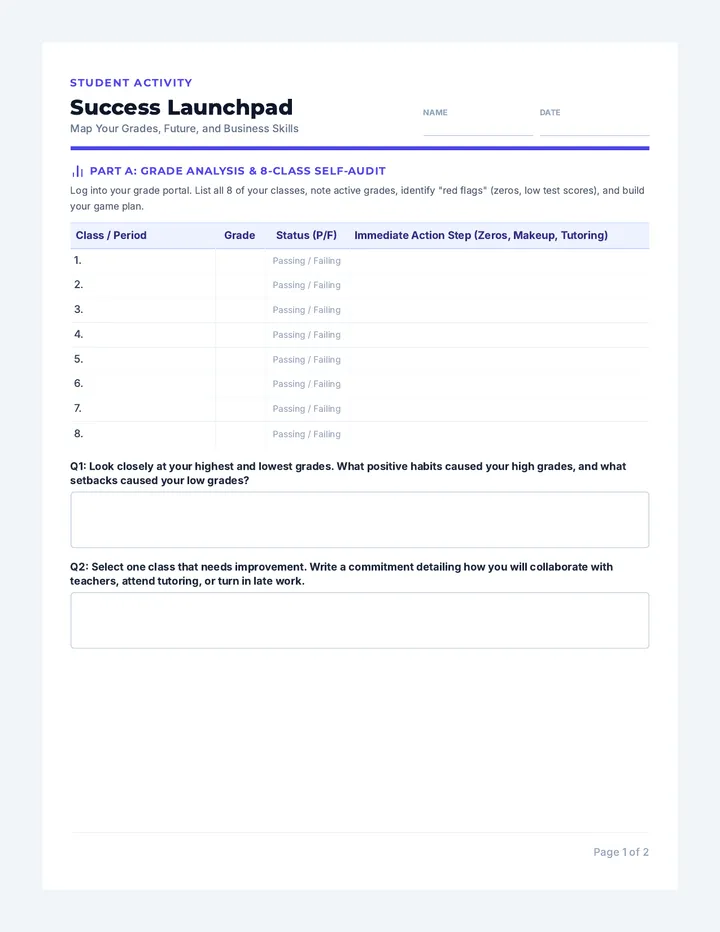
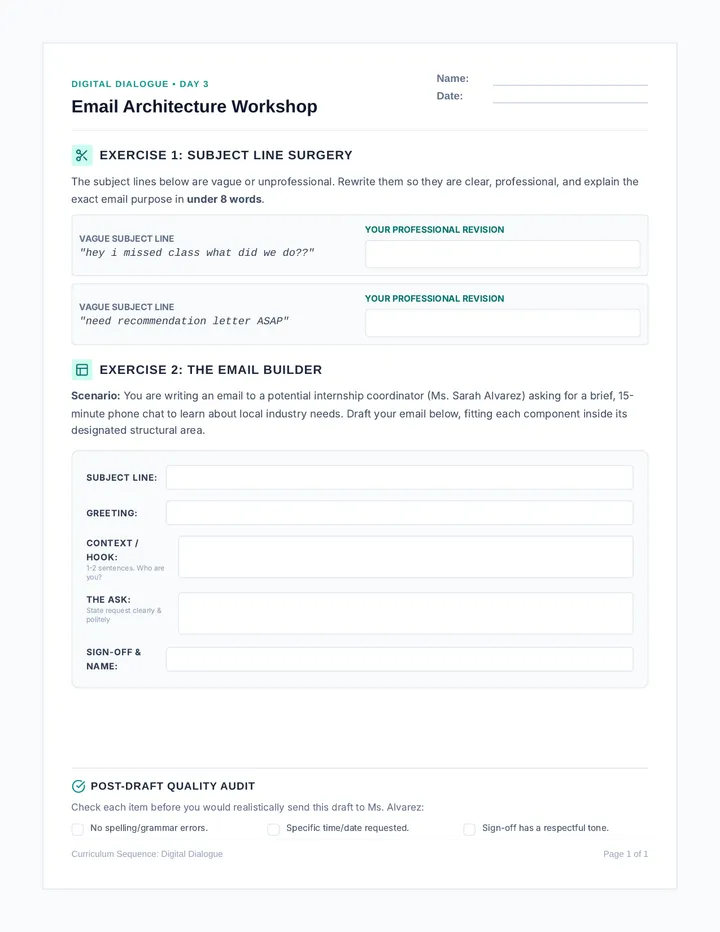
Time Management in a Community • Sequence • Lenny.com
Time Management in a Community
A comprehensive four-year scaffolded social-emotional learning unit that guides high school students from personal preparation to community leadership through effective time management.
Active Activity: Direct students to work independently on their Worksheet blueprints. Circulate and check for practical, realistic goals.
Closing: Collect the exit tickets in the last few minutes. Let them know you will be cheering for their "Ready Modes"!
Check for Understanding:
"What is the easiest step to shift from Rushed to Ready?"
Distraction:
Self-Regulation: Controlling options and actions.
Wellness: Maintaining physical and mental health.
Boundaries: Setting active personal limits.
Time Allocation: Budgeting specific hours to tasks.
Time-Management: Smart overall organization of hours.
Classroom Delivery Script
Warm-Up: "Everyone, today we're exploring our balance. There are exactly 24 hours in a day. No matter who you are, that time is fixed. If sleep takes 8 hours and school takes 7 hours, we have 9 hours left. If most of those hours are spent scrolling social media, how does that affect our mood, sleep, and connections with friends?"
Direct Instruction: "Time allocation is about making choices that align with our values. When we prioritize, we're setting boundaries. Self-regulation isn't about avoiding screen time forever; it's about making sure screens don't take away from our physical well-being. Today, we reflect on our true balance."
Guided Discussion Prompts
Question 1: "How does setting physical boundaries on screen time protect our overall wellness?"
Expected Answers: Keeps us from staying up too late; leaves more time for sports or homework; reduces eye strain and brain fatigue; allows for active face-to-face quality time.
Question 2: "What usually happens to our time and stress levels when we don't actively allocate our free hours?"
Expected Answers: We default to digital distractions; we lose track of time; we end up feeling anxious because our actual goals and homework got pushed to the last minute.
Why This Works
Promotes self-awareness around daily screen time by analyzing and mapping daily hours.
Encourages healthy decision-making by guiding students to identify positive wellness boundaries.
Supports overall academic success and wellness by emphasizing physical and emotional balance.
Balanced Life • Handout Page 2 Page 2 of 2
Time Allocation
Deciding how much time to spend on tasks.
Self-regulation keeps your life in check.
Teacher Notes
Explanation: Walk through definitions. Explicitly connect Boundaries and Self-Regulation to mental wellness and social connection.
Concept: Prioritizing doesn't mean no screen time; it means "work first, scroll second."
Check for Understanding:
"What does setting a healthy screen boundary look like in daily practice?"
Active Reflection 05 / 05
The 24-Hour Balance Wheel
Turn to Page 2 of your Worksheet:
Sketch your typical hours on the Daily Wheel
Rate each activity by how much it energizes you
Write down 1 concrete boundary to protect your sleep
Map Your Daily Hours!
Handout Page 2
Teacher Notes
Active Activity: Circulate as students work on mapping out their daily balances. Emphasize self-reflection and emotional wellness over exact mathematics.
Focus: Help students who struggle to reflect on how their screen habits align with their true energy goals and sleep quality.
Check for Understanding:
"Which areas on your wheel bring you the most joy and relaxation?"
Looking at your daily wheel, do you feel happy with how you spend your time? What area makes you feel most stressed or most relaxed?
Write down 1 personal boundary you can set on your device this week to protect your sleep, relationships, or homework time:
Balanced Life • Handout Page 2 Page 2 of 2
Productivity: Getting things done effectively.
Perseverance: Continuing effort despite setbacks.
Self-Advocacy: Communicating personal needs directly.
Motivation: Internal push to complete goals.
Executive Functioning: Brain skills used for planning.
Readiness Skills: Skills needed to transition forward.
Time-Management: Smart overall scheduling of hours.
Pacing: Spacing out effort to prevent burnout.
Classroom Delivery Script
Hook: "Welcome, Grade 11. You are preparing for major next steps: college, careers, adult choices. Think about compounding habits. If you get 1% better every day, you develop incredible strength over time! Daily positive actions compound exactly like healthy relationships. That is the power of readiness."
Direct Instruction: "Executive functioning isn't about being perfect; it's about setting up support systems. And when those systems feel heavy, we use self-advocacy. If you don't understand an assignment, staying silent gets us nowhere. Communicating your struggle is a true strength."
Guided Discussion Prompts
Question 1: "Why do high schoolers sometimes feel self-advocacy is 'weakness' when it's actually strength?"
Expected Answers: People worry about looking like they don't know the answer; we are taught to struggle in silence; we don't want to bother our teachers.
Question 2: "How do executive functioning skills directly prepare you to support others in your community?"
Expected Answers: When we are organized, we can help our teammates; we keep our commitments, which builds trust; we communicate clearly so projects run smoothly.
Why This Works
Connects present actions to future outcomes by helping students understand how current habits influence long-term success.
Builds goal-setting and planning skills as students identify postsecondary pathways and steps to reach them.
Strengthens motivation and purpose by developing essential readiness skills such as persistence and self-management.
Time Management in a Community • Unit Scaffold Page 2 of 2
Your daily time habits compound over time.
Teacher Notes
Explanation: Explain how small, positive habits lead to incredible personal changes over time.
Contrast: Explain how procrastination or disorganization acts like "negative compounding"—it starts small, but eventually drops productivity to zero.
Check for Understanding:
"What is a 1% improvement you can make today?"
Active Application 05 / 05
The Self-Advocacy Pitch
Turn to Page 2 of your Worksheet to write your email formula:
Subject: Question about [Topic]
"Dear Mr./Ms. [Name], I am working on [Assignment] and struggled with [Concept]. I have tried [Strategy]. Could we meet for 5 minutes during [Time]?"
Be Proactive, Build Support!
Handout Page 2
Teacher Notes
Active Activity: Walk students through drafting their email template. Stress the importance of mentioning what they have already tried—this shows genuine respect for the teacher's time.
Wrap up: Emphasize that self-advocacy prevents late-night panic. Collect the exit tickets.
Check for Understanding:
"Why include what you've tried first?"
Collaboration: Working closely with others to reach a goal.
Initiative: Starting tasks and taking action without being told.
Accountability: Being responsible for your actions and progress on your team.
Partnership: Working as mutually supportive teammates.
Efficiency: Completing tasks in a smart way with minimal wasted time.
Circulate: Spreading tasks or information among a group.
Commitment: Dedication to completing group tasks.
Classroom Delivery Script
Warm-Up: "Welcome, seniors. Today we transition from personal time management to community leadership. As leaders, our choices and routines affect everyone around us. When we run late or miss a deadline in a group, we aren't just hurting ourselves—we are stealing time and energy from our friends and team. Today, we learn how to protect and uplift our team."
Direct Instruction: "Leadership is an act of shared responsibility. Shared responsibility means taking care of the people and tools in our community. We practice accountability when we are open about our progress. If you run into a setback, communicating it early is not a failure; it is active leadership. It allows the team to support you."
Guided Discussion Prompts
Question 1: "Why does being transparent and honest about our task progress represent high-level shared responsibility?"
Expected Answers: It allows team members to plan ahead; it builds trust; it allows the group to reallocate work if someone feels burnt out or gets sick.
Question 2: "What is a supportive, leader-like way to approach a group member who is struggling to finish their part?"
Expected Answers: Asking open-ended questions like 'How can I support you?'; helping them break the task into smaller steps; avoiding blame and emphasizing team success.
Why This Works
Develops real-world leadership skills by giving students opportunities to guide and collaborate with others.
Strengthens teamwork and communication as students work together toward shared community goals.
Promotes civic responsibility and engagement by helping students understand their collective impact.
Time Management in a Community • Unit Scaffold Page 2 of 2
3
Accountability
Being responsible for explaining your actions and progress to your team.
Support your teammates, manage resources together.
Teacher Notes
Direct Instruction (10 Minutes): Walk through definitions. Explicitly connect Shared Responsibility and Collaboration to team wellness and project deadlines.
Concept: Leadership is not about commanding others; it's about sharing responsibility so everyone succeeds.
Check for Understanding:
"What does shared responsibility look like in a group?"
Group Practice
Managing Project Timelines
Goal: Plan a Community Toy Drive
Step A: Collect Toy Donations (Donation Team)
Step B: Inspect & Clean Toys (Cleaning Team)
Step C: Wrap & Deliver Toys (Delivery Team)
Teammate Dependency: Step C cannot start until Step B is complete. How do we support each other to succeed?
Refer to Page 2 of your worksheet to analyze this team challenge!
Teacher Notes • Activity
Guided & Partner Work (20 Minutes)
Show students how steps rely on each other. You cannot deliver toys (Step C) until they are cleaned (Step B).
Teacher Script: "In your groups, reflect on how teammate tasks rely on one another. Discuss how delay in one task affects the whole team's timeline. How do we practice shared responsibility when a teammate falls behind?"
Focus: Shared Responsibility Slide 5 of 6
Final Step
Reflect on Your Leadership
1
What did you learn about scheduling a team project today?
2
How can you practice shared responsibility in your own high school community?
Complete your Exit Ticket before leaving today!
Teacher Notes • Dismissal
Exit Ticket & Wrap Up (10 Minutes)
Distribute the double exit tickets. Collect them as a check for understanding of shared responsibility and task dependency.
Teacher Script: "Excellent work today, seniors. Remember: as leaders, your time management choices build up our whole community!"
Focus: Self-Reflective Assessment Slide 6 of 6
Your classmate Taylor is leading Step B (Cleaning) but gets sick and has to go home, leaving half the toys uncleaned. If B is delayed, what happens to the Delivery Team's schedule? How can you practice shared responsibility to help Taylor and make sure the drive is a success?