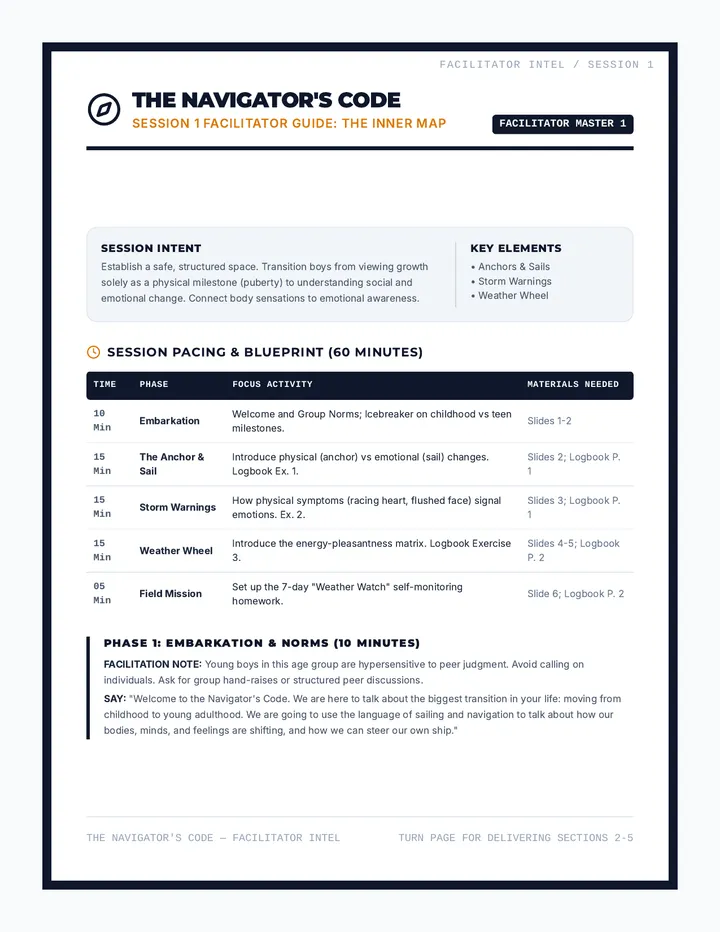
Physiology Teacher Guide Physiology of Emotion
Teacher Facilitation Guide
Lesson 01
Somatic Markers Sequence
ESSENTIAL QUESTION
How can tuning into our physiological sensations provide early warning systems for our emotional states?
LEARNING OBJECTIVES
Identify the roles of the Sympathetic and Parasympathetic nervous systems.
Explain how biological signals (hormones, neurotransmitters) create physical "markers."
Demonstrate the mind-body connection through visualization.
The Hook: The Sour Lemon Simulation
Instructions: Have students close their eyes. Walk them through a vivid visualization of holding a bright, juicy lemon. Describe cutting it open, seeing the juice bead up, and finally, biting into it.
Observe
Mouth watering / Salivation
The Link
Thought → Physical Response
Prompt
"What happened before you ate?"
Direct Instruction Focus
Mobilization (Sympathetic)
Fight or Flight. Heart rate ↑, Pupil dilation, Digestion pauses.
Restoration (Parasympathetic)
Rest and Digest. Heart rate ↓, Muscle relaxation, Focus returns.
Chemical Messengers
Adrenaline (Surge), Cortisol (Stress), Oxytocin (Connection).
PREP CHECKLIST
Print "ANS Blueprint" Worksheets
Review Slide Deck (Slides 1-12)
Set up "The Sour Lemon" visualization script
Worksheet Answer Key
Section 1: System Identification
SYMPATHETIC SCENARIO (FIGHT/FLIGHT)
Example: Hearing a loud bang behind you.
Responses: Quick breathing, tensed shoulders, tunnel vision, increased sweating.
PARASYMPATHETIC SCENARIO (REST/DIGEST)
Example: Taking a warm bath or listening to soft music.
Responses: Slow pulse, belly breathing, relaxed muscles, feeling of warmth.
Section 2: The "Why" (Chemical Drivers)
Chemical Function Physical Sensation Adrenaline Immediate energy surge Racing heart, jittery hands Cortisol Sustained stress response Tightness in chest, digestive issues Dopamine Reward and motivation Feeling of light "buzz" or energy
Reflective Insight Expected:
Students should recognize that their physical body often reacts to thoughts as if they are physical threats (like the lemon). The goal is to identify that an emotion like "fear" isn't just a feeling, it's a series of measurable biological events.
Physiology Slides The Physiology of Emotion
Lesson 01: Mapping Somatic Markers
The Sour Lemon Simulation
Close your eyes. Imagine holding a bright yellow, cold lemon.
Slice it open. See the juice spray.
Now, imagine taking a giant bite.
Discussion
Did your mouth water?
Did your jaw tighten?
Is there a lemon in the room?
The Mind-Body Highway
The Mind
Your thoughts, visualizations, and perceptions of the world.
The Body
Your physical response system (nerves, organs, muscles).
"Your body doesn't know the difference between a thought and a threat."
The ANS: Two Operating Modes
Sympathetic
"The Gas Pedal"
• Fight or Flight
• Mobilizes Energy
• Heart Rate Increases
• Survival Focused
Parasympathetic
"The Brake Pedal"
• Rest and Digest
• Conserves Energy
• Heart Rate Decreases
• Recovery Focused
Chemical Messengers
Adrenaline
The immediate surge of power and speed.
Cortisol
The "alarm bell" that stays on during stress.
Oxytocin
The "cuddle chemical" that signals safety.
What is a Somatic Marker?
A "Somatic Marker" is a physical feeling in your body that marks a specific emotional state.
Sweaty Palms
Racing Heart
Lump in Throat
Heavy Chest
ANS Blueprint Worksheet The ANS Blueprint
Lesson 01: Mapping Somatic Markers
Name:
Date:
1 System Identification
Determine which part of your Autonomic Nervous System (ANS) is likely active in the following scenarios. Write S for Sympathetic (Mobilization) or P for Parasympathetic (Restoration).
You are settling into your favorite chair to read a book after a long day.
You just realized you have a major project due tomorrow that you haven't started.
You are walking alone at night and hear a sudden, loud footstep behind you.
You are practicing slow, deep breathing exercises during a guided meditation.
2 The Physical Print
Our body uses chemicals to create physical sensations. For each chemical below, list two physical sensations you might feel when it's flooding your system.
Adrenaline
Cortisol
3 Lemon Logic
Reflect on the Sour Lemon Simulation. If there was no actual lemon, why did your body respond physically? What does this tell you about the relationship between your thoughts and your physical sensations?
Mapping Markers Slides Mapping Somatic Markers
Lesson 02: Interoceptive Awareness
Guess the Emotion
EMOTION A
Heat in chest, face, and hands.
EMOTION B
Heaviness in chest, cold limbs.
EMOTION C
Full body "sparkle" or warmth.
Interoception
The "Sixth Sense." It is the ability to perceive internal signals from your body.
Heart Rate
Breathing
Hunger
Temperature
Beyond "I Feel Bad"
Buzzing
Vibration/Energy
Hollow
Empty/Cold
Tangled
Tight/Twisted
Heavy
Weighted/Sinking
Expanding
Warm/Large
Piercing
Sharp/Stabbing
Cloudy
Foggy/Fuzzy
Prickly
Stinging/Static
Activity: The Somatic Map
1
Recall a recent memory where you felt a strong emotion.
2
Close your eyes and scan your body from head to toe.
3
Use colors and labels to mark exactly WHERE you felt it.
Personal Body Map Worksheet The Personal Somatic Map
"The body keeps the score before the mind tells the story."
IDENTIFIER:
Lesson 02 Lab Sheet
Somatic Target Area
Use the space above to color-code your sensations.
Red = Heat/Anger | Blue = Cold/Fear | Yellow = Energy/Joy | Gray = Heavy/Grief
The Triggering Event
Describe the situation briefly...
Sensory Inventory
HEAD & FACE (Eyes, Jaw, Throat)
CORE (Chest, Heart, Stomach)
EXTREMITIES (Hands, Feet, Shoulders)
Somatic Vocabulary
Buzzing Tight Hollow Fluttery Heavy Numb Sharp Expanding
The "Somatic Message"
If your body could speak this feeling in words, what would it be saying? (e.g. "I'm not safe," "I'm excited," "I need to hide.")
Decoding Anxiety Slides Decoding Anxiety & Excitement
Lesson 03: Arousal Congruence
The Biological Twins
Did you know that your body's response to Panic and Joy is almost identical?
Common Symptoms
Racing Heart
Sweaty Palms
Short Breath
Butterflies
ANXIETY
EXCITEMENT
Arousal
Biological State
The Power of the Label
Reframing Anxiety
Instead of:
"I am nervous."
Try:
"I am excited."
Why it works:
Anxiety and Excitement are both High Arousal states.
It is much easier to switch between two fast states than to try and force your body to Calm Down.
The Blind Taste Test
"My hands are shaking, my heart is pounding in my ears, and I feel like I'm about to jump out of my skin."
Context A
Waiting for a test result.
Context B
About to go on stage.
The physical data is identical.
Activity: The Reframe Lab
You will receive a list of "Blind Symptoms." Your job is to create two scenarios: one where it's Terrifying and one where it's Thrilling .
Identify
Reframing
Mastery
Symptom Lab Worksheet The Symptom Lab
Lesson 03: Decoding Arousal
SUBJECT:
Part 1: The Blind Symptom Test
Below are three "Somatic Profiles." For each one, provide two different emotional contexts that could produce these exact physical feelings.
Somatic Profile A
• Rapid heart rate
• Tingling in fingers
• Dry mouth
Label: ANXIETY
(When might this be bad?)
Label: EXCITEMENT
(When might this be good?)
Somatic Profile B
• "Butterflies" in stomach
• Shaky hands
• Hyper-focus
Negative Context
Positive Context
Part 2: The Reframing Playbook
Think of a future event that currently makes you feel anxious (e.g., a sports game, a big test, a social event). Practice "Arousal Congruence" by shifting your internal label.
The High Arousal Situation:
The "Nervous" Story
What does my brain say when I call this "Anxiety"? (e.g., "I'm going to fail.")
The "Excited" Story
What does my brain say when I call this "Readiness"? (e.g., "My body is preparing for a challenge.")
Complete the mantra for yourself:
"I'm not nervous, I'm ________________________."
Escalation Curve Slides Tracking the Escalation Curve
Lesson 04: Early Warning Signs
The Point of No Return
Video Clip Analysis
Analyzing the Sports Foul
What to look for:
The first sign of muscle tension.
Changes in facial expression.
The Flashpoint: The exact second the brain "went offline."
The Escalation Curve
1-3: Baseline
Calm, rational, flexible.
4-7: The Yellow Zone
Muscles tighten, focus narrows.
INTERVENTION POINT
8-10: The Red Zone
Emotional Flooding. Brain is offline.
Emotional Flooding
What happens?
The Prefrontal Cortex (the logic center) is effectively bypassed by the Amygdala (the alarm).
Symptoms of Flooding:
Tunnel Vision
Auditory Exclusion (muffled sound)
Loss of fine motor skills
Inability to process words
Catch the "4"
You cannot "logic" your way out of a 9 or 10. You must use your body to regulate at a 4 or 5 before the flood starts.
Watch for Jaw Clenching
Watch for Shallow Breath
Watch for Restless Legs
Escalation Tracker Worksheet Escalation Tracker
Lesson 04: Predictive Awareness
IDENTIFIER:
LEVEL 4 FOCUS
Part 1: The Detective Work
Analyze the video clip provided in class. Identify the moment the subject's body began to "escalate" before they reached a breaking point.
Physical Observations (Levels 1-5)
The "Flashpoint" (Level 8+)
Part 2: Mapping Your Personal Curve
Fill in the stages of your own escalation. What specific somatic markers tell you that you are moving up the scale?
1-3 Green
My Baseline (e.g. relaxed jaw, slow breath):
4-7 Yellow
My "Early Warnings" (Intervention point!):
8-10 Red
Flooding / Breaking Point:
Detective Insight:
"If I can catch myself at a Level 4, I still have control of the car. At a Level 9, the car has already crashed; all I can do is wait for the tow truck."
What is the most reliable Level 4 signal your body sends you?
Regulation Toolkit Slides Somatic Regulation Strategies
Lesson 05: The Regulation Toolkit
The 2-Minute Challenge
Goal: Lower your BPM
Using only your breath and focus, can you drop your heart rate in 120 seconds?
The Protocol:
1 Measure your resting pulse now.
2 Choose a technique (Box Breath).
3 Measure your pulse again after 2 min.
Box Breathing
Used by Navy SEALs to stay calm in high-stress situations. It physically signals the Parasympathetic system to take over.
Inhale 4s
Hold 4s
Exhale 4s
Hold 4s
REPEAT
Technique 2: Cold Water Immersion
Splashing ice-cold water on your face triggers the Mammalian Dive Reflex.
The Science:
Your body thinks you are diving into water. It instantly slows your heart rate and redirects blood to your brain and heart to conserve oxygen.
Your Somatic Menu
PMR
Progressive Muscle Relaxation. Tense and release muscle groups from toe to head.
5-4-3-2-1
Grounding. Identify things you can see, hear, touch, smell, and taste.
Weighting
Pushing against a wall or using a weighted blanket to create proprioceptive input.
Experiment to find what works for YOUR body.
Regulation Lab Worksheet Somatic Intervention Lab
Lesson 05: Applied Regulation
SUBJECT:
Experiment 1: The Pulse Shift
STARTING BPM TECHNIQUE USED ENDING BPM NET CHANGE
Box Breathing...
|
|
|
Experiment 2: Strategy Testing
Test at least two different regulation strategies. Record how your physical body felt before and after each one.
Test A Strategy:
Before (Sensations):
After (Sensations):
Test B Strategy:
Before (Sensations):
After (Sensations):
My Emergency Somatic Menu
Based on your testing, list three techniques you will commit to trying the next time you hit a Level 4 on your escalation curve.
Choice 1:
Choice 2:
Choice 3: