Leader Compass Facilitator Guide Week 1 Facilitator Guide Junior Leader Lab • Grade 3
The Leader Compass
Focus: Integrity • Role Models • Doing What is Right
Group Size: 4-6 Students
Session Length: 35 Mins
Core Learning Objectives
Define a leader as someone who guides others with actions, not just a loud voice.
Understand integrity : doing the right thing even when nobody is watching.
Identify 3 personal values that help guide daily choices in class and at recess.
Materials Needed
• True North Mission Sheets
1 Welcome Circle & The Compass Hook 7 Mins
Pass around a magnetic compass. Ask: "What does this instrument do when lost in the woods?" Connect this to an inner compass: our values tell us which way is right.
Key Question: "Can anyone be a leader, even if they are quiet or not the team captain?"
2 Concept: What is Integrity? 8 Mins
Teach the kid-friendly definition: Integrity is doing what is right, honest, and fair, even when the teacher is looking away. Give quick relatable examples (returning dropped money, telling the truth about spilled paint).
3 Guided Practice: True North Mission Sheet 15 Mins
Hand out the True North Mission Worksheet . Students reflect on 3 mini-scenarios, select their core values for their compass points, and write how they lead by quiet example.
4 Leader Pledge & Debrief Check-out 5 Mins
Each student shares one compass value aloud. Conclude with the group cheer: "Leaders guide with head and heart!"
Facilitator Pro-Tip: Third graders often equate leadership with power or bossiness. Gently re-anchor the conversation to positive influence: listening, being helpful, keeping promises, and including someone sitting alone.
True North Mission Worksheet Mission #1 Junior Leader Lab
Name:
Date:
My True North Compass
A leader's inner compass points toward integrity : doing what is right, honest, and helpful.
Part 1: My Leadership Compass Points
Write one way you show each leadership trait in your everyday school day:
N Honesty (North)
S Responsibility (South)
E Empathy (East)
W Work Together (West)
Part 2: The Integrity Test
Scenario: You accidentally kick a classmate's water bottle in the hallway. It spills across the floor. The hallway is empty and nobody saw you do it.
What would a leader with high integrity do?
Part 3: Bossy vs. Leader
A Bossy Person:
• Orders everyone around
• Only cares about their own ideas
A True Leader:
• Asks for others' thoughts
• Leads by setting a kind example
How can you be a leader at recess today without being bossy?
Week 1 Leader Badge Earned
"I know my inner compass and choose integrity!"
Leader Signature:
Echo Voice Facilitator Guide Week 2 Facilitator Guide Junior Leader Lab • Grade 3
Echo and Voice
Focus: Active Listening • Confident Expression • Respectful Feedback
Group Size: 4-6 Students
Session Length: 35 Mins
Core Learning Objectives
Practice whole-body listening (eyes watching, ears listening, mouth quiet, heart open).
Contrast passive, aggressive, and assertive (confident & kind) voices.
Learn the formula for clear "I-Statements" to express needs respectfully.
Materials Needed
• Super Communicator Sheets
1 Warm-Up: The Echo Game 6 Mins
Partner students up. Partner A describes their favorite weekend activity in 20 seconds. Partner B must "echo back" what they heard before adding a thoughtful follow-up question. Reverse roles.
Key Teaching Point: "Listening isn't just waiting for your turn to talk; it's caring enough to understand."
2 Skill Spotlight: The Three Voices 8 Mins
Demonstrate 3 styles: Mouse (whispering, looking at feet), Lion (yelling, pointing fingers), and Leader Owl (calm, clear eye contact, assertive words). Have students practice the Leader Owl voice.
3 Guided Practice: "I-Statement" Repair Lab 15 Mins
Distribute Super Communicator Mission Worksheet . Model transforming blame statements into constructive "I-Statements": "I feel ____ when you ____ because ____. Can we please ____?"
4 Circle Debrief & Listening Clap 6 Mins
Ask: "How does it feel inside when someone looks you in the eye and really hears your idea?" Conclude with the synchronized leader double-clap.
Facilitator Pro-Tip: If shy students hesitate to speak, allow them to pass the talking token or give them a sentence frame to read aloud first. Leadership confidence builds gradually with small verbal wins.
Super Communicator Mission Worksheet Mission #2 Junior Leader Lab
Name:
Date:
Super Communicator Lab
Great leaders listen with their whole body and speak up with courage, clarity, and kindness.
Part 1: Whole-Body Listening Checklist
How does a leader listen? Check the boxes and write one quick tip for each:
Eyes on Speaker
Heart is Open
Mouth Stays Quiet
Part 2: The "I-Statement" Repair Machine
Turn bossy or angry blaming into strong leader communication using the formula:
"I feel [Emotion] when [Action]. Can we please [Solution]?"
❌ Blaming: "You never share the red marker and you're ruining my poster!"
✨ Leader I-Statement:
❌ Blaming: "Stop talking over me! Nobody is listening to my idea!"
✨ Leader I-Statement:
Part 3: My Voice Superpower
What is one time this week you will use your clear Leader Owl voice to speak up kindly?
Week 2 Leader Badge Earned
"I speak with courage and listen with respect!"
Leader Signature:
Team Power Facilitator Guide Week 3 Facilitator Guide Junior Leader Lab • Grade 3
Stronger Together
Focus: Cooperation • Shared Roles • Collective Responsibility
Group Size: 4-6 Students
Session Length: 35 Mins
Core Learning Objectives
Recognize that true leaders share responsibility instead of doing everything themselves.
Assign and respect diverse team roles (Planner, Cheerleader, Resource Pro, Reporter).
Execute a cooperative building challenge requiring collective input and consensus.
Materials Needed
• Crew Challenge Mission Sheets
1 Warm-Up: The Human Knot or Linked Finger Challenge 6 Mins
Have students stand in a close circle and hold hands across to form a mini knot, then untangle without letting go. Ask: "What happens if one person jerks or ignores everyone else?"
Key Teaching Point: "Leadership in a team isn't about running ahead alone; it's about making sure everyone crosses the finish line together."
2 Concept: Roles in the Leader Crew 7 Mins
Introduce four rotating leadership roles: The Architect (organizes the plan), The Encourager (keeps morale high), The Supply Captain (manages materials), and The Spokesperson (shares group ideas).
3 Team Challenge: The Index Card Tower 16 Mins
Give the group 20 index cards and 12 inches of tape. Goal: build the tallest freestanding tower in 10 minutes. Rule: Every student must place at least 3 cards and verbally encourage their teammate. Then record debrief notes on the mission sheet.
4 Team Shout-Outs & Wrap-Up 6 Mins
Each student gives one specific shout-out to the person to their left praising how they cooperated or helped during the build.
Facilitator Pro-Tip: Watch for "takeover leaders" who snatch materials or do everything themselves. Praise students who say, "What do you think we should try next?" or who hand materials to quieter group members.
Crew Challenge Mission Worksheet Mission #3 Junior Leader Lab
Name:
Date:
The Crew Challenge Log
Leadership is team power. When we share responsibility, our whole crew reaches higher.
Part 1: My Crew Role Today
Circle the role you took today and complete the pledge:
The Architect Helps plan design
The Cheerleader Boosts energy & hope
Supply Pro Shares & organizes
Spokesperson Shares team ideas
How did I help my group succeed in this role?
Part 2: The Tower Build Debrief
1. What did our crew do when cards slipped or ideas differed?
2. What did it feel like to share the work instead of doing it alone?
Part 3: Teammate Shout-Out
Leaders lift others up! Write an authentic shout-out to someone in your group today:
"I want to give a shout-out to because they helped our crew by:"
Week 3 Leader Badge Earned
"We go further together as a united crew!"
Leader Signature:
Heart First Facilitator Guide Week 4 Facilitator Guide Junior Leader Lab • Grade 3
Heart on Sleeve
Focus: Empathy • Perspective-Taking • Welcoming Inclusion
Group Size: 4-6 Students
Session Length: 35 Mins
Core Learning Objectives
Define empathy as seeing through another person's eyes and feeling with their heart.
Identify subtle signs of peer exclusion at lunch, recess, and group work.
Practice concrete phrases that open the circle and welcome isolated peers.
Materials Needed
• Empathy Glasses Worksheets
1 Warm-Up: The "Empathy Glasses" Demo 6 Mins
Hold up fun glasses. Explain: "When you put on Empathy Glasses, you stop only looking at what you want. You look at what others are feeling."
Key Teaching Point: "An inclusive leader notices who isn't being invited and makes space for them."
2 Perspective-Taking Practice 8 Mins
Share a scenario: A new student joins the classroom mid-year and sits quietly holding their lunch bag. Ask: "What thoughts might be running in their head? What butterflies might be in their stomach?"
3 Role-Play: "Widen the Circle" 15 Mins
Have students role-play in pairs using the Empathy Glasses Mission Worksheet . Model magic welcoming phrases: "Hey, do you want to play four-square with us?" and "We have an open spot at our table, come over!"
4 Circle Commitment & Heart Stamp 6 Mins
Students state one concrete action they will take before Friday to ensure a peer feels seen, welcomed, and included.
Facilitator Pro-Tip: Remind students that welcoming others doesn't mean you must become best friends instantly; it means treating every human being with dignity and never allowing someone to feel invisible.
Empathy Glasses Mission Worksheet Mission #4 Junior Leader Lab
Name:
Date:
The Empathy Glasses Mission
An empathetic leader notices feelings, steps into other people's shoes, and widens the circle.
Part 1: Stepping into Their Shoes
Recess Scenario: Lucas drops his basketball. Two kids laugh and shout, "You missed!" Lucas walks to the fence with his head down.
How might Lucas be feeling inside?
What can an empathetic leader say or do?
Part 2: "Widen the Circle" Word Bank
Write 2 welcoming sentences you can use whenever you see a classmate sitting or playing alone:
1. At the lunch table:
2. On the playground / recess line:
Part 3: My Inclusion Goal for the Week
One way I will help someone feel included and cared for this week is:
Week 4 Leader Badge Earned
"I wear empathy glasses and welcome everybody!"
Leader Signature:
Fixer Crew Facilitator Guide Week 5 Facilitator Guide Junior Leader Lab • Grade 3
The Fixer Crew
Focus: Problem-Solving • Flexible Thinking • Win-Win Solutions
Group Size: 4-6 Students
Session Length: 35 Mins
Core Learning Objectives
Differentiate between rigid "Rock Thinking" and bendable "Playdough Thinking".
Apply the 4-step WIN-WIN Problem Solver framework to group conflicts.
Practice negotiation and compromise in low-stakes scenario role-plays.
Materials Needed
• Conflict Solver Sheets
1 Warm-Up: Rock vs. Playdough Brain 6 Mins
Pass around a rock and modeling dough. Explain: "A rock brain says 'It's my way or nothing!' A playdough brain bends, tries new ideas, and finds creative workarounds."
Key Teaching Point: "Great leaders don't just react with temper; they pause and engineer a solution where everyone wins."
2 The 4-Step Win-Win Formula 8 Mins
Walk through the 4 steps: 1. Cool Down & Breathe • 2. Name the Problem without Blame • 3. Brainstorm 3 Options • 4. Pick the Win-Win Fix .
3 Guided Practice: The Problem Clinic 15 Mins
Hand out Conflict Solver Mission Worksheet . Students tackle the common conflict: "Two teammates both want to color the main title on the group science poster." Guide them to generate compromises.
4 Debrief & Flexible Thinking High-Five 6 Mins
Ask: "Why is a compromise usually better than one person crying and one person boasting?" Have students share one flexible solution they discovered today.
Facilitator Pro-Tip: Normalize that disagreeing is healthy and happens in every leadership team. The leadership skill is not eliminating conflict, but solving it with fairness, flexible thinking, and calm words.
Conflict Solver Mission Worksheet Mission #5 Junior Leader Lab
Name:
Date:
The Win-Win Solution Studio
Leaders don't just react or demand their way. They bend their thinking and create solutions where everyone wins.
Part 1: Rock Brain or Playdough Brain?
🪨 Rock Brain (Stuck)
"I won't play unless I'm always first."
How can this person bend like playdough?
🎨 Playdough Brain (Flexible)
"You go first this round, and I'll go first next round!"
Why is this a leader move?
Part 2: Solve the Group Project Clash
The Problem: Maya and Sam are partners on a poster. Maya wants to draw an erupting volcano with markers. Sam wants to build a paper volcano that pops up. Neither wants to give in.
Idea A (Compromise #1):
Idea B (Compromise #2):
✨ The Ultimate Win-Win Agreement:
Part 3: My 5-Second Cool Down
When I feel frustrated with a peer's idea, my first step to stay calm and lead is:
Week 5 Leader Badge Earned
"I stay flexible and create win-win solutions!"
Leader Signature:
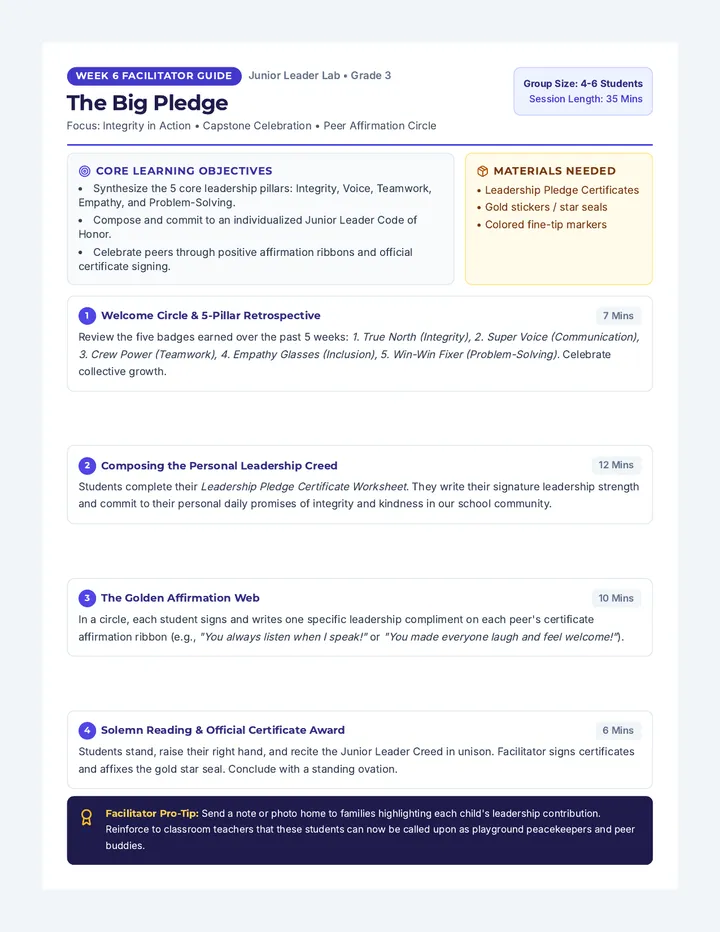
Leadership Capstone Facilitator Guide Week 6 Facilitator Guide Junior Leader Lab • Grade 3
The Big Pledge
Focus: Integrity in Action • Capstone Celebration • Peer Affirmation Circle
Group Size: 4-6 Students
Session Length: 35 Mins
Core Learning Objectives
Synthesize the 5 core leadership pillars: Integrity, Voice, Teamwork, Empathy, and Problem-Solving.
Compose and commit to an individualized Junior Leader Code of Honor.
Celebrate peers through positive affirmation ribbons and official certificate signing.
Materials Needed
• Leadership Pledge Certificates
1 Welcome Circle & 5-Pillar Retrospective 7 Mins
Review the five badges earned over the past 5 weeks: 1. True North (Integrity), 2. Super Voice (Communication), 3. Crew Power (Teamwork), 4. Empathy Glasses (Inclusion), 5. Win-Win Fixer (Problem-Solving). Celebrate collective growth.
2 Composing the Personal Leadership Creed 12 Mins
Students complete their Leadership Pledge Certificate Worksheet . They write their signature leadership strength and commit to their personal daily promises of integrity and kindness in our school community.
3 The Golden Affirmation Web 10 Mins
In a circle, each student signs and writes one specific leadership compliment on each peer's certificate affirmation ribbon (e.g., "You always listen when I speak!" or "You made everyone laugh and feel welcome!" ).
4 Solemn Reading & Official Certificate Award 6 Mins
Students stand, raise their right hand, and recite the Junior Leader Creed in unison. Facilitator signs certificates and affixes the gold star seal. Conclude with a standing ovation.
Facilitator Pro-Tip: Send a note or photo home to families highlighting each child's leadership contribution. Reinforce to classroom teachers that these students can now be called upon as playground peacekeepers and peer buddies.
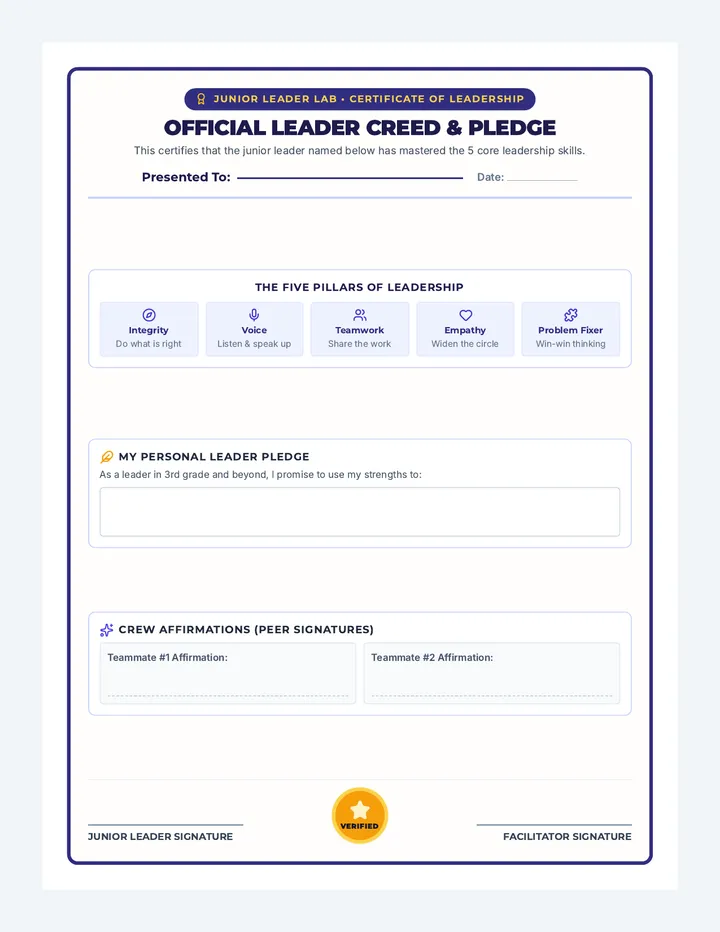
Leadership Pledge Certificate Worksheet Junior Leader Lab • Certificate of Leadership
Official Leader Creed & Pledge
This certifies that the junior leader named below has mastered the 5 core leadership skills.
Presented To: Date:
The Five Pillars of Leadership
Integrity Do what is right
Voice Listen & speak up
Teamwork Share the work
Empathy Widen the circle
Problem Fixer Win-win thinking
My Personal Leader Pledge
As a leader in 3rd grade and beyond, I promise to use my strengths to:
Crew Affirmations (Peer Signatures)
Teammate #1 Affirmation:
Teammate #2 Affirmation:
Junior Leader Signature
Verified
Facilitator Signature