Friendship Circle Slides Life Skills for Adults Lesson 1
Healthy Friends
What does a good friend do? How do healthy friendships feel?
Kindness
Listening
Trust
Friendship Skill 1
Good Friends Listen
They Wait
A friend lets you finish speaking. They do not talk over you.
They Look
A friend pays attention to you when you share something.
They Care
They care about your feelings, good days, and bad days.
"Listening shows that your friend's words matter to you."
Friendship Skill 2
Good Friends Are Kind
Healthy Friends Do:
• Say kind and polite words
• Celebrate when good things happen to you
• Offer help when you need it
Healthy Friends Do Not:
• Call you mean names
• Tease you or make fun of you
• Pressure you to do things you dislike
True friends make you feel safe and welcome.
Friendship Skill 3
Trust and Respect
Trust
You can count on a friend. They tell the truth and keep private things safe.
Respect
A friend accepts who you are. They respect your hobbies, your choices, and your limits.
Respect goes both ways: we give respect, and we get respect.
Self-Check
How Does Your Friendship Feel?
Do I feel happy when I spend time with this person?
Do I feel safe being myself around them?
Does this friend listen when I have something to say?
If you answered YES, that is a healthy friendship!
Friendship Checklist Worksheet Life Skills • Lesson 1
Good Friend Checklist
Healthy Boundaries & Friends
Name:
Date:
1
What Does a Healthy Friend Do?
Read each sentence. Put a check mark [ ✓ ] next to what a good friend does.
Listens when I talk
Calls me mean names
Says "please" and "thank you"
Takes my things without asking
Smiles and greets me
Cheers for me when I do well
2
Read and Decide
Read each story. Circle YES or NO.
Scenario A: Lunch Break
Marcus saves a chair for Sam at lunch and asks, "How was your morning?"
YES NO
Scenario B: Activity Time
Dave laughs and points when Lisa drops her art supplies on the floor.
YES NO
Scenario C: Break Room
Elena tells James, "Good job on finishing your work today!"
YES NO
3
My Friendship Reflection
Complete this sentence: A good friend makes me feel...
One kind thing I can say to a friend today is:
Healthy Friendships: Kindness • Listening • Trust • Respect
Personal Space Slides Life Skills for Adults Lesson 2
Personal Space
We all have an invisible space bubble. Learn how to protect your space and respect others.
My Space Bubble
One-Arm Rule
Ask First
Concept 1
What is Personal Space?
Your Invisible Bubble
Personal space is the area around your body. It helps you feel safe, calm, and comfortable.
The One-Arm Rule
When talking to peers, keep about one arm's length of distance between you and the other person.
Try it: Stretch your arm out straight in front of you. That is a safe distance!
Awareness
Why Does Space Matter?
Standing Too Close:
• Can make people feel trapped or nervous
• Can feel overwhelming and loud
• Pops their invisible bubble
Giving Good Space:
• Helps both people feel relaxed
• Shows respect and good manners
• Keeps conversations comfortable
Giving someone space is an easy way to show kindness.
Action Step
Always Ask Before Touching
High Five?
Ask: "Can we do a high five?" Wait for their smile or nod.
Hug?
Ask: "Can I give you a hug?" It is okay if they say "No thank you."
Wave!
A friendly wave or thumbs up is always a great choice without touching!
Your body belongs to you. Other people's bodies belong to them.
Observation
Notice Body Language Clues
If someone steps backward: They need more space. Take one step back.
If someone crosses their arms: They might feel crowded. Give them room.
If someone smiles and leans in: They are comfortable at this distance.
Remember: When in doubt, take one step back!
Space Bubble Worksheet Life Skills • Lesson 2
My Personal Space Bubble
Healthy Boundaries & Friends
Name:
Date:
1
Personal Space Rules
Read each sentence. Circle TRUE or FALSE.
1. Everyone has an invisible personal space bubble.
TRUE FALSE
2. It is okay to hug someone without asking first.
TRUE FALSE
3. An arm's length is a good distance when talking.
TRUE FALSE
4. A wave or thumbs up is a friendly way to say hello.
TRUE FALSE
2
Ask First Before Touching
Practice these polite questions. Check the box [ ✓ ] after you read each one out loud.
"Can I give you a high five?"
Hand Contact
"May I have a hug, or would you prefer a wave?"
Hug
"Is it okay if I sit next to you?"
Seating
3
What Should You Do?
Situation: You walk up to talk to Maria. She takes one step backward and crosses her arms. What is the best choice?
A. Step closer and touch her arm.
B. Take one step back and give her room.
C. Get mad and yell at her.
Rule of Thumb: One arm's length keeps conversations safe and comfortable!
Circle of Control Slides Life Skills for Adults Lesson 3
Circle of Control
Some things are up to me. Some things are not. Learn what to focus on and what to let go.
My Choices
Others' Choices
Inner Calm
Inside My Control
Things I Can Control
My Words
I choose what I say. I can use polite, kind words.
My Actions
I choose what my body does. I can keep hands to myself.
My Reaction
When something goes wrong, I can take a deep breath.
"I am in charge of my own words and my own body."
Outside My Control
Things I Cannot Control
Other People
What other adults say, think, or feel is up to them.
The Weather
Rain, snow, or heat. We cannot change the weather.
When Someone Says No
If a friend does not want to play a game, that is their choice.
We cannot force other people to change. That is okay!
Peace of Mind
Why It Helps to Let Go
Trying to Control Everything:
• Makes us feel tired and upset
• Can lead to arguments with friends
• Does not change the other person
Letting Go Gives You:
• More energy to enjoy your day
• Calmer feelings in your body
• Happier and healthier friendships
Put your energy into what you can do today.
Toolbox
What Can I Do Right Now?
1
Take 3 Slow Breaths: In through your nose, out through your mouth.
2
Say Calm Words: "I cannot control them. I can control myself."
3
Pick a Positive Activity: Read, walk, draw, or talk with a supportive staff member.
Accepting what we cannot control makes us strong and wise.
Control Sorting Worksheet Life Skills • Lesson 3
What Can I Control?
Healthy Boundaries & Friends
Name:
Date:
1
Sort the Situations
Read each box. Circle I CAN CONTROL or I CANNOT CONTROL.
1. The words I choose to say to others
I CAN CONTROL I CANNOT CONTROL
2. If it rains outside during break time
I CAN CONTROL I CANNOT CONTROL
3. How my friend is feeling today
I CAN CONTROL I CANNOT CONTROL
4. Keeping my hands and feet to myself
I CAN CONTROL I CANNOT CONTROL
5. If a peer says "No" when I ask to share
I CAN CONTROL I CANNOT CONTROL
6. Taking deep breaths when I feel frustrated
I CAN CONTROL I CANNOT CONTROL
2
What Can I Do When Things Don't Go My Way?
Check [ ✓ ] the two calm, healthy choices:
Take 3 slow deep breaths
Scream and stomp feet
Remind myself: "I control me"
Yell at my friend
3
My Daily Focus
Write one positive thing you can control today (Example: my words, my smile, my kindness):
Wisdom: I cannot control other people, but I can always control my own choices!
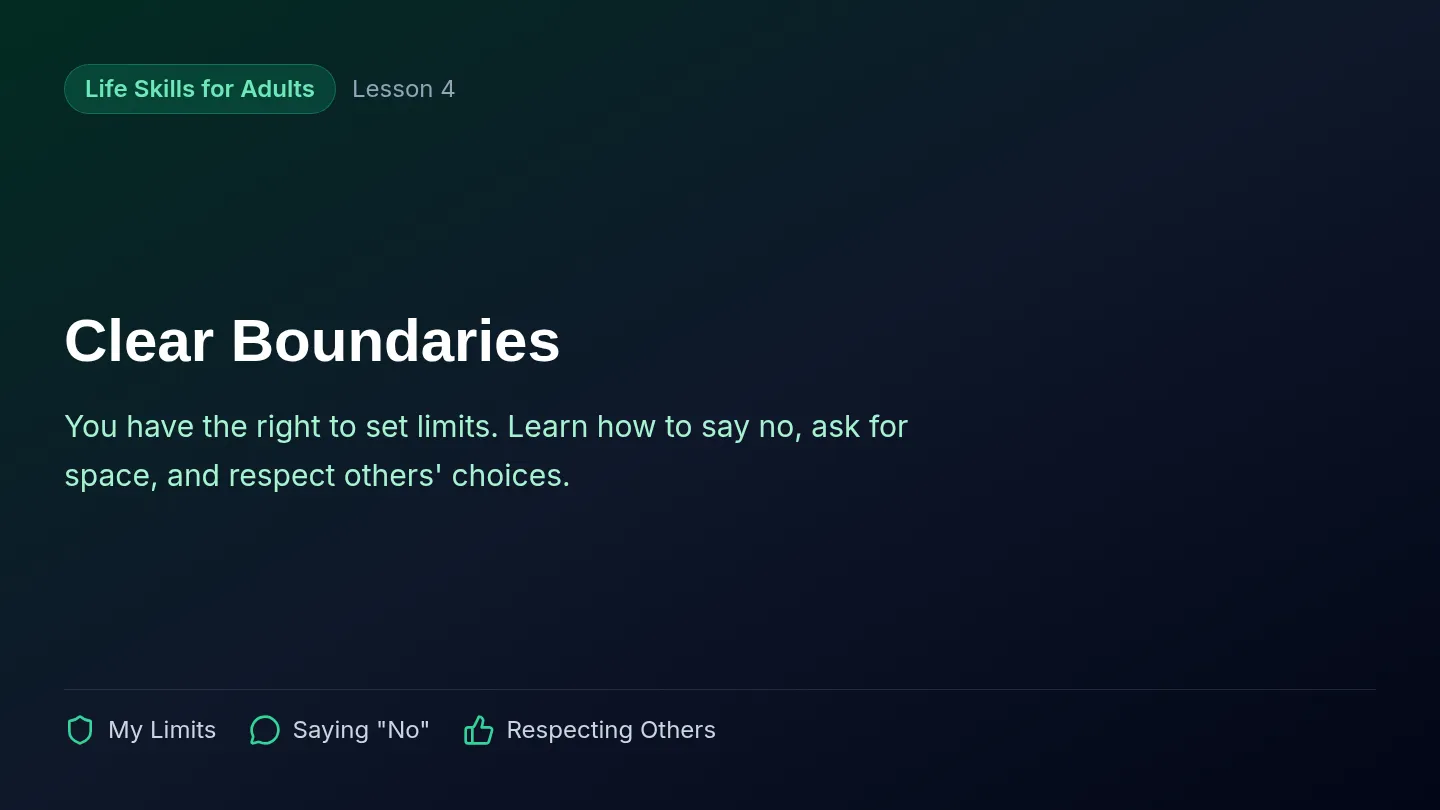
Clear Boundaries Slides Life Skills for Adults Lesson 4
Clear Boundaries
You have the right to set limits. Learn how to say no, ask for space, and respect others' choices.
My Limits
Saying "No"
Respecting Others
Definition
What is a Boundary?
An Invisible Safe Line
A boundary tells people what is okay and what is not okay for your body, time, and feelings.
It is Always Okay to Say No
Setting a boundary does not make you mean. It keeps you safe and shows self-respect!
Healthy friends listen when you set a boundary.
Practice
Words You Can Use
For Physical Touch
"No thank you."
"I do not want a hug today. A wave is good."
For Personal Space
"Please step back."
"I need some space right now, thank you."
For Quiet Time
"I need a break."
"I want some quiet time by myself."
Speak in a calm, clear, and firm voice. You do not need to yell.
Two-Way Respect
When Someone Tells You "No"
Healthy Response:
• Say: "Okay, thank you for telling me."
• Step back and give them room
• Choose another activity calmly
Unhelpful Response:
• Begging or asking over and over
• Getting angry or calling names
• Ignoring their boundary
"No" is not an insult. It just means they need something different right now.
Safety First
What if Someone Ignores Your Boundary?
1
Say It Again Clearly: "Please stop. I need space."
2
Walk Away: Move your body to a safe spot or different table.
3
Tell a Staff Member: "I need help with my boundary. They are not giving me space."
Support staff and teachers are always here to help you stay safe!
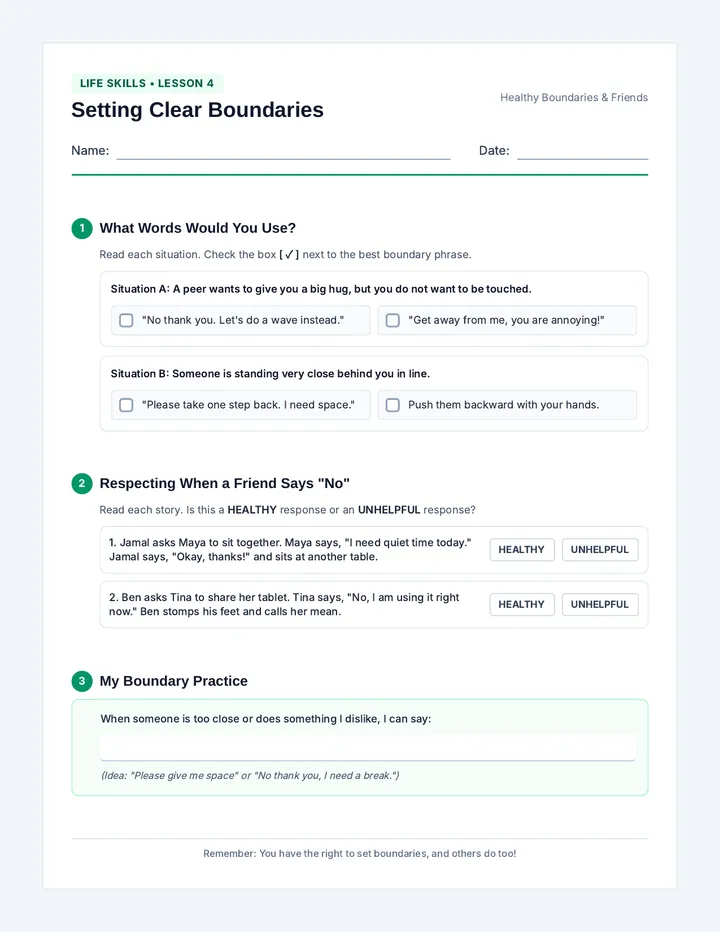
Boundary Scenarios Worksheet Life Skills • Lesson 4
Setting Clear Boundaries
Healthy Boundaries & Friends
Name:
Date:
1
What Words Would You Use?
Read each situation. Check the box [ ✓ ] next to the best boundary phrase.
Situation A: A peer wants to give you a big hug, but you do not want to be touched.
"No thank you. Let's do a wave instead."
"Get away from me, you are annoying!"
Situation B: Someone is standing very close behind you in line.
"Please take one step back. I need space."
Push them backward with your hands.
2
Respecting When a Friend Says "No"
Read each story. Is this a HEALTHY response or an UNHELPFUL response?
1. Jamal asks Maya to sit together. Maya says, "I need quiet time today." Jamal says, "Okay, thanks!" and sits at another table.
HEALTHY UNHELPFUL
2. Ben asks Tina to share her tablet. Tina says, "No, I am using it right now." Ben stomps his feet and calls her mean.
HEALTHY UNHELPFUL
3
My Boundary Practice
When someone is too close or does something I dislike, I can say:
(Idea: "Please give me space" or "No thank you, I need a break.")
Remember: You have the right to set boundaries, and others do too!