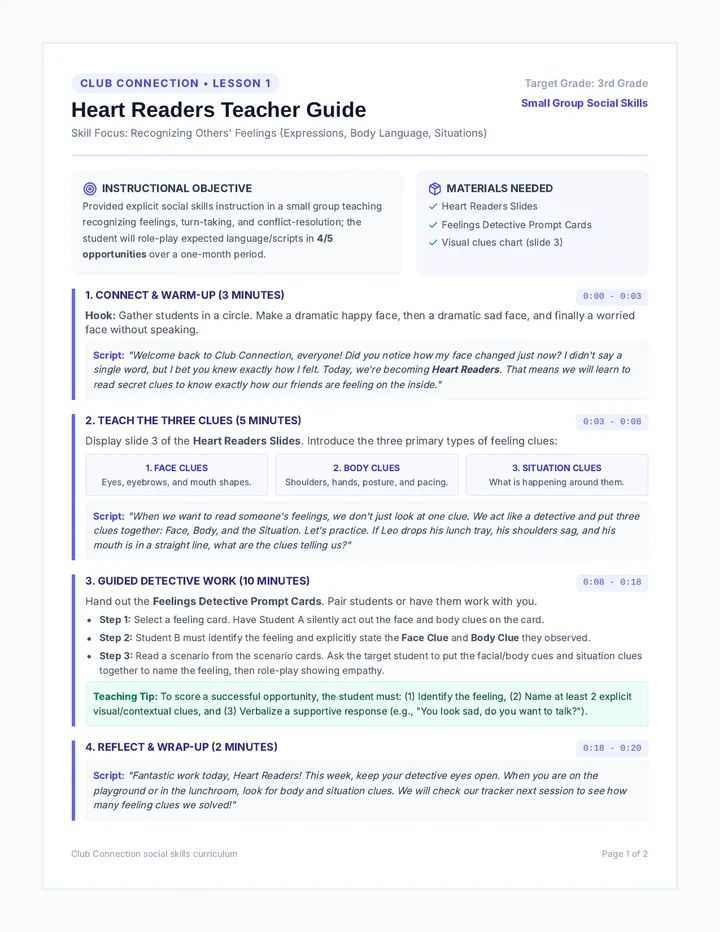
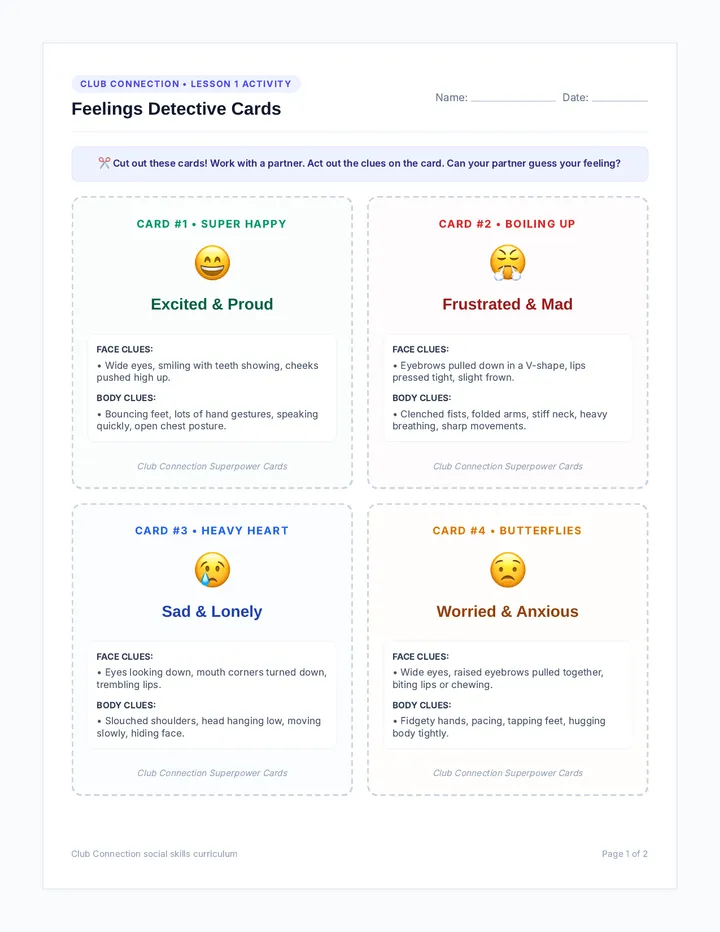
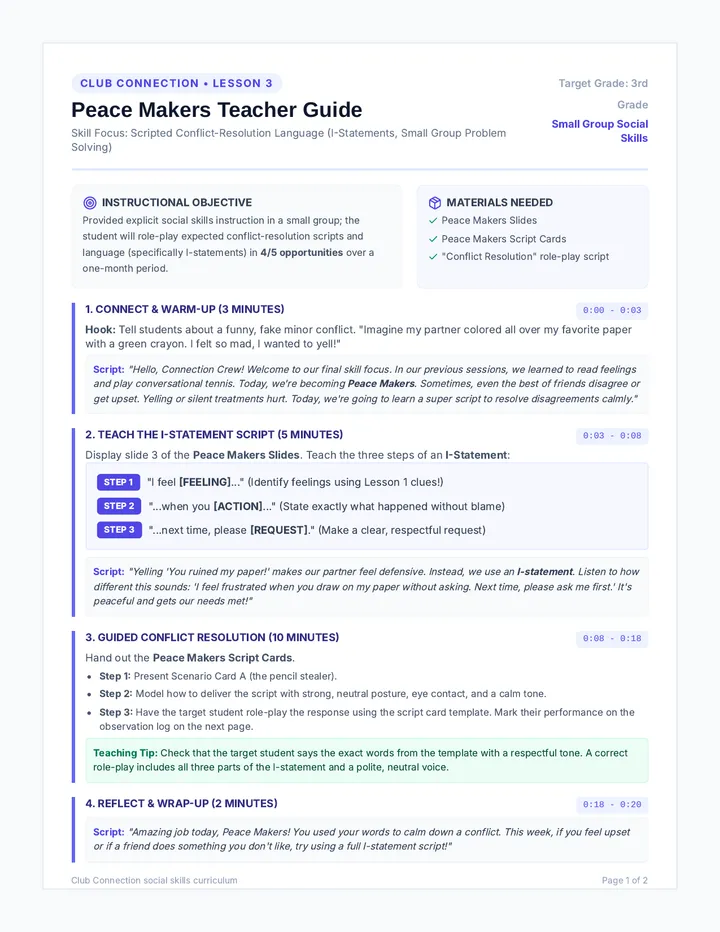
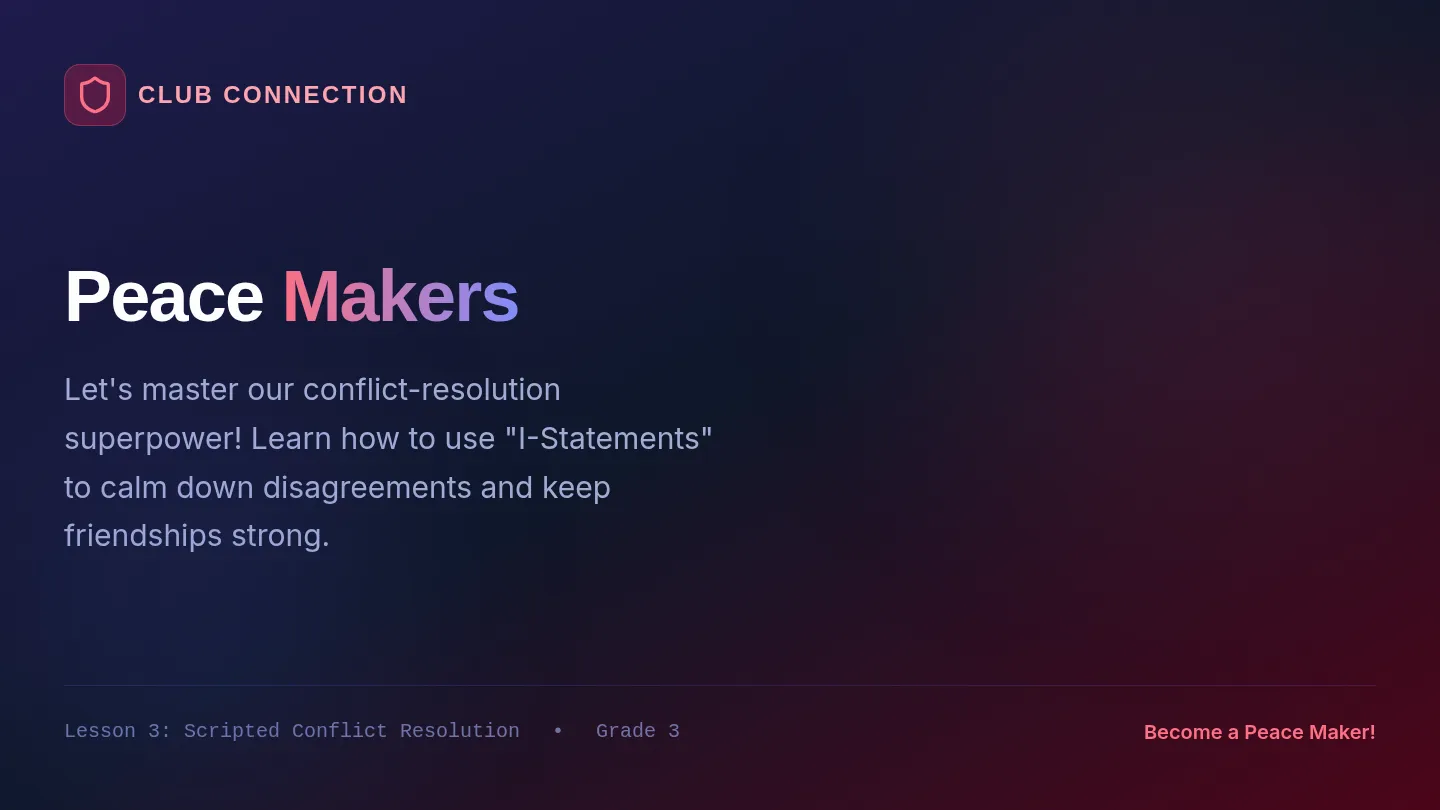
Sweet and Sour Slides The Sweet and Sour Mix
Emotional Explorers Lesson 1
A Taste Test for the Mind
Have you ever...
Tasted a candy that is sour and sweet at the exact same time?
Think of a Lemon Drop or a Sour Patch Kid. Does the sour part ruin the sweet part? Or do they work together to make a whole new flavor?
Can feelings be like that too?
Is it possible to feel two opposite things at the exact same time?
Vocabulary Spot: Bittersweet
Definition:
A feeling that is both happy and sad at the same time.
Why it happens:
Because life has many parts! You might be happy about a new thing, but sad about leaving an old thing.
HAPPY
SAD
BITTER-
SWEET
The Sauce of Emotions
Spicy
Anger or Surprise
Cool
Calm or Peace
Zesty
Excitement or Joy
"Just like a chef, we can have many ingredients in our emotional heart at once!"
Explorer Challenge
Think of a time you were proud but also a little nervous . (Maybe presenting in front of the class?)
Proud
Nervous
Sweet and Sour Mixer Worksheet The Sweet & Sour Mixer
Emotional Explorers: Lab Report #1
Name: _________________________________
Date: __________________________________
Your Mission: Just like a chef mixes different flavors to make a tasty meal, our hearts mix different feelings to process life. Today, we are looking for "Bittersweet" moments—when you feel happy and sad at the exact same time.
1 The Bittersweet Recipe
What is the "Sweet" part of Bittersweet?
Example: Joy, Pride, Excitement, Love
What is the "Bitter" part of Bittersweet?
Example: Sadness, Worry, Loneliness, Fear
2 Situation Tasting
Read the scenario. Write down the two feelings that are mixing together.
Scenario: It is the last day of 3rd grade. You are excited for summer break, but you will really miss your teacher and your friends.
Flavor 1:
Flavor 2:
Scenario: You finally learned how to ride a bike without training wheels! You are so proud, but your knees are a little scraped up and stinging.
Flavor 1:
Flavor 2:
3 My Own "Chef's Special"
Think of a time you felt two opposite things at once. Draw a picture of that moment in the pot below, then list your ingredients.
My Memory Portrait
The Ingredients
Feeling 1:
Feeling 2:
Why was it mixed?
Sweet and Sour Teacher Guide Chef's Notes: Facilitation Guide
Lesson 1: The Sweet and Sour Mix
This lesson introduces the concept of complex emotions using a sensory metaphor. The goal is to help students move beyond "binary" feelings (just happy OR sad) to seeing emotions as a blend.
Objectives
Identify situations where two opposite emotions coexist.
Define the term bittersweet correctly.
Apply a cooking metaphor to internal emotional states.
Pacing (45 Min)
Hook (Lemon Drop Demo)5 min
Interactive Slide Deck15 min
Sweet & Sour Worksheet15 min
Group Share & Reflection10 min
Discussion Prompts: The Flavor of Feelings
The Hook
"If you had a candy that was only sour and never got sweet, would you still like it? What if life was only ever 'sweet'—would we appreciate the good things as much?"
Deeper Dive
"Why do you think our brains can feel two things at once? How does it help us deal with big changes, like moving or graduating?"
Metaphor Check
"If 'sad' is cool blue water and 'happy' is warm yellow sun, what color is 'bittersweet'? How would you describe that color?"
Common Misconceptions
The "Cancellation" Myth
Students often think a happy feeling "cancels out" a sad one, or vice-versa. Emphasize that both exist fully at the same time.
The "Flip-Flop"
Students might think they feel happy for a minute, THEN sad. Clarify that 'bittersweet' is the simultaneous blend, like the flavor of the sauce itself.
Differentiation Strategies
For Extra Support
Use physical colors (paint/markers) to literally mix blue and yellow to see green, reinforcing the "blend" concept.
For Fast Finishers
Challenge them to come up with other flavor metaphors (e.g., "Salty & Sweet" for relief mixed with lingering stress).
ELL Support
Provide a "Flavor Palette" with emojis for each feeling to reduce the language barrier in the identification phase.
The Big Move Slides The Big Move
Case Study: Understanding Ambivalence
The Mystery of the Mixed-Up Mover
"Leo is moving to a new city tomorrow. He is packing his toys. He is smiling because his new room has a loft bed, but he is also crying because he has to leave his best friend, Sam."
Is Leo happy or sad? What do you think?
New Explorer Term
AMBIVALENCE
(am-BIV-uh-lents)
Feeling two opposite ways about the same thing at the exact same time.
Mapping the Conflict
The Sadness
"I'm going to miss my friends, my school, and my favorite park."
The Excitement
"I get a bigger room, a new soccer team, and a pool in the backyard!"
The Emotional Tug-of-War
"I don't want to go."
"I can't wait to go!"
Leo isn't "half-happy" or "half-sad." He is 100% both. That is what makes ambivalence so big and loud!
Your Turn
We are going to read a letter from Leo's friend, Sam. Your job is to find the "Happy Clues" and the "Sad Clues" to map out the ambivalence.
Can you find both sides of the story?
The Big Move Case Study Handout The Explorer's Mailbag
Case Study: Evidence of Ambivalence
Name: _________________________________
Date: __________________________________
Moving Day
Dear Sam,
I am sitting on my last box in my empty living room. It feels so weird to hear my voice echo against the walls! My mom says the moving truck will be here in one hour.
I found that Lego set we built together last week under my bed. I started to cry because I realized we won't be able to build them together for a long time. I'm going to miss our Saturday morning soccer games so much.
But then, my dad showed me a picture of my new school. It has a huge playground with a zipline! And my new room is twice as big as this one. I already have a spot picked out for my posters. I can't wait to see what my new neighborhood looks like.
My stomach feels like it's doing backflips. I want to stay here forever, but I also want to get in the car and start driving right now. See you soon?
Your friend,
Leo
Sad Clues (The Bitter)
What is Leo losing or missing?
Excited Clues (The Sweet)
What is Leo gaining or looking forward to?
The Explorer's Verdict
Is Leo feeling ambivalence ? Why or why not? Explain using the clues you found above.
The Big Move Teacher Guide Case Study Guide: The Big Move
Lesson 2: Analyzing Ambivalence
This lesson uses a relatable scenario (moving houses) to apply the concept of ambivalence . Students will practice "emotional detective work" by finding evidence of conflicting feelings within a text.
Instructional Flow
The Reveal:
Use Slide 2 to introduce Leo. Ask: "Is it possible for someone to be smiling and crying at the same time? What does that look like?"
Term Introduction:
Define Ambivalence . Explain that 'ambi' means 'both' (like ambidextrous). It's having 'both values' or feelings at once.
Collaborative Read:
Read Leo's letter aloud. Have students circle "Happy Clues" in yellow and "Sad Clues" in blue on their handout.
Key Evidence (Answer Key)
Sad Clues:
Echoing walls (loneliness)
Realizing he won't see Sam
Saturday soccer games ending
"I want to stay here forever"
Excited Clues:
New school playground (zipline)
Room is twice as big
New neighborhood
"I want to start driving right now"
The Deep Dive: Discussion Questions
Refining the Label:
"If Leo only felt sad, would he still be moving? If he only felt excited, would he be a good friend? How does feeling BOTH help him say goodbye AND hello?"
Personal Connection:
"Have you ever felt ambivalent about starting a new grade? What were you leaving behind (bitter) and what were you gaining (sweet)?"
Facilitator Tip: Validating Complexity
Students often feel pressure to "pick a side" (e.g., "Well, he should just be happy because he gets a zipline!"). Remind them that ambivalence is uncomfortable but normal . Validating that we can be 100% sad and 100% excited at once reduces the shame kids feel when they have "conflicting" thoughts.
Energy Twins Slides The Energy Twins
Nervous vs. Excited: What's the Difference?
The Rollercoaster Test
Imagine you are next in line for the biggest rollercoaster in the world.
How does your body feel?
Heart beating fast?
Butterflies in stomach?
Sweaty palms?
[Imagine: A Giant Rollercoaster Loop]
Two Names, One Energy
NERVOUS
The "Oh No" Twin
VS
EXCITED
The "Oh Boy" Twin
Did you know? Your body feels ALMOST EXACTLY the same when you are nervous and when you are excited!
The Mind is a Label Maker
Your body sends the "Energy" signal. Your brain decides which label to put on it based on what is happening.
"If I think I'm in danger, I call it Nervous. If I think I'm having fun, I call it Excited."
LABEL
Taking a Hard Math Test
LABEL
Opening a Birthday Present
LABEL
Going to a Brand New Place
The "Reframing" Trick
If you feel too nervous, you can try to "reframe" it. Instead of saying "I am scared," tell your brain, "My body is getting ready for a big adventure!"
"I'm not nervous... I'm just very, very excited!"
Energy Twins Comparison Chart The Energy Twins Lab
Comparison Study: Body vs. Brain
Name: _________________________________
Date: __________________________________
1 Evidence of the "Twins"
Check the boxes for how your body feels when you are Nervous and when you are Excited . Do you notice any patterns?
Physical Sensation When I'm Nervous When I'm Excited Fast heart beat
|
| Butterflies in stomach |
|
|
| Tapping feet or fidgeting |
|
|
| Sweaty or cold hands |
|
|
What did you discover? Are the twins identical or different?
2 The Label Maker
Read the situation. If you were feeling "Big Energy," which twin would you invite to the party? Circle one!
1. You are about to walk onto a stage to perform a play for the whole school.
Nervous Excited
2. Your parent tells you that you are going to Disneyland tomorrow morning!
Nervous Excited
3 The Reframing Magic
"Sometimes we feel too nervous and it feels bad. We can try to reframe it by telling ourselves we are just really excited for a big challenge."
Try it! Reframe this thought:
Original Thought: "I'm so scared I'm going to mess up my presentation."
My New "Excited" Thought:
Energy Twins Teacher Guide Reframing Guide: Managing Energy
Lesson 3: The Energy Twins
This lesson focuses on physical literacy —helping students recognize that high arousal states (nervousness) can be cognitively reframed as positive anticipation (excitement).
Key Concept: Arousal
The sympathetic nervous system responds similarly to threats and rewards. In 3rd grade terms: "Your body doesn't have a separate button for 'nervous' and 'excited'. It only has one BIG ENERGY button." The mind provides the context.
The Script:
"Class, when your heart starts racing, it's not a warning that something is wrong. It's your body giving you the POWER you need to do something important!"
Pacing (40 Min)
Rollercoaster Simulation5 min
Energy Twins Slide Deck10 min
Lab Report (Comparison)15 min
Reframing Practice10 min
Classroom Reframing Drills
"I'm so nervous about the spelling bee."
REFRAME TO:
"I'm excited to see how many words I can remember!"
"It's scary to go to a new soccer camp where I don't know anyone."
REFRAME TO:
"I'm excited to meet new teammates and learn new drills!"
Important Nuance
When NOT to reframe:
If a student is in actual danger or experiencing significant trauma, do not ask them to reframe it as "excitement." Reframing is for performance anxiety or new experiences , not for genuine safety concerns. Teach students to listen to their "Gut Warning" vs. their "Challenge Energy."
Quick Practice: "The Anchor Word"
Teach students an "Anchor Word" they can say aloud when they feel the Energy Twins arriving. Instead of "I'm nervous," they say "I am excited!" Research shows that saying "I am excited" leads to better performance than saying "I am calm."
Step 1: Notice the heart rate
Step 2: Say "I am excited!"
Step 3: Go for it!
Emotional Freeze Tag Slides Emotional Freeze Tag
Practicing Emotional Agility
How Fast Can You Shift?
"Life doesn't stay the same flavor for long. Sometimes, a sweet moment turns sour in a split second. Other times, a scary moment turns into a huge relief."
Are you ready to practice your "Emotional Reflexes"?
New Explorer Skill
AGILITY
Being able to move your feelings quickly and accurately to match what is happening.
Flexible explorers don't get stuck in one feeling!
How to Play: Freeze Tag
1
The Scenario
The teacher reads a situation. Start acting it out!
2
FREEZE!
When the teacher says "FREEZE," stop exactly where you are.
3
The Pivot
The teacher adds a "Plot Twist." You must change your feeling label instantly!
Trial Run
The Scenario:
You are walking to get a big bowl of your favorite ice cream.
THE PLOT TWIST:
You trip and the ice cream falls on the hot sidewalk!
Show me the shift!
Emotional Freeze Tag Cards Emotional Freeze Tag
Activity Kit: Scenario & Plot Twist Cards
Print & Cut
Agility Rule: When the teacher says "FREEZE!" , you must stop. When they read the PLOT TWIST , you must change your expression and body language to match the new feeling immediately!
Scenario A
The Start:
You are building the world's tallest card tower. You are concentrated and careful.
The Plot Twist:
Someone opens a door and a gust of wind knocks it all down!
Scenario B
The Start:
You are waiting for the school bus in the pouring rain. You are cold and bored.
The Plot Twist:
You see your best friend's car pull up and their mom offers you a ride!
Scenario C
The Start:
You just found out there is a surprise math quiz right now.
The Plot Twist:
The teacher laughs and says, "Just kidding! It's actually a popcorn party!"
Scenario D
The Start:
You are at a birthday party and it's time for cake. You are very excited.
The Plot Twist:
You realize they forgot to invite your favorite cousin to the party.
Create Your Own Agility Card
The Start:
The Plot Twist:
Emotional Freeze Tag Teacher Guide Game Guide: Emotional Freeze Tag
Lesson 4: Building Emotional Agility
This lesson uses embodied play to practice emotional agility . Students learn that feelings are not permanent states, but dynamic responses that can and should change as situations evolve.
Setting the Stage
Clear a space in the classroom where students can stand and move safely. If your class is very high-energy, they can play "Emotional Freeze Tag" while sitting in their desks, using only their faces and arms to express the feelings.
The Goal:
"We aren't just playing a game; we are training our brains to be flexible . If a bad thing happens, we feel it, but we also practice being ready for the next thing."
Pacing (45 Min)
Introduction & Rules5 min
Guided Practice (Slide 5)5 min
Round 1-4 (Teacher Led)15 min
Student-Created Scenarios10 min
The Agility Debrief10 min
Pro-Explorer Tips for Teachers
The "Freeze" Mastery:
"Encourage students to hold their first 'feeling' completely still. This visual contrast makes the 'Plot Twist' shift much more powerful and obvious."
Naming the Change:
"After each plot twist, ask 1-2 students: 'What was your first label? What is your new label?' Use this to reinforce vocabulary from Lessons 1-3."
The Agility Debrief
Q:
Which was harder: shifting from a "Happy" feeling to a "Sad" one, or "Sad" to "Happy"? Why?
Q:
When you get 'stuck' in a feeling in real life, what is one thing that helps you move to the next one? (Taking a breath, talking to a friend, etc.)
Q:
How does knowing about 'Ambivalence' (Lesson 2) help you when things are changing quickly? Can we feel the old feeling AND the new feeling at once?
Troubleshooting
If students are struggling with the game concept:
Issue: Over-acting/Distraction
Limit movement to "Statue Mode." They can only change their face and hands. This focuses the exercise on internal labeling rather than physical comedy.
Issue: Getting "Stuck"
If a student can't think of a new label, offer them the "Mixed Mixer" option: "It's okay to feel both! Show me what a Bittersweet face looks like."
Mapping Emotional Landscapes Slides Charting Your Feelings
Emotional Explorers Capstone Project
Your Emotional Landscape
The Mission:
Pick a big memory from your life. Instead of just saying it was "fun" or "scary," you are going to draw it as a map .
"Memories aren't just one flavor. They are a whole geography of feelings!"
Where was the mountain of PRIDE?
Where was the ocean of SADNESS?
Where was the wind of NERVOUS-ENERGY?
Map Maker's Toolbox
Color Coding
Use different colors to show mixed feelings overlapping.
The Legend
Explain what your symbols and colors mean to others.
The Path
Show how your feelings shifted during the memory.
What Memory Will You Map?
The Last Day of School
Happy for summer, but sad to say goodbye.
A Sports Championship
Nervous at first, proud at the end, maybe a little tired.
Moving to a New House
Ambivalence in every box you packed.
Getting a New Sibling
Excited to be an older brother/sister, but worried about sharing toys.
My Emotional Map Template Emotional Landscape Map
Memory Explorer: Final Project
Explorer Name: __________________________
Memory Topic: ____________________________
N | S | E | W
CHART YOUR EMOTIONS HERE
(Mountains, Rivers, Paths, Clouds)
Map Legend
Color 1: _________________
Color 2: _________________
Symbol: _________________
The Explorer's Journal
1. The Mixed Mix
What were the two biggest emotions you felt at the same time? Why were they both there?
2. The Agility Pivot
Did your feelings change from the beginning of the memory to the end? What made them shift?
3. Self-Discovery
What is the most important thing you learned about your own feelings during this project?
Emotional Map Rubric Project Rubric: Emotional Landscapes
Lesson 5: Capstone Assessment
This rubric is designed to assess the student's ability to identify and represent complex, overlapping emotions and their emotional agility (shifts over time). Use this for teacher grading or student self-reflection.
Criteria Master Explorer (3) Skilled Guide (2) New Recruit (1) Mixed Feelings Correctly identifies and maps 2 or more opposite feelings overlapping in one memory. Identifies 1 mixed feeling, but they are not clearly opposite or overlapping. Identifies only single, simple feelings (just happy or just sad). Emotional Agility Shows a clear path or shift in feelings from the start to the end of the memory. Shows different feelings but no clear path or order of how they changed. Feelings stay the same throughout the entire map. Map Legend Legend is complete with clear colors and symbols for every feeling on the map. Legend exists but is missing some symbols or colors used on the map. No legend provided, or it doesn't match the map. Written Reflection Journal entries are detailed and explain the "why" behind the mixed feelings. Journal entries are short or only list the feelings without explanation. Reflection is incomplete or missing.
Teacher Comments
Final Explorer Rank
New Recruit
Skilled Guide
Master Explorer
Explorer Peer Review (Optional)
"Exchange maps with a partner. Can you find their 'Bittersweet' moment without them telling you? Use the clues in their map and legend!"
I found a mixed feeling!
The legend is clear!
I can see the feeling path!