Emotion Explorers Overview Document Emotion Explorers
10-Day Scope & Sequence • Kindergarten
The Mission
Students will become Emotion Explorers , learning to map their internal world. The core goal is to bridge the gap between feeling and reacting by mastering "The Pause" —a moment to stop, notice, and choose a safe path.
Day Focus Topic The Skill 1 Feelings Detective
Happy, Sad, Mad
| Identifying basic facial expressions and tone of voice. |
| 2 |
Emotion Expert
Scared, Excited, Calm
| Connecting feelings to classroom situations. |
| 3 |
Body Buzz
The Physical Connection
| Noticing "body clues" like fast hearts or tight hands. |
| 4 |
Size of Feeling
Intensity Scale
| Rating emotions from 1 (Small) to 5 (Big). |
| 5 |
The Pause Button
Stopping Reactivity
| The Core Tool: Stopping before our hands or feet move. |
Page 1 of 2
Scope & Sequence (Continued)
Day Focus Topic The Skill 6 Notice Now
Internal Observation
| Naming the feeling during the pause: "I am noticing [Feeling]." |
| 7 |
Choice Power
Safe Reactions
| Differentiating "Safe Hands/Feet" vs "Unsafe Actions." |
| 8 |
Breath Magic
Physical Regulation
| Using Balloon Breaths to stay in control. |
| 9 |
Say It
Verbal Expression
| Turning "reactions" into "requests" using words. |
| 10 |
Explorer Graduation
Cumulative Review
| Role-playing scenarios and celebrating safety. |
Key Vocabulary
The Pause Wait 3 Seconds
Notice Now Name the feeling
Safe Choice Protect self & others
Ready to Explore?
Help your students master their inner world.
Page 2 of 2
Master Teacher Handbook Emotion Explorers
Master Teacher Handbook • Kindergarten
10-Day Unit Guide
The Explorer Framework
This unit moves students from reacting (the "Body Buzz") to regulating (using "The Pause"). By Day 10, students will have a toolkit of breaths, words, and choices.
5 Feeling Levels
3 Core Tools
SAFE The Goal
Unit Goal
"I can stop, notice my feeling, and make a safe choice."
Weekly Roadmap
1
Week 1: Mapping the World
Day 1: Detective Work (Happy, Sad, Mad)Day 2: Expert Vocabulary (Scared, Excited, Calm)Day 3: The Body Buzz (Physical Sensations)Day 4: The Feeling Scale (1-5 Intensity)Day 5: The Pause Button (How to Stop)
2
Week 2: Taking Action
Day 6: Notice Now (Naming during the Pause)Day 7: Choice Power (Safe vs Unsafe Actions)Day 8: Breath Magic (Balloon Breathing)Day 9: Power Words (Using Words to Ask)Day 10: Graduation (Review & Celebration)
Emotion Explorers Handbook Page 1 of 6
Week 1
Identifying Emotions
Day 01
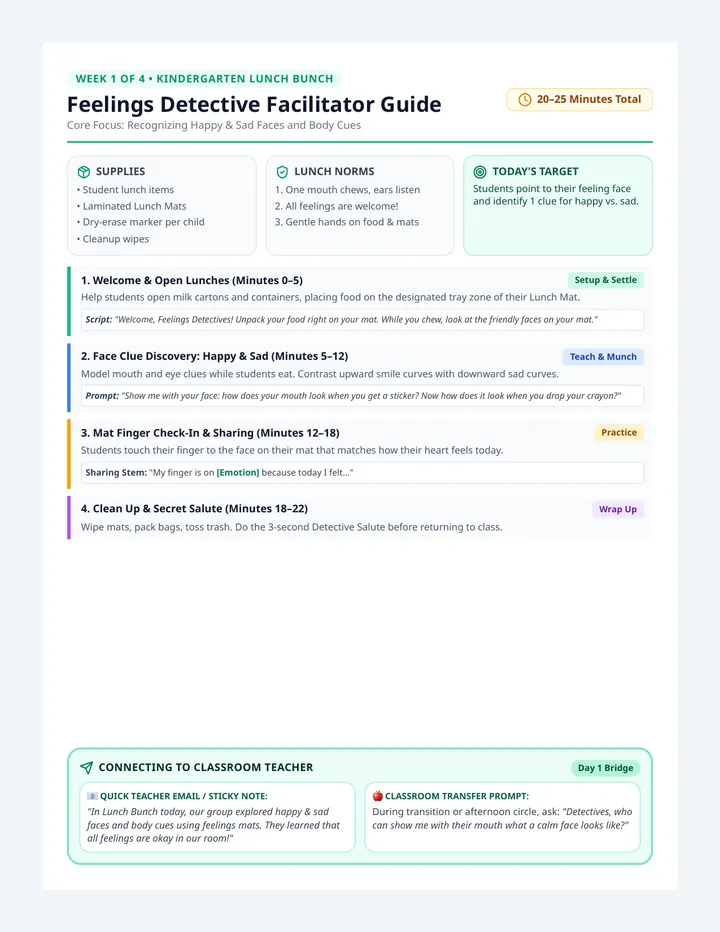
Feelings Detective
Objective: Identify Happy, Sad, and Mad through visual and vocal clues.
Key Script
"Explorers use their eyes and ears. Look at my mouth—it's turned up. Listen to my voice—it's bright! I am Happy."
Activity
Mirror Matching: Teacher makes a face, students mimic and name it.
Resource
Detective Mission Worksheet
Day 02
Emotion Expert
Objective: Connect Scared, Excited, and Calm to school scenarios.
Key Concept
Introduce Calm as our "Base Camp"—the place where we can think clearly.
Scenario
"Someone yells 'Surprise!' How does your face look? That's Excited!"
Action
Emotion Statues: Freeze like you're 'Scared' when the music stops.
Emotion Explorers Handbook Page 2 of 6
Week 1
Internal Signals
Day 03
Body Buzz
Feelings Detective Slides Presentation Feelings Detective
Mission #1: Hunting for Clues
What is an Explorer?
👀
We LOOK
We look for clues on faces and in bodies.
👂
We LISTEN
We listen to how voices sound.
The Big 3 Feelings
😊
Happy
Clues: Big smile, shiny eyes, light body.
😢
Sad
Clues: Frown, heavy body, maybe tears.
😡
Mad
Clues: Grumpy mouth, tight eyebrows, hot face.
I-Spy Clues!
Look at your partner...
"Can you show me a MAD face?"
What did their eyebrows do?
Feelings Detective Mission Worksheet Feelings Detective
Day 01 • Finding Clues
Explorer Name
Clues are everywhere!
Explorers use their eyes and ears to find clues. Look at the mouth, the eyes, and listen to the voice to name the feeling!
Mission 1: Name the Face
😊
SAD
HAPPY
😡
MAD
HAPPY
😢
SAD
MAD
Mission 2: Draw Your Happy Face
Don't forget the clues: wide smile and bright eyes!
Draw Here
Emotion Explorers
Mission Complete? [ ]
Explorer Parent Letter Emotion Explorers
Unit 1 • Day 01
Dear Families,
This week, our class is starting an exciting new journey! We are becoming Emotion Explorers . Over the next 10 days, your child will learn how to map their internal world, identify big feelings, and use "The Pause" to choose safe reactions.
What we are learning:
The Body Buzz
Noticing physical clues like a fast heart or hot face that signal a big feeling is coming.
The Pause Button
Stopping our hands and feet for 3 seconds before we react to a big feeling.
Breath Magic
Using deep "Balloon Breaths" to find our calm base camp.
How to help at home:
When your child has a big feeling, try asking: "Where do you feel the Body Buzz?" or "Let's press our Pause Buttons together." Using the same language helps them master these skills faster!
We are so excited to see our Explorers grow. Thank you for your support!
Warmly,
The Kindergarten Team
Emotion Expert Slides Presentation Emotion Expert
Mission #2: New Feelings on the Map
New Explorations
🤩
Excited
Jumping body, loud voice!
😨
Scared
Hidey body, shaky voice.
😌
Calm
Still body, soft voice.
Where does it happen?
🎂
You are going to a party...
EXCITED!
🔦
The lights go out...
SCARED!
📖
Listening to a story...
CALM.
Statue Game!
When I say a feeling, turn into a statue that shows that clue!
"Show me CALM!"
Emotion Expert Worksheet Emotion Expert
Day 02 • Student Mission
Explorer Name
Date
New Feelings Found!
Experts know that feelings aren't just happy or sad. Sometimes we feel Scared , Excited , or Calm . Draw how your face looks for these big feelings!
Scared
Excited
Calm
Scenario Search
How would an Expert feel in these places? Draw a line to the emotion.
A Surprise Birthday Party
A Loud Thunderstorm
Quiet Reading Time
Body Buzz Map Activity Mission: Body Buzz
Day 03 • Mapping the Inside
Explorer Name
Where do you feel it?
When we have a big feeling, our body gives us clues. Sometimes our hands get tight, our face gets hot, or our heart beats fast. Color where you feel "MAD" on your body map!
My Body Clues
Body Clue Key
🔥
Hot Face
💓
Fast Heart
✊
Tight Hands
🦋
Wiggly Tummy
Expert Tip
"When you notice a clue, your body is talking to you!"
Feeling Scale Poster Tool The Feeling Meter
Day 04 • Classroom Tool
Small Feeling
"It feels like a tiny mosquito bite. I can handle this easily!"
Big Feeling
"It feels like a heavy weight or a loud alarm. I need a tool!"
How big is the feeling?
1
Chill I'm Good
2
Okay Steady
3
Uh-Oh Wobbling
4
Alert Tough
5
BIG Need Pause!
Explorer Practice
Ask: "Is this a Level 1 problem or a Level 5 feeling? Let's check the meter!"
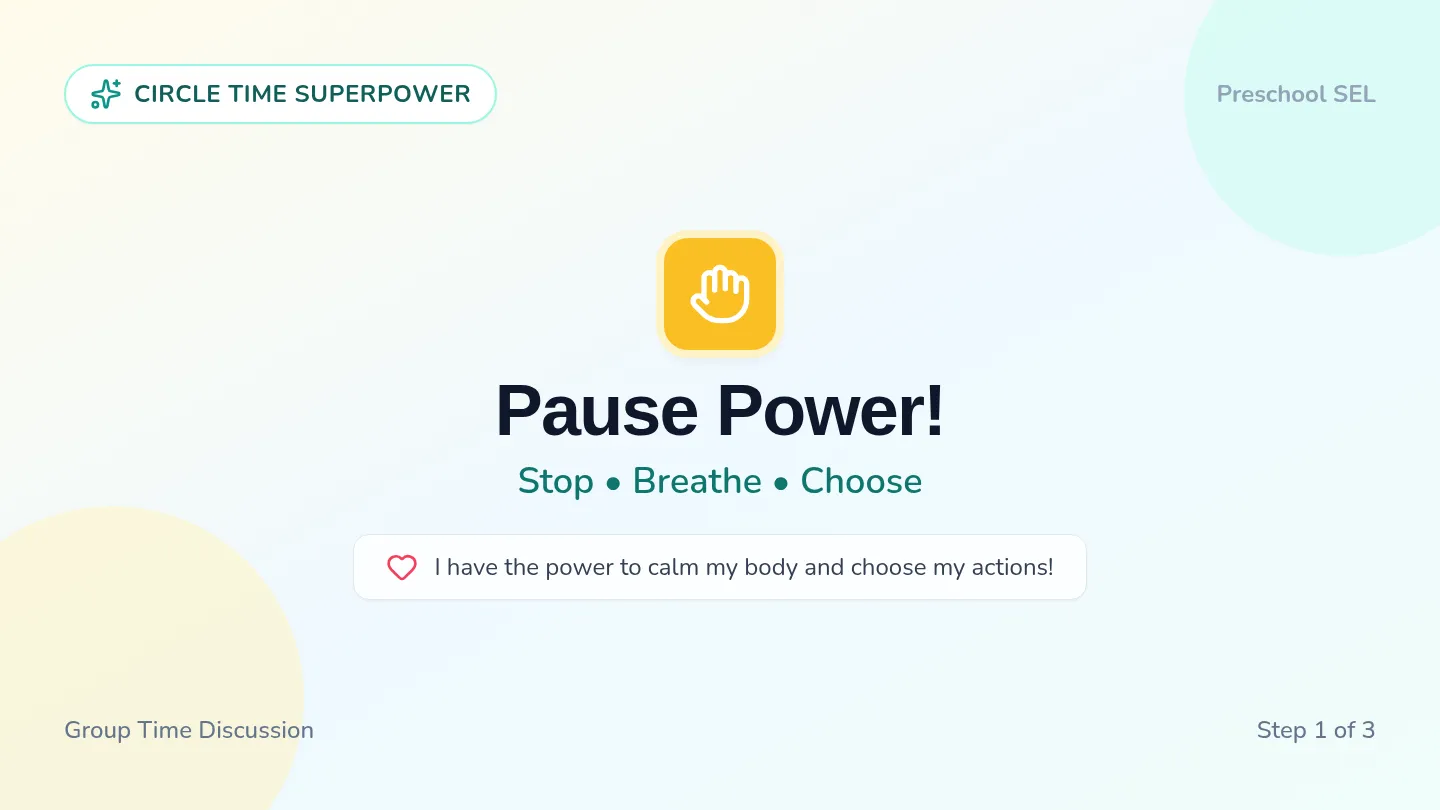
The Pause Button Slides Presentation STOP
The Pause Button
Mission #5: The Most Important Power
What is The Pause?
Without The Pause, our hands move before our brain thinks.
With The Pause, our brain stays the boss!
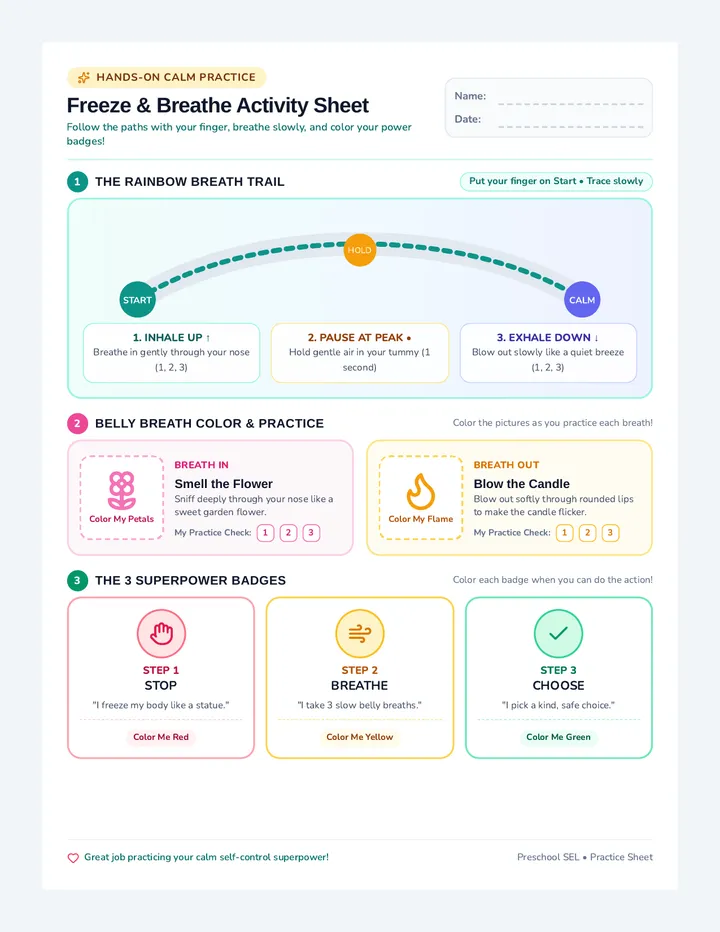
3-Step Pause Power
1
FREEZE
Keep your hands and feet still like a statue.
2
BREATHE
Take one big breath in through your nose.
3
WAIT
Count to 3 in your head. 1... 2... 3...
Let's Try!
I'm going to drop this ball...PRESS THE PAUSE .
The Pause Button Teacher Guide Facilitation Guide: The Pause Button
Day 05 • Core Regulation Skill
Vital Skill
The Objective
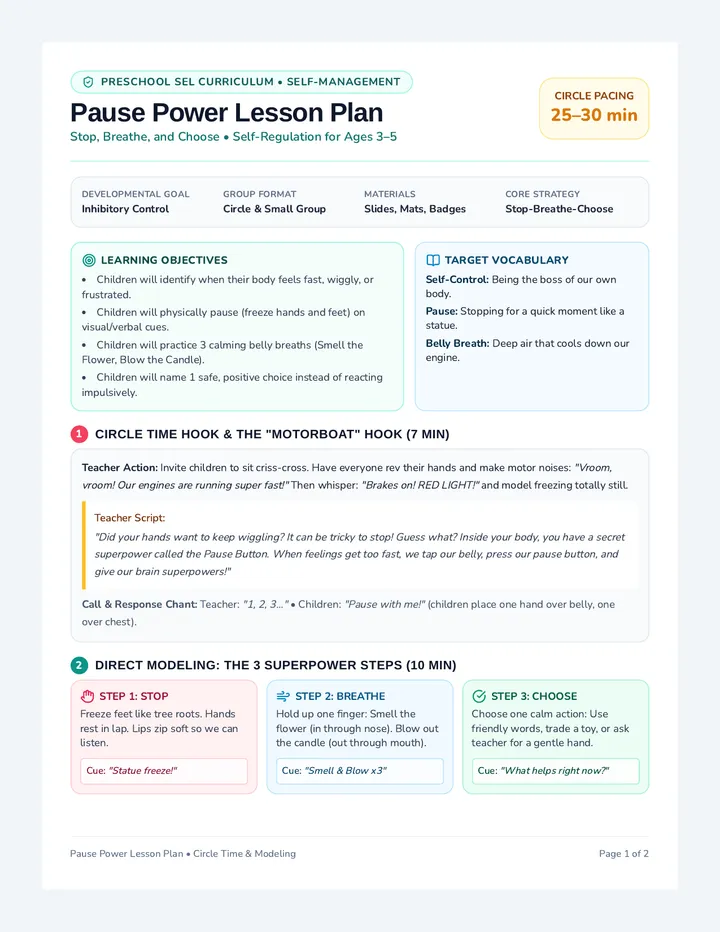
Introduce students to the concept of the "Gap" between a feeling and a physical action. The goal is to move from "I feel, I hit" to "I feel, I Pause , I Choose."
Part 1: The Introduction
1
The Hook: Freeze Play (5 min)
Use a tambourine or music. When the sound stops, students must freeze like a statue. If they move, they "re-freeze."
"Explorers, notice how your body feels when you have to stop suddenly. That's your Pause Button in action!"
2
Direct Instruction (10 min)
Introduce the 3-step sequence. Model it with exaggerated movements.
1. FREEZE (Stop hands/feet)
2. BREATHE (One big Balloon Breath)
3. WAIT (Count to 3)
Day 5 Facilitation Guide Page 1 of 2
3
Guided Practice: Ball Drop (5 min)
Hold a ball high. The floor is the "Trigger." When the ball hits the floor, every student must "Press The Pause" immediately. Vary the drop speed.
The Explorer Script
"Explorers, your feelings are always okay, but your actions must be SAFE. You are the boss of your hands! When you feel a Big Buzz, find your Pause Button."
"I'm noticing a lot of Level 4 energy. Let's all press our Pause Buttons together. Freeze... Breathe... 1, 2, 3."
Scaffolding
For High-Energy Students:
Provide a "Pause Sticker" (red octagon) for them to press on their desk or hand during transitions.
Environment
Visual Reminders:
Post a "Pause Button" icon near the classroom line-up area and the playground door.
Objective: Full-class demonstration of the 3-step Pause.
Page 2 of 2
Notice Now Activity Log The Notice Now Log
Day 06 • Internal Investigation
Explorer Name
Name it to Tame it!
When we press The Pause Button , we look inside our hearts. Tell yourself what you feel!
What do you feel?
😊 Happy
😡 Mad
😢 Sad
😨 Scared
Mission:
If a friend takes a toy without asking, what do you notice? Draw yourself using The Pause and naming your feeling!
Show Your Work
"I notice I feel "
Notice Now • Breathe • Choose
Choice Power Sorting Activity Safe or Unsafe?
Day 07 • Choice Power Activity
Explorer Name
"I have the power to choose a safe reaction!"
Safe
Unsafe
Cut these out and glue them above
Take 3 Breaths
Pushing a Friend
Using Kind Words
Kicking the Wall
Yelling Names
Asking for Help
Breath Magic Worksheet Breath Magic
Day 08 • Student Practice
Explorer Name
Balloon Breathing
"I can use my breath to find my calm base camp."
👐
Step 1
Hands on head like a balloon.
🌬️
Step 2
Deep breath in. Balloon grows!
💨
Step 3
Let it out: "Pshhhhh!"
The Magic Bubble
Practice 3 Balloon Breaths. After each one, color one of the magic bubbles above!
Calm • Cool • Collected
Breath Magic Slides Presentation Breath Magic
Mission #8: The Balloon Inside You
The Calming Secret
When we feel MAD or SCARED, our body gets tight.
Breathing deeply tells your body:
Balloon Breathing
IN
Breathe in through your nose...
OUT
Breathe out through your mouth...
Explorer Challenge
Let's take 3 Balloon Breaths together...
1... 2... 3...
Power Words Reference Sheet Power Words Card
Day 09 • Using Your Voice
Instead of a push... use a sentence!
When we use our words, our teachers and friends know how to help us.
🗣️
Step 1: The Feeling
"I feel _______."
Try: Mad, Sad, Scared, or Excited
🙏
Step 2: The Ask
"Can I please _______?"
Try: Have a turn, get a hug, or have space
Explorer Scenario Practice
1
Scenario: Someone cut in line
"I feel mad! Can you please go to the back of the line?"
2
Scenario: You dropped your paper
"I feel sad. Can I please have a new paper?"
Words are your superpower!
Day 9 Practice Sheet
Explorer Graduation Certificate Official Explorer
CERTIFICATE
This award is proudly presented to:
Student Name
For mastering the power of The Pause , naming their Body Buzz , and always making a Safe Choice .
Teacher Signature
100%
Date
Certified Emotion Explorer