Family Bridges Slides
Connection Quest • Lesson 1
LifeSkills Lesson 7 - Family Communications Part 1
Family Bridges
Navigating changing roles, reading unspoken signals, and building real communication pathways.
Unit 6: Communication Basics LifeSkills Training
Let's talk, listen, and connect.
Slide 1 of 9
Our Connection Roadmap
Family Communication Goals
Evolving Roles
Understand how our roles and responsibilities within our families change as we grow and seek independence.
Signal Alignment
Master the alignment of verbal statements with body language to prevent daily misunderstandings.
Safe Expectations
Establish crystal-clear safety agreements around boundaries, rules, and substance avoidance.
Family Interview
Prepare to interview a caregiver to co-create healthy boundaries and build mutual respect.
Unit 6 • Goal Overview Slide 2 of 9
The More Things Change...
Activity A: Family Role Reflection
How have your roles shifted over the years?
As toddlers, our primary needs are absolute safety and care. As teens, we build autonomy, but caregivers must adapt.
Group Challenge (10 Mins)
Brainstorm specific family roles you held in elementary school versus the roles you carry today.
Comparing Our Phases
Stayed the Same
Changed / Evolved
Youngest / Oldest child
More adult responsibilities
The funny or creative one
Earning trust & good grades
Family Traditions
Making independent choices
Examine • Analyze • Predict Slide 3 of 9
Negotiating Independence
The Balancing Act
Adolescent Growth Needs
Developing individual identities and beliefs
Taking healthy risks and personal decisions
Spending quality time with peers and friends
Co-existence
Caregiver Concerns
Keeping children safe and secure
Preventing risky habits (e.g., substance use)
Establishing core values and family boundaries
The Key: Caregivers must adapt rules to fit your growing maturity, but they need to trust your decision-making. Clear dialogue is how we bridge this gap.
LifeSkills Guide • Balancing Autonomy Slide 4 of 9
It's What You Don't Say!
Verbal vs. Non-Verbal Signals
The Verbal Channel
The actual words you select. Choosing explicit language like: "I understand your rule, but I would like to negotiate an extension to curfew."
The Non-Verbal Channel
Your body language, eye contact, and tone. Rolling eyes, looking away, or crossing arms can completely contradict a calm verbal message.
Alignment Check!
To build trust, your verbal message must match your non-verbal message. If you say "I'm listening" but look at your phone, the caregiver only hears the phone signal.
Unspoken Rules • Match Your Signals Slide 5 of 9
Four Skills to Avoid Misunderstandings
Preventing Conflicts
1
Align Your Channels
Make sure what you say and how your body says it are perfectly matched.
2
Be Specific
Say exactly what you mean. Give clear details such as exact times, actions, and places.
3
Ask Questions
If you are unsure of an expectation or parent's rule, ask for clarification immediately.
4
Paraphrase
Repeat what you heard in your own words. "So what you're saying is..."
Understanding vs. Agreement: You don't have to agree with everything a family member says to understand and validate their feelings.
LifeSkills Unit 6 • Clear Communicator Slide 6 of 9
Can You Hear Me Now?
Activity C: Partner Challenge
Step 1: Read & Respond
With a partner, choose one of the family rules on your worksheets. Take turns being Speaker and Listener.
Example Scenario:
Step 2: Analyze Cues
While your partner is speaking, practice specific cues. Check them off on your worksheet as you go:
Proper Eye Contact
Passive Signals (Nodding, "I see")
Active Listening (Paraphrasing)
Debrief Question: How does paraphrasing a parent's rule show that you are mature and ready for more responsibility?
Interactive Drill • 10 Minutes Slide 7 of 9
Your Mission: Family Interview
Activity D: Out of Class Project
A
Select Your Target
Identify a caregiver or trusted adult at home to interview before our next session. Pick a low-stress time.
B
Apply the 4 Skills
Use eye contact, nod, paraphrase, and ask clarifying questions as they outline safety expectations.
C
Log Your Insights
Write down their exact quotes on your prep sheets. Note any rules that surprised you.
Pro Interviewing Tip:
If you get nervous, just ask: "What is one safety rule that you think is most important for our family, and why?" Recording is optional but super helpful!
Prepare for Next Week • Build Bridges Slide 8 of 9
Thank you
Donna Sherfield-Nelson, BS
Prevention Specialist
Phoenix House TX
512-665-4233
dnelson@phoenixhousetx.org
Supporting families, building strength.
Family Bridges Teacher Guide Teacher Instruction Manual
Family Bridges Guide
LESSON 7 • UNIT 6
Duration: 45-50 Mins
Instructional Intent & Background
Adolescents face unique friction as they transition into more independent individuals. Caregivers naturally respond with boundaries designed to secure safety, which teens can interpret as lack of trust. This lesson equips students with core communication strategies (active/passive listening, paraphrase, and non-verbal channel alignment) to navigate changing roles peacefully.
Student Objectives
Map role evolution from preschool to today.
Identify physical/emotional growth impacts.
Harmonize verbal messages with body posture.
Apply paraphrasing to clarify home rule intent.
Materials Checklist
Family Bridges Presentation Slides
Family Bridges Student Organizer
Classroom Scenario Practice Cards
Interview Prep Form (Homework Assignment)
Lesson Phase 1: Evolving Roles (15 Minutes)
Activity A: The More Things Change... Slides 3-4 | 10 Mins
Have students assemble in pairs or trios. Direct them to open their Student Organizers to Page 1. They must list roles they played at preschool age versus current age, highlighting responsibilities that have shifted.
Verbatim Teacher Script:
"Think about when you were four. Your job was basically to eat, nap, and keep yourself safe under direct supervision. Now, as high schoolers, you are expected to self-manage, handle school deadlines, navigate friendships, and make safe choices. But caregivers don't wake up one day and magically change all their rules. Roles change, but safety remains the priority. Let's look at how we talk about this transition."
Guiding Discussion Questions:
• "In what ways have you earned more independence at home? What actions helped you get it?"
• "Why do parents sometimes struggle to notice that your needs and maturity have grown?"
Unit 6 • Family Communication Page 1 of 2
Teacher Instruction Manual
Communication & Interview Setup
PHASE 2 & 3
Lesson Phase 2: Skills for Signal Alignment (20 Minutes)
Activity B & C: Can You Hear Me Now? Slides 5-7 | 15 Mins
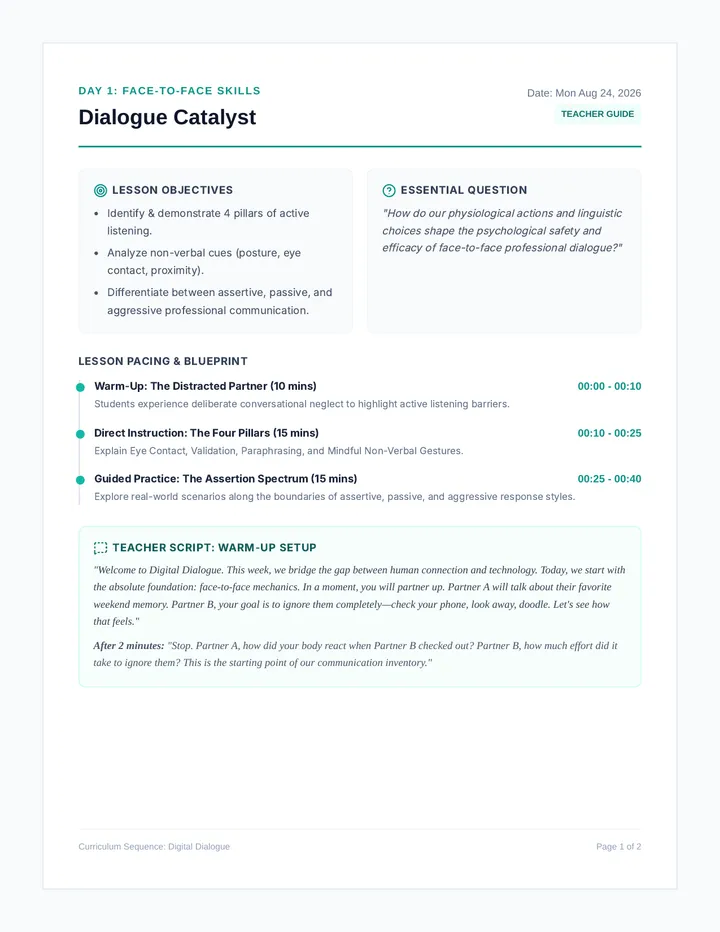
In this phase, explain that communication occurs across two primary channels: Verbal (the words we choose) and Non-Verbal (our body language, pitch, and posture). If these channels are not in sync, listeners experience confusion.
1. Alignment
Family Bridges Student Organizer Student Organizer • Connection Quest
Family Bridges Worksheet
Unit 6: Lesson 7
Student Name:
Class Period:
Date:
Activity A: The Growth Tracker
How have your responsibilities, boundaries, and tasks shifted in your family since you were younger? Brainstorm and fill in the table below comparing your roles in early childhood to high school.
Preschool Age (0-4)
Elementary School (5-9)
Middle & High School (10-18)
E.g., Cleaning up toys, taking naps, following simple directions.
E.g., Making bed, cleaning room, small academic chores.
E.g., Supervised 100% of the time by parents or caregivers.
E.g., Allowed to play nearby outside; walked to bus stop with friends.
Growth Reflection
1. In what physical, emotional, or social ways have you changed the most since elementary school?
2. How do these personal changes affect the roles, boundaries, and rules your caregivers set for you today?
Connection Quest • Unit 6 Lesson 7 Page 1 of 2
Student Organizer • Part 2
Skills & Homework Interview
Activity C: "Can You Hear Me Now?" Partner Drill
With your partner, take turns acting as Speaker and Listener. The speaker reads a typical safety rule. The listener must respond and validate. Check off the skills you practiced:
Checklist of Applied Skills
Eye Contact: Mindful, non-confrontational eyes.
Passive Gestures: Nodding or short cues ("I see").
Paraphrasing: Stating the rule in your own words.
Partner Practice Observation
Activity D: Family Interview Prep (Homework)
Interview a caregiver at home before next week's class. Pick a low-stress time. Use your communication skills. Ask these two questions and record their verbatim responses in the blank areas below.
Question 1: "What are the most important safety expectations or rules you have for me right now?"
Question 2: "How can we work together to show you that I'm earning more independence and trust?"
Connection Quest • Unit 6 Lesson 7 Page 2 of 2
Family Bridges Scenario Cards Classroom Activity Cards
Family Bridges Scenario Cards
Print & Cut
Directions: Cut along the dashed lines to separate the cards. In pairs, choose a card. One partner acts as the Speaker (Caregiver) and the other as the Listener (Teen) . Apply active communication techniques.
SCENARIO 1 Pacing: 3 Mins
Curfew Extension Request
Speaker (Caregiver): Says curfew is strictly 9:00 PM because of late-night road hazards.
Listener (Teen): Wants to negotiate to 10:00 PM to finish a high school study group.
Focus: Paraphrase safety concern before arguing your perspective.
SCENARIO 2 Pacing: 3 Mins
The Phone Shutdown
Speaker (Caregiver): Demands all screens off by 10:00 PM because they noticed you were exhausted.
Listener (Teen): Feels frustrated because they are chatting with friends.
Focus: Practice alignment. Keep body relaxed and open. Avoid crossed arms.
SCENARIO 3 Pacing: 3 Mins
Social Media Rules
Speaker (Caregiver): Insists on checking your shared posts to make sure no personal info is public.
Listener (Teen): Feels this is an invasion of privacy and feels micromanaged.
Focus: Ask clarifying questions rather than reacting defensively.
SCENARIO 4 Pacing: 3 Mins
Riding with Teen Drivers
Speaker (Caregiver): Forbids riding in a car with other teen drivers for safety.
Listener (Teen): Wants to ride with a licensed friend to a local ballgame.
Focus: Define "Understandings vs. Agreements" during negotiation.
SCENARIO 5 Pacing: 3 Mins
The "Check-In" Text
Speaker (Caregiver): Explains they feel intense worry if you don't answer calls instantly.
Listener (Teen): Forgets because they are active in school events.
Focus: Match your verbal reassurance with matching open posture.
SCENARIO 6 Pacing: 3 Mins
The Substance Standard
Speaker (Caregiver): Outlines zero tolerance for vaping or underage drinking.
Listener (Teen): Wants caregivers to understand the pressure peers apply in high school.
Focus: Paraphrase expectation, then co-create a safe exit strategy together.