Startup Spend Materials Startup Spend
Lesson 1: Categorizing Business Costs
SLIDE DECK
The $100K Challenge
Imagine you have $100,000 to open a coffee shop.
Espresso Machine? ($15,000)
Rent? ($4,000/mo)
Coffee Beans? ($5/lb)
What do you buy first? What can wait?
Key Discussion Questions
1 Which costs happen only once ?
2 Which costs stay the same every month?
3 Which costs go up when you sell more?
The Three Cost Buckets
1. Startup Costs
One-time expenses to get the doors open.
Example: Security deposit, legal fees, signage, initial equipment.
2. Fixed Costs
Stay the same regardless of sales volume.
Example: Rent, insurance, administrative salaries, internet bill.
3. Variable Costs
Change based on how much you produce/sell.
Example: Raw materials (flour, beans), packaging, shipping fees.
COST CRUSHER
Student Worksheet
Entrepreneur Name
Venture Name
Part 1: Brainstorming the Burn
List 10 items your business needs to survive and grow. Then, check the box that best describes that cost.
Expense Item Startup Fixed Variable □ □ □ □ □ □ □ □ □ □ □ □ □ □ □ □ □ □
The Critical Question
Why is it important for an entrepreneur to know the difference between Fixed and Variable costs before they start selling?
Revenue Engines Slides Lesson 2
REVENUE
ENGINES
How businesses actually make money (and why some make more than others).
The Battle for the Wallet
Movie Theater
You pay $15 once to see one movie.
Transactional Model
Netflix
You pay $15 every month for unlimited movies.
Subscription Model
Which business is more stable? Which one has higher potential for growth?
The Revenue Menu
Direct Sales
Customers pay a one-time fee for a product or service. Simple and clear.
Freemium
Basic service is free; customers pay for "premium" features. (e.g., Spotify, Fortnite)
Licensing
You charge others to use your intellectual property (logo, software, patents).
Franchising
Allow others to open your business using your brand and systems for a fee.
Picking Your Engine
A revenue model isn't just how you get paid—it defines your relationship with your customer.
High Cost / Rare Purchase?
Direct Sales is often best (e.g., selling a car).
Daily Use / Low Barrier?
Subscription or Freemium creates long-term value.
Pricing Power Worksheet Pricing Power
Lesson 3: Developing Pricing Strategies
WORKSHEET
Student Name
Product Concept
The Pricing Trio
1. Cost-Plus
Take your cost and add a specific profit margin (e.g., $5 cost + 50% = $7.50 price).
2. Competitive
Set your price based on what everyone else is charging for the same thing.
3. Value-Based
Set your price based on how much the customer thinks your product is worth.
Part 1: Margin Mastery
The Profit Formula
Price - Variable Cost = Gross Margin
Product
Gourmet Burger
Retail Price
$14.50
Variable Cost
$6.25
Gross Margin?
Product
Custom Hoodie
Retail Price
$45.00
Variable Cost
$18.50
Gross Margin?
The Strategy Pitch
Choose one of the products above. Which pricing strategy (Cost-Plus, Competitive, or Value-Based) would you use to sell it, and why ? Think about the brand perception.
The Zero Point Workshop The Zero Point
Lesson 4: Calculating Break-Even
FINANCE LAB
The Big Question
"How many units do I need to sell before I actually start putting profit into my own pocket?"
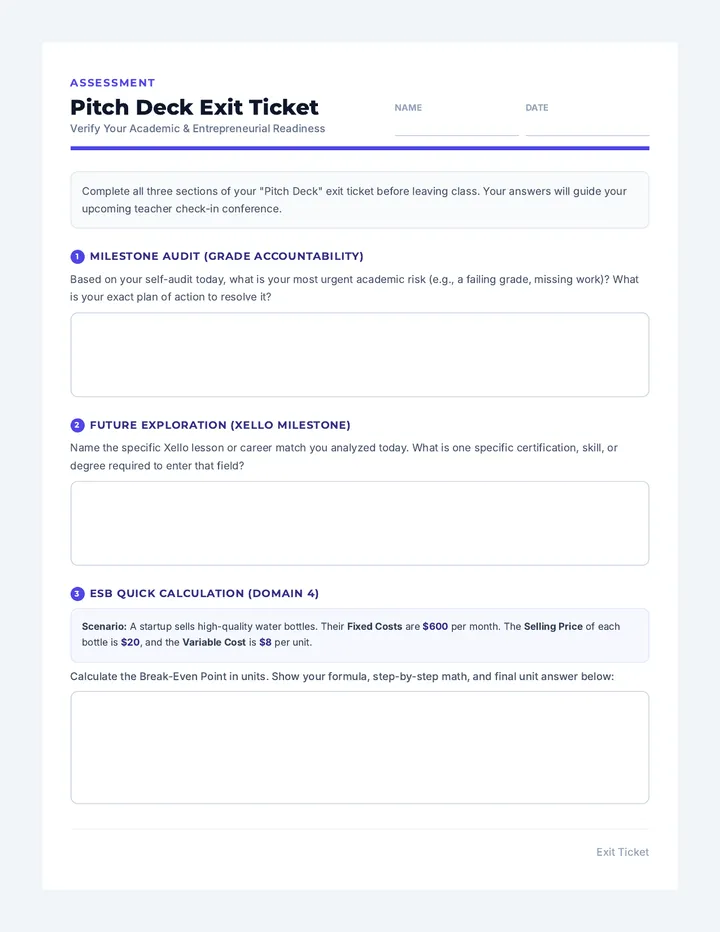
The Golden Formula
Break-Even Units
=
Total Fixed Costs
Price - Variable Cost
Pro Tip: (Price - Variable Cost) is also known as your Contribution Margin .
Case Study: The Sneaker Shop
Rent & Salaries (Fixed): $5,000 / month
Cost to Buy Sneaker (Variable): $60 / pair
Sale Price: $110 / pair
Show Your Calculation:
Target Units:
FEASIBILITY CHECK
Just because you calculated a break-even point doesn't mean your business will be successful. You have to ask: Is this number realistic?
Market Size
Are there even enough people in town who want to buy this many units?
Capacity
Do you have the machines/staff to actually make and sell that many?
Pacing
How many months of loss can you survive before you hit that number?
Analysis Reflection
If your Break-Even Point is 500 units per month, but your shop can only hold enough inventory for 200 units, what are three specific changes you could make to the business plan to reach feasibility?
1
2
3
Exit Ticket
"Profit isn't what you make, it's what you keep after everyone else is paid."
Define Break-Even in your own words below:
Profit Projection Planner Future Forecasts
Lesson 5: Forecasting Financial Performance
PROJECT PLANNER
The 12-Month Projection
Forecasting isn't guessing—it's using assumptions about your business environment. Think about Seasonality (holidays, summer, school year) and Growth (word of mouth, advertising).
Metric M1 M2 M3 M4 M5 M6 M7 M8 M9 M10 M11 M12 REVENUE Units Sold Total Income ($) EXPENSES Fixed Costs Variable Costs Total Outgo ($) NET PROFIT/LOSS
Assumptions & Strategy
Why do your "Units Sold" change in specific months? (e.g., "M12 increases because of holiday shopping.")
The "Valley of Death"
Identify which months show a Loss (negative number). How will you fund the business until it becomes profitable?
The Investor Pitch
You've done the math. Now, you need to convince someone to trust you with their money. Use your data to answer these three critical investor questions:
1. The "Skin in the Game"
What are your total Startup Costs, and what is the single biggest expense you need to launch?
2. The "Safety Net"